research
Eames: plywood, house, film, and experiment as one method
Object, house, educational film, and prototype are linked by one practice: testing an idea through material and media.
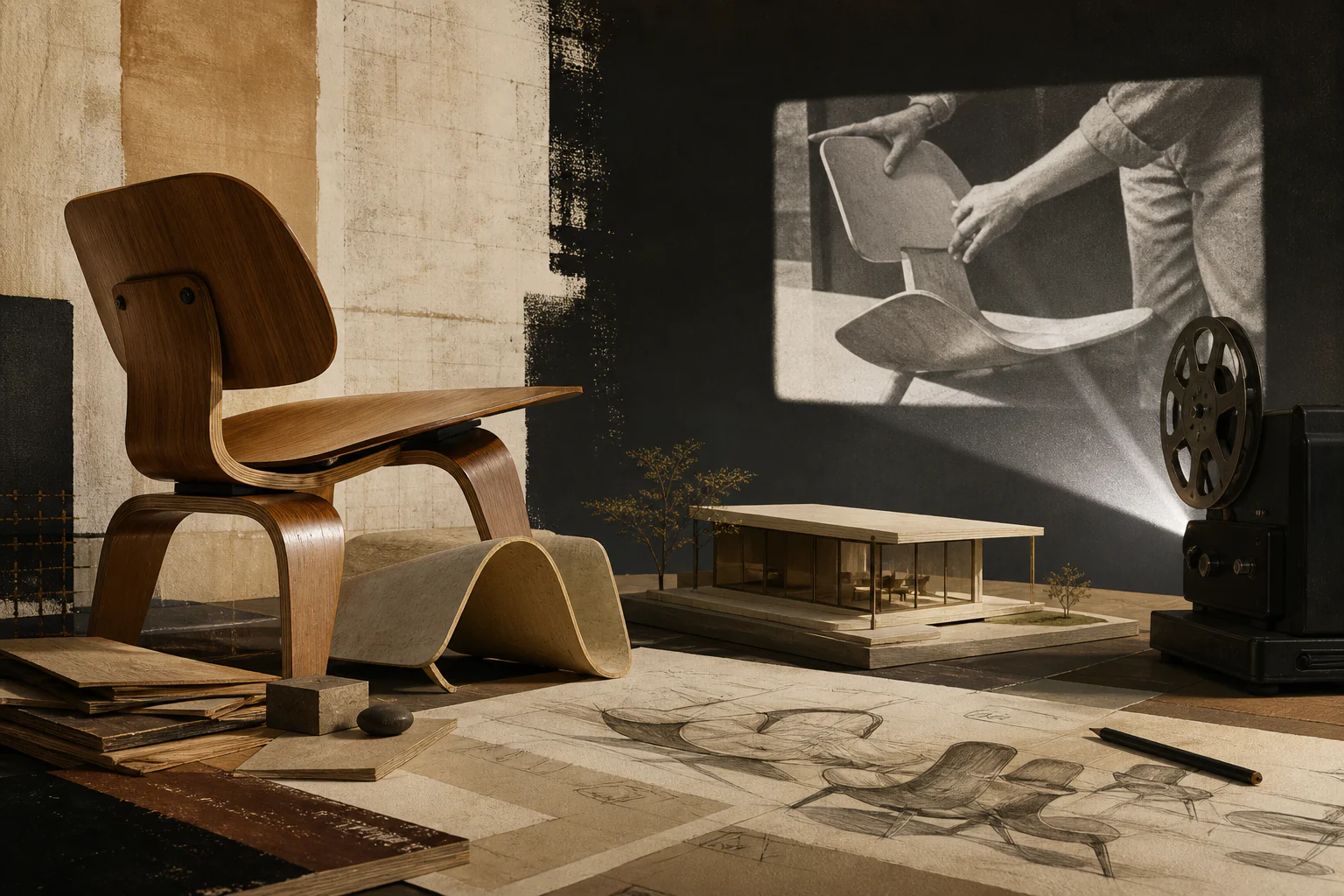
The Eames method links object, house, educational film, play, and laboratory prototype into one practice of testing ideas through material and media.
1. Research thesis
The work of Charles and Ray Eames is usually sorted by genre: furniture, architecture, film. It is more accurate to treat it as one practice — a consistent testing of hypotheses in which the material changes and the method does not.
2. Why this is more than an office profile
What is interesting is not a list of works but a way of working: mock-up, prototype, filming, presentation, revision. The office operated as a laboratory, and so its legacy is better described by protocol than by style.
3. Historical setup
The practice took shape around the war and postwar years in California, when new moulding technologies were available and there was demand for cheap mass housing and furnishing. The constraints of the period were part of the brief.
4. The office as a system
The office combined design, filming, model making, and exhibition work under one roof. That organisation allowed an idea to be tested in several media within a short period — and that is the main organisational contribution.
5. The object layer: plywood as laboratory
Moulded plywood was not a material choice but a research programme. The problem was to obtain a complex three-dimensional shell from a flat sheet, and years went into adhesives, pressing regimes, and permissible curvature.
6. The leg splint as prototype
A splint for transporting the wounded, developed during the war years, was the first serial application of the technology. It set hard conditions — anatomical form, low weight, stackability — and therefore taught more than free formal search.
7. From splint to chair
The transfer of the technology into furniture was direct: the same shell problem, the same press, a different load. The chairs of the later 1940s read as a continuation of the wartime commission rather than a break from it.
8. The material limit and the transition
Plywood has a curvature limit beyond which laminations separate. It is that limit, rather than a change of taste, that explains the subsequent move to fibreglass and moulded shells: the same form was sought by other means.
9. The spatial layer: the house as demonstration
Their own house, built in Pacific Palisades in the late 1940s within a programme of experimental houses, was assembled from catalogue industrial components. It proved a thesis: industrial parts can produce personal rather than barrack-like housing.
10. The house as continuation of method
The project was reworked in progress: the ordered components were given a different configuration when the authors changed their decision. Reassembly from the same elements is exactly the logic of the furniture programme.
11. Media and publication
The office’s films were an instrument of explanation rather than advertising. A short film could show a process, a scale, or a principle in a few minutes where a drawing and a text demanded preparation from the viewer.
12. Film as a tool for explaining scale
The film about orders of magnitude, made in the 1970s, took the device to its limit: continuous change of scale made an abstract idea visible. It is a teaching aid built as an attraction.
13. The exhibition as a third medium
Exhibition projects allowed object, image, and visitor movement to be combined. For the office this was another laboratory, testing how an explanation performs in public.
14. Interface and user
One requirement recurs across all media: a person must understand the object without instruction. Hence the attention to seating position, to height, to how a chair is picked up and moved.
15. The economy of form
The stated goal — cheap and plentiful — was not fully achieved. Tooling proved expensive, and some products remained in the upper price segment. This is the honest part of the case, usually omitted.
16. Canon and museum
The objects entered museum collections early and became a teaching example of postwar design. Museum status secured the reputation but moved experimental objects into the category of classics, which contradicts their original purpose.
17. Archive and reproducibility
Prototypes, process footage, and correspondence with manufacturers survive. Because of this the method is verifiable: it is visible how many failed variants preceded the known result.
18. Where the myth begins
The myth begins with an image of carefree Californian creativity. In reality this was years of technological work with a press, adhesives, and rejects — a slow and awkward process.
19. Where the myth blocks analysis
Romanticisation obscures the role of the manufacturer and the engineers. Serial production required an industrial partner, without whom the experiments would have stayed prototypes in a workshop.
20. Comparison with adjacent systems
Unlike the European line that proceeded from a rule set, the method here proceeded from the prototype. Such an approach yields more discoveries and transfers worse: it requires a laboratory rather than a document.
21. Link to fashion
A shell that follows the body is a problem shared with tailoring. The difference is that a chair accepts one averaged body while clothing must accept a particular one.
22. Link to the image
Filming was part of designing rather than documentation of a result. It is an early example of a practice in which the image tests an idea on equal terms with the prototype.
23. Link to architecture and space
The house showed that a catalogue of industrial components can work as an architectural vocabulary. That thesis proved more influential than the building itself.
24. Link to technology
Technology here did not serve an intention but generated it: the capabilities of the press determined which forms were worth conceiving at all. It is a precise illustration of how a tool expands the thinkable.
25. Link to materials
Plywood, fibreglass, cast aluminium, and leather solve one shell problem by different means. Comparing these versions is the best way to understand what each material actually contributed.
26. Market and logistics
Stackability and demountability entered the construction from the start: the products were calculated for transport and storage. This is another case in which logistics participated in form-making.
27. Critique and limits
The critique is fair: the promise of affordability was not met, some objects are expensive today, and the method transfers poorly to organisations without their own workshop. The experimental model requires resources not everyone has.
28. What has changed today
Digital modelling and printing have made the test cycle faster and cheaper without changing its logic. The method proved more durable than any particular material it was tied to.
29. What to connect next
The material links to the entries on plywood, on composites, on the house as a typology, on motion design, and on the office’s individual objects. A separate treatment of the films as a genre of explanation would be useful.
30. Editorial conclusion
The unity of this practice is procedural rather than stylistic: hypothesis, prototype, test, explanation. It is the procedure, not the recognisable curvature of a shell, that constitutes the transferable part of the legacy.
31. How to read this case today
Look at the number of rejected variants rather than at the final object. The surviving prototypes explain the result better than any photograph of a finished chair.