research
Interview
Conversation, celebrity and the magazine as a social network
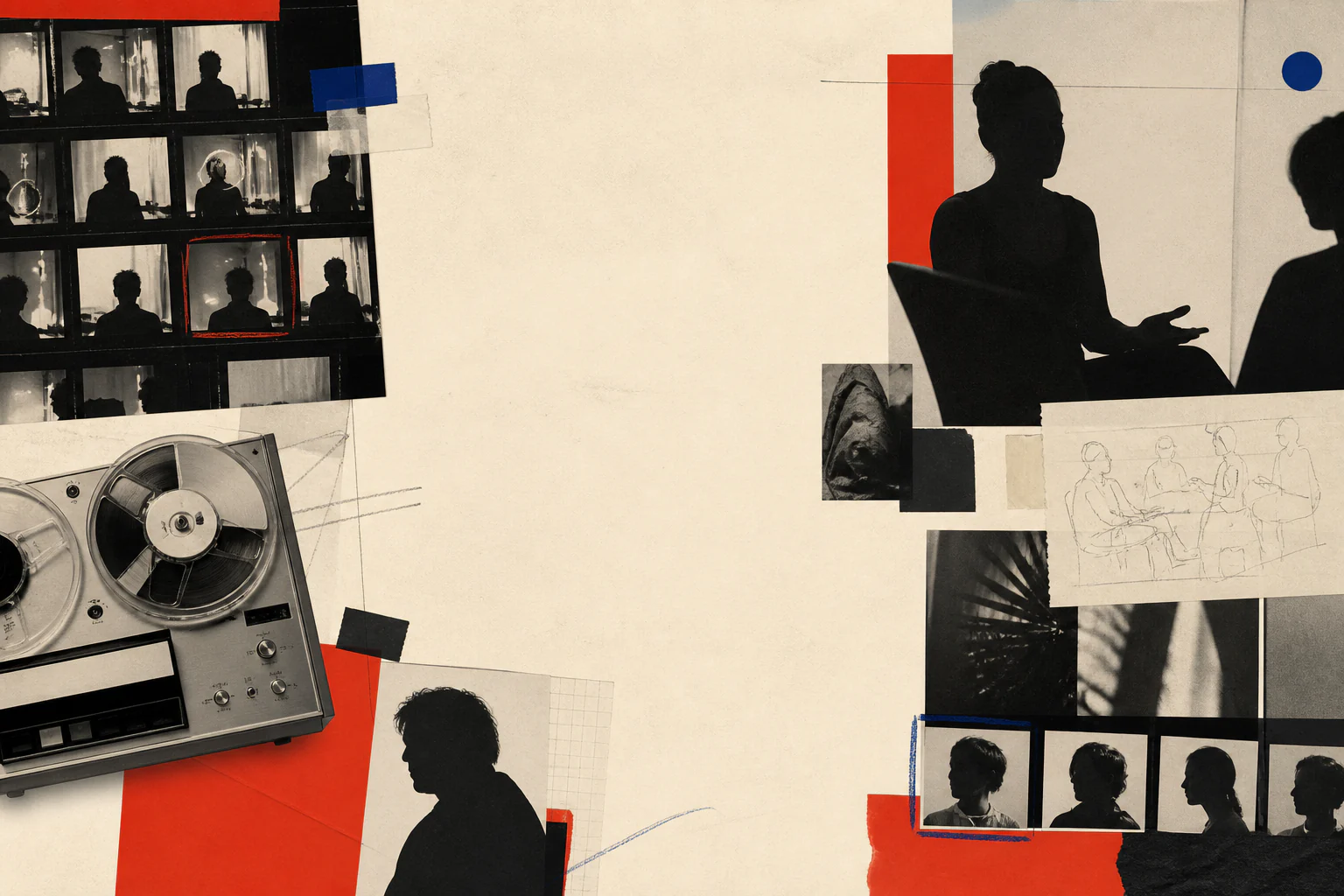
Interview matters not because it invented celebrity or because it was the first publication to mix art and commerce. Its strength lies elsewhere: it turned conversation, access, photography, design, nightlife, advertising and archive into one reproducible system of relationships. From inter/VIEW in 1969 and The Factory through Richard Bernstein, Ingrid Sischy and the current Mel Ottenberg/Richard Turley team, it is a history of how a magazine can operate like a social network long before digital platforms.
Editorial thesis
Interview should be read as an editorial network: its influence is produced not by one author or one aesthetic, but by a system of relationships, recorded conversations, portraits, design, commerce and the repeated activation of its archive. [source]
Reader question
What changes when a magazine stops merely conducting interviews and begins building the network of people in which those conversations become events?
Short answer
Then the magazine becomes not a container for texts but an infrastructure of cultural proximity. Interview made voice, face and social connection parts of one editorial form, then learned to carry that form across generations, technologies and visual styles. [source]
1. 1969: inter/VIEW begins as a monthly film journal
The first issue appeared in 1969 as inter/VIEW: A Monthly Film Journal. That matters because Interview's later reputation as a celebrity magazine can obscure its cinematic origins. Early issues combined avant-garde film, Warhol's fascination with screen personalities, and an affection for old Hollywood. The publication did not begin as a fashion supplement to nightlife; it emerged as another medium within a practice where film, print and conversation continually crossed into one another. [source]
2. Andy Warhol and John Wilcock: authorship is collective from the start
Interview was founded by Andy Warhol and journalist John Wilcock. That formulation is more accurate than the familiar myth of a magazine created by Warhol alone: from the start, the project depended on editors, subjects, transcribers, photographers, designers and people around The Factory. [source] Collective authorship does not diminish Warhol's role; it clarifies one of his central abilities - turning a social environment into an operating cultural system.
3. Underground film meets old Hollywood
Early inter/VIEW placed discussions of new cinema beside avant-garde filmmakers and nostalgia for classic stars. [source] This combination established a productive tension: the magazine looked forward while also giving new life to already familiar faces. The same logic later shaped its approach to fashion, music and art, placing emerging figures beside established icons so that both could appear newly contemporary.
4. The tape recorder changes the interview form itself
The tape recorder became one of Interview's most important technologies. Recorded conversation made it possible to preserve pauses, interruptions, mundane details, abrupt changes of subject and accidental remarks rather than filtering everything through a journalist's summary. [source] Recording technology therefore became part of the editorial aesthetic. A device for capturing sound changed the reader's sense of proximity to celebrity more radically than a decorative graphic effect could have done.
5. Minimal editing preserves pauses, repetitions and personality
Warhol and the editorial team favored conversations that remained relatively lightly edited. [source] This did not mean there was no editorial construction: choosing the participants, staging the encounter, transcribing, shortening, sequencing and designing the material still created a frame. But visible roughness became an advantage. Instead of a polished statement, the reader received the impression of being in the room rather than reading a press release.
6. The Factory becomes an editorial ecosystem
The Factory was not only a mythic location for Interview but an infrastructure. Artists, actors, musicians, models, collectors, publishers and future celebrities passed through it. [source] The magazine converted those encounters into a repeatable editorial process: a person might appear in a conversation, a photograph, a party report, Warhol television, or become the subject of a commissioned portrait. The editorial operation functioned as a node rather than an isolated office.
7. Bob Colacello: the magazine becomes an operating editorial machine
Bob Colacello led Interview from 1970 to 1983 and helped turn an informal project into a more durable editorial machine. [source] He connected interviews, society reporting, deadlines, advertising, relationships with subjects and the business side of Warhol's expanding enterprise. The lesson is not that 1970s chaos magically produced a cult magazine; spontaneity could become a publication only because someone converted a flow of contacts into issues that actually shipped.
8. OUT: nightlife becomes a way to map culture
Colacello's OUT column and photographs treated nightlife not as an accessory to the magazine but as a method of cultural observation. [source] Who sat with whom, who arrived, who disappeared, and which artists were suddenly adjacent to designers, politicians and models formed a live map of influence. Interview understood that society life was not the opposite of serious culture; it was one place where cultural alliances became visible.
9. Advertising, portraits and publishing share one attention economy
Interview openly connected art, commerce and social capital. Warhol used advertising, commissioned portraits and the magazine within one attention economy, and The Warhol Museum emphasizes the role of advertising in the publication's broader brand strategy. [source] The magazine therefore offers an early example of a media system in which editorial prestige, celebrity access and commercial attractiveness reinforce one another.
10. 1972: Richard Bernstein turns the cover into a pop portrait
In 1972 Richard Bernstein began creating Interview covers, dramatically strengthening the magazine's visual recognition. [source] Instead of a neutral portrait, the viewer encountered a face transformed into a vivid pop object. Bernstein should be understood as an independent author of a visual language rather than a decorative assistant to Warhol; for years his work became one of the primary ways audiences identified Interview before reading a word.
11. The handwritten logo makes the title part of the image
The handwritten Interview title became part of that visual energy. [source] The logo did not behave like a rigid corporate seal; it resembled an autograph, a marker stroke, a gesture inside the picture. For a magazine built around personalities, this was significant. The title already looked like someone's voice, so the cover felt less like a table of contents and more like direct contact.
12. Photography plus airbrush: celebrity becomes a graphic construction
Bernstein often began with a photographic portrait and used airbrush, collage, color and retouching to create a hybrid of photograph and image. [source] The result occupied a space between document and fantasy. The viewer recognized the celebrity but saw an amplified version of the public persona. In contemporary terms it resembles identity-directed post-production, but Interview developed the logic long before digital filters became commonplace.
13. The cover does not merely record fame - it helps produce it
Interview covers did more than record fame that already existed. Appearing on a cover within Warhol's network could intensify a subject's status and place that person within a specific cultural circle. [source] The magazine can therefore be read as a fame-production machine: editors select the face, the visual artist heightens it, the interview creates intimacy, and circulation turns a private encounter into public image.
14. Celebrity interviews celebrity: authority is redistributed
The formula of one celebrity interviewing another changed the normal hierarchy of journalism. [source] The subject was no longer only an object of questions, and the interviewer was not necessarily a professional mediator. The two participants might speak as colleagues, rivals, friends or fans. The result could be less systematic, but it offered a different kind of knowledge: not simply biography, but the dynamics of a relationship.
15. The long conversation matters more than the perfect answer
Long conversations allowed Interview to preserve material that conventional editing often removes: failed jokes, detours, domestic pauses and third-party interruptions. [source] These apparently unnecessary details produced a sense of personality. The magazine demonstrated that substance is not always identical with information density; sometimes the rhythm of speech and what happens between formal answers reveal more.
16. Studio 54 and New York's social graph
In the 1970s and 1980s Interview operated inside a dense New York network in which Studio 54, The Factory, galleries, restaurants, fashion shows and private homes formed one system of contact. [source] The magazine did not simply report on that network - it helped connect it. Participants became one another's subjects, while editorial work converted temporary encounters into printed memory.
17. Interview, Warhol portraits and television operate as one media network
The Warhol Museum presents Interview alongside Warhol's commissioned portraits and television projects as an interconnected system. [source] The same person could appear in the magazine, on television and in a painted portrait; each medium increased the value of the others. The logic resembles a platform more than a collection of isolated works: multiple formats hold an audience inside one shared world.
18. 1987: the magazine survives the death of its founder
After Andy Warhol died in 1987, Interview faced its central institutional test: could a magazine built around the charisma of a founder continue without his physical presence? [source] Its survival shows that by then the system had become larger than one individual. The conversational format, cover culture, archive of relationships and accumulated cultural capital could be reproduced and transformed by a new team.
19. After Warhol: the brand learns to exist without the author's constant presence
The post-Warhol period required a new balance between inheritance and contemporaneity. Had Interview only repeated The Factory, it would have become a museum of its own fame; had it discarded the past entirely, it would have lost its distinct identity. [source] The magazine would repeatedly solve this problem by retaining access, conversation and provocation while changing its subjects, photography, design and cultural emphasis.
20. Ingrid Sischy, 1990-2008: the magazine becomes a map of contemporary culture
Ingrid Sischy served as editor in chief from 1990 to 2008. [source] Under her, Interview broadened its cultural range and reinforced the connections between art, fashion, film and music. Sischy was not simply a caretaker of Warhol's archive; she brought an editorial position of her own, supporting new talent and keeping Interview a map of current culture rather than a relic of the 1970s.
21. Herb Ritts and 1990s photography: gloss gains psychological density
Photographers including Herb Ritts played a central role in creating a new emotional density for covers and portraits during the Sischy era. [source] The visual language became less dependent on Bernstein's pop retouching and more invested in photographic staging, light, bodies and psychological contact. Interview proved that a magazine's recognizability can survive radical changes in image style if its principle of intimate access remains intact.
22. Fabien Baron: image, typography and luxury become a disciplined system
During the 2000s and 2010s Fabien Baron held key visual leadership roles at Interview, combining disciplined typography, large-scale photography and the language of fashion luxury. [source] This period demonstrates another form of editorial power: instead of the deliberately handmade pop graphics of the 1970s, the magazine used scale, restraint and controlled sexuality. The surface changed again without abandoning the idea that the portrait should feel like an event.
23. 2018: financial crisis reveals the vulnerability of a cult magazine
In May 2018 Interview ceased operations and entered Chapter 7 bankruptcy, making the financial fragility of even a famous cultural brand highly visible. [source] The episode matters not as gossip but as infrastructure: prestige does not eliminate payroll, invoices, image rights or production costs. Editorial mythology survives only while an organization can support the labor and economics required to produce it.
24. September 2018: a return with Agnès Varda and a new visual tone
A few months later Interview returned with a September 2018 issue featuring Agnès Varda, reconnecting the relaunch to the magazine's earliest cinematic history. [source] The return used heritage as material for a new form rather than as museum decoration. A changed design system, pace and tone accompanied the reference to the first era of the publication.
25. Mel Ottenberg: fashion becomes an editorial action again
Mel Ottenberg joined the relaunched Interview as creative director in 2018 and later became editor in chief. [source] His background as a stylist helped make fashion less a department than a method for editing an image as a whole: clothing, subject, photographer, conversation and provocation operate together. Contemporary Interview is again personality-driven, but the personality is distributed through a visible editorial team rather than centered on Warhol alone.
26. Richard Turley: design restores roughness and humor
Richard Turley, currently Editorial & Design Director, helps contemporary Interview move away from frictionless universal gloss. [source] Layout, typography and image selection can value roughness, surprise and visual humor as much as premium finish. This reconnects with an early principle of the publication: design should carry the temperament of the conversation rather than merely advertise the production budget.
27. The archive becomes living editorial material rather than a cemetery of the past
Interview now regularly recirculates its archive: past conversations return after a subject's death, an anniversary or a new cultural event, and some participants revisit what they said decades earlier. [source] The archive therefore acts as active editorial material. The past is not sealed into chronology; it is made to speak again to the present and gives younger readers new entry points into the magazine's history.
28. 2021-2026: a new masthead and the magazine as collective voice
As of August 12, 2026, Interview's masthead lists Mel Ottenberg as Editor in Chief, Richard Turley as Editorial & Design Director, and Kelly Brant as President. [source] This is a useful counterpoint to the myth of singular authorship: the current magazine explicitly distributes functions across editing, design, fashion, photography, digital publishing, research and commercial partnerships.
29. Interview in the social-media era: slow conversation versus instant reaction
In the platform era Interview often works at an almost opposite tempo: instead of instant comment, a prepared encounter; instead of a short reaction, a sustained conversation; instead of an algorithmic feed, a deliberately chosen pairing. [source] The magazine is not outside social media - it uses those channels for distribution. Its difference lies in the value created by framing, access and the quality of the collision between two voices.
30. The central legacy: a social network before social media
Interview's central legacy is not one logo or one cover style. It demonstrated how an editorial operation could behave like a social network long before digital platforms: gathering people, connecting disciplines, recording conversations, turning relationships into images, and returning the archive to circulation. [source] For VANSMITHLAB, the lesson is direct: a strong magazine is not a container for content but a system of relationships among people, media and time.