research
The History of the Balenciaga Fashion House
How a Basque tailor turned fabric into architecture, and a closed couture house — after a relaunch, the digital revolution and a succession of creative eras — became one of the most influential labels of the present day
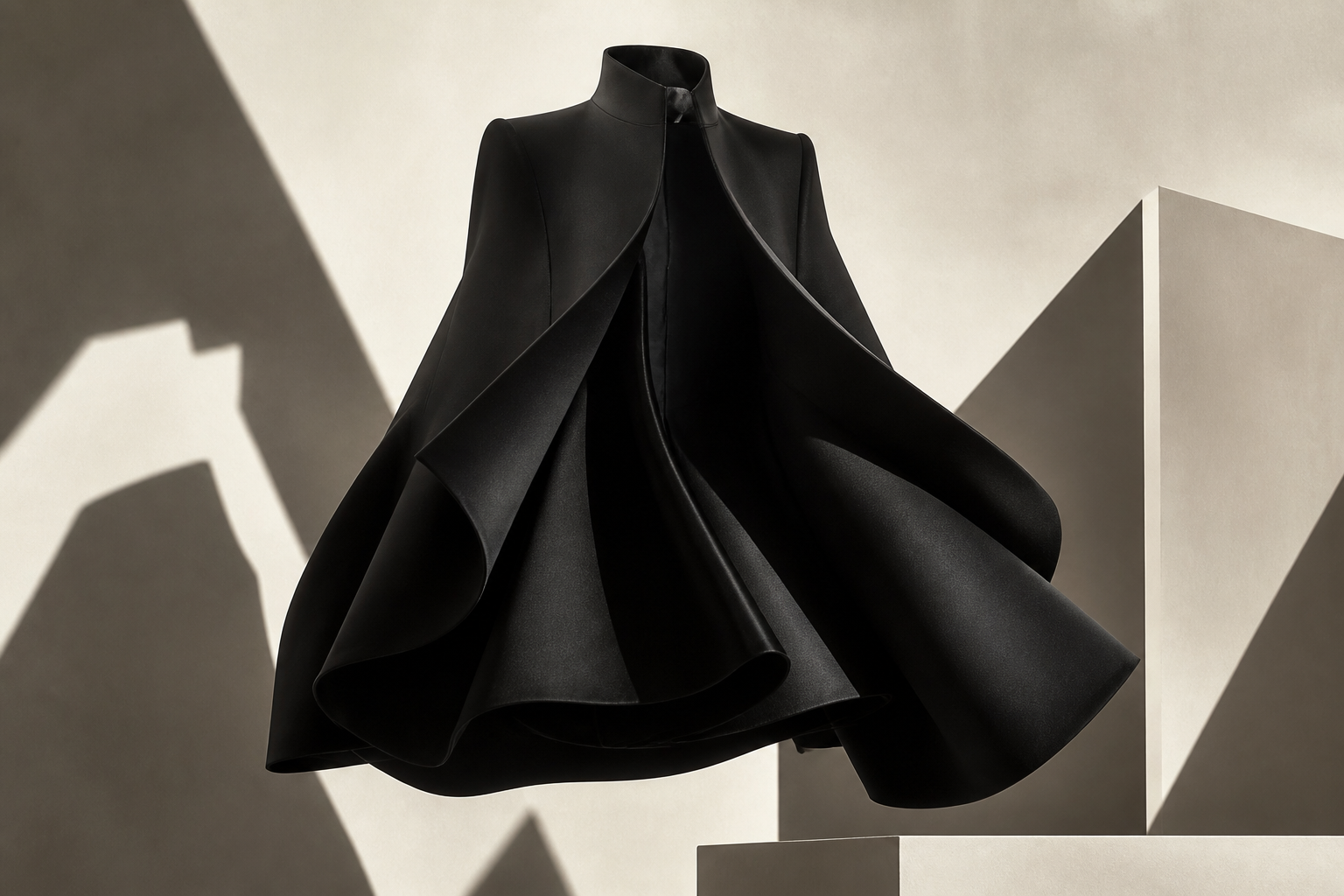
Balenciaga matters not because it once created a few recognisable silhouettes. The house changed the very way of thinking about clothing: fabric stopped repeating the body and began to form a space around it. Every later era of the label — from Nicolas Ghesquière and Demna to Pierpaolo Piccioli — tests whether this method can be preserved while the visual language keeps changing.
Editorial thesis
The history of Balenciaga is made of ruptures, not of the continuous evolution of a single company. Cristóbal Balenciaga built in Spain and Paris a couture system founded on mastery of craft, the behaviour of fabric, the freedom of the body and precise control of volume. In 1968 he closed the houses, refusing to adapt his own model to ready-to-wear. The brand was relaunched in the 1980s as ready-to-wear and became influential again under Nicolas Ghesquière, then turned under Demna into a laboratory of modern luxury in which couture coexisted with hoodies, trainers, internet memes and institutional critique. The era of Pierpaolo Piccioli returns the question to its starting point: is Balenciaga a set of archival forms or a method of creating space around a person?
Reader question
How did Cristóbal Balenciaga change the construction of clothing, why did his house close in 1968, how was the label restored, and what connects the historical couture with the Balenciaga of today?
To present Balenciaga at once as the biography of a master, the history of a couture institution, the object of a corporate relaunch and a contemporary design system. The material separates the Spanish companies Balenciaga and Eisa from the Parisian house, and the founder's historical legacy from the decisions of later creative directors.
The central subject is the history of Balenciaga from Cristóbal Balenciaga's first registered business in San Sebastián in 1917 to the state of the house within Kering as of 5 August 2026.
The Spanish and French flags in the title mark the founder's origins and the institutional history of the Parisian house, not a dual modern jurisdiction.
C. Balenciaga, Balenciaga y Cía, Cristóbal Balenciaga, Eisa Costura and the Parisian Maison Balenciaga are not conflated into a single legally continuous company.
Formulations such as 'invented modern fashion', 'created the sack dress first' or 'the only true couturier' are treated as historical judgements and quotations rather than neutral, measurable facts.
The periods of Michel Goma and Josephus Thimister are included as part of the relaunch, although their archive is documented less fully than the eras of Ghesquière, Wang and Demna.
The scandal of the 2022 advertising campaigns is described accurately, without reproducing the disputed images and without unverified accusations against individual employees.
Kering does not report Balenciaga's financial data as a separate revenue line; segment figures must not be presented as the sales of a single house.
Pierpaolo Piccioli's first full system is still taking shape; any assessment of his era as of the cut-off date is preliminary.
Every image passes the rights gate: author, date, rights holder, licence or permission, credit, caption and alt-text.
Short answer
Cristóbal Balenciaga opened his own couture business in San Sebastián in 1917 and the Parisian house at Avenue George V in 1937. He reshaped the female silhouette through volume, shifted waistlines, a liberated back, the sack dress, the baby-doll and sculptural constructions in gazar. In 1968 the master closed the houses and left fashion. The label was relaunched in 1986, regained influence under Nicolas Ghesquière, joined Kering in 2001 and became a global phenomenon under Demna, who brought couture back in 2021. Since July 2025 the creative direction has been led by Pierpaolo Piccioli; the House's CEO since January 2025 is Gianfranco Gianangeli. In the first half of 2026 Kering reported that Balenciaga was going through a difficult creative transition, while leather goods remained a strong category.
1. Getaria: the port, the mother's craft and an early vision of fabric
Cristóbal Balenciaga Eizaguirre was born on 21 January 1895 in Getaria, a small fishing town on the Basque coast. His father was a fisherman and died when the boy was eleven. His mother, Martina Eizaguirre, worked as a seamstress, serving among others the family of the Marquises of Casa-Torres. Balenciaga's early biography therefore joins two worlds: the practical craft of a working household and close observation of the clothing of an aristocratic clientele.
This environment explains one of the enduring traits of his method. Balenciaga never treated clothing as a drawing that someone else would then have to execute technically. For him, material, fit, seam, balance and movement formed a single process. The later architectonic quality of his couture grew out of direct work with the hands, not from a wish to turn a dress into a static sculpture.
2. San Sebastián: training in the city of European fashion
By 1907 Balenciaga was registered in San Sebastián and had begun learning the tailoring trade in establishments linked to Parisian fashion. At the turn of the twentieth century the city was the summer residence of the court and an international resort. Spanish aristocracy, French suppliers, the tourist economy and a seasonal culture of commissioning all met here.
Stories of how the Marchioness of Casa-Torres gave the teenager a dress to copy and then helped him with his training appear in many biographies, though the details vary. For an encyclopedic article it is safer to record what is confirmed: the marchioness was an early patron and client, and San Sebastián gave Balenciaga a professional environment in which local dressmaking practice was directly connected to Paris.
3. 1917–1937: C. Balenciaga, Eisa and the Spanish system of houses
In 1917 the twenty-two-year-old Balenciaga registered the business C. Balenciaga on Calle Vergara in San Sebastián. The enterprise soon became Balenciaga y Cía with the participation of the Lizaso sisters. After the partnership ended in 1924 the designer again worked under his own name. According to the museum, by the same year the company already employed 71 people — a sign that this was not a small individual workshop but a developed couture operation.
In 1927 a second label appeared, first Martina Robes et Manteaux, then Eisa Costura — the name derived from his mother's surname, Eizaguirre. Eisa expanded to Madrid in 1933 and Barcelona in 1935. The system made it possible to serve different markets while retaining authorial control. Garments from the Spanish ateliers were often labelled Eisa, so museum objects require precise identification of the label, the city and the date.
4. The Civil War and the decision to move to Paris
The Spanish Civil War destroyed his familiar clientele and economic environment. Balenciaga closed or suspended part of his Spanish operations and moved the centre of activity to Paris. The move was not a rejection of Spain: visual, religious and structural sources continued to shape his work. What changed was the institutional position — a master from a Spanish resort entered the system of Parisian haute couture.
Paris offered access to fabrics, embroidery houses, suppliers, the international press and a global clientele. At the same time it demanded participation in the seasonal calendar and constant comparison with Chanel, Schiaparelli, Mainbocher, Dior and other houses. Balenciaga managed to use the system while keeping a rare distance from publicity.
5. 1937: the house at 10 Avenue George V
In 1937 Balenciaga opened the couture house at 10 Avenue George V and presented the first Parisian collection. The address became an important part of the label's identity: the salons, fitting rooms and ateliers were here, and later the house's first fragrance was named Le Dix. In 2021 the modern company brought couture back to this very historical location.
The first collections drew attention through technical precision and Spanish historical quotations. By 1939 the Infanta line already linked the silhouette to portraits of the Spanish court. Yet the influence of painting did not mean copying a costume: Balenciaga translated historical proportion into modern construction, stripped away decoration and rebuilt the relationship between shoulder, waist and hip.
6. Spain as a visual archive: Velázquez, Zurbarán, the matador and religious dress
Black lace, rigid white collars, boleros, the forms of the matador's costume, the volumes of infantas and the restrained monumentality of religious dress appeared regularly in Balenciaga's work. These references connect him with Velázquez, Goya, Zurbarán and the material culture of Catholic Spain. But the precise source of any given garment requires museum or archival attribution.
The main result of the Spanish influence was not decorative exoticism but a sense of contrast. Deep black worked beside pink, red or ivory; a severe surface concealed a complex construction; a closed front could be paired with a dramatic back. This tension between asceticism and spectacle later became one of the ways of recognising Balenciaga without a logo.
7. The Balenciaga method: fabric before drawing
Contemporaries emphasised that Balenciaga could draft a pattern, cut, assemble and fit a garment entirely on his own. Unlike a designer who hands a sketch to the atelier, he understood every stage of production. The phrase 'the fabric decides' captures the principle precisely: the material did not fill a pre-conceived shape but determined the possible construction.
This approach demanded long, patient repetition. Many innovations did not arrive in a single spectacular gesture but developed over several seasons: the back became freer, the waist gradually disappeared, the sleeve merged with the body and volume moved away from the figure. The history of Balenciaga's silhouettes is therefore better read as a sustained investigation than as a list of sudden inventions.
8. The space between the body and clothing
Balenciaga's key contribution was the creation of a controlled space between the body and the fabric. Clothing could hug the front and stand away from the back, wrap the shoulders in a cocoon, widen at the hips or hover around the figure. The body remained the centre of the construction but ceased to be the only contour a dress was obliged to repeat.
Freedom of volume is not the same as shapelessness. For fabric to stand away from the body and still hold its balance required an exact grain line, weight distribution, inner support and an understanding of movement. Balenciaga's sculptural quality worked only because it was engineered in relation to the human figure.
9. 1947–1953: the tonneau, the cocoon and a new construction of the back
In 1947 the tonneau, or barrel line, appeared: a rounded body that altered the familiar geometry of waist and hips. In the early 1950s the cocoon and semi-fitted lines continued the movement away from the rigid hourglass. The front of a garment could keep its discipline while the back received volume and air.
The method is especially visible in coats and jackets. Instead of decorative complexity, Balenciaga worked with large planes, cut-in-one sleeves, shifted seams and a smooth transition from shoulder to back. A garment seemed simple only after the complexity had been hidden inside.
10. 1955–1958: the tunic, the sack and the baby-doll
The tunic dress of 1955 loosened the dress's dependence on the natural waist. The sack dress of 1957 made the break explicit: a straight silhouette let fabric fall around the body without the traditional emphasis on bust, waist and hips. Press reaction was mixed, but the form quickly entered mainstream fashion and became one of the predecessors of the silhouettes of the 1960s.
The baby-doll of 1958 continued the abstraction through a short, trapezoidal volume. It is important not to describe these forms simply as the liberation of women: they arose within a system of expensive individual couture and offered a new aesthetic, but they did not remove fashion's social constraints. Their historical radicalism lies in shifting the visual centre of the figure.
11. Gazar and the designer's alliance with a fabric manufacturer
In the late 1950s Balenciaga worked with Gustav Zumsteg and the Swiss house Abraham on gazar — a light but stiff silk fabric capable of holding volume. The cloth became the technical precondition of his late constructions. It allowed large forms to be built without a heavy frame and moved the dress into the realm of near-geometric abstraction.
The history of gazar shows that innovation in fashion rarely belongs to a single person. The designer formulates the task, the manufacturer develops the material, the atelier works out the finish and the client tests the garment in movement. A correct article therefore names the collaboration rather than turning the fabric into a magical individual invention.
12. The client, the fitting and the hidden engineering of couture
Balenciaga dressed Mona von Bismarck, Gloria Guinness, Ava Gardner, Pauline de Rothschild and other influential clients. His couture rested on individual fittings and the ability to adapt an experimental form to a particular body. Even radical volumes had to allow the wearer to sit, move and enter a room.
In photographs the late dresses look almost seamless, yet museum analysis of the construction reveals its complexity: whole panels, the absence of side seams, hidden fastenings and the precise joining of parts. The minimalism of the surface was the result of a great deal of handwork, not of its absence.
13. The 1960s: minimalism, abstraction and the envelope dress
In the 1960s Balenciaga's language became increasingly reduced. Colour and form worked as large autonomous fields; the decorative detail yielded to proportion, curve and emptiness. Dresses could recall liturgical vestments, Japanese constructions or abstract sculpture while still performing their couture function.
The envelope dress of 1967 pushed the experiment to the edge of wearability. The four-pointed form in gazar was received with admiration by the press but was practically difficult for the client. The object matters precisely as an investigation of what fabric can do, not as a commercial hit. It shows that Balenciaga's couture simultaneously served the client and tested the limits of clothing.
14. 1968: the closing of the houses as a conscious decision
In 1968 Cristóbal Balenciaga presented his final collection and closed the couture houses. The museum links the decision to the changing industry: haute couture was losing ground, ready-to-wear was becoming the dominant system of modern fashion, and the master did not want to rebuild his own method to a new scale. The closure was not the bankruptcy of an aesthetic but a refusal to continue under conditions he did not accept.
Balenciaga died on 24 March 1972. Closing while the founder was still alive sharply distinguishes his history from that of houses that continued seasonal production under successors. Between the historical couture and the modern brand there is a real institutional break that must remain visible in the site's chronology.
15. A legacy without an operating house: disciples, museums and copying
Balenciaga's influence continued through André Courrèges, Emanuel Ungaro, Hubert de Givenchy and other designers who worked beside him or developed related principles. The lesson was not a specific form but the discipline of cutting, attention to the back, purity of line and the ability to begin a project from the material.
Museums played a major role in turning Balenciaga into a canon of design history. The World of Balenciaga exhibition at the Met in 1973, the retrospectives that followed and the museum in Getaria secured access to the objects and the technique. At the same time the market copied the sack, the cocoon and the baby-doll, often reducing the inner construction to an outer outline.
16. 1986–1997: the ready-to-wear relaunch
In 1986 the Jacques Bogart group acquired the rights to Balenciaga and relaunched the label as ready-to-wear. This moment changes the type of object: a historical house founded on individual couture becomes a brand that must work through serial collections, licences, fragrance and international distribution.
Michel Goma led the early phase of the relaunch, then in 1992 Josephus Thimister took over the creative direction. His minimalist collections returned attention to the founder's structural drama, but the house's commercial position remained weak. The period matters as a laboratory: without it, the later revival under Nicolas Ghesquière would look sudden.
17. Nicolas Ghesquière: the archive as science fiction
Nicolas Ghesquière became creative director in 1997. He did not try to recreate the couture of the 1950s but used the archive as a system of transformations: rounded shoulders, cocoons, stiff fabrics and Spanish motifs met futurism, sportswear materials, a robotic surface and the culture of the late twentieth century.
His collections restored Balenciaga's critical influence and showed that a legacy can be continued through contradiction. The architecture of form remained, but the objects of investigation became trousers, minidresses, jackets, synthetic fabrics and the modern woman moving through the city. In 2012 the house and the designer announced the end of their collaboration after fifteen years.
18. The City bag and the transition from collection to global product
In 2001 the bag known as Le City or the Motorcycle bag appeared. Its soft construction, external straps, metal hardware and deliberately informal surface set it apart from the rigid status bags of traditional luxury. It became an important part of Balenciaga's transition from an editorially influential ready-to-wear house to a large-scale international business.
The history of the City bag shows the economic role of the accessory. A collection idea can attract the press, but a bag creates a repeatable product recognisable beyond the runway. The claim that the model 'saved the house' nevertheless calls for caution: Balenciaga's success was the result of a combination of design, ownership, distribution and category expansion.
19. Kering and the scaling of an international house
In 2001 Balenciaga joined the Gucci Group, later part of Kering. The new structure provided capital, a retail network, operational functions and the opportunity to develop leather goods, shoes, menswear and stores. The house ceased to depend on a single collection reputation and began to build a global model.
Corporate support does not make the creative work automatic. On the contrary, Balenciaga constantly balances experiment against the need to build large commercial categories. The conflict is especially visible in the periods of Ghesquière and Demna, when the most radical shows coexisted with bags, trainers and logo products.
20. Alexander Wang: athletic clarity and a brief transition
After Ghesquière's departure Alexander Wang became creative director. His 2012–2015 period intensified athleticism, black-and-white graphics, mesh materials and clear commercial silhouettes. He drew on the archival architecture but made it smoother and more accessible to global retail.
In retrospective accounts Wang often sits between two more strongly canonised eras. Yet he sustained the house's international scale and demonstrated the limit of a strategy in which an impeccable product does not always build an equally distinct cultural position. The collaboration ended in 2015.
21. Demna: the everyday as material for luxury
Demna was appointed artistic director in October 2015. He brought to Balenciaga the experience of Vetements and a view of clothing as a social document. A work jacket, a hoodie, an office suit, a paper bag, a blanket, a travel bag and a delivery-service uniform became material for luxury design through changes of scale, cut, context and price.
His connection to Cristóbal showed itself not in visual resemblance but in the work with volume and distance from the body. An oversize puffer, a coat with a pushed-back shoulder or a gigantic suit continued the investigation of space around the figure. At the same time Demna added irony, digital culture, post-Soviet experience and a critique of consumption — elements the historical house never had.
22. Trainers, the logo and the economy of new recognisability
Triple S, Speed and other footwear models helped Balenciaga become one of the centres of luxury streetwear. The massive sole, the deliberately complex layering and the pairing of a sporting form with a high price changed the trainer market. Logo hoodies, T-shirts and caps made the label instantly readable on social media.
Commercial success carried a risk: product recognisability could overshadow the design content. The house itself tried to restore the top of the pyramid through couture, complex shows and rare pieces. For the article it is important not to set 'the real Balenciaga' against streetwear: both systems were part of one strategy but performed different cultural and economic functions.
23. Digital fashion, gaming worlds and the show as a cultural format
Under Demna Balenciaga experimented with show formats: digital films, gaming spaces, red carpets, artificially created weather and scenographies that became independent media images. A collection ceased to be merely a set of objects and turned into a managed environment of perception.
Collaborations with popular culture and gaming platforms expanded the audience but demanded precise documentation of rights and partners. The approach matched the digital attention economy: the house produced not only goods but images, memes, avatars and events that spread faster than physical clothing.
24. 2021: the return of haute couture
On 7 July 2021 Balenciaga presented its 50th couture collection — its first since the house closed in 1968, 53 years earlier. The return took place in the historical space of Avenue George V and became a way of connecting the modern label with the founder's atelier. In the collection couture techniques were applied not only to evening dresses but also to T-shirts, jeans, coats and everyday typologies.
The gesture did not literally restore the institution of 1937. The modern couture existed inside a global Kering brand and performed several functions at once: it preserved the craft, created unique client pieces, strengthened the prestige of mass categories and allowed Demna to prove that his streetwear language could sustain the highest level of execution.
25. 2022: the advertising crisis and the question of institutional responsibility
In November 2022 two advertising campaigns drew international criticism. In one, children held teddy-bear bags with elements interpreted as BDSM accessories; in the other, a fragment of a document related to a US Supreme Court ruling on legislation concerning child sexual abuse material appeared on the set. The house removed the images, and Demna and the CEO apologised.
The crisis showed that responsibility cannot be reduced to a photographer, a prop master or a single approving person. In a large company an image passes through a creative, production, legal, marketing and executive chain. After the scandal Kering announced the creation of group-wide brand safety controls. For the site this case matters as an example of governance, not as an occasion to repeat the sensational versions circulating on social media.
In March 2023 the first show after the crisis was deliberately focused on the construction of clothing. Reputational damage cannot be measured only through online reactions: it affected sales, relationships with celebrities and trust in the control process. At the same time the brand retained the possibility of recovery thanks to its product, couture and long-standing cultural significance.
26. 2025–2026: Pierpaolo Piccioli and the return to method
In 2025 Demna moved to Gucci. On 19 May Kering announced Pierpaolo Piccioli as the new creative director of Balenciaga from 10 July. The House's CEO since 2 January 2025 (an appointment announced back in November 2024) is Gianfranco Gianangeli. Piccioli's first collection, Summer 2026, was presented in October 2025 and framed as a recalibration rather than archival homage.
Piccioli focused on humanity, colour, lightness and couture volume. He drew on the sack, the cocoon and the work with distance from the body, but created his own materials and a contemporary softness. In July 2026 his first couture collection became the house's 55th. As of the cut-off date it is too early to assess the era as a completed system.
The financial context remains difficult. In its first-half 2026 report Kering said Balenciaga had experienced a more difficult quarter amid the creative transition and the rebalancing of the business, although leather goods remained a strong category. This underlines the point: the return to the couture code must work at once as a cultural idea and a commercial strategy.
27. The codes of Balenciaga: what truly belongs to the house
Balenciaga's enduring codes are not only the logo and the colour black. They include volume at the back, a shifted waistline, the cocoon, the sack, the cut-in-one sleeve, sculptural gazar, the contrast between a severe front and a dramatic back, Spanish black, saturated colour, religious monumentality, technical purity and comfort within a complex form.
The modern house added codes of its own: the City bag, Ghesquière's sportive materials, extreme oversize, corporate typography, the distressed surface, massive trainers and Demna's reinterpretation of everyday objects. They do not belong to Cristóbal, but they already belong to Balenciaga's history. An encyclopedia must date each code and must not present the later language as an eternal heritage.
28. The business model, categories and current growth constraints
Today Balenciaga operates through ready-to-wear, leather goods, shoes, accessories, couture and fragrance. Leather goods and shoes create scale, ready-to-wear sustains the creative identity, and couture forms the summit of symbolic value. In 2025 the house brought back fragrance with a collection of ten scents referring to Le Dix.
Kering does not publish Balenciaga's standalone revenue in its regular segment reporting. The house is included in Fashion & Leather Goods together with other labels, so segment figures cannot be used as Balenciaga sales. The available corporate comments make it possible to assess category and regional dynamics but not to build a precise financial model of the brand without further disclosures.
29. Critical questions: scarcity, provocation, sustainability and cultural memory
Balenciaga constantly works with the tension between a high price and an outwardly everyday appearance. A paper bag, scuffed shoes or a work jacket become luxury not only through construction but through the brand, limited access and cultural capital. The critique of 'expensive poverty' does not exhaust the phenomenon, but it reveals the ethical risk of turning social codes into a consumer game.
Provocation can be an analytical tool only when a working system of responsibility is in place. The 2022 crisis showed the limit of deliberate ambiguity: when an image touches vulnerable groups, an explanation of artistic risk does not replace control. A modern house must combine creative freedom with legal, ethical and production review.
Claims about sustainability require measurable data on materials, production volumes, repair, logistics and the supply chain. The long life of an archival form or the high price of a piece does not prove environmental sustainability. Likewise, keeping Cristóbal's name does not guarantee the survival of his craft method — only concrete products and practices can confirm that.
30. Conclusion: legacy as a way of working, not an archival form
The history of Balenciaga matters because it shows several different ways of continuing a legacy. Cristóbal himself developed form through fabric and repetition; Ghesquière translated the archive into futurism; Demna applied the principle of volume to mass everyday life and the digital image; Piccioli returns attention to the human hand, colour and the couture method.
A house stays alive when its legacy operates as a question rather than a ready answer: what can fabric do, how much space does the body need, where is the line between simplicity and engineering, how does couture speak to the present? Balenciaga loses its meaning not when it changes its aesthetic but when it stops asking these questions.