research
Chanel: History of the Fashion House
How a Paris atelier turned freedom of movement, material codes and craft infrastructure into an enduring fashion-house system.
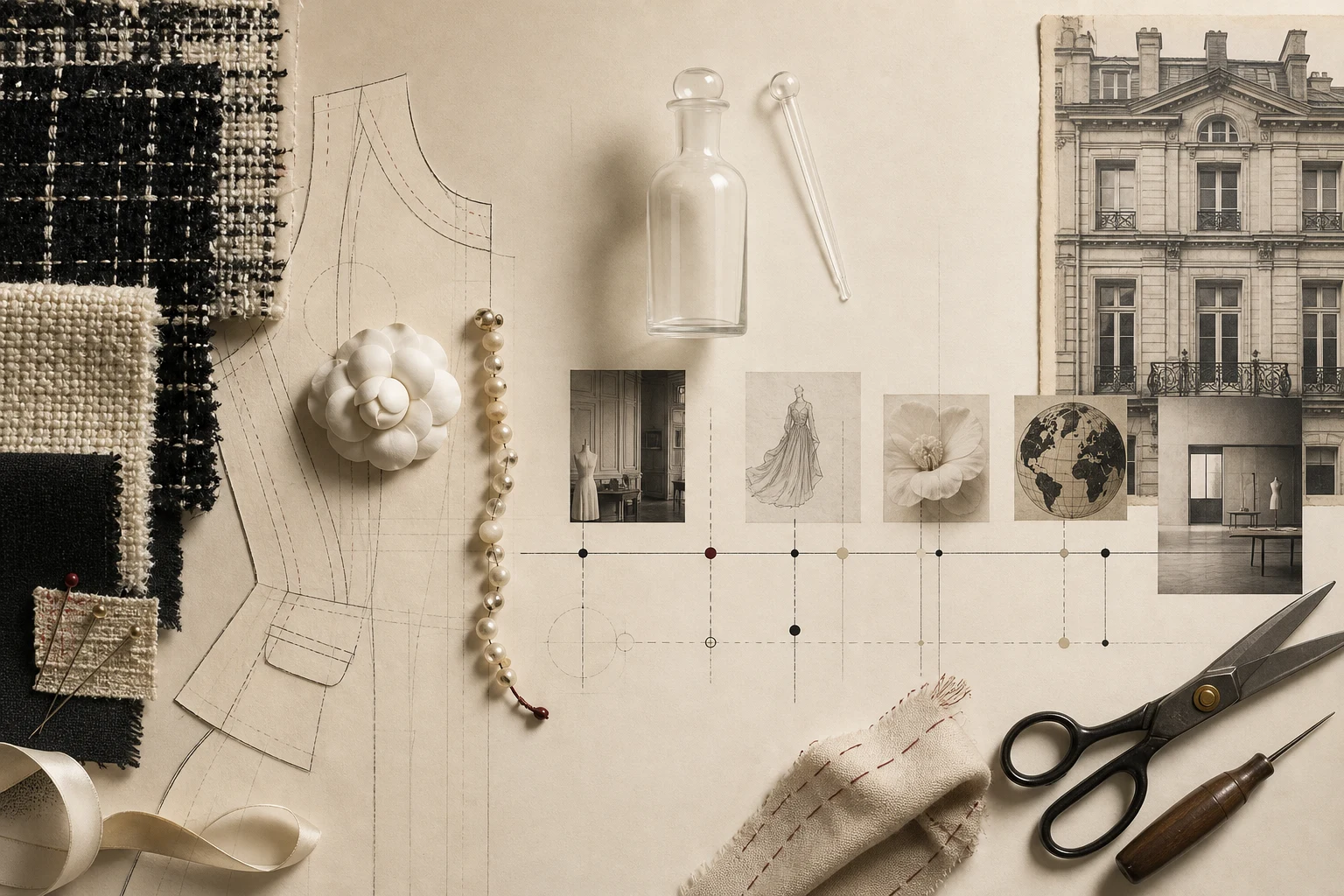
Freedom of movement, repeatable codes and craft infrastructure as the basis of a fashion house's longevity
Chanel matters not as a collection of immutable symbols but as a system of translation: material becomes silhouette, silhouette becomes habit, and habit becomes a cultural code that each generation must make contemporary again.
Editorial thesis
Chanel's history is often reduced to a short list of recognisable objects. That version is convenient but incomplete. The house endured because clothing, fragrance, accessories, ateliers, communication and heritage management learned to operate together. Its influence comes from more than a sign: it comes from connecting disciplines through a shared principle of precise form without restricted movement.
Reader question
How did a small Paris millinery shop become a house whose methods still shape ideas of modern womenswear, luxury and institutional memory?
1. From hats to a clothing system
Chanel's official chronology dates the opening of the Chanel Modes hat boutique at 21 rue Cambon to 1910. A Deauville boutique followed in 1912 and began selling jersey sportswear in 1913; a couture house opened in Biarritz in 1915, and in 1918 the house moved to 31 rue Cambon, bringing boutique, salons and workshops together.1
The sequence matters more than a myth of instant invention. Chanel grew through infrastructure: each new place widened the offer while changing how the house produced, presented and discussed clothes with its clients.
2. Material and freedom of movement
The V&A describes Gabrielle Chanel's method through comfort, simplicity and wearability. Jersey, previously associated mainly with utilitarian clothing, enabled a more fluid and liberated silhouette; tweed later travelled a comparable path from sporting and country fabric to urban dress.5
This established a durable principle: prestige did not require conspicuous complexity. Familiar material could be edited with enough precision to hold its form while allowing the body to move.
3. Extending beyond clothing
In 1921 the house launched its first fragrance, N°5, created through Gabrielle Chanel's collaboration with perfumer Ernest Beaux. Société des Parfums CHANEL was established in 1924 to make and sell fragrance and cosmetics.2
Fragrance became more than a secondary product. The house learned to carry a coherent character between dress, scent, packaging, interior and public image without reducing them to literal repetition.
4. Return and the post-war formula
Gabrielle Chanel reopened her couture house in 1954 at the age of 71. The official history records the 2.55 bag in 1955 and the trimmed tweed suit in 1956; the V&A connects the post-war suit with practicality, soft construction and freedom of movement.5
The suit functioned as a system rather than a single model. A straight jacket, coordinated materials, controlled balance and variable colour and trim created recognition without exact repetition.
5. How a code survives its author
After Gabrielle Chanel's death in 1971, the house faced the central problem of any heritage brand: how to continue a language without turning it into museum reconstruction. Karl Lagerfeld became artistic director in 1983; Chanel's chronology associates his tenure with ready-to-wear, revived cruise collections, Métiers d'art and pre-collections.4
His strategy treated the archive as material for montage. Scale, proportion, context and medium changed while relations between tweed, contrast, ornament and strict construction remained legible.
6. A new creative chapter
Chanel announced Matthieu Blazy as artistic director of fashion activities with responsibility for haute couture, ready-to-wear and accessories; the official announcement stated that he would join the house in 2025.6
The appointment is best understood not as a promise of a predetermined result but as a change of editor within a complex system. A new director inherits ateliers, crafts, archives and expectations whose relationships must be made contemporary.
7. The house as production and cultural institution
The V&A exhibition Gabrielle Chanel. Fashion Manifesto brought together more than 200 looks and traced the designer's work from her first millinery boutique to her final collection in 1971. The scale of this corpus shows how the legacy exists simultaneously as clothing, document, exhibition material and object of research.5
Institutional continuity requires two opposing acts: preserving the provenance of objects while allowing their principles to work in the present. An archive is useful only when it helps distinguish method, replica and surface styling.
8. Economic scale without using numbers as design criticism
For the 2025 financial year Chanel reported revenue of $19.3 billion and operating profit of $4.712 billion; it also reported capital expenditure of $1.449 billion and more than 40 boutique openings during the year.7
These figures describe organisational scale, not artistic quality. For design analysis, the relevant point is that a large network, investment programme and craft ecosystem support long development cycles while raising the cost of using historical codes mechanically.
9. Why Chanel remains a system
The house's history links several levels: a liberated silhouette, material research, expansion into fragrance and accessories, atelier production and archive management. Together they turn functional decisions into a repeatable cultural language.1
Chanel therefore cannot be judged by the familiarity of its signs alone. Strong heritage editing preserves proportion, movement and material logic; weak editing leaves only decoration. The house's longevity depends on translating its history into new conditions rather than reproducing its surface.
Short chronology
| Year | Event | |---|---| | 1910 | Chanel Modes opens at 21 rue Cambon | | 1915 | First couture house opens in Biarritz | | 1918 | The house moves to 31 rue Cambon | | 1921 | N°5 launches | | 1924 | Société des Parfums CHANEL is established | | 1954 | Gabrielle Chanel returns to haute couture | | 1955 | The 2.55 bag is created | | 1956 | The trimmed tweed suit appears | | 1983 | Karl Lagerfeld is appointed | | 2025 | A new chapter begins under Matthieu Blazy |