research
The History of the Giorgio Armani Fashion House
How a soft jacket, a neutral palette, cinema and an independent model of governance created one of the most consistent languages in modern Italian fashion
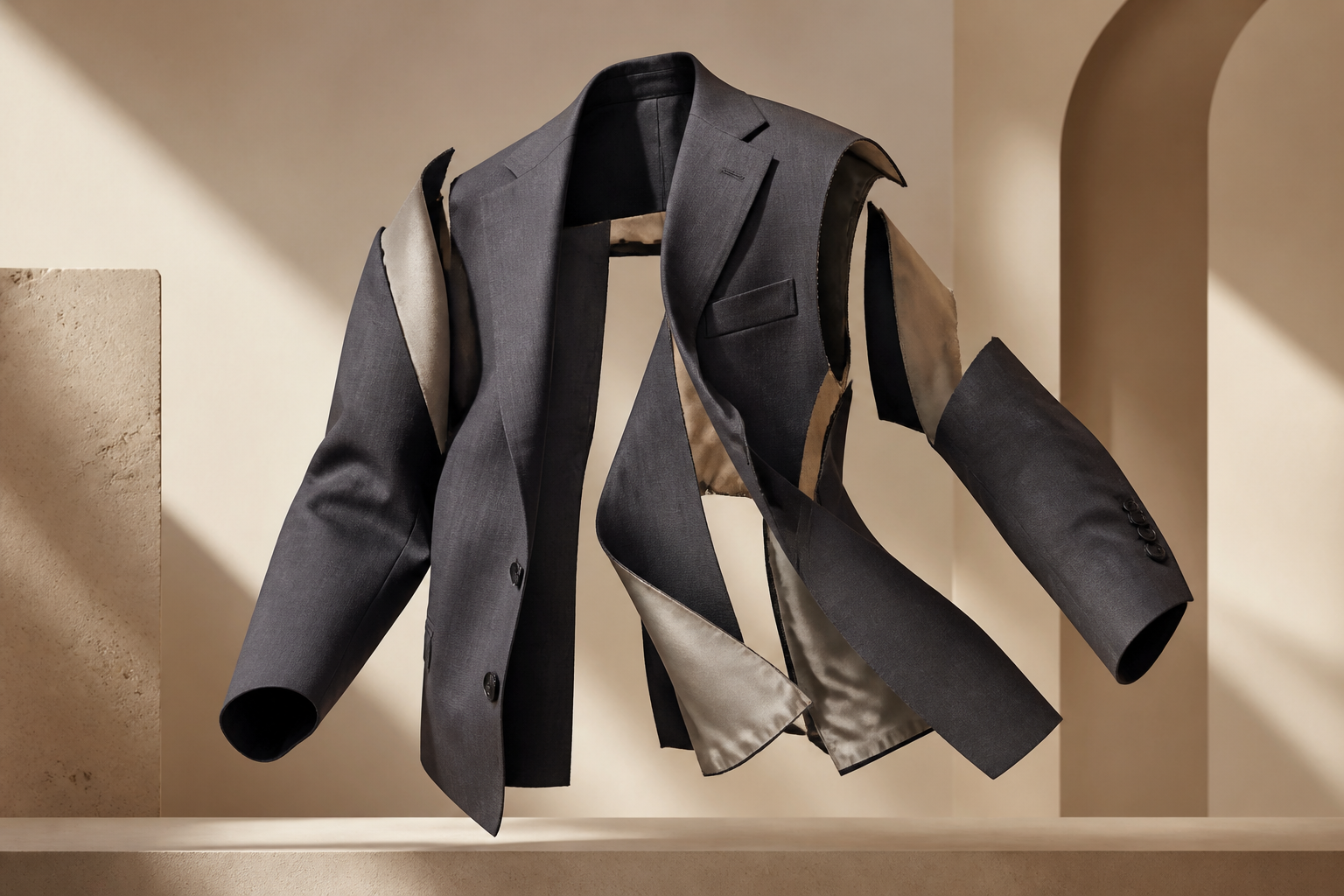
“Armani changed the suit not by adding a spectacular detail, but by removing what was unnecessary: rigidity, ostentation and the distance between formal dress and real life. From that reduction emerged an entire system—from the soft jacket and greige to cinema, the red carpet, interiors and a global business.”
Editorial thesis
Armani’s historical importance rests not on a single ‘invention’, but on a sustained restructuring of the language of modern dress. The house relaxed the traditional construction of the men’s jacket, brought the soft suit into the women’s wardrobe, turned neutral palettes and fluid materials into signs of authority without aggression, and then extended this aesthetic into film, interiors, hospitality and popular culture. After Giorgio Armani’s death in 2025, the central historical question became not only how to preserve a recognisable style, but how to move from a company directed for decades by one founder to collective governance and a legally mandated transformation of its capital.
Reader question
How did Giorgio Armani transform the soft construction of the suit into the international language of modern elegance, how did the house expand into a multi-tiered system of brands and what has changed since the death of the founder in 2025?
To present Armani simultaneously as a design system, media image, production organisation and independent private business. The article separates documented facts from brand mythology, does not reduce the house’s influence to the ‘power suit’, and records the group’s structure as of 5 August 2026.
The main object is Giorgio Armani S.p.A. and the system of brands, products and cultural institutions created around it from 1975 to 2026.
A biography of Giorgio Armani before 1975 is included only insofar as it explains his method: La Rinascente, Cerruti/Hitman, industrial prêt-à-porter and the work of an independent designer.
Giorgio Armani, Emporio Armani, EA7 and A|X Armani Exchange are considered different levels of the same group; they cannot be described as interchangeable names.
Armani Beauty, eyewear and selected categories operate through long-term licensing agreements; the article distinguishes creative control, legal ownership and production partners.
The phrases “Armani invented the deconstructed jacket”, “created power dressing” and “dressed all of Hollywood” are replaced with precise formulations about popularization, systematization and influence.
The current structure after the death of the founder is transitional. Plans for the stake sale and eventual listing are described as a legally mandated process rather than a completed transaction.
Financial indicators are recorded as of the date of audit and are not used as a universal measure of cultural impact.
Every image passes a rights gate: author, date, source, rights holder, licence or written permission, credit, caption and alt text.
Short answer
Giorgio Armani founded the company with Sergio Galeotti in Milan on 24 July 1975. His softly constructed jacket loosened the traditional suit’s internal architecture, making formal dress lighter, more fluid and closer to the body. In the women’s collections, this system combined professional authority with mobility and sensuality; through cinema—especially after American Gigolo—it became a global visual code. Armani subsequently built a multi-tiered group encompassing Emporio Armani, A|X, EA7, Armani/Casa, Armani Privé, hotels and a cultural archive. The founder retained creative and managerial control until his death on 4 September 2025. In 2026 the group is led by Chairman Pantaleo Dell’Orco and CEO Giuseppe Marsocci, while its capital structure undergoes the transformation prescribed by Armani’s will.
-
Before 1975: from Piacenza and La Rinascente to industrial prêt-à-porter
-
1975: Giorgio Armani and Sergio Galeotti found the company
-
Soft jacket: deconstruction without showing destruction
-
Women's costume: power without armor
-
Greige, smoky tones and material intelligence
-
American Gigolo: cinema as a global showroom
-
Emporio Armani: a design system for the new urban generation
-
1985: death of Sergio Galeotti and concentration of management
-
The red carpet and the new celebrity economy
-
A|X, EA7 and brand architecture
-
Armani/Casa: clothes turn into space
-
Armani Privé: restraint within haute couture
-
Hotels, restaurants and the idea of a total environment
-
Sports, uniforms and mass visibility
-
Armani/Silos and Archivio Armani: turning heritage into infrastructure
-
Independence, licenses and limits of personal control
-
Sustainability: between style longevity and measurable impact
-
2025: fifty years of the house and the founder’s death
-
2025–2026: new management structure and mandatory capital transformation
-
Visual codes of Giorgio Armani
-
Critical Reading: Sequence, Scope, and the Risk of Self-Repetition
-
Why Armani remains important
Appendices: chronology • governance • claim ledger • glossary • media plan • sources • front matter • release checklist
Armani emerged in the mid-1970s not as a decorative alternative to existing fashions, but as a reconstruction of the suit’s mechanics. Rigid padding, lining and formality were removed or relaxed; fabric moved more freely around the body. A muted palette, an exacting choice of materials and the avoidance of visual excess supported this structural idea. Cinema made the style instantly legible, Emporio Armani broadened its audience, and the vertically controlled group extended the aesthetic into the home, restaurants, hotels and sport. After the founder’s death in 2025, the brand must prove for the first time that its consistency can survive without a single author and owner.
1. Before 1975: from Piacenza and La Rinascente to industrial prêt-à-porter
Giorgio Armani was born in Piacenza on 11 July 1934. His route into fashion was indirect: he studied medicine, served in the military and, in 1957, began working at the Milan department store La Rinascente. There he was involved in window display, sales and buying. This experience matters not as a romantic prelude to design, but as an early school of observation: Armani saw clothing simultaneously as object, commodity, composition and consumer behaviour. [4]
The next decisive step was his work with Nino Cerruti on the Hitman menswear line. Unlike the traditional couturier, who formed a garment within his own atelier, Armani worked in an industrial environment. He learned how a complex idea must survive serial production across cut, material, size and distribution. Archivio Armani links the later ‘deconstructed revolution’ precisely to this combination of Cerruti prêt-à-porter experience and the softness of Neapolitan tailoring. [3]
In the early 1970s Armani worked as an independent designer for several manufacturers. This multiplicity of clients helped shape a method based not on recognisable motifs, but on proportion, fabric and fit. The future house grew out of knowledge of production: how to reduce a garment’s weight, preserve its shape and make the suit a natural part of movement.
2. 1975: Giorgio Armani and Sergio Galeotti found the company
On 24 July 1975, Giorgio Armani and Sergio Galeotti founded Giorgio Armani S.p.A. in Milan; the first men’s and women’s ready-to-wear collections were presented that same year. [1] Galeotti is sometimes abbreviated to a ‘business partner’ in popular histories of the brand, but the phrase understates his role in the early company. He helped turn Armani’s design practice into a house in its own right: establishing the enterprise, supporting its commercial expansion and creating the conditions in which an aesthetic could become a system.
The company emerged at a time when Italian prêt-à-porter was strengthening Milan's international role. Armani offered not a theatrical alternative to Paris, but a new type of industrial sophistication. His clothes looked less stiff than a business suit, but did not devolve into informal sportswear. This intermediate state—precision without constraint—became the first stable code of the house.
It is important to distinguish between the date of legal foundation and the long-term formation of the method. 1975 marks the emergence of a company and a collection under its own name, but not the sudden invention of a ready-made aesthetic. It grew from previous work in men's suiting, textiles and industrial production.
3. Soft jacket: deconstruction without showing destruction
Armani’s central design contribution was the softly constructed jacket. In the traditional men’s suit, internal padding, a rigid chest and a fixed shoulder line created distance between the body and its social role. Armani relaxed this architecture by removing some internal elements, lightening the lining, repositioning the fastening and allowing the fabric to drape. FIT describes his suits as loose and fluid, with minimal visible internal structure. [6]
The term ‘deconstruction’ needs qualification here. An Armani garment does not look destroyed or expose its seams as a critical gesture. The jacket is deconstructed at the level of construction while retaining its social legibility. A suit still communicates composure, professionalism and status—it simply ceases to resemble armour.
This is why Armani’s influence was so extensive. A radical object may belong in a museum, but the soft Armani jacket entered the office, restaurant, cinema and everyday wardrobe. The change was visible enough to establish a new silhouette and practical enough to become habitual.
4. Women's costume: power without armor
In the women’s wardrobe, Armani carried over the methods of men’s tailoring without simply scaling down a man’s suit. A loose jacket, trousers, a fluid blouse and neutral colour created a professional image without excessive sexualisation or a rigid imitation of male power. The Met connects Armani with a new language of gender balance and the refined glamour of the late 1970s. [5]
This contribution is often reduced to the formula of the ‘power suit’. The phrase is useful, but reductive. In the 1980s, power dressing often relied on broad shoulders, contrast and the visual enlargement of the figure. Armani might employ an emphatic shoulder, but the strength of his system lay elsewhere: in the ability to appear formal while remaining mobile. Women did not disguise themselves as men; the male code became a shared instrument.
It is critical not to take sole credit for “women's liberation” to the designer. Changes in clothing occurred along with the growth of women's participation in the professional environment, the transformation of work and mass culture. Armani gave these changes a compelling visual language and made it internationally recognizable.
5. Greige, smoky tones and material intelligence
The Armani color system is based on complex neutral shades: greige, mushroom, stone, tobacco, smoky blue, soft black and muted flesh tones. FIT links this palette to the perception of Giorgio Morandi's painting. [4] However, its significance is not only cultural. Neutral color enhances the appearance of fabric, weight, shine and movement.
In Armani clothing, material often plays the role of image. Silk, crepe, wool, velvet, matte viscose or soft leather absorb and reflect light differently; the shade reveals itself not as a flat pattern, but as a surface in motion. Therefore, apparent “simplicity” requires precise production. If you remove the ornament, a defective fit or cheap shine becomes more noticeable.
Greige also helped the house avoid dependence on seasonal fashion. Chromatic restraint gives the collections a visual continuity across decades. Yet that same consistency carries a risk: critics may see repetition rather than timelessness. For VANSMITHLAB, it is more accurate to say that Armani turned a limited palette into a method of long-term identity, not a universal standard of good taste.
6. American Gigolo: cinema as a global showroom
In 1980 Armani created the wardrobe for the film American Gigolo. Richard Gere’s clothes—soft suits, shirts and an easeful physical confidence—became part of the narrative of the modern man. The house’s official chronology treats the film as the beginning of its systematic relationship with Hollywood. [1]
The significance of American Gigolo extends beyond product placement. The camera showed the suit in motion: the protagonist selects clothes, combines them, dresses and inhabits them. Viewers encountered not an abstract runway look, but a model of behaviour. Armani was ideally suited to cinema because his clothes depended on the plasticity of fabric and body rather than details legible only in a still photograph.
After the film, the brand's connection with the actors, costumes and ceremonies became permanent. Hollywood has become an international display system, and Armani has become one of the houses that shaped the modern understanding of red-carpet dressing. At the same time, the article should not claim that one film single-handedly created international success: it accelerated the recognition of an already formed product.
7. Emporio Armani: a design system for the new urban generation
Emporio Armani and Armani Jeans were launched in 1981, alongside the first Emporio Armani store in Milan. [1] Emporio was not simply a cheaper version of the main line. It offered a younger, more dynamic and communicative layer of the brand: denim, knitwear, underwear, accessories and urban ready-to-wear.
The name emporio—‘marketplace’—suited the idea of a broad world of objects. The eagle emblem was more overt and reproducible than the discreet Giorgio Armani signature. Where the main line was built on the almost invisible authority of fabric, Emporio could employ a graphic sign, advertising, music and urban scale.
This model proved important across the industry: a design house could preserve an expensive flagship line while expanding its audience through a separate brand with its own identity. The advantage was greater cultural visibility; the risk, confusion between tiers and a loss of clarity. The later restructuring of Armani’s portfolio shows that a complex system of sub-brands requires constant editing.
8. 1985: death of Sergio Galeotti and concentration of management
Sergio Galeotti died in 1985. After this, Giorgio Armani assumed even more complete management control. This point is fundamental for understanding the subsequent decades: the company became a rare large fashion house in which the founder simultaneously determined the design, strategy and ownership structure.
This concentration produced exceptional consistency. Collections, stores, advertising and interiors could all be governed by one sense of measure. Unlike a listed conglomerate, Armani was not compelled to replace creative directors in pursuit of short-term gains or to explain each collection to external shareholders.
But the strong side gradually became the main risk of succession. The more closely a brand is connected to a personal system of decisions, the more difficult it is to separate the principles from the habits of one person. The question “who will be the next designer?” for Armani was always insufficient: after the founder, it was necessary to replace not just one position, but a whole node of creative, financial and symbolic control.
9. The red carpet and the new celebrity economy
Throughout the 1980s and 1990s, Armani worked consistently with actors and awards ceremonies. His eveningwear suited the red carpet for the same reason it suited cinema: it emphasised the person without turning the dress or suit into a spectacle in itself. In photographs, Armani often produced an impression of natural ease—complex work made to look effortless.
This work helped shape the modern economy of celebrity dressing, in which a house supplies or creates clothes for a public event and the resulting image circulates through global media. Armani cannot claim this development alone, but the house’s consistency made neutral elegance an important alternative to visual sensationalism.
The red carpet also strengthened the association between the brand and ‘good taste’. Here a critical issue arises: taste can be presented as natural and universal even though it depends on class, access, bodily norms and media conventions. Armani’s history shows how minimalism can function not as a refusal of status, but as one of its most effective forms.
10. A|X, EA7 and brand architecture
A|X Armani Exchange developed as a more accessible tier aligned with young urban culture. EA7, integrated into Emporio Armani, connected the house’s name with sportswear, uniforms and performance. Armani thus became not a single line, but an architecture of different prices, functions and audiences.
For editorial clarity, the brand and the group must be distinguished. Giorgio Armani is the principal luxury line; Emporio Armani is a distinct designer tier; EA7 is Emporio’s sports division; A|X is a more accessible fashion and lifestyle brand. The historical Armani Jeans and Armani Collezioni served different roles before being reduced or absorbed into a clearer structure.
The layered model increases scale but creates the effect of an “accessible symbol”: the consumer can enter the world of Armani through a T-shirt, watch, fragrance or glasses without having to buy a suit. This is not automatically a democratization of design, since many categories are produced under license and sell name recognition above all else. The analysis must separate the diffusion of aesthetics from the diffusion of logos.
11. Armani/Casa: clothes turn into space
Armani/Casa, launched in 2000 according to the official chronology, carried the language of the house into furniture, lighting, textiles and interior design. [1] It is especially noticeable here that the Armani aesthetic has never been limited to the silhouette. A neutral palette, dark wood, varnish, metal, stone, soft light and controlled emptiness create the space as an extension of the clothing.
The interior line shows the difference between lifestyle expansion and casual licensing. When a new product follows the same relationships between surface, color and proportion, the brand truly creates a holistic environment. However, the wider the range, the higher the risk of turning the aesthetic language into a set of recognizable features.
Armani/Casa is also associated with large residential and hospitality projects. On this scale, the designer's name becomes not only a brand of an object, but a promise of a certain life scenario: silence, control, privacy and material restraint. This scenario is culturally significant, but not neutral - it encodes luxury through the absence of visual noise and access to space.
12. Armani Privé: restraint within haute couture
Giorgio Armani Privé was launched in 2005 as a haute couture line and admitted to the Paris system as a corresponding member. [1][20] It allowed the house to work with private commissions, elaborate embroidery, crystals and evening constructions without abandoning its central principle of control.
Privé is important because it shows that Armani's minimalism does not equal asceticism. In couture, shine, rich color, complex surfaces and a high level of handwork appear. But decorativeness is usually organized through repetition, gradation and pure line; excess is disciplined.
The line also reinforced the house's role on the red carpet. Couture and celebrity dressing have become mutually supporting systems: an individual item receives a global image, and a public figure receives the aura of an exclusive craft. For a historical article, it is necessary to distinguish the institutional status of haute couture from the marketing use of the word couture.
13. Hotels, restaurants and the idea of a total environment
The first Armani Hotel opened in 2010 in Burj Khalifa in Dubai, the second in Milan in 2011. These projects developed a model in which the guest temporarily enters a completely controlled environment: architecture, furniture, light, service, smell, restaurant and packaging. [1]
Hospitality became a logical extension of the brand, because Armani initially sold not a decorative image, but a mode of behavior - calm, precise, collected. The hotel makes this mode spatial and long-lasting. The client not only wears the item, but sleeps, eats and moves within the aesthetics.
Critically, this model demonstrates the transformation of a fashion house into a luxury ecosystem. On the one hand, it confirms the integrity of the design; on the other hand, it blurs the line between cultural contribution and monetization of a name. Therefore, hotels and restaurants should be seen as part of the brand's history, but not as a direct extension of the sewing craft.
14. Sports, uniforms and mass visibility
Through EA7, collaboration with national teams and ownership of the Olimpia Milano basketball club, the group linked the tailoring identity with sports. Official reports indicate that Armani became the main sponsor of Olimpia Milano in 2004 and took full control in 2008. [15]
Sportswear may seem the opposite of a soft suit, but both share a principle: clothes should accompany movement rather than resist it. EA7 translates that principle into technical fabrics, graphics and serial products. Here functionality becomes the central argument, while status is upheld by the brand.
Sport simultaneously expands Armani's national role. The Olympic uniform and club identity place the house in the public culture of Italy, and not just in luxury retail. However, this collaboration requires separate verification for each event: years, disciplines and agreements cannot be combined into the general statement “Armani dresses the Olympics.”
15. Armani/Silos and Archivio Armani: turning heritage into infrastructure
In 2015, to mark the company's fortieth anniversary, the Armani/Silos exhibition space opened in a former granary in Milan. The official report defines its mission as preserving and presenting the creative heritage of ideas, materials and clothing. [1][14]
The name Silos emphasizes the function of storage rather than palace representation. The space translates the commercial archive into a public cultural format: clothes are organized not only chronologically, but also thematically - around androgyny, color, exoticism and work with celebrities. This installation shapes the interpretation of heritage by the house itself.
In 2025, the development of Archivio Armani made collections and documents part of the digital infrastructure. [3] For VANSMITHLAB this is especially important: the official archive is a strong primary source for dates, collections and images, but its interpretations remain corporate. They need to be compared with museum and independent research.
16. Independence, licenses and limits of personal control
Until his death, Giorgio Armani remained the principal shareholder and maintained the group’s exceptional independence from major luxury conglomerates. That structure enabled long-term planning and a consistent visual language. At the same time, the group made extensive use of licensing—above all in fragrance and cosmetics, eyewear, watches and certain product categories. [15]
Independence does not mean that every category is produced autonomously. A licensing partner may possess technology, a global network and industrial scale that the fashion house does not. Armani provides the name, design direction and image control; the partner produces and distributes. This distinction must be made clear, or fragrance and eyewear can be mistaken for products of the same manufacturing system as a jacket.
Armani’s personal control also had limits: the more divisions the business acquired, the more it relied on design leads, managers, factories and partners. The myth of one person personally creating every object obscures the collective organisation of labour. The history of the house must preserve the founder’s role without erasing the institution that made his decisions possible.
17. Sustainability: between style longevity and measurable impact
Armani has repeatedly advocated a slower pace of fashion and the formula of "producing less and doing better." In 2016, the group announced a complete abandonment of real fur; reports also record climate goals, requirements for suppliers, packaging and materials. [14][15]
The durability of visual language can reduce the symbolic obsolescence of an item: a suit that is not tied to a sharp trend remains acceptable longer. But aesthetic timelessness does not equal environmental sustainability. Impact is determined by raw materials, energy, production volume, logistics, use and end of life.
Therefore, the article should not use minimalism as evidence of environmental friendliness. Good analysis relies on measurable reports, data boundaries, and independent verification. The group's public sustainability documents are a useful primary source, but at the same time a form of corporate reporting, and not external certification of all activities.
18. 2025: fifty years of the house and the founder’s death
In 2025, the company celebrated its fiftieth anniversary. This anniversary was to confirm a rare continuity: Giorgio Armani still personally led the house founded in 1975. However, on September 4, 2025, the designer died in Milan at the age of 91. [7]
His death ended one of the longest systems of authorial control in modern fashion. It also changed the meaning of the anniversary archive: the retrospective became not only a celebration, but a mechanism for transmitting principles. For the first time, collections, employees and family representatives had to act without the founder’s final decision.
Editorially, it is important to avoid two extremes. The first is to turn history into an obituary of one “genius”, erasing Sergio Galeotti, Pantaleo Dell’Orco, Silvana Armani and thousands of employees. The second is to underestimate the uniqueness of personal control. Armani truly bridged the roles of designer, chairman, CEO and owner; after him, the company could not simply appoint one successor to the same position.
19. 2025–2026: new management structure and mandatory capital transformation
After the death of the founder, Pantaleo Dell'Orco, Armani's long-time partner and head of men's style, became chairman of the company. In October 2025, Giuseppe Marsocci, who had been with the group for more than two decades, was appointed CEO; Silvana Armani was given the role of vice-chairman. An eight-seat board of directors was formed in November. [10][11]
Giorgio Armani's will provided for a phased change of capital: the sale of an initial 15% stake within a specified period, with priority to LVMH, L'Oréal and EssilorLuxottica or a comparable partner, and then further sale or listing over a period of several years. The Giorgio Armani Foundation and Dell'Orco received key voting positions; the fund must maintain long-term impact. [9]
As of 29 April 2026, the group reported revenue of approximately €2.2 billion for 2025 and no meetings under way with the three potential buyers; on 10 May Reuters reported a scenario in which the 15% stake would be divided among three partners, although the company had not confirmed it. [12][13] No completed transaction had been publicly confirmed by the article’s cut-off date. The accurate description is therefore of a transitional structure and a prescribed process, not a ‘sale of Armani’.
The main question of the period was how to preserve the style, which was built on the editing of one person. The new system distributes functions: Dell’Orco and Silvana Armani support creative continuity, Marsocci is responsible for management, the board and the Foundation are responsible for strategic constraints. Success will not be measured by a literal repetition of the past, but by the ability to distinguish sustainable principles from the personal habits of the founder.
20. Visual codes of Giorgio Armani
The first code is soft tailoring. The shoulder and chest shape the figure, but do not rigidly fix it; the jacket acts as a movable shell. The second is a fluid combination of masculine and feminine: trousers, vest, shirt and evening drapery exist in a common system.
The third code is a neutral palette and tonal combinations. Greige, smoky blue, stone, black and flesh shades allow you to build an image through surface and light. The fourth is a matte-shiny contrast: wool next to silk, velvet next to transparent fabric, strict form next to fluid movement.
The fifth code is controlled sensuality. The body is revealed through the back, transparency, a deep neckline or a soft fit, but rarely through all effects at once. The sixth is cinematic: the garment is designed for movement, distance and the camera’s light. The seventh is the architectural restraint of space, from store to hotel.
These codes are not an immutable checklist. They have varied across decades, lines and functions. Their value lies in their relationships: softness balances form, sheen balances matte surfaces, and status balances the absence of a loud sign.
21. Critical Reading: Sequence, Scope, and the Risk of Self-Repetition
Armani’s greatest strength is its rare consistency. In an industry where renewal often demands an ostentatious rupture, the house proved that change could occur within a restricted language. A subtle shift in shoulder, length, material or sheen can alter the image without destroying its identity.
The same consistency gives rise to criticism: collections can seem repetitive and brand extensions too broad. When one language is applied to a suit, a fragrance, a sofa, a chocolate and a hotel, the question arises whether the design system is maintained or whether only the atmosphere of the name is sold.
Another conflict relates to “quiet luxury.” Armani, long before the modern term, built status on material and fit rather than on a flashy logo. But quiet luxury is no less socially exclusionary: its code requires knowledge of quality and financial access. Restraint can appear neutral while remaining a powerful sign of class.
Finally, the house’s history reveals the limits of the cult of the founder. Personal continuity created value, but delayed a public understanding of succession. The transition after 2025 will test whether Armani is a system capable of educating a new generation, or an aesthetic inseparable from one author.
22. Why Armani remains important
Armani changed not only the appearance of the suit, but the idea of how authority could look on the body. The designer proposed form without rigidity, luxury without compulsory decoration and sensuality without overt display. This language proved compatible with the office, cinema, the red carpet and everyday life.
The house also became a model of the independent Italian fashion company: industrial knowledge, global distribution, licensing, image control and expansion into lifestyle. Its history shows that a fashion house can be at once an authorial practice and a complex organisation.
After the founder’s death, Armani’s importance does not diminish, but changes. The house now becomes a case study in the institutionalisation of taste: can its sense of measure, editing and discipline be transmitted through archives, people and rules? The answer will shape not only one company’s future, but the wider fate of brands built around a designer’s personality.
Giorgio Armani’s history is one of removing the superfluous, not of simplification. The soft suit required complex knowledge of construction; quiet colour required exacting material; understated elegance required strict control. The house consequently established one of the most enduring visual languages of the late twentieth and early twenty-first centuries. Its next era begins not with a new logo or a dramatic creative turn, but with a harder task: transforming the founder’s personal method into a collectively governed and demonstrably viable system.