research
History of the Gucci fashion house
How a Florentine workshop transformed travel goods, equestrian hardware and a family name into a global language of luxury—and why the house continually reinvents itself while preserving recognisable codes
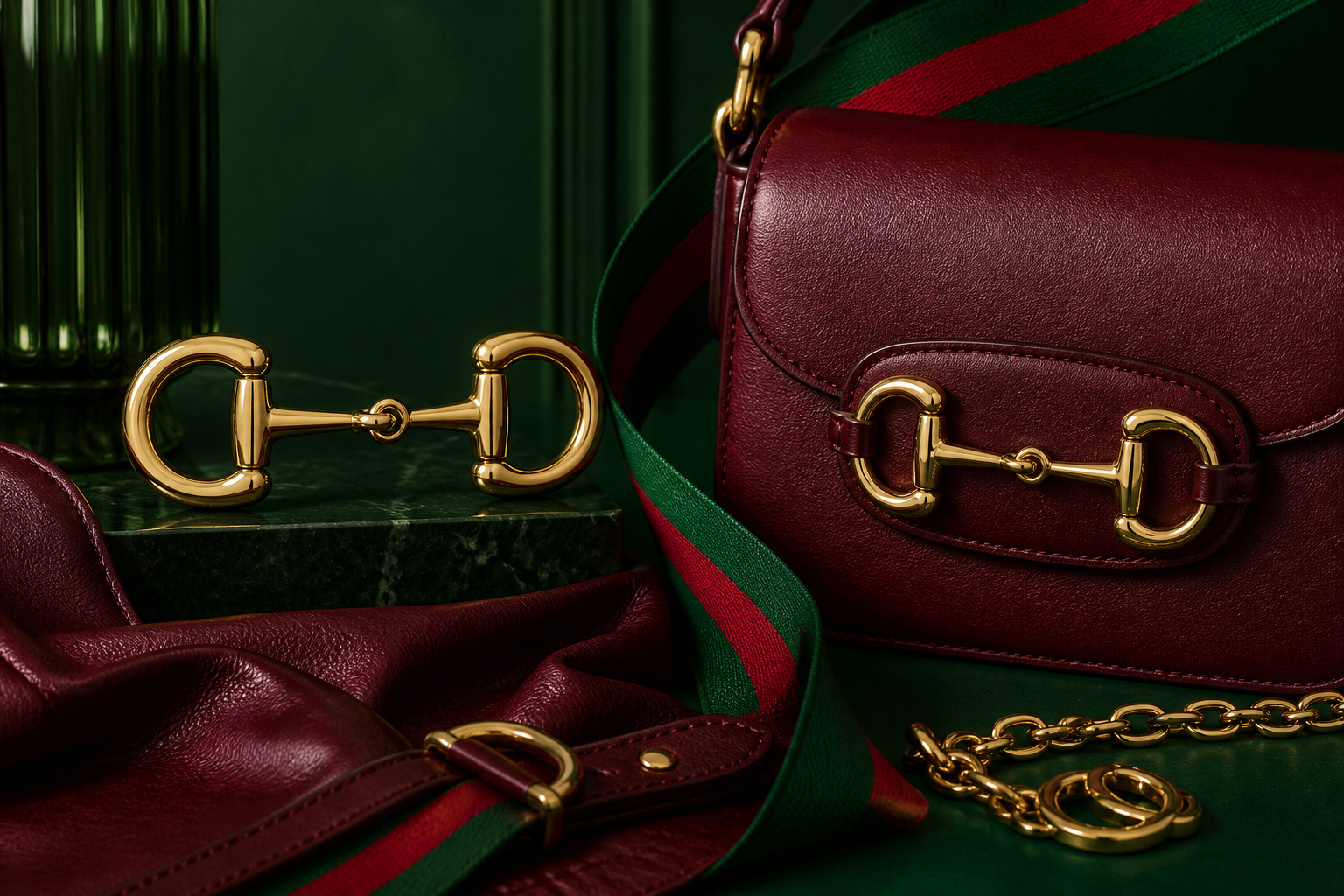
“Gucci remains influential not because it repeats one aesthetic. The house has created a compact archive of forms and signs that can be translated again and again into the language of a new era: from the bamboo handle and Horsebit to Tom Ford velvet, Alessandro Michele’s historical collage and Demna’s radical revision of heritage.”
Editorial thesis
Gucci's longevity is not due to a single family legend, the GG logo, or a single "brilliant" designer. The house has built a system of controlled contradictions: Florentine craft and international jet set, the practicality of luggage and decorative excess, equestrian accessories and pop culture, minimalism and maximalism, heritage and a deliberate break with it. Bamboo, Horsebit, Web, GG, Flora and Jackie form an archive that different creative directors have transformed into fundamentally different versions of modernity.
Reader question
How did a small Florentine travel store survive international expansion, devastating family conflict, changes in ownership and several radically different creative eras to become one of the main symbols of Italian luxury?
To trace Gucci as a history of design, craft, brand management and cultural translation. The article separates documented events from later brand mythology, identifies the contributions of the family, managers and designers, and explains why the same codes can function within radically different aesthetic systems.
The main object is the Gucci house: travel items, leather goods, shoes, ready-to-wear, accessories, jewelry, watches, beauty, spaces and cultural projects.
The chronology runs from Guccio Gucci’s birth in 1881 and the founding of the house in 1921 to the brand’s position as of 5 August 2026.
Family conflicts are considered only where they have changed ownership, management, product quality or the public mythology of the house.
The article is not a catalog of all collections and bags. Included are objects and shows that changed the visual language, product system or positioning of Gucci.
The official history of Gucci is used as the primary institutional source, but language about the origin of the codes is verified against museum, business, and independent publications.
The concept of "icon" is used as a designation of a stable brand code, and not as a neutral assessment of artistic value.
Financial figures are drawn only from Kering’s public reporting and are always dated to a specific period.
No image is embedded without an identified rights holder, licence, credit, alt text and a specific connection to the subject.
Short answer
Gucci was founded by Guccio Gucci in Florence in 1921 as a workshop and store for travel goods. In the post-war decades, his sons turned the family enterprise into an international luxury brand: Bamboo, Horsebit, Web, GG, Flora and the bag later known as Jackie all emerged. Excessive licensing and family conflict weakened the house in the 1970s and 1980s, while Maurizio Gucci’s sale of the remaining family stake to Investcorp in 1993 ended the family’s ownership. Dawn Mello, Domenico De Sole and Tom Ford rebuilt the brand in the 1990s; in 1999 Gucci entered the orbit of PPR, the future Kering. Frida Giannini developed a more commercial interpretation of its heritage, Alessandro Michele turned the archive into a maximalist cultural universe, Sabato De Sarno attempted to restore visual discipline, and since 2025 Demna has been re-editing the house’s entire vocabulary. As of 5 August 2026, Gucci is led by President and CEO Francesca Bellettini, with Demna defining its artistic direction. [1][2][19][20]
Before 1921: Savoy, Florence and the culture of baggage
1921: foundation of the house and the Florentine quality model
Material as strategy: canvas, Diamante and the scarcity of leather
Bamboo 1947: a limitation turned into code
1953: New York, Horsebit and an international Gucci
1960s: jet set, Jackie, GG, Web and Flora
Ready-to-wear and lifestyle: expansion of the 1970s–1980s
Family system, licenses and loss of control
Investcorp, Dawn Mello and relaunch preparations
Tom Ford and Domenico De Sole: new luxury house model
1999: Gucci Group, PPR and the fight for control
After Ford: Alessandra Facchinetti and Frida Giannini
Alessandro Michele: the archive as an endless contemporary collage
Sabato De Sarno: an attempt to bring back reduction and product
Demna: Gucci as a system of archetypes
House codes: Bamboo, Horsebit, Web, GG, Flora and Jackie
Archives, museums, spaces and cultural infrastructure
Business model and position of Gucci in 2026
Critical Issues: Logo, Appropriation, Diversity and Sustainability
Conclusion: why Gucci can outlive its own versions
Appendices: chronology, leadership periods, fact register, glossary, media plan, sources and release checklist
Gucci is often described in extremes. For some it is synonymous with impeccable Florentine leather goods, for others it is logomania, sexuality of the 1990s, maximalism of the 2010s or public family drama. All these ideas relate to one house, but none of them explains it completely.
Unlike couture houses founded around an authorial system of cutting, Gucci took shape around objects made for movement: suitcases, travel bags, gloves, belts and accessories. Its original object was not a dress but a container; not a runway novelty but a synthesis of function, material and social sign. This logic later expanded into footwear, clothing, interiors and cultural projects.
Gucci’s defining quality is its ability to turn historical limitations into visual advantages. A shortage of leather led to canvas and unconventional materials; a metal element from horse tack became the ornament of a loafer; family initials became a repeatable surface; a botanical scarf became a world in its own right. Gucci’s history can therefore be read as the history of a design system, not merely a sequence of biographies.
1. Before 1921: Savoy, Florence and the culture of baggage
Guccio Gucci was born in Florence on March 26, 1881. According to the modern official history of the house, as a young man he worked as a porter at London's The Savoy Hotel, overseeing the luggage of wealthy international guests. Gucci links this experience with the founder's future interest in travel, the quality of materials and the social language of things. It is important to label this connection as the institutional history of the brand itself: it plausibly explains its mythology, but should not replace independent research into the early biography. [1][3]
At the end of the nineteenth century, London gave the young worker a view of a new international elite. A suitcase or travel bag was no longer merely protection for possessions: it communicated class, route, habits and a level of service. In design terms, luggage brought together architecture, joinery, textiles, leather, metal and personalisation.
After returning to Florence, Guccio worked in an environment where the traditions of Tuscan leather craft were strong. Gucci's later brand formula - a combination of English elegance and Italian craftsmanship - simplifies a complex history, but accurately describes the tension on which the house's early identity was built: an international dream expressed through local production.
2. 1921: foundation of the house and the Florentine quality model
The canonical founding date of Gucci is 1921. Guccio Gucci opened a store in Via della Vigna Nuova 7 in Florence, focusing on travel items and leather goods. This date is confirmed by the modern history of Gucci, Kering and the museum attribution of The Metropolitan Museum of Art. [1][2][9]
In some old publications and museum descriptions, 1906 or 1923 is found. For VANSMITHLAB, 1921 remains the main year because it is consistently used by the house and the brand owner as the date of institutional founding. Earlier dates can be interpreted as a possible prehistory of Guccio's commercial activities, but should not be confused with the establishment of the house in its stable organizational form.
Early Gucci was not a ‘fashion house’ in the modern sense. It sold objects whose value depended on workmanship, durability and service. This is why later Gucci fashion repeatedly returns to the language of craft: handle, seam, lock, lining and surface. Its legend of luxury was formed not around an inaccessible idea, but around an object expected to withstand real use.
3. Material as strategy: canvas, Diamante and the scarcity of leather
In the late 1930s, Gucci expanded its use of durable canvas. The official chronology associates the diamond-motif Diamante fabric with this period, one of the house's earliest recognizable designs and a precursor to the later monogram fabric. [1]
Material change cannot be explained through aesthetics alone. The interwar economy, import restrictions and wartime shortages forced Italian businesses to seek alternatives to traditional leather. Gucci experimented with fabric, hemp, wood and other materials. These solutions later became evidence of the ‘ingenuity of the house’, but they began as responses to the availability of raw materials.
This point is important for understanding Gucci: luxury here is formed not only by the price of rare material. It can arise from the precision of processing of ordinary materials, complex fittings and the ability to make a technical solution recognizable. Canvas allowed the brand to create a repeatable surface - the future basis for a strong graphic identity.
4. Bamboo 1947: a limitation turned into code
In 1947, the house introduced a bag with a curved bamboo handle, today known as the Gucci Bamboo 1947. The handle is formed by heating and bending individual sections of bamboo over a flame, so each item retains subtle differences. [2][4]
Bamboo was an unusual choice for European luxury leather goods. Its use is often explained by the post-war shortage of materials. The official story also cites an internal legend about one of Guccio's sons' love for walking sticks. These explanations do not contradict each other, but have different status: the first refers to the economic context, the second to the branded oral tradition.
From a design perspective, Bamboo matters because its handle does not conceal the limitation but makes it the central visual event. A rigid arch opposes a soft body; a natural surface, treated leather; an artisanal gesture, the serial name of a model. The house subsequently changed the bag’s scale, proportions and construction many times, while preserving the recognisable handle as a minimal unit of identity.
5. 1953: New York, Horsebit and an international Gucci
The year 1953 marked a turning point: Gucci opened its first New York store and introduced the loafer with metal Horsebit hardware. Guccio Gucci died that same year, leaving the house’s further development to his sons. [2][5]
Horsebit consists of elements reminiscent of the bits of a horse harness. It transforms a functional metal form into a decorative sign. It is important not to oversimplify the story to the point that Gucci was originally a saddle manufacturer: it is safer to say that the post-war house purposefully embraced the visual language of the equestrian world, associated with aristocratic leisure and international elegance.
The loafer was a particularly effective product for expansion. It combined Italian manufacturing, American informality and recognizable fittings. Unlike a complex seasonal look, these shoes could last for decades, change materials and retain their shape. Horsebit became not just decor, but a system: later the motif appeared on bags, belts, jewelry and clothing.
The purchase of Palazzo Settimanni in Florence in 1953 gave the house a production base that later became an archive. This space shows that Gucci's growth was both geographical and institutional: New York created the market and public image, Florence preserved the craft and documentary memory. [1][8]
6. 1960s: jet set, Jackie, GG, Web and Flora
In the 1950s and 1960s, Gucci entered the international jet set culture. Hollywood actors, aristocrats, politicians and wealthy travelers turned the house's products into part of their public image. It was during this period that most of the codes that are today perceived as “eternal” were formed, although each has a separate and not always fully documented history.
The predecessor of the Jackie 1961 bag appeared in the early 1960s and was associated with the image of Jacqueline Kennedy Onassis, who repeatedly wore a similar model. The modern name emphasizes this association. The article should distinguish between the date of construction, public communication with the client and the later establishment of the marketing name. [1][7]
The GG monogram turned Guccio Gucci’s initials into ornament. Different sources associate its development with Aldo Gucci and post-war international expansion. The dates of its various forms are not consistent, so it is more accurate to say that the monogram took shape and became widespread during the 1960s than to assign it a single moment of invention.
The green-red-green Web stripe also refers to equestrian equipment and has become a way to brand a product without a full monogram. Its strength lies in its simplicity: the color rhythm is easily transferred from a bag to clothing, shoes, a belt, packaging or interior design.
In 1966, Rodolfo Gucci commissioned the artist Vittorio Accornero de Testa to create a silk scarf for Grace Kelly, Princess of Monaco. This is how Flora was born - a composition of about 27 types of flowers and many individual shades, associated with Florentine botany and the image of Botticelli's “Spring”. Initially, a single gift became a repeatable code, and in 1981 it became the basis of the collection at Sala Bianca. [6]
7. Ready-to-wear and lifestyle: expansion of the 1970s–1980s
Gucci began producing ready-to-wear in the mid-1960s, and in 1972 opened a separate clothing store in New York at 699 Fifth Avenue. In the 1970s, the house presented collections and expanded its range far beyond luggage: from umbrellas and games to sports items, pet products and decor. [1]
Expansion followed logically from the strength of the name. Clients could not only travel with Gucci, but dress in it, furnish their homes with it and make the brand part of an everyday environment. This model anticipated the modern luxury lifestyle, in which a house sells not one product category but an entire world.
In 1981, Gucci showed a collection centered around Flora at Sala Bianca at Florence's Palazzo Pitti. The event symbolically cemented the transition from a manufacturer of accessories to a participant in the fashion system. However, the expansion also created a risk: the more categories, licenses and logo variations, the more difficult it was to control quality and rarity.
8. Family system, licenses and loss of control
After the death of the founder, the house developed as a family structure in which sons and grandsons combined property, management of markets and personal ambitions. Aldo, Rodolfo and other family members made significant contributions to international expansion, but by the 1970s and 1980s the distribution of power became a source of conflict.
The problem was not limited to scandal. Broad licensing increased the brand’s presence but weakened product control. The logo appeared on goods of uneven quality, while easy availability undermined exclusivity. Gucci faced a classic danger of the luxury business: short-term revenue from circulating a sign can destroy the sign’s long-term value.
In 1988 the investment company Investcorp acquired a substantial stake in Gucci. In 1993 Maurizio Gucci sold it the remaining shares, bringing the founder’s family ownership to an end. His murder in 1995 became a major episode in popular culture, but for design history the organisational outcome matters more: the brand was separated from the family and could be rebuilt by professional management. [11][12]
This transition should not be described as simply replacing the “chaotic family” with the “efficient corporation.” The family created the product, the network, the archive, and most of the code. The corporate structure, in turn, provided product discipline, capital resources and a new system of creative leadership.
9. Investcorp, Dawn Mello and relaunch preparations
In 1989 Maurizio Gucci invited Dawn Mello, known for her work at Bergdorf Goodman, to help restore the brand to the highest tier of luxury. Her remit included reducing dilutive licences and reassessing stores, product and visual language. In 1990 Mello recruited the young American designer Tom Ford, initially for the women’s line. [10]
Gucci’s relaunch is often attributed to Ford alone, but it resulted from distributed work. Mello established a strategy of reduction and quality; Domenico De Sole later built the financial and commercial system; Ford created a compelling image of desire. Without managerial discipline, provocative aesthetics could not have become a sustainable business model.
Early collections in the early 1990s sought a balance between the archive and new fashion. The change occurred under conditions of limited resources and was not immediate. This period is important as proof that the revival of a heritage brand does not begin with an advertising campaign, but with a clearing of the assortment, control of sales channels and a clear definition of what the client should pay for.
10. Tom Ford and Domenico De Sole: new luxury house model
Tom Ford became Gucci’s creative director in 1994. Together with CEO Domenico De Sole, he transformed a weakened brand into one of the defining fashion companies of the 1990s. Kering identifies Ford as the house’s first Creative Director, while museum collections and fashion histories connect his era with the restored commercial power of luxury and the designer’s new role as author of an entire public image. [2][9][10]
Ford's aesthetic was built on a controlled sexuality: velvet suits in rich colors, silk shirts, exposed bodies, precise evening dresses, polished surfaces and advertising images that teetered between luxury and provocation. The Met characterizes his 1996-1997 suiting as a reimagining of the sensual culture of Studio 54, and his evening ensembles as a modern reworking of historical lines from the 1930s and 1970s. [9]
Ford did not abandon Gucci’s heritage; he edited it. Horsebit, Bamboo, loafers and the monogram returned, but within a visual system of the nocturnal city, the body and glossy modernity. The archive ceased to function as proof of age and became material for desire.
Equally important is De Sole's business architecture. Gucci tightened its control over retail, cut unprofitable licenses and built consistent global communications. This combination became a model for subsequent luxury conglomerates: a strong creative director is responsible not only for the clothes, but for the product, the store, advertising, celebrities and the cultural tone of the brand.
The Ford period ended in 2004 after disagreements with the new controlling shareholder over issues of autonomy and control. His departure showed the dual nature of the “star designer”: personal authorship can dramatically increase the value of a house, but at the same time creates the risk of a brand becoming dependent on one public figure.
11. 1999: Gucci Group, PPR and the fight for control
In the late 1990s, Gucci found itself at the center of a struggle between luxury groups. LVMH increased its stake in the company, and François Pinault, through PPR, acted as an alternative investor. In 1999, PPR acquired a significant stake in the Gucci Group; the structure later became part of the future Kering. [13][14]
The deal changed more than just the property. The Gucci Group evolved into a platform that brought together multiple houses and could finance international development, real estate, advertising and acquisitions. Thus, the brand created by a family of artisans found itself at the center of the formation of a modern system of luxury conglomerates.
For Gucci, being part of a group provided stability but raised questions about autonomy. In subsequent years, each creative period existed within a larger financial structure, where the collection was judged simultaneously on artistic influence, leather goods sales, store productivity and ability to maintain global desirability.
12. After Ford: Alessandra Facchinetti and Frida Giannini
After Ford’s departure, the house divided creative responsibility among several designers. Alessandra Facchinetti briefly led the women’s line, John Ray the men’s line, while Frida Giannini oversaw accessories. The transition revealed how difficult it is to replace a unified authorial system with a set of separate roles.
In 2006 Frida Giannini became Gucci’s sole creative director. She shifted the emphasis from Ford’s nocturnal provocation towards a lighter, bohemian and archival version of Italian luxury. One important early gesture was the return of Flora: reintroduced to accessories in 2005, the motif became a commercial success. [1][6]
The Giannini period is often underestimated because of the Michele visual revolution that followed. However, it was then that Gucci systematically developed bags, shoes, men's direction, jewelry and global flagships. Giannini showed that the archive can work not only as a dramatic quotation, but also as a stable commercial language.
Her departure in 2014–2015 coincided with the need to find new cultural tension. The house retained its scale, but its visual image became predictable. In luxury, predictability is safe for the product, but dangerous for attention—the resource on which desire depends.
13. Alessandro Michele: the archive as an endless contemporary collage
In January 2015 Alessandro Michele, who had worked within Gucci for many years, became creative director. His first men’s show was assembled to a compressed timetable and immediately changed the brand’s image: soft silhouettes, vintage fabrics, embellishment, historical quotations and blurred gender boundaries replaced the previous polished sexuality. [15]
Michele handled the archive not as a restorer, but as a collector. GG, Web, Flora, Horsebit, animals, ancient inscriptions, library images, pop culture and religious motifs existed simultaneously. His Gucci offered not just one correct era, but the idea of a time in which the past constantly returns in new combinations.
This method coincided with the visual culture of social networks. The detail, accessory and stylized character were easily distributed separately from the show. The store became a cabinet of curiosities, the campaign became a film story, and the collection became the basis for an endless number of images. Museum attribution for Look 48 Fall/Winter 2017–2018 captures the period's signature layering of materials, embellishments, and historical references. [16]
The commercial growth of Gucci under Michele and CEO Marco Bizzarri has proven that maximalism can become mass-readable if it is based on strong codes. At the same time, the problem of saturation arose: when every thing is a quotation, the unexpected gradually turns into a familiar formula.
Michele’s departure in November 2022 ended one of Gucci’s most influential eras. His legacy lies not only in individual collections, but in changing luxury’s relationship with gender, vintage, the archive, casting and cultural eclecticism.
14. Sabato De Sarno: an attempt to bring back reduction and product
In January 2023, Kering appointed Sabato De Sarno as creative director of Gucci. His debut took place in September of the same year. The mandate covered women's and men's clothing, leather goods, accessories and lifestyle. [17]
De Sarno offered a sharp departure from Michele's encyclopedic maximalism. Ancora red, short proportions, coats, hoodies, leather and more discreet bags created a language of straightforwardness and urban wardrobe. Strategically, this was an attempt to once again make the product the main carrier of desire, rather than an element of a complex mythology.
The problem was that the visual reduction coincided with a weakening of the global luxury market and an internal restructuring of Gucci. The new language needed time to develop recognizable products, while the business expected a quick recovery. In February 2025, Gucci ended its collaboration with De Sarno; the transitional period collections were prepared by the design studio. [18]
This short period is important as an example of the mismatch between the creative cycle and financial time. A design system typically takes several seasons to create repeatable codes, whereas a public company evaluates changes on a quarterly basis.
15. Demna: Gucci as a system of archetypes
On March 13, 2025, Kering announced Demna as artistic director of Gucci, starting in July. After a decade at Balenciaga, he was given the task of not just creating a new style, but redefining one of the most famous luxury brands in the world. [19]
The first public expression was La Famiglia, a set of character archetypes introduced in 2025 through the lookbook and short film The Tiger. Instead of a linear collection, Demna proposed the Gucci “family”: La Bomba, La Contessa, Incazzata, Flora and other figures, each of which embodied a separate version of the brand - bourgeois, sexy, eccentric, archival or everyday.
Demna's first full runway show for the house, Gucci Primavera, took place at Milan Fashion Week in 2026. Official communications marked it as the beginning of a new chapter; beauty and styling combined references to the 1970s and 1990s with modern proportions. [21]
Demna’s method differs from Michele’s. Michele accumulated references and created a world without a single centre. Demna classifies the brand, isolates its stereotypes and turns them into lucid characters. It is almost a curatorial operation: not the addition of one more historical layer, but a decision about which versions of Gucci resonate most strongly today.
As of August 5, 2026, it is too early to assess the long-term outcome. It is correct to record the direction, first collections and public documents, but not to declare the era successful or unsuccessful until stable product and financial dynamics emerge.
16. House codes: Bamboo, Horsebit, Web, GG, Flora and Jackie
Gucci doesn't have a single silhouette comparable to Dior's New Look. Its identity is modular: small, recognizable elements can exist across different categories and under different artistic directors. This modularity is one of the reasons for the brand's sustainability.
Bamboo is a code of material and an artisanal gesture. Even without a logo, the curved handle communicates the house through the contrast between nature and workmanship. Horsebit is a code of hardware: a technical detail becomes ornament and travels between shoes, bags and jewellery. Web is a code of colour and rhythm that remains legible at a distance.
GG is a code of graphic repetition. It makes the surface a bearer of the name while creating the problem of excess: the more visible the monogram, the stronger the brand, but the greater the risks of copying, fatigue and a loss of rarity. Different eras therefore either intensify GG or remove it almost entirely.
Flora is a code of image and narrative. Unlike the geometric monogram, it carries a specific authorial history, a botanical world and a connection to Florentine art. Jackie is a code of social recognition: the bag’s form gains additional meaning through its association with a public figure and through repeated reissues.
The system works by combining different levels of visibility. The client can choose the obvious GG canvas, the discreet Horsebit loafer, or the almost anonymous leather item that only those familiar with the construction will recognize. Gucci simultaneously caters to conspicuous and hidden consumption.
17. Archives, museums, spaces and cultural infrastructure
Palazzo Settimanni, acquired by Gucci in 1953 as a production space, today serves as the house's archive. Its function goes beyond storage. The archive becomes a working infrastructure: designers study samples, shapes, fabrics, advertising materials and technical documents, and the brand receives a source of verifiable continuity. [8]
In Florence, Gucci Garden combines exhibition, shopping and gastronomic functions. Such spaces translate the brand story from text to route: the visitor sees the object, interior, image and commercial product as parts of one system.
In 2021, for the centenary of the house, Gucci intensified its work with its own history; subsequent projects, books and exhibitions continued the institutionalization of the archive. This is an important trend in luxury: heritage no longer exists only in advertising legend, it turns into a cataloged asset, a museum narrative and a source of future products.
However, the archive is not neutral. The selection of objects, the names of the “icons” and the exhibition scenario form a convenient version of the past. Therefore, VANSMITHLAB must collate the archival narrative with museum collections, business records, and independent criticism.
18. Business model and position of Gucci in 2026
Gucci belongs to Kering and remains the group’s largest brand. Francesca Bellettini was appointed President and CEO of Gucci in September 2025; Demna has defined its artistic direction since July 2025. [19][20]
Public reporting shows that this aesthetic transition is occurring amid a major business restructuring. In the first half of 2026, Gucci generated revenue of €2.757 billion, down 9% as reported and 5% on a comparable basis. Performance improved markedly in the second quarter; recurring operating income for the half-year was €468 million, representing a margin of 17.0%. These figures describe one particular period and should not be read as a definitive judgement on Demna, whose products were only beginning to reach the market. [22]
Gucci’s business rests on leather goods, footwear, ready-to-wear and accessories distributed through its own global network. Control of retail allows the house to manage prices, assortment and experience, but demands high fixed costs. When demand falls, the scale of the network becomes both an advantage and a burden.
In 2026 the house must synchronise three time horizons: the rapid cultural signals of a new creative era, the slower development cycle of leather goods, and the financial need to restore sales and margins. Gucci’s history shows that a durable turnaround occurs when all three support one another, as they did under Ford and De Sole—not when communication attempts to substitute for product.
19. Critical Issues: Logo, Appropriation, Diversity and Sustainability
The monogram gave Gucci global recognition and at the same time made it one of the main objects of counterfeiting and unofficial reinterpretation. In the 1980s, Dapper Dan in Harlem turned fabrics with luxury logos into clothing for musicians and athletes, creating a language that European houses had long rejected. In 2017, Gucci was criticized for a look that was close to Dapper Dan's famous work; the subsequent collaboration and opening of his atelier with the support of Gucci was an attempt to move from unilateral borrowing to recognition and partnership. [24][25]
This case shows that authorship in fashion is not limited to legal ownership of the mark. A subculture can change the meaning of a logo so much that the official brand begins to borrow from people who were previously persecuted by the intellectual property system.
Another question concerns racial and cultural failures within a global company. Individual Gucci products and campaigns have drawn criticism; the brand’s response has included diversity initiatives and Gucci Changemakers. A neutral article must neither reduce the problem to one scandal nor treat a corporate programme as proof that a systemic issue has been resolved.
Sustainability also requires a distinction between claim and outcome. Gucci and Kering are developing the Circular Hub to advance recycled materials, repairability and circular Made in Italy processes. It is a significant infrastructure initiative, but it does not erase the impact of global production, raw materials, logistics and the continual renewal of collections. [23]
A critical account of Gucci must retain a double perspective: the house creates genuine craft knowledge, employment and cultural images, but operates within an industry where exclusivity is sustained by growth, the continual obsolescence of desire and unequal access to symbols of status.
20. Conclusion: why Gucci can outlive its own versions
Gucci evolved from a store for travel goods into a global house because its identity has never depended on a single category. It can transfer meaning among material, hardware, logo, celebrity, show, space and archive.
The family era created the codes and international network. The corporate relaunch of the 1990s demonstrated the power of combining design with management. Ford made Gucci a language of controlled sexuality; Giannini stabilised the commercial use of the archive; Michele turned the brand into a cultural collage; De Sarno tested the possibility of reduction; Demna began classifying and dramatising the house’s multiple identities.
Therefore, the “real Gucci” cannot be reduced to one period. True continuity lies deeper than the stylistic surface: in the ability to recognize several stable signs, destroy the usual way of connecting them and assemble a new system of desire.
The house’s future depends not on the number of archival quotations, but on the quality of their reinterpretation. A code retains force only when it answers a contemporary need—functional, emotional or cultural. Used as an empty emblem of the past, heritage becomes decoration. When its constructive logic is understood and rethought, the brand becomes contemporary once more.
Sections 1–7 are based primarily on the official Gucci and Kering chronology, verified against museum attributions. Official histories are reliable for dates of institutional events and names of current products, but can simplify causality and romanticize the origins of codes. Sections 8–15 use independent business and museum sources for property history and creative direction. Section 18 contains only dated figures for Kering's public reporting. Interpretations about the design system, contradictions and cultural translation are an editorial synthesis of VANSMITHLAB and should not be presented as Gucci quotes.