research
The History of the Hermès Fashion House
How a Parisian harness workshop turned function, material, manual skill and control of time into one of the most resilient systems in modern luxury
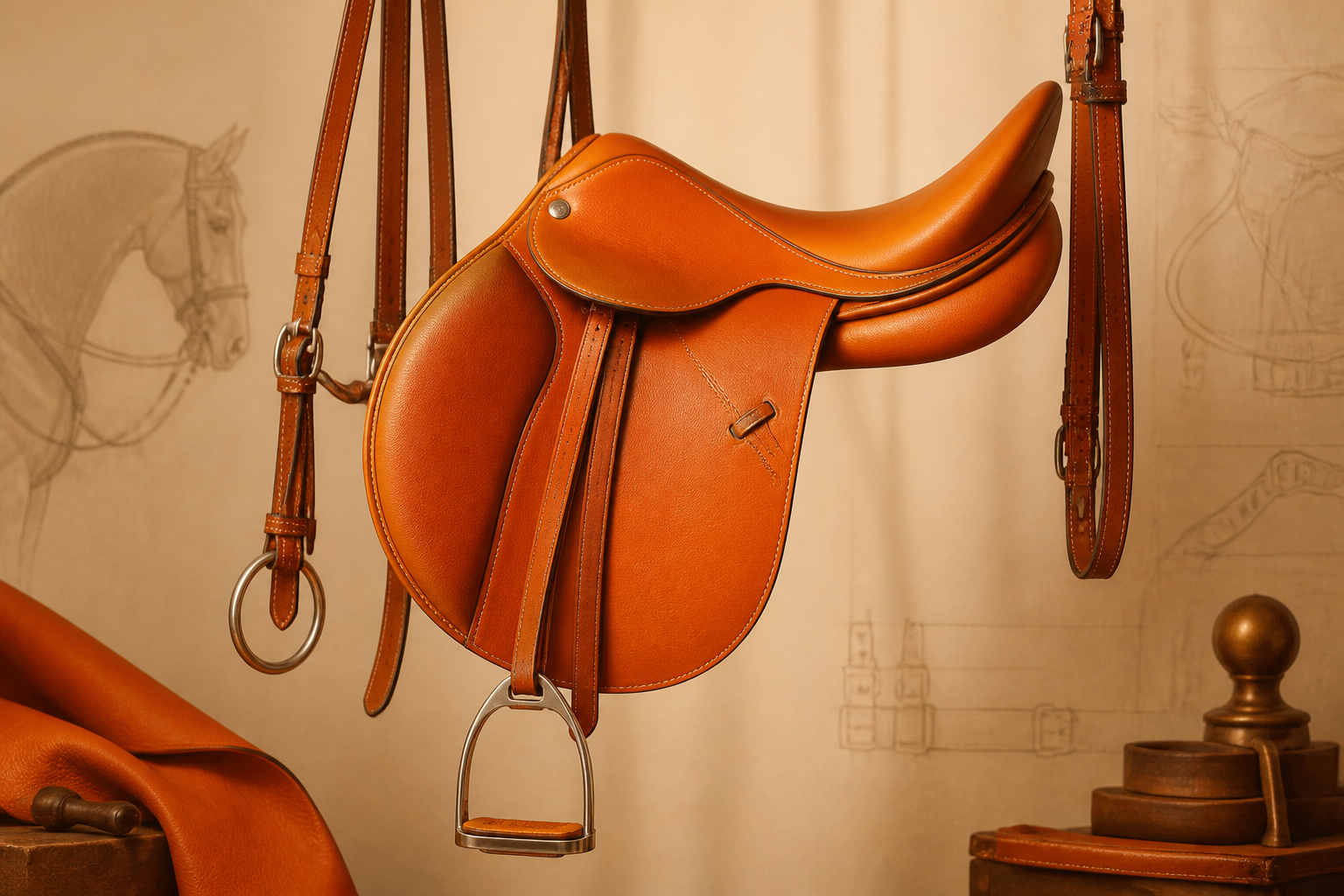
“Hermès has retained its influence not because it turned its equestrian history into a decorative legend. The house built a system in which the origin of form can be read through function, quality through material and the maker’s gesture, and modernity through an old skill’s capacity to answer a new way of life.”
Editorial thesis
Hermès’s longevity cannot be explained by a single scarce handbag or by mastery of hand stitching. The house has consistently translated the original logic of saddlery—precise fitness for purpose, respect for material, repairability and the maker’s personal responsibility—into new categories: travel goods, clothing, silk, watches, jewellery, interiors, fragrance and beauty. Its history shows how craft becomes not the opposite of modernity, but an infrastructure for controlled renewal.
Reader question
How did the harness workshop opened by Thierry Hermès in Paris in 1837 become an independent family-owned luxury house whose bags, silk scarves, clothes and objects for the home are understood at once as functional things, status symbols and cultural objects?
To trace Hermès through the history of mobility, materials, production organisation, artistic direction and distribution control. The material separates verified events from corporate legend, explains the role of key objects without advertising language, and connects the house’s visual codes with its craft and business model.
The principal subject is the Hermès house and brand: saddlery, leather goods, silk, ready-to-wear, watches, jewellery, fragrance, beauty, home and their associated spaces and communications.
John Lobb, Puiforcat and Saint-Louis are considered only in relation to the expansion of Hermès’s craft portfolio; their independent histories require separate entries.
The chronology runs from 1837 to the position of the house as of 5 August 2026.
Hermès’s official chronology is used as a primary institutional source. Where it constructs a product’s origin story, the wording retains attribution and does not substitute for independent archival verification.
The names Kelly, Birkin and Bolide are analysed as historical objects and construction systems, not as purchase recommendations or investment assets.
Financial figures are given with a date and reporting period; market capitalisation and secondary-market prices are not used as measures of cultural significance.
Disputes over access to the Birkin, the use of exotic skins and environmental claims are presented with their source, the status of the allegation and the company’s response; claims made in litigation are not presented as proven facts.
No image is embedded without an established provenance, rights holder, permitted mode of use, caption, credit and alt text.
Short answer
Hermès was founded in Paris in 1837 as a harness workshop. The house grew by following changes in transport and everyday life: from saddles and travel bags to the zip, the silk carré, clothing, watches, fragrance and objects for the home. Its influence rests on a rare combination of family control, integrated production, lengthy craft training, artistic freedom within individual métiers and a predominantly proprietary retail network. The Birkin and Kelly became global symbols, but they are products of a wider system in which an object is designed to be used, to age, to be repaired and to be passed on. [1][2][3]
Before 1837: Paris, the carriage and the technical culture of movement
1837: Thierry Hermès’s workshop on rue Basse-du-Rempart
1867–1880: recognition of the craft and the move to 24 Faubourg Saint-Honoré
From horse to automobile: Émile Hermès and a changing way of life
1922–1928: the zip, the Bolide and the first new métiers
1937: the carré, a square of silk as a wearable archive of drawing
Robert Dumas: the Kelly, Chaîne d’ancre and the language of functional elegance
The orange box, the carriage emblem and visual identity
1960–1978: window displays, womenswear and Le Monde d’Hermès
Jean-Louis Dumas: international expansion and the culture of the object
1984: the Birkin and the transformation of a utilitarian bag into a social symbol
Women’s ready-to-wear: from Catherine de Karolyi to Nadège Vanhée
Men’s ready-to-wear: Véronique Nichanian’s 37 years and the transition to Grace Wales Bonner
Sixteen métiers: how the house expands without a single head designer
24 Faubourg, Pantin and architecture as a culture of production
The shop, the window, the magazine and the website as Hermès media
Family independence, governance and the conflict over LVMH’s stake
2008–2021: the Fondation, petit h, Apple Watch, Beauty and the school of crafts
Hermès codes: the saddle stitch, leather, hardware, colour, humour and the annual theme
The business model and Hermès’s position in 2026
Critical questions: scarcity, access, the secondary market, animal materials and sustainability
Conclusion: why Hermès remains contemporary
Appendices: chronology, governance and creative periods, fact register, glossary, media plan, editorial constraints, sources and release checklist
1. Before 1837: Paris, the carriage and the technical culture of movement
In the first half of the nineteenth century, the horse formed part of urban infrastructure. Carriages carried people, goods and post; the quality of a harness affected not only appearance but safety, manoeuvrability and the animal’s condition. The saddler worked at the intersection of several disciplines, understanding the properties of leather and metal, equine anatomy, load distribution, the movement of a carriage and the client’s social code.
Harness was visible engineering. It had to withstand tension, avoid chafing the animal, allow movement to be controlled and suit the scale of the carriage. A client’s wealth could appear in the finish, but no ornament could conceal poor construction. This union of practical necessity and visual precision became the foundational culture of the future Hermès.
The house’s later phrase, the “aesthetics of function,” is not a retrospective embellishment of its history. In saddlery, form genuinely grows from use. The saddle stitch, leather edges, buckles, loops and straps read simultaneously as technical solutions and a graphic language. When the horse ceased to be the principal form of urban transport, that language did not disappear: it migrated into luggage, bags, shoes, clothing and jewellery. [1][21]
2. 1837: Thierry Hermès’s workshop on rue Basse-du-Rempart
The house’s official history begins in 1837, when Thierry Hermès opened a harness workshop on rue Basse-du-Rempart in Paris. Hermès describes its early products as light, restrained and durable—qualities suited to changing urban mobility. The workshop’s work received an award at the Paris Universal Exhibition of 1867. [1]
The founding date matters as more than the start of a family line. Hermès emerged before the modern fashion industry, seasonal ready-to-wear and mass advertising. Its original product was a made-to-measure tool intended for prolonged use. The ideas of a “collection,” a “fashion image” and a “brand” entered the house’s history considerably later than its material discipline.
Six subsequent generations of the family developed the company under different economic conditions, but the early model left several lasting principles: proximity between design and manufacture; a high cost of error; forms tied to specific uses; the possibility of servicing an object; and a reputation founded on repeatable quality rather than a single public success.
3. 1867–1880: recognition of the craft and the move to 24 Faubourg Saint-Honoré
Thierry Hermès’s son Charles-Émile continued the business. In 1880, the workshops moved to 24 rue du Faubourg Saint-Honoré, where a shop opened. Bespoke saddles and harnesses were made at the address; it became not merely a sales point, but a meeting place for client, maker, archive and the house’s future categories. [1]
Faubourg Saint-Honoré connected craft with the geography of Parisian power, commerce and taste. Yet the address meant something different to Hermès from an ordinary flagship. For many years production took place directly above the shop. The customer saw the result, while the organisation preserved physical proximity between order and manufacture.
In the twenty-first century, 24 Faubourg functions as a symbolic centre: a shop, an archival image, the name of fragrances and designs, a setting for annual windows and a source of architectural motifs. Editorial material should resist turning the address into a mystical formula. Its power is explicable: a rare luxury house has retained the same urban anchor across several technological eras. [1][24]
4. From horse to automobile: Émile Hermès and a changing way of life
The greatest threat to a saddlery house in the early twentieth century was also an opportunity. The automobile was gradually transforming transport, travel and luggage. The company could defend its old market or apply its knowledge of leather, fastenings and loads to new objects. Under Émile Hermès, the house chose the latter path.
The official chronology describes the interwar years as a move from harnesses and saddlery into leather goods. What matters is not diversification itself, but its logic: Hermès did not begin making every fashionable object. It followed the customer’s movement. Objects first served the carriage, then the automobile, train, ship, sport, city and a changing wardrobe. [1]
Émile Hermès also assembled a collection of books, artworks, tools, textiles and historical objects. The Collection Émile Hermès remains an internal source of designs, forms and historical connections. Here the archive operates not as a museum of a completed past, but as a research base from which creators extract a motif, construction or name and translate it into a new object. [1][25]
5. 1922–1928: the zip, the Bolide and the first new métiers
During a trip to Canada, Émile Hermès noticed the American “close-all” system used in automotive equipment. In 1922 he obtained exclusive rights to use it; the system now known as the zip began to appear in the house’s luggage. [1]
The Bolide was created in 1923: a travel object with rounded corners and a zip, designed for motor travel and placement in a car boot. Hermès’s official material calls it the house’s first use of a zip on a bag; broader claims that it was “the first zipped bag in history” should be avoided without separate patent research. [5]
In the years that followed, Hermès opened new fields: a men’s golf jacket in 1925, jewellery in 1927, and watches and sandals in 1928. These dates show the house becoming a system of lifestyle objects long before the post-war luxury conglomerate. Expansion proceeded through categories for which a material or functional competence already existed: leather, metal, strap, movement, fastening and time.
6. 1937: the carré, a square of silk as a wearable archive of drawing
In 1937, Hermès released its first silk carré, Jeu des omnibus et dames blanches. The square format allowed the house to transfer its culture of line from leather and harnesses into a printed image. The scarf can be unfolded as a composition, folded into a fragment of colour, worn on the body or used as a sign of belonging. [1]
The carré changed the scale of the house’s communication. A saddlery object demands close acquaintance with its material; the scarf turns an image into a mobile surface visible from a distance. Equestrian motifs, straps, carriages, botany, architecture, geography and fantastic subjects could coexist within a single wearable archive.
Technically, silk requires its own chain of skills: drawing, colour separation, printing and edge finishing. Hermès continues to invite artists from different generations and cultures, but the right to an image does not remove editorial responsibility. A historical carré must be published with its designer, date, title, technique, image source and permitted mode of use. Records at The Met confirm the presence of Hermès scarves from the 1950s in the Costume Institute collection. [9]
7. Robert Dumas: the Kelly, Chaîne d’ancre and the language of functional elegance
Robert Dumas, Émile Hermès’s son-in-law, took charge of the company in 1951. Before then, he had already contributed to several key house objects: the first carré, the bag later named Kelly, and the Chaîne d’ancre bracelet, inspired by anchor chains in Normandy. [1]
The bag now known as the Kelly was developed in the 1930s. In 1956, a photograph of Grace Kelly carrying the model circulated widely, after which Hermès named the bag for the Princess of Monaco. Three events must be distinguished: the creation of the form, its public association with Grace Kelly and the later adoption of the name. [1][6]
The Kelly shows how the house turns a construction system into an enduring code. The trapezoidal body, flap, straps, turn-lock, padlock and handle can be reduced, enlarged and transferred to other categories while remaining recognisable. This is not merely a silhouette; it is a grammar of details that can be quoted without printing a large logo.
Chaîne d’ancre works similarly. A maritime chain became a jewellery module while retaining its sense of weight and connection. Hermès repeatedly builds design through such transitions: a utilitarian detail becomes ornament without losing the memory of function.
8. The orange box, the carriage emblem and visual identity
Hermès’s visual identity extends beyond its wordmark. The motif of a carriage and waiting groom refers to a painting by Alfred de Dreux in the Collection Émile Hermès and preserves the original scene of service to movement. The owner’s absence is important: the carriage is ready, the groom waits, and the person for whom the object was made remains outside the image.
The orange box did not begin as a deliberately designed global system. In Hermès’s official account, the earlier shades of packaging became unavailable after the Second World War because of paper restrictions, while a supplier could offer orange cardboard. An accidental material gradually became a house sign; Hermès states that the colour became official in 1960. [22]
The story is useful as an example of a constraint shaping identity, but it should be attributed to the house: it is a corporate oral and archival tradition, not an independently reconstructed standard of the packaging industry. The box also expresses Hermès’s duality—a bright exterior conceals an object whose value should reveal itself through material and use.
Bolduc ribbon connects packaging with the annual theme. The house’s communication is thus never wholly detached from the object: the theme moves through windows, events, designs and packaging, creating a temporary layer over permanent codes.
9. 1960–1978: window displays, womenswear and Le Monde d’Hermès
In the early 1960s, Leïla Menchari joined Annie Beaumel in creating the windows at 24 Faubourg. From 1978 to 2013, Menchari independently devised fantastical scenes for the shop, combining Hermès objects with theatre, nature, travel and craft. The window became not a dense product display, but a brief visual novella. [1]
In 1967, Catherine de Karolyi took responsibility for the women’s wardrobe and designed clothing and accessories, including the H buckle, until 1980. The first women’s ready-to-wear did not displace Hermès’s culture of objects: clothing was conceived as an extension of the moving body, leather, buckle and pocket. [1]
Die Welt von Hermès appeared in Germany in 1973; the French Le Monde d’Hermès followed two years later. The publication sits between catalogue, magazine and cultural map. It creates context around objects, but cannot serve as an independent source for evaluating the house: it is a primary corporate media object, valuable for understanding self-description, visual culture and creative collaborations.
10. Jean-Louis Dumas: international expansion and the culture of the object
Jean-Louis Dumas took charge of Hermès in 1978. The official history associates his tenure with geographic expansion, new métiers and a more active connection between heritage and contemporary culture. That same year the watch business was formalised as La Montre Hermès. John Lobb, Puiforcat and Saint-Louis also entered the portfolio while retaining their own names and craft specialities. [1]
Jean-Louis Dumas’s approach differed from a strategy in which a single logo is rapidly extended across licensed categories. Hermès developed internal fields and acquired houses founded on specific know-how. The model is harder to scale, but it preserves cultural distinctions among shoemaking, silverwork, crystal, silk and leather.
International expansion was accompanied by architectural individuality in the shops. Maison Hermès in New York opened in 2000, Renzo Piano’s building in Ginza in 2001 and the Maison in Seoul in 2006. Each translated shared house codes into a local urban fabric rather than reproducing an identical interior. [1]
Under Jean-Louis Dumas, Hermès came to be understood as a “house of objects,” not merely a fashion house. This distinction helps explain why a saddle, cup, watch and dress can coexist: what unites them is not category but an attitude to form, material and use.
11. 1984: the Birkin and the transformation of a utilitarian bag into a social symbol
The official history of the Birkin begins with a meeting between Jean-Louis Dumas and Jane Birkin on a Paris–London flight in 1984. Birkin said she could not find a capacious bag suited to life as a young mother; Dumas sketched a rectangular bag with a flap, saddle stitching and room for everyday possessions. [4]
The Birkin’s construction joins the travel bag with the formal object. It is spacious enough for use, yet its straps, lock and metal hardware slow access and make opening it a ritual. Much of its cultural effect lies in this tension between utility and ceremony.
The Birkin later became a symbol of status, scarcity and the secondary market, but those meanings should not be projected backwards onto the intention of 1984. The history of a product and the history of its social value are different processes. The V&A included Jane Birkin’s first Birkin alongside the Kelly in Bags: Inside Out, examining bags through function, status, identity and production. [8]
The popular claim that the bag is a guaranteed investment should be rejected. Auction prices depend on material, size, condition, provenance, rarity and the market cycle. VANSMITHLAB treats the Birkin as an object of design and cultural economics, not a financial instrument.
12. Women’s ready-to-wear: from Catherine de Karolyi to Nadège Vanhée
Hermès womenswear did not develop under a single unchanging artistic image. Catherine de Karolyi created the house’s early wardrobe; later designers translated its material codes into clothing in different ways. The best-documented turn came in 1997, when Jean-Louis Dumas invited Martin Margiela to lead women’s ready-to-wear. [10]
Margiela’s period, which lasted until 2003, was built on comfort, the mature body, fine materials and concealed construction. His Hermès did not literally reproduce the deconstructive language of his own label. The exhibition Margiela, The Hermès Years showed that the two systems met in precision of cut, bodily freedom and a refusal of conspicuous fashion effects. [10]
Jean Paul Gaultier led the women’s line from 2003 to 2010, heightening its imagery, equestrian quotations and theatrical energy. Christophe Lemaire succeeded him in 2010 and developed a quieter, functional wardrobe until 2014. Hermès appointed Nadège Vanhée-Cybulski in 2014; her first collection was presented in 2015. [11][12]
In 2026, Nadège Vanhée remains artistic director of women’s ready-to-wear. Her work exemplifies the Hermès model: a designer is given a long period in which to develop a language, but does so within a system of materials, workshops and the artistic coordination of Pierre-Alexis Dumas. [3]
The history of the women’s line should not be told as a contest among famous names. More important to Hermès is the continuity of its questions: how does clothing move, where is the fastening placed, how does leather meet fabric, how can colour work without a logo, and how can a wardrobe age more slowly than a seasonal image?
13. Men’s ready-to-wear: Véronique Nichanian’s 37 years and the transition to Grace Wales Bonner
Véronique Nichanian joined Hermès at Jean-Louis Dumas’s invitation in 1988 and shaped men’s ready-to-wear and the broader men’s universe for nearly four decades. Her approach rested on the study of material, colour, technical detail and unforced freedom of movement. Her final collection was presented on 24 January 2026. [13]
The exceptional length of this tenure matters in itself. In an industry where artistic leadership often changes in pursuit of short-term renewal, Nichanian could develop gradual distinctions: the proportion of a shoulder, the weight of leather, an internal finish, a transformable detail, a shade, and the relationship between formal and sports wardrobes.
On 21 October 2025, Hermès announced Grace Wales Bonner as the new creative director of men’s ready-to-wear. Her first collection for the house is planned for January 2027. At the article’s cut-off date, it is therefore accurate to discuss the appointment and transition, but not to attribute the aesthetics of an as-yet unseen collection to Hermès. [14]
The transition is especially significant because Wales Bonner has developed her own practice at the intersection of clothing, craft, music and cultural history. VANSMITHLAB should nevertheless avoid predicting exactly how she will change Hermès menswear. Until the first collection, this remains an open editorial question.
14. Sixteen métiers: how the house expands without a single head designer
In 2026, Hermès describes its system as sixteen métiers: leather goods and equestrian, women’s and men’s silk, women’s and men’s ready-to-wear, footwear, belts, hats, gloves, jewellery, watches, fragrance, beauty, furniture and art de vivre, tableware and petit h. [3]
The house has no single figure who personally designs every category. Pierre-Alexis Dumas is responsible for overall artistic coordination, while individual fields have their own creative or artistic directors. As of August 2026, they include Nadège Vanhée, Grace Wales Bonner, Pierre Hardy, Christine Nagel, Gregoris Pyrpylis, Cécile Pesce, Priscila Alexandre Spring and others. [3]
This structure allows different temporal rhythms to coexist. Fragrance develops differently from a bag; watches require a different engineering from a carré; furniture engages with architecture, while petit h begins not with the market but with the surplus material available. Overall artistic direction establishes compatibility without erasing specificity.
This is an organisational hallmark of Hermès: heritage resides not only in an archive of images but in the distribution of expertise. The house remains resilient so long as it knows who is responsible for form, who for material, who for manufacture and who for transmitting the skill.
15. 24 Faubourg, Pantin and architecture as a culture of production
In 1992, the leather workshops moved from the upper floors of 24 Faubourg to Pantin. The new complex gave makers more light and space; in 2013 it was expanded by the Cité des métiers, which connects buildings and themed gardens. The RDAI project received architectural recognition in France. [1]
The move shows that preserving craft does not mean preserving historical crampedness. Precise handwork requires ergonomics, light, training, logistics, humidity control and the safe organisation of materials. A modern workshop is not a romantic stage set but a technological environment.
In 2025, Hermès opened its twenty-fourth leather-production site in France, the L’Isle-d’Espagnac manufacture, designed ultimately for 260 makers. The official strategy at the end of 2025 cited more than twenty leather workshops grouped around ten regional centres of expertise. [1][2]
The architecture of shops serves another purpose: to create a “home for objects” within a particular city. Renzo Piano’s Ginza building, Maison Madison Avenue and other addresses are not copies of Faubourg. They maintain a recognisable rhythm of materials and light while incorporating local architectural logic. This corresponds to the “multi-local” approach Hermès also applies to store assortments.
16. The shop, the window, the magazine and the website as Hermès media
Hermès controls not only production but much of the context in which an object meets its buyer. More than 92 per cent of 2025 revenue came through a network consisting mainly of units operated by the group. Stores have latitude in purchasing, so different addresses do not carry entirely identical assortments. [2]
This model strengthens the role of the sales adviser and local store director. They do more than execute a central plan, shaping a selection from a large number of references. The advantage is adaptability and a sense of discovery. The risk is opacity in access to the most sought-after objects and the emergence of unofficial ideas about required purchases.
The window, Le Monde d’Hermès and the annual theme create a narrative layer. The e-commerce site launched in the United States in 2002 and France in 2005; the global digital platform was renewed in 2017. The online store does not wholly replace the physical network, but distributes categories and services across different channels. [1]
For VANSMITHLAB, this is an important example of a brand acting as publisher and curator. Corporate media must nevertheless be read critically: they are reliable for dates of in-house initiatives, authors and declared strategy, but do not independently prove cultural superiority or environmental effectiveness.
17. Family independence, governance and the conflict over LVMH’s stake
Hermès remains a public company with an unusual control structure. Official documents state that the group is controlled by the family group through Émile Hermès SAS and the H51 and H2 family structures. In 2026, executive management is led by Axel Dumas; Pierre-Alexis Dumas is responsible for artistic direction. [15][16]
Family control does not automatically guarantee high quality, but it creates the conditions for a long investment horizon. The company can expand training and workshops more slowly than demand grows without transferring critical categories to mass licensees. The model’s limitation is reduced external transparency around internal decisions and a strong dependence on the family’s ability to transmit management.
In the 2010s, independence became the subject of an open corporate conflict after LVMH accumulated a significant stake in Hermès. In 2014, the parties reached an agreement mediated by the President of the Paris Commercial Court: LVMH undertook to distribute its Hermès shares to its shareholders, while affiliated structures agreed to refrain from further acquisitions for a specified period. [17]
This episode matters not as a personal duel between two executives but as a collision of luxury models. A conglomerate builds strength through a portfolio of houses and centralised resources; Hermès defended family control and an autonomous pace. Both models can support craft, but distribute capital, risk and power differently.
18. 2008–2021: the Fondation, petit h, Apple Watch, Beauty and the school of crafts
The Fondation d’entreprise Hermès was created in 2008 to work across artistic creation, the transmission of skills, education, solidarity, biodiversity and environmental preservation. It should be treated as a separate institutional structure with programmes of its own, not as proof of the social value of every commercial product. [1][18]
In 2010, Pascale Mussard launched petit h, a practice of “reverse creation” that begins with unused materials and components from other métiers. The project does not solve the full volume of production waste, but institutionalises a different design sequence: first the available material, then the possible object. [1][19]
Apple and Hermès introduced the Apple Watch Hermès in 2015. The partnership linked a digital device, its interface and strap with the house’s leather expertise. It showed how a historical brand could participate in a fast-renewing technology category without attempting to build the electronic platform itself. [1][20]
Beauty became the sixteenth métier in 2020 with Rouge Hermès. The house transferred its work with colour, packaging materials and refillable elements into cosmetics. The École Hermès des Savoir-Faire opened in 2021, awarding vocational qualifications in leatherwork. The school is crucial to the growth model: a workshop can be built faster than a resilient community of skilled workers can be formed. [1]
19. Hermès codes: the saddle stitch, leather, hardware, colour, humour and the annual theme
The saddle stitch is made with both ends of a single thread passing towards each other through holes in the leather. Hermès stresses its strength: damage to one stitch need not unravel the entire seam. In the house’s visual language, the stitching remains visible and communicates construction rather than being concealed as a purely technical trace. [21]
Leather at Hermès is not a single material. Differences in grain, density, tanning, suppleness and patination change how the same design behaves. A model name without its material therefore describes only part of an object. A research page about a bag needs a separate block for leather, lining, hardware, assembly method, period and condition.
Equestrian codes appear in straps, buckles, stirrups, bridles, chains, pockets and methods of joining. Their force lies not in a literal image of a horse but in structural memory. Even an abstract metal link can read as part of a harness.
The house’s colour system extends far beyond its orange packaging. Carrés, leather, enamel and clothing use complex combinations and unusually named shades. Humour is another constant code: trompe-l’œil, a disproportionate object, a hidden pocket or an unexpected function softens the solemnity of an expensive material.
Since 1987, the annual theme has served as a temporary research framework for different métiers. It does not require every product to look alike; rather, it establishes a shared question that can be translated into a design, window, name, event or packaging ribbon.
20. The business model and Hermès’s position in 2026
Hermès’s official strategy is expressed through three pillars: creation, craft and an exclusive, balanced distribution network. The company emphasises independence, family ownership, vertical integration, proprietary retail and the production of a significant share of its objects in France. [2]
For 2025, Hermès reported revenue of €16.002 billion and recurring operating income of €6.569 billion, equivalent to 41.0 per cent of revenue. First-half 2026 revenue was €8.163 billion, with 27,107 employees at the end of the period. These figures describe economic scale but do not replace analysis of object quality or production conditions. [7]
At the end of 2025, the network comprised 294 stores in 45 countries; more than 92 per cent of revenue came through a network largely operated by the group. Hermès stated that 75 per cent of objects were made in France and 55 per cent in internal and exclusive workshops. Such statements must include the year, since the production structure changes. [2]
Growth is constrained by more than marketing choice. Handwork requires training, workshops, materials, quality control and time. Scarcity is also part of the consumer experience and increases symbolic value. A sound analysis must hold both sides together: the physical limit on productivity and the economic effect of restricted availability.
In 2026 the house is at a transitional point in menswear: Véronique Nichanian’s tenure has ended and Grace Wales Bonner has been appointed, but her first collection is expected in January 2027. Nadège Vanhée continues to lead womenswear, while Pierre-Alexis Dumas provides overall artistic coordination. [3][13][14]
21. Critical questions: scarcity, access, the secondary market, animal materials and sustainability
The most visible controversy around Hermès concerns access to the Birkin and Kelly. A US antitrust suit filed in 2024 alleged that customers had to buy other products to be given the opportunity to purchase a Birkin. In September 2025, a federal judge again dismissed the claims, ruling that an alleged preference for the biggest-spending customers did not itself constitute an antitrust violation. The allegations therefore cannot be presented as a practice established by the court. [26][27]
Even without a legal violation, the distribution system remains culturally significant. Non-public availability, personal relationships with a store and high secondary prices create information asymmetry. For some buyers this is personal service and rarity; for others, an opaque status filter. An encyclopaedic article should describe the mechanism and the parties’ positions, not offer advice on “getting the bag.”
The secondary market extends the life of objects and demonstrates their repairability, but also turns the bag into a speculative asset. Rare auction records are not average returns. Editorial material should not repeat the claim “better than gold” without representative data, fees and consideration of counterfeiting, storage and liquidity risks.
The use of leather, including exotic species, remains a fundamental ethical question. Hermès states that 98 per cent of the hides it uses are by-products of the food industry and that sourcing is governed by an animal-welfare policy; by the end of 2023, all its crocodile skins came from certified facilities. These are corporate metrics and require independent assessment of the standards, the audit and the acceptability of animal materials themselves. [23]
Within sustainability, the model’s strengths are durability, repair and production control. Hermès reported more than 96,000 repairs in 2025 and a network of fifteen repair workshops. Yet a long-lasting object is not automatically impact-neutral: material extraction, tanning, energy, transport, packaging and rising volume also produce effects. [19]
A sound conclusion is therefore neither unconditional admiration nor a reduction of the house to manufactured scarcity. Hermès is a rare case in which craft discipline is genuinely embedded in the business model; at the same time, the brand’s economic power demands greater transparency on materials, access and environmental claims.
22. Conclusion: why Hermès remains contemporary
Hermès survived the transition from the horse-drawn city to the automobile, from individual commissions to global retail, from the paper catalogue to e-commerce and from mechanical watches to the connected device. It did not preserve modernity through perpetual rejection of the past. It used the past as a library of methods: a strap, stitch, buckle, box, drawing, skill and address could all be reconnected to a new way of life.
Its central achievement is organisational. Hermès turned quality from an advertising promise into a network of interdependent systems: artistic directors, makers, schools, regional production, archive, repair, proprietary stores and family capital. The iconic object emerges within this network and cannot be fully explained by a celebrity name or by scarcity.
Hermès’s central contradiction also remains a source of its strength. The house speaks of useful, durable objects but sells them through a system of exceptional access and extraordinarily high prices. It defends manual labour while operating as a global public company. It preserves an equestrian memory while developing digital products. Its ability to sustain these tensions—without resolving them once and for all—makes Hermès not a historical relic but an active model of modern luxury.
The following blocks are intended for transferring the material into the knowledge database, editorial review, media production and publication control. They do not all form part of the main reader-facing text.