research
The History of the Prada Fashion House
How a Milanese maker of travel goods turned industrial nylon, the uniform, architecture and intellectual contradiction into one of the most influential languages of contemporary fashion
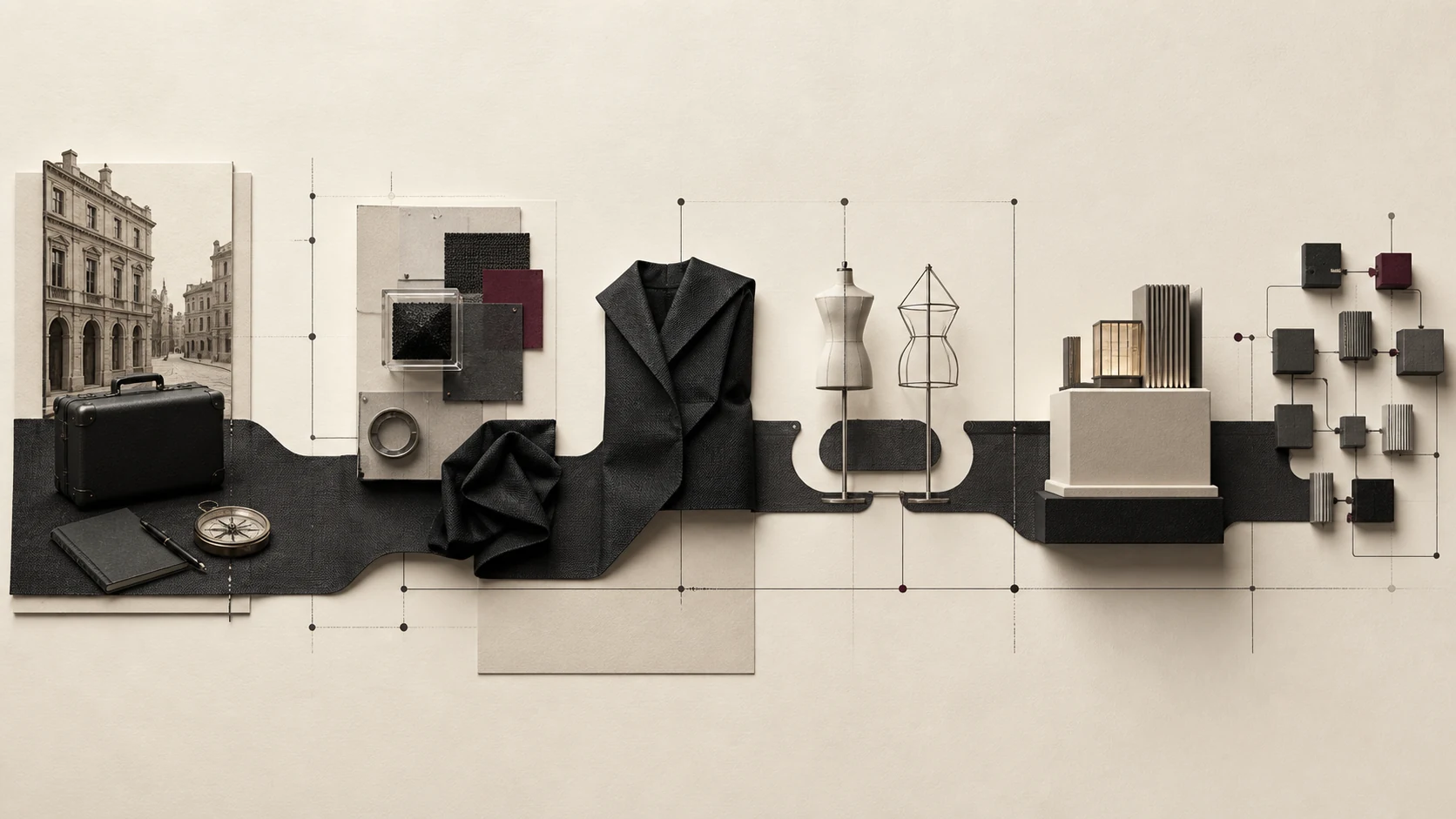
Prada became influential not because it offered one ideal image. The house taught luxury to work with contradictions: the beautiful and the uncomfortable, the bourgeois and the industrial, the severe and the strange, the archival and the not-yet-named.
Editorial thesis
Prada's durability is explained neither by a single bag, nor by the triangular logo, nor by abstract 'minimalism'. The house created a method: take a material, a form or a social code that seems too utilitarian, outdated, bourgeois or unattractive, and place it within a new system of proportions, context and desire. Under Miuccia Prada this logic turned a family leather-goods business into an intellectual fashion platform; the partnership with Patrizio Bertelli made the experiment scalable, and the collaboration with Raf Simons confirmed dialogue as part of the brand's creative structure.
Reader question
How did a shop of travel goods opened in Milan's Galleria Vittorio Emanuele II in 1913 become a house that changed ideas of luxury, femininity, fashion minimalism, store architecture and the role of culture in the luxury business?
Short answer
Prada was founded by Mario Prada in Milan in 1913 as a shop of travel goods and luxury objects. In 1919 the company became an official supplier to the Italian Royal House, which fixed the coat of arms of the Savoy dynasty and the knotted rope in the trademark. The turning point came in the 1970s, when the founder's granddaughter Miuccia Prada began collaborating with the entrepreneur Patrizio Bertelli: her design thinking and his production and retail strategy created a new business model. Black industrial nylon, the first clothing collection of 1988, the menswear line and Miu Miu in 1993, Linea Rossa and Luna Rossa in 1997, the architectural Epicenter stores, the Fondazione Prada and Re-Nylon expanded the meaning of a fashion house. Since 2020 Prada collections have been created by Miuccia Prada and Raf Simons as equal co-creative directors. In the first half of 2026 Prada brand retail sales grew 3.3%, accelerating to 6.3% in the second quarter; these figures belong to the current business snapshot, not to a historical assessment of the design. [1][2][3][4][15]
1. Before 1913: Milan, travel and a new urban luxury
At the turn of the nineteenth and twentieth centuries Milan was changing quickly: railways, international trade, new hotels and a bourgeois culture of travel created demand for objects that had to be both durable and representative. Luggage became the mobile architecture of private life. It protected clothing and documents, but it also announced the owner's route, status and level of service.
The Galleria Vittorio Emanuele II, linking Piazza del Duomo with the Teatro alla Scala, was the ideal setting for such a business. The gallery combined commerce, strolling, cafés, theatre and public observation. The customer did not simply acquire an object: he entered a modern urban ritual. This bond between Prada and the Galleria later became part of the brand's identity — Milan functioned not as a backdrop but as proof of a cultural position.
For the future house it also mattered that travel goods demanded a cross-disciplinary craft. Leather, cloth, wood, metal, locks, hardware, inner compartments and personalisation all had to work as a single whole. Such an object culture precedes the Prada fashion system and explains why the brand later moved so easily from the bag to architecture, from clothing to sport, and from material to engineering project.
2. 1913: Fratelli Prada in the Galleria Vittorio Emanuele II
The official history of Prada begins in 1913, when Mario Prada opened the first shop in Milan's Galleria Vittorio Emanuele II. The enterprise traded under the name Fratelli Prada and specialised in travel goods, bags, trunks and luxury objects. The contemporary brand emphasises the rare materials and refined craftsmanship of the early range; editorially it matters to recall that this wording comes from the company's own institutional history. [1][2]
Prada began as a retailer and maker of objects built for long-term use. Unlike seasonal fashion, a trunk or suitcase had to keep its construction, be repairable and accompany its owner for years. This logic of durability did not disappear when clothing arrived. It continued in the rigid structure of Saffiano, in functional nylon, in the repeatability of the bags and in attention to the technical side of the product.
The first shop also matters as a model for the brand. From the very beginning Prada existed within a carefully chosen urban environment. The later Green Store and the Epicenters were not a random turn towards architecture: they extended the principle according to which the way an object is displayed is part of the object itself.
3. 1919: royal status, the coat of arms and the triangular emblem
In 1919 Prada was granted the status of official supplier to the Italian Royal House. Thereafter elements of the Savoy coat of arms and the motif of the knotted rope entered the trademark. The group's official profile explicitly ties the modern emblem to this appointment. [2]
Royal status gave the young company symbolic capital: quality was endorsed not only by the customer but by the institution of monarchy. After the abolition of the Italian monarchy the historical mark survived. This shows how a luxury brand detaches a symbol from its original political function and turns it into evidence of age, continuity and legitimacy.
Prada's triangular plaque became one of the most recognisable shapes in modern fashion, yet its history is more complex than the popular story of an 'eternal logo'. Over different periods the proportions, the lettering and the ways the mark was applied all changed. For analysis what matters is not the search for one absolute original, but a principle: a small geometric metal detail can turn a utilitarian surface into an identifiable object.
4. The family business before Miuccia Prada
After the death of Mario Prada control remained within the family. Fewer public documents survive about the early decades than about the era of Miuccia Prada, and the official chronologies move from the founding and the royal status almost directly to the 1970s. The gap itself is significant: the modern brand history is organised around two beginnings — Mario Prada and Miuccia Prada.
Within the family the leather-goods trade continued, yet by the postwar period the model of an elitist travel-goods shop needed renewal. Mass aviation was changing luggage, ready-to-wear was changing the rhythm of fashion, and new international luxury brands were learning to scale a way of life rather than a single artisanal product.
Miuccia Prada, the founder's granddaughter, entered the company not as a traditionally trained couturier. She studied political science and worked in theatre. These details are often used to build the image of an 'intellectual designer', but their real significance runs deeper: her method arose not from an academic school of cutting but from observation of power, social roles, behaviour and the contradictions of personal taste. [3][7]
5. 1975–1977: the meeting of Miuccia Prada and Patrizio Bertelli
The official profile of the Prada Group dates the start of the collaboration between Miuccia Prada and the entrepreneur Patrizio Bertelli to 1975. In 1977 Bertelli created IPI S.p.A., concentrated production resources in leather goods and obtained an exclusive licence to manufacture and distribute Prada products; the family businesses were later merged. [1][2]
Different sources give 1977, 1978 or 1979 as the moment when Miuccia 'took the helm' of the house. These need not contradict one another. 1975 describes the start of the collaboration, 1977 the formation of the business model, and the end of the decade the actual transfer of creative and strategic control. A publication should preserve this sequence rather than artificially choose one magic date.
The partnership changed how the brand was organised. Bertelli argued against uncontrolled licensing and sought to unite production, product, store and communication. Miuccia Prada could experiment because beside her there existed a system that turned experiment into a repeatable, quality product. Here one of the key models of the modern luxury business takes shape: creative independence is supported not by an absence of control but by extremely strict control over processes.
6. 1979–1983: footwear, production and Prada Green
In 1979 Prada presented its first women's footwear. The category expansion was logical: shoes allowed the work with leather, proportion and hardware to move closer to the body without immediately jumping to a full fashion collection. [2]
In 1983 a second shop opened on Via della Spiga in Milan, decorated in a characteristic pale green. That shade, later given the unofficial name Prada Green, became one of the house's spatial codes. It did not shout luxury and did not imitate a historic palace; a cool, almost administrative green created distance and order.
Prada's retail was becoming a controlled stage. Objects received space, silence and rhythm that set them apart from a department store. It is here that one can see the early shift from the traditional boutique to the brand as environment: the colour of the walls, the light, the furniture and the distance between objects communicated the same idea as the products themselves.
7. Nylon: how an industrial material became a new luxury
Black nylon became Prada's most famous material gesture. According to interviews and materials republished by the Prada Group, Miuccia Prada conceived the nylon backpack in 1984; other sources place its commercial launch and wide recognition in the middle or late 1980s. It is therefore more accurate to speak of development in the first half of the decade and a later transformation into a commercial code. [22]
The material was linked to Pocono — a durable nylon fabric reminiscent of cloths used for military and industrial purposes. In the traditional luxury hierarchy it looked too technical and too cheap. Prada did not try to disguise it as leather: the black surface, practical straps, pockets and a small metal triangle preserved its utility.
The radicalism of the decision did not lie in nylon never having been used in clothing or luggage before. Prada changed the cultural assessment of the material. Price and prestige ceased to depend directly on outward rarity; what became valuable was the idea, the construction, the proportion and the context. The Metropolitan Museum of Art describes the introduction of black nylon into clothing and accessories as a subversive rethinking of conventional luxury. [7]
Nylon also made it possible to create a particular image of the modern urban person: mobile, protected from the weather, not flaunting traditional bourgeois luxury, yet reading a precise sign. In this sense the Prada backpack was at once an anti-status and an extremely status-bearing object.
8. 1988: the first ready-to-wear collection
Prada presented its first women's clothing collection in 1988. The V&A describes this transition as the moment when Miuccia Prada, after working with accessories, brought the house into the fashion system. [5]
Prada did not try to compete with Italian fashion through the most obvious signs of glamour. The early collections were built on clean lines, muted colours, quality fabrics and elements of the uniform. Their apparent simplicity demanded great precision: when there are few decorative distractions, what matters are the length of the skirt, the position of the waist, the weight of the fabric and the distance between body and garment.
The move into ready-to-wear changed the very nature of the house. A bag exists beside a person; clothing creates a social body. Now Prada could explore not only the function of the object but how a woman appears in the office, the school, the family, the city and public culture. This led the brand to its most significant theme — the tension between personal desire and the imposed role.
9. The 1990s: minimalism, ugly chic and complex femininity
In the 1990s Prada became one of the central authors of fashion minimalism, yet its version of minimalism was not neutral purity. It contained schoolgirl forms, bourgeois skirts, synthetics, brown and swampy tones, old-fashioned prints and proportions that could seem awkward. Simplicity became a way of sharpening psychological ambiguity.
Critics applied to Prada the expression 'ugly chic' — an aesthetic in which the unattractive, the outdated or the 'wrong' is restructured as desirable. The term should not be taken literally: the point is not producing ugly things but resisting an automatic formula of beauty. A colour may be too muddy, a skirt too severe, a shoe too heavy, a print reminiscent of upholstery. Together they create a new taste.
A spring–summer 1995 nylon dress in the Met's collection is described as an example of utility chic and of the minimalist aesthetic of the mid-decade, sitting between school and military uniform. The museum also connects Prada's design to the question of women's position in society. [6]
Miuccia Prada did not offer a single liberated heroine. Her woman could be at once strong, constrained, sexual, intellectual, conservative and ironic. This complexity distinguished Prada from advertising that promises clothing will entirely solve the problem of identity.
10. 1993: the menswear line, Miu Miu and a cultural institution
1993 was a year of systematic expansion. Prada launched its menswear line; Miu Miu appeared — a separate brand named after Miuccia Prada's family nickname; and Miuccia Prada and Patrizio Bertelli created the cultural organisation Milano Prada Arte, later to become the Fondazione Prada. [1][9][22]
Prada menswear developed the same interest in the uniform but did not copy the women's line. Suits, coats, shirts, technical jackets and shoes became instruments for analysing masculine order, status and vulnerability. In the following decades the brand repeatedly joined office clothing with workwear and sportswear.
It is important not to describe Miu Miu as a 'young Prada line'. It is an independent brand with its own logic, even if historically it grew out of Miuccia Prada's creative system. Its launch showed that an author can divide different impulses between separate institutions without forcing one brand to express everything at once.
The Fondazione Prada became the most consistent proof that the group's cultural activity is not limited to sponsoring a fashion exhibition. Since 1993 the organisation has developed projects in contemporary art, architecture, film, philosophy and scientific knowledge. It is critically important to preserve the institutional boundary: the Fondazione is not an advertising department, even though its existence strengthens the cultural capital of the Prada name.
11. 1997: Linea Rossa and Luna Rossa
In 1997 Prada launched a line of technical and leisurewear clothing marked by a red stripe — Linea Rossa. In the same year Patrizio Bertelli created the Prada Challenge team, later Luna Rossa, for the America's Cup. [1][17][18]
The red line worked as an extremely simple sign on a technical product. Unlike the heraldic triangle, it did not refer to historic luxury. It was a graphic marker of speed, engineering and modern sport. Linea Rossa joined the urban wardrobe to the materials and constructions of performance clothing before luxury and technical sportswear became a commonplace alliance.
Luna Rossa turned sport into a laboratory. A sailing team demanded work with aerodynamics, protection, humidity, movement and team uniform. For Prada this was not merely sponsorship: the project demonstrated how a fashion house's name can take part in technical culture and the national sporting imagination.
Together Linea Rossa and Luna Rossa reinforced one of the brand's central paradoxes. Prada could remain a symbol of intellectual urban fashion and at the same time build an identity around the measurable efficiency of material.
12. The late 1990s: an attempt to build an Italian luxury group
In the late 1990s and early 2000s the Prada Group acquired stakes and control in a number of companies, including Jil Sander, Helmut Lang, Church's and Car Shoe. The aim was to build a significant Italian luxury group able to compete with the rapidly growing French conglomerates. [22]
The strategy proved uneven. Church's and Car Shoe remained in the portfolio, while Jil Sander and Helmut Lang were sold in 2006. The episode shows the limits of the idea that a strong creative brand can be scaled purely through financial consolidation. Different brands require different tempos, leadership, distribution and cultural autonomy.
For the history of Prada what matters is not the list of deals themselves but the lesson of the organisational boundary. In the following years the group concentrated on its own brands, its production platform and direct retail. The acquisition of Versace in 2025 returned the group to a large multi-brand model, but in a different financial and managerial configuration.
13. 2001–2004: Epicenters and the store as media
In the early 2000s Prada created a network of experimental Epicenter stores. The New York project by OMA/Rem Koolhaas opened in 2001; the Tokyo Epicenter by Herzog & de Meuron in 2003; and the Los Angeles space, created by OMA, in 2004. [1][10]
The Epicenter was conceived not simply as an expensively decorated boutique. The store was to work as a public space, an exhibition, a stage and a technological laboratory. In New York a large wave-like surface could be a staircase, a catwalk and an event area. Architecture did not passively serve the merchandise — it became a way of discussing consumption.
These projects arose in a period of optimism about 'smart' retail: interactive screens, RFID, new fitting rooms and personalised service. Not every technology became an everyday standard, but the principle itself retained its influence. The luxury store no longer had to look like a historic salon; it could be a research space that expresses the brand's method.
The collaboration with OMA/AMO continued in show design and research projects. In this way Prada turned architecture into a permanent partner of fashion rather than a one-off decoration.
14. The 2000s: the product system, Galleria and cultural expansion
In the 2000s Prada developed a full set of categories: clothing, footwear, bags, eyewear and fragrance through licensing agreements. The growth of categories did not cancel the centrality of leather goods. On the contrary, the bag became the place where the heritage of the 1913 shop met the modern name and global distribution.
The Prada Galleria bag was presented in 2007 and took its name from the first historic store. A rigid construction, Saffiano, double handles and a restrained emblem created a product that did not depend on a seasonal print. [19]
The name Galleria works as built-in chronology: the new object carries the address of the brand's origin. This is a typical luxury-house strategy, but in Prada it is especially consistent — space, material and product form a closed system of references.
Cultural activity expanded in parallel. Prada took part in film, publishing projects, exhibitions and architecture, yet the strongest initiatives did not literally illustrate a collection. They created a separate field in which the brand was associated with research into contemporary culture.
15. 2011–2019: the stock exchange, the archive and Re-Nylon
In 2011 Prada S.p.A. listed its shares on the Hong Kong Stock Exchange; the group's official history calls it the first Italian company to enter that platform. The listing underlined the strategic importance of Asia for the global luxury market. [1][16]
Public status raised reporting requirements and made the financial side of the business more visible. For a historical article this creates a useful distinction: the cultural influence of the brand and its economic dynamics are connected but not identical. A successful collection does not always immediately appear in revenue, and sales growth does not prove artistic significance.
Prada's archive gradually became an active design infrastructure. Archiving clothing, footwear and leather goods makes it possible to return to specific forms and materials without simple repetition. The Re-Edition line, for example, makes the dated origin of a model part of the contemporary product.
In 2019 Prada launched Re-Nylon, replacing the original nylon with the regenerated material ECONYL. The project mattered because it concerned not a minor 'green capsule' but one of the house's central codes. [11]
The language of sustainability, however, demands precision. The possibility of regenerating fibre and the use of recycled raw material do not automatically make the entire life cycle of a bag circular or neutral. An article should separate the characteristics of the material, the supplier's data, corporate goals and an independent assessment of impact.
16. 2020: Miuccia Prada and Raf Simons — creativity as dialogue
In February 2020 Prada announced that Raf Simons would join Miuccia Prada as co-creative director with equal creative responsibilities; the agreement took effect on 2 April, and the first joint collection was the women's spring–summer 2021. [3][15]
The appointment was unusual for an industry accustomed to building a house around a single authorial name. Simons already had his own brand and experience leading Jil Sander, Dior and Calvin Klein; Miuccia Prada remained an active author rather than a symbolic founder. The joint direction turned dispute, editing and the exchange of questions into a publicly declared method.
In the collections attention to archetypes increased: coats, knitwear, the uniform, the skirt, the shirt, the triangle. Simons neither 'replaced' Prada nor dissolved into her archive. The work was built on differences: Miuccia's interest in social incongruity met Simons's interest in youth culture, subcultures and precise graphics.
The joint conversations after the shows became part of the communication. They do not fully reveal the internal process, but they demonstrate an important shift: a modern luxury house can present authorship as dialogue rather than as the cult of an inaccessible solitary genius.
17. 2024–2026: Axiom Space and material beyond fashion
In October 2024 Prada and Axiom Space presented the flight design of the lunar spacesuit AxEMU, being developed for the NASA Artemis III mission. Axiom is responsible for the design, certification and production of the system, while Prada specialists contributed to materials, production technologies and the external construction. [12][13][14]
In June 2026 Axiom Space and Prada separately presented the inner Liquid Cooling and Ventilation Garment — an engineered knitted layer designed for cooling and ventilation during long extravehicular work. [13]
It is easy to turn the project into an advertising metaphor, 'fashion has gone to the Moon', but its real significance is more precise. Prada used competencies accumulated in technical textiles, ergonomics and work with the body inside a system with strict safety requirements. Here design cannot exist as a visual gesture without engineering validation.
Mission dates can change. The correct formulation is that the AxEMU is being developed for Artemis III; one cannot assert that the flight has taken place or is guaranteed on a specific date until the mission is officially completed.
18. The codes of Prada: the triangle, Saffiano, nylon, green and the uniform
Prada is recognisable not through a single continuous silhouette but through a set of codes of different natures. They can appear together or separately, which is why the brand can change collections without entirely losing identity.
The triangular sign joins a historic heraldic language with an industrial plaque. It is small enough not to turn every object into a monogrammed surface, yet geometric enough to transfer onto a pocket, a shoe, a piece of jewellery or the shape of a neckline.
Saffiano is a leather with a diagonal cross-hatched texture that Prada connects to Mario Prada and a historic patent. Until the patent document has been separately verified, the claim of patenting should be attributed to the house. Practically, the material is valued for its structure and surface durability. [20]
Nylon communicates mobility, lightness and technical modernity. Prada Green transfers identity into the interior. The uniform — school, office, military, work — gives the brand a social frame that can be broken through material, length, colour and stylisation.
The most important code cannot be photographed on its own: it is contradiction. Prada joins what the market usually separates — severity and eroticism, age and youth, bad taste and discipline, mass material and high price. It is precisely this operation that makes individual signs part of a single language.
19. Fondazione Prada, architecture and cultural infrastructure
The Fondazione Prada was created by Miuccia Prada and Patrizio Bertelli in 1993. Its mission rests on the belief that art and research are necessary for understanding change in the world. The organisation develops exhibitions, film, architecture, philosophy, and educational and scientific projects. [9]
The Milan complex of the Fondazione, designed by OMA and opened in 2015, joined a former industrial site with new architectural volumes. The Venetian venue Ca' Corner della Regina added historic architecture. In both cases the cultural institution neither imitates a Prada boutique nor is obliged to promote a seasonal collection visually.
The effect for the brand is nonetheless significant. The Fondazione creates a long-term association with research, institutional knowledge and contemporary art. Such cultural capital is harder to measure than the sales of a particular bag, but it helps Prada occupy the position not only of a maker of objects but of a participant in the intellectual life of the city.
The architectural projects of the stores, the shows and the Fondazione form a continuous line: space is used to pose a question. The viewer must not only see the product but also feel that the accustomed way of looking, moving and buying has been deliberately organised by someone.
20. Prada and the Prada Group: how not to confuse the brand with the holding company
Prada is a specific brand within the Prada Group. By 2026 the group also owns Miu Miu, Church's, Car Shoe, Versace, Marchesi 1824 and Luna Rossa, and works in eyewear and beauty through licences. As of 31 December 2025 the group reported 843 directly operated stores, including 423 Prada stores and 220 Versace stores, consolidated since 2 December 2025. [21][23]
These figures are useful for understanding scale, but they must not become a claim that all the assets share a single aesthetic. Miu Miu has an independent creative direction; Versace rests on a different history and visual language; the Fondazione Prada has a separate cultural mission.
The distinction matters especially after the acquisition of Versace. The deal changes the financial and managerial architecture of the group, but it does not retrospectively rewrite the history of the Prada brand. The site requires a separate 'Prada Group' object and separate related objects for each house.
21. The business model and the position of the brand in 2026
The modern Prada model is based on direct retail, control of production, a global network, e-commerce and licences in individual categories. The group emphasises 25 directly owned production plants and a presence in more than 70 countries; these figures refer to the consolidated company, not only to the Prada brand. [21]
For the first half of 2026 the Prada Group reported net revenues of €3.048 billion, up 16% year on year, with organic growth of 5% excluding Versace. Prada brand retail sales grew 3.3%, accelerating to 6.3% in the second quarter. [4]
The current data show that the brand retains commercial resilience in a difficult luxury market, yet an article should not turn quarterly growth into proof of unchanging strength. A financial result depends on currencies, the comparison base, regions, assortment and macroeconomics. Indicators should therefore always carry a date, units and a source.
Group management and brand creativity should also be kept separate. As of 5 August 2026 the CEO of the Prada Group is Andrea Guerra, the chairman of the board is Patrizio Bertelli; Miuccia Prada remains executive director and co-creative director of Prada alongside Raf Simons. [3]
22. Critical questions: elitism, sustainability and scale
Prada's intellectual reputation can work as a new kind of social exclusion. The logo demonstrates purchasing power directly; 'an understanding of complex taste' demonstrates it indirectly. Refusing obvious luxury therefore does not necessarily mean refusing status — sometimes it creates a more exclusive code of belonging.
The 'ugly chic' aesthetic also depends on the power of the brand. An object that without the Prada name would be considered old-fashioned or unsuccessful acquires cultural value through the context of the show, the price, the criticism and institutional authority. This does not cancel design, but it shows that taste is produced by a system and does not exist apart from it.
Re-Nylon is a substantive step because it changes the brand's signature material, yet sustainability cannot be reduced to a single fibre. Data are needed on the origin of energy, dyeing, mixed components, repair, logistics, service life and end of life. Phrases such as 'infinitely recyclable' and 'fully sustainable' should be attributed to the producer and the brand, not repeated as an independent conclusion.
Global scale also creates cultural risks: the borrowing of craft forms, the representation of communities, working conditions in the supply chain, and the conflict between volume growth and environmental promises. Every specific controversy must be described by dates, participants and primary statements, avoiding generalisations such as 'the brand stole a culture' without an established subject and context.
Finally, Prada faces the problem of succession. The joint direction of Miuccia Prada and Raf Simons shows one way of transmitting method through dialogue, while the participation of the next Bertelli generation represents managerial preparation. But long-term sustainability will depend on whether the organisation can preserve the right to doubt when the founders of the modern system cease to determine its decisions every day.
23. Conclusion: why Prada remains contemporary
Prada has existed for more than a century, yet its contemporaneity is not based on an attempt to look eternally young. The house knows how to use age as an archive rather than as a museum showcase. A historical emblem can appear on technical nylon; a bourgeois skirt can stand beside a work jacket; a shop can become an architectural study; fashion competence can take part in developing a spacesuit.
The chief legacy of Miuccia Prada is not a set of specific objects, even though many of them became enduring products. It lies in a method that makes it possible to doubt the hierarchy of materials, obligatory attractiveness, a single version of femininity, and the boundary between commerce and culture.
Prada remains influential as long as its contradictions do not become an empty formula. Nylon must again be material, not merely a nostalgic sign; architecture must change experience rather than serve as decoration; the cultural institution must preserve its autonomy; the joint direction must produce genuine exchange. The history of the house shows that luxury can be not a promise of an impeccable answer but the right to ask a more precise question.