research
The History of the Versace Fashion House
How ancient symbolism, metallic fabric, the cult of the body, supermodels and pop culture transformed a Milanese family house into a global language of maximalism
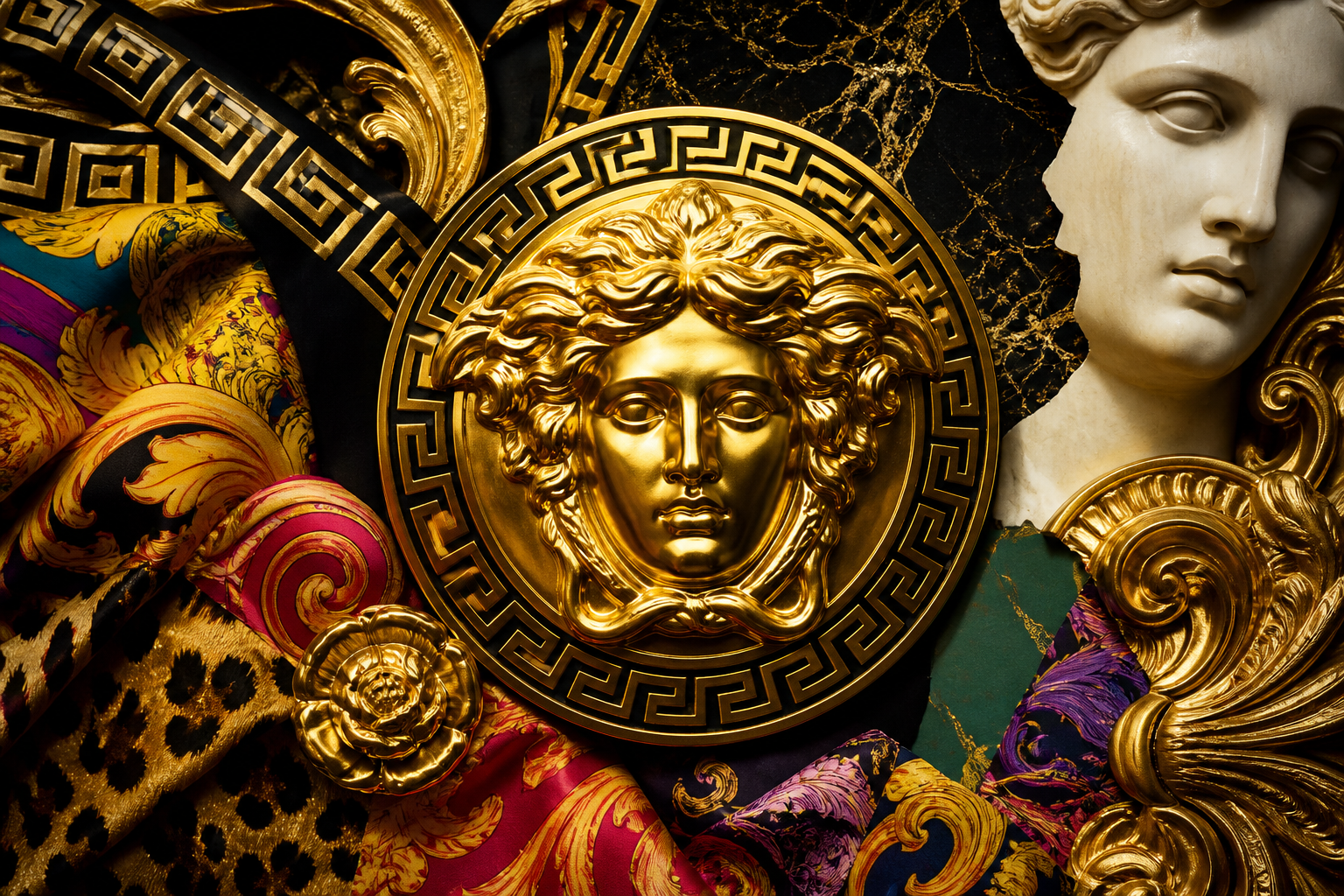
“Versace made luxury not a quiet sign of belonging but a public act. In the house’s hands, antiquity became a pop image, metal became fluid fabric, the show became a media event, and the body became the primary arena for conversations about power, sexuality and freedom.”
Editorial thesis
Versace’s historical significance rests not only on maximalism or recognisable prints. Gianni Versace built a system in which the classical culture of Southern Italy converged with rock music, theatre, contemporary photography and unabashed sexuality. The house turned the runway into mass media, made celebrity part of design and showed that industrial luxury could operate simultaneously as craft, spectacle and pop culture. After 1997, Donatella Versace did not merely preserve her brother’s archive: she rebuilt it for the digital era, the red carpet and global business. The transition into the Prada Group and the appointment of Pieter Mulier in 2026 pose a new question: how can one of fashion’s loudest languages be renewed without reducing it to a set of logos and quotations?
Reader question
How did Gianni and Donatella Versace create the house’s visual system, why did it change fashion’s relationship with the body, music, celebrities and the internet, and what does Versace’s move into the Prada Group mean?
To present Versace as a design system, a family enterprise, a media machine and an object of corporate transformation. The material separates documented facts from brand mythology, distinguishes the periods of Gianni, Donatella, Dario Vitale and Pieter Mulier, and records the house’s current structure as of 5 August 2026.
The primary subject is the house of Versace, from its founding in Milan in 1978 to its position within the Prada Group as of 5 August 2026.
Gianni Versace’s biography before 1978 is included only insofar as it explains the origins of his method, his work with his dressmaker mother and his first commissions in Milan.
The history of the house is not reduced to the story of its founder’s murder; the events of 1997 are treated as an institutional rupture and a question of succession.
Donatella Versace is considered an author in her own right and the leader of the 1997–2025 period, not merely the guardian of her brother’s legacy.
Claims that “Versace invented the supermodel,” “created sexuality in fashion” or “Jennifer Lopez’s dress created Google Images” are replaced with precise formulations about influence, popularisation and an officially acknowledged technological impetus.
Versus Versace, Atelier Versace, Versace Home, fragrance, eyewear and hospitality are distinguished by function, ownership and licensing arrangements.
The transition from family control to Blackstone, Capri Holdings and the Prada Group is described through transaction documents, not value-laden narratives of “rescue” or “decline.”
Current financial data and executive roles are tied to a cut-off date and must be verified again before publication.
Every image passes through a rights gate: author, date, rights holder, licence or permission, credit, caption and alt text.
Short answer
Versace was founded by Gianni Versace in Milan in 1978, with the key participation of his brother Santo and sister Donatella. The house combined ancient motifs, saturated colour, Baroque prints, metal, leather and emphatic physicality; in the 1980s and 1990s it turned shows, advertising and relationships with musicians and models into a cultural spectacle in their own right. After Gianni’s murder in 1997, Donatella assumed creative direction and created iconic moments of her own, including the Jungle dress of 2000. Capri Holdings acquired Versace in 2018, and the Prada Group completed its purchase of the house on 2 December 2025. Since 1 July 2026, Pieter Mulier has been Chief Creative Officer, reporting to Versace Executive Chairman Lorenzo Bertelli. Versace contributed €305 million to Prada Group revenue in the first half of 2026, while the house remains in a phase of creative and commercial repositioning.
1. Reggio Calabria: the mother’s workshop and the origins of the method
Gianni Versace was born on 2 December 1946 in Reggio Calabria, a city in southern Italy facing the Strait of Messina and the cultural memory of Magna Graecia. His mother, Francesca, ran a dressmaking workshop. This matters not as a romantic legend of a child among fabrics, but as an early acquaintance with garment construction, client commissions and the discipline of fitting. Versace’s later flamboyance grew not in spite of craft, but from a confident command of it.
Southern Italy gave the designer an enduring visual vocabulary: archaeological fragments, the Greek key, gold, mosaic, Catholic theatricality, sunlit colour and an attitude towards the body as an open presence. The house later turned this archive into an international luxury code. Editorially, however, not every ornament should be explained through “Calabrian origins”: some images arose from contemporary art, club culture, cinema and commercial graphics.
2. Milan before 1978: industry, knitwear and the first labels
In the early 1970s, Gianni Versace moved to Milan and worked for several manufacturers, commonly identified as Florentine Flowers, Callaghan, Genny and Complice. Biographical sources differ on the precise sequence of these early contracts, so the period is best understood as his formation within Italian industrial prêt-à-porter, not as a perfectly linear career ladder.
Experience with knitwear and serial production taught Versace to unite a striking image with the technology of a repeatable product. His future house was not an atelier that gradually became a factory: it emerged from the outset within a mature Italian production system in which designer, textile industry, communications and wholesale network operated simultaneously.
3. 1978: the founding of the house and the first independent collection
The independent house of Gianni Versace was established in Milan in 1978. Its first women’s collection was presented that spring, and a boutique opened on Via della Spiga the same year. The precise date and format of the debut require archival verification, but the founding year is confirmed by the house and by corporate documents.
The logic that would later become a signature was already visible in the early collections: clean construction joined saturated colour, leather met silk, and classical form met unabashed physicality. Versace did not build luxury on distance. His clothes were designed for movement, the stage, nightlife and the camera.
4. The family system: Gianni, Santo and Donatella
Versace developed as a family structure. Gianni was responsible for creative direction; Santo Versace for financial and corporate organisation; and Donatella became an adviser, designer and the principal intermediary between the house, music and the new celebrity culture. This triangle enabled an aesthetic decision to become both a product and a public event with unusual speed.
The family character was both strength and risk. It created speed, trust and coherence of image, but concentrated too many functions among too few people. After 1997 it became clear how much the company’s identity depended on personal relationships within the family and on Donatella’s ability to transform them into a new system of management.
5. Medusa, the Greek key and Southern Italy as a visual archive
The principal symbol of the house is the head of Medusa. In corporate mythology it is linked to classical culture and the magnetic power of the image. The Greek key became an architectural frame for prints, hardware, packaging and interiors. These signs function not as neutral archaeology but as a theatricalised version of the classical: antiquity turned into an emblem of desire and power.
The precise date on which the Medusa logo was standardised is often oversimplified in popular accounts. Without access to the primary graphic archive, it is safer to say that by the early 1990s Medusa and the Greek key had formed an established house identity. The article should distinguish the Medusa motif, the circular emblem, the proprietary wordmark and the specific logos of different periods.
6. Oroton: when metal began to move like fabric
In the early 1980s Versace made metal mesh one of his most important materials. Oroton looked like liquid metal: it reflected light, traced the body and simultaneously evoked ancient chain mail, Byzantine mosaic and disco culture. The Metropolitan Museum of Art notes the material’s distinctive capacity to gather into fluid folds and create classical effects.
Oroton should not be described as the sole-handed “invention of metallic fabric.” Metal mesh existed earlier; Versace’s contribution was its technical and aesthetic transformation into a systematic couture and ready-to-wear code. The material demonstrates the house’s essential logic: rigidity becomes movement, armour becomes sensual, and craft becomes spectacle.
7. The body, sexuality and power without guilt
Versace designed clothes around the visible body. Slits, corsetry, transparency, metal mesh, leather and vivid prints did not conceal a person’s presence but amplified it. Curator Richard Martin called Gianni Versace one of the first great “post-Freudian” designers: sexuality in his work did not require justification through morality or propriety.
Yet bodily freedom at Versace was always both liberating and prescriptive. The house celebrated strength, muscularity and controlled sensuality, but often worked within narrow ideals of beauty. A contemporary analysis must hold both aspects in view: the historical expansion of the language of desire and the industrial discipline that determines which bodies are allowed to occupy the centre.
8. Art, theatre, ballet and the culture of quotation
Gianni Versace worked extensively with theatre, ballet and stage costume, created looks for performers and quoted Warhol, Lichtenstein, Kandinsky, Klimt, the Baroque and Byzantium. For him art was not a cultural alibi for the brand; it became material for surfaces, scenography and advertising photography.
This practice requires precise attribution. A print “in the manner of Warhol” and the licensed use of an artwork are not the same thing. When publishing a specific look, the source of the motif, the rights holder and the permission status must be established. What matters analytically is Versace’s method: high and mass visual languages were joined without hierarchy.
9. The show as mass media and the birth of the supermodel spectacle
Versace was one of the designers who turned the fashion show into an event that existed beyond buyers and the press. Music, staging, photographers and recognisable models produced an image capable of living on television, in magazines and in the viewer’s memory. The finale of the Autumn/Winter 1991 show, in which models performed Freedom! ’90 in unison, became a symbol of the supermodel era.
It would be inaccurate to say that Versace “invented the supermodel.” He systematically used an emerging culture of celebrity models and gave it a vivid stage. His contribution lay in joining model status, the music video, advertising photography and the runway into a single infrastructure of recognition.
10. Versus and the house’s youth laboratory
Launched in 1989, Versus became a space for a younger, more experimental and accessible language. It was closely associated with Donatella Versace, whom Gianni entrusted with the project’s creative development. Versus offered a place to test the energy of club culture, graphics, denim and more direct forms of communication.
The history of Versus shows that the architecture of the Versace brand was never a simple pyramid of “expensive” and “less expensive.” The line functioned as a laboratory and as a means of dialogue with a generation that might not buy Atelier but shaped music, nightlife and the visual codes of the street.
11. Miss S&M, the safety-pin dress and the aesthetics of risk
The Autumn/Winter 1992–93 collection, often called Miss S&M, combined leather, straps, metal hardware and elements of bondage. In 1994 Elizabeth Hurley attended the premiere of Four Weddings and a Funeral in a black Versace dress fastened with oversized gold safety pins. The look became one of the most recognisable red-carpet moments of the twentieth century.
The pin functioned at once as fastener, ornament and metaphor for possible disintegration. The dress turned structural risk into public confidence. Its significance cannot be reduced to “shocking exposure”: it demonstrated how a single object could transform the status of a person, a film and a brand through photography and mass circulation.
12. Versace menswear: the object of desire and a new masculinity
Versace menswear emphasised the body differently from the traditional business suit. Close cuts, silk shirts, leather, colour, gold and an exposed chest made the man not only the subject of the gaze but also its object. This resonated with club, music and queer cultures, in which clothing could serve as a declaration of presence.
Yet not all Versace menswear should automatically be labelled “queer fashion.” The house’s connection with LGBTQ+ culture is real and important, but specific interpretations must be grounded in a collection, campaign, interview or context of use, not in stereotypes about flamboyance and sexuality.
13. 1997: Gianni’s death and an institutional rupture
On 15 July 1997, Gianni Versace was murdered outside his home, Casa Casuarina, in Miami Beach. In fashion history, the event often overshadows everything else and turns the brand into a drama. For institutional analysis, the consequences matter more: the house lost its founder, chief designer and central public voice at the same time.
Ownership remained with the family; Donatella assumed creative leadership, Santo continued his corporate role, and Allegra Versace later received the share assigned to her in Gianni’s will. Precise legal percentages changed in subsequent transactions and should therefore be tied to a specific date rather than described as a permanent structure.
14. Donatella Versace: not a guardian, but the author of a new era
Donatella Versace assumed creative leadership in circumstances that demanded both a repetition of Gianni and proof of her independence. Her early years were a period of stabilisation, but she gradually established her own version of the house: a more direct relationship with pop music, the red carpet, female celebrities and digital culture.
Her contribution is often underestimated when it is described merely as a continuation of the archive. It was Donatella who sustained the visibility of the Medusa and Baroque codes in a changing market, created viral moments and made her own public persona part of the institutional image. She also turned Gianni’s memory into an open resource rather than a sealed memorial.
15. The Jungle dress and fashion’s passage into the visual internet
In February 2000, Jennifer Lopez appeared at the Grammy Awards in the green Versace Jungle dress with its plunging neckline. According to Google’s official account, the volume of image searches for the dress exposed the limitations of text-only results and helped inspire the launch of Google Images in July 2001.
The accurate formulation is that the dress helped inspire the service, not that it single-handedly “created internet images.” The more important point is the cultural transition: a fashion object became not merely a magazine image but a user query. Versace stood at the centre of a new visual-search economy in which viewers demanded access to an image for themselves.
16. Atelier, the red carpet and celebrity infrastructure
Atelier Versace developed bespoke evening and couture-like pieces designed for the stage, the ceremony and the close-up. The house built long-term relationships with musicians, actors and performers, from Elton John and Madonna to contemporary artists. Clothes were created not simply for a celebrity, but for a specific media situation.
Celebrity dressing became an infrastructure: design, fitting, stylist, photographer, event and digital distribution operated as a single channel. Versace was one of the key houses to demonstrate that the red carpet could carry cultural significance comparable to that of the runway.
17. Blackstone: external capital and the professionalisation of management
In 2014 Blackstone acquired a minority stake in Versace. The transaction was intended to support international expansion and retail development. External capital marked a shift from a predominantly family structure to a model in which growth strategy, stores and operational efficiency became subjects of institutional control.
This period should not be described solely as a “loss of independence.” The family retained a significant interest and creative influence, but the house entered a system shaped by a financial investor’s expectations. The gap between cultural visibility and sustainable profitability became one of the defining questions of its later history.
18. Capri Holdings: global scale and the limits of expansion
Capri Holdings completed its acquisition of Versace on 31 December 2018. The stated enterprise value was €1.83 billion, or approximately $2.12 billion. The group planned to expand retail, footwear, accessories and menswear, with the goal of taking Versace revenue to $2 billion.
The results proved more complex than the original model. The pandemic, shifts in luxury demand and the need to refine positioning limited growth. The Capri period should not be judged only through the later sale at a lower price: the company invested in the network and management, but could not realise the announced scale within the intended timeframe.
19. 2025: Donatella becomes Chief Brand Ambassador
On 13 March 2025, it was announced that Donatella Versace would move from Chief Creative Officer to Chief Brand Ambassador on 1 April. She focused on representing the brand globally, philanthropy and supporting the house’s values. The move concluded almost thirty years of her formal creative leadership.
The transition should not be called a departure from Versace. Donatella retained a public connection to the house, but operational and design responsibility passed to the next leader. For the brand’s history, this was the first formal separation between the Versace name and day-to-day creative management.
20. The brief Dario Vitale era
Dario Vitale, formerly of Miu Miu, became Chief Creative Officer on 1 April 2025. His debut Spring/Summer 2026 collection offered a less polished, more personal view of early Versace, approaching clothing, the body and the archive without the usual monumental staging.
After the Prada Group acquisition was completed, it was announced that Vitale would leave the house on 12 December 2025. An eight-month tenure and a single principal collection do not support the idea of a fully formed “era,” but they matter as a transitional experiment between family leadership and a new corporate structure.
21. Prada Group and the return to an Italian group
On 10 April 2025, the Prada Group announced an agreement to acquire 100 per cent of Versace from Capri Holdings at an enterprise value of €1.25 billion. Following regulatory approvals, the transaction was completed on 2 December 2025. Versace joined a group that also includes Prada, Miu Miu, Church’s and other brands.
The phrase “return to Italy” is emotionally intelligible but requires precision: before the transaction, Versace remained Italian in origin, design and a significant share of its operations. What changed was corporate ownership, from an American public company to Italy’s Prada S.p.A. The central question is not national symbolism but the Prada Group’s ability to give the house time, a production base and a distinctive strategy.
22. Pieter Mulier and a new creative architecture
On 5 February 2026, the Prada Group announced Pieter Mulier’s appointment as Chief Creative Officer of Versace from 1 July 2026. He reports to Lorenzo Bertelli, Versace’s Executive Chairman. Mulier previously worked with Raf Simons at Jil Sander, Dior and Calvin Klein before leading Alaïa.
As of 5 August 2026, it is too early to speak of his “Versace style”: a complete new system has yet to be presented. The appointment matters more as a managerial signal. The Prada Group selected a designer known for architectural precision and sensuality without excessive reliance on logos, potentially creating a productive tension with Versace’s historical maximalism.
23. Versace codes: what truly constitutes the house’s identity
Versace’s identity does not consist of a single print. Its enduring elements include the Medusa, the Greek key, gold, Baroque imagery, saturated colour, black, metal, leather, drapery, the slit, body-conscious construction, classical quotation, pop music and demonstrative photography. Each period selects different combinations from this vocabulary.
A code becomes heritage only when it can generate a new solution. Simply applying the Medusa to a product reproduces recognition, but not necessarily the Versace method. That method appears in collisions of opposites: antiquity and the club, armour and fluidity, luxury and the mass image, structural control and visible risk.
24. Products, licences, Home and hospitality
Versace operates as a complete luxury universe: ready-to-wear, leather goods, shoes, accessories, eyewear, fragrance, watches, Home, Atelier and hospitality. Some categories are developed through licences and partnerships. The brand, legal owner of a design, manufacturer and operator of a particular product may therefore be different organisations.
Palazzo Versace and interior projects extended the house’s language from clothing into space. Here maximalism becomes architecture: marble, gold, print and Medusa organise the environment. A hospitality project must nevertheless be analysed separately from the fashion house, with attention to the operator, licence, date and current status of each property.
25. Critical questions: the body, appropriation, labour and sustainability
Versace has historically associated freedom with visibility, but contemporary publishing must ask who gains access to that freedom. Size range and representation across ages, races, genders and bodies matter as much as an arresting campaign. An aesthetic free of prejudice is demonstrated by practice, not corporate language alone.
Ancient, Byzantine, Baroque and non-European motifs require precise attribution and context. Not every quotation should automatically be labelled appropriation, but the commercial use of a sacred or culturally specific image must be traceable. Supply chain, materials, chemicals, leather, metals, licences and sustainability claims require a dedicated verification block.
The longevity of an aesthetic code does not equal the environmental sustainability of a product. Claims about reduced impact require measurable data, defined boundaries and independent verification. Within the new Prada Group structure, Versace must be considered in relation to group-wide policies, but Prada’s performance should not automatically be attributed to the house without separate disclosure.
26. Conclusion: maximalism as discipline, not an accumulation of decoration
The history of Versace shows that maximalism can be a rigorous system. Its power lies not in the quantity of gold but in the clarity of the scene: body, material, sign, music and camera are directed towards a single effect, presence. Gianni Versace created this language, Donatella taught it to survive personal tragedy and inhabit digital culture, and successive owners sought to turn its cultural power into a sustainable international business.
In 2026 the house stands at a rare juncture: the family name retains its symbolic presence, but creative and corporate management have been decisively separated from the family. The success of the new period will depend neither on a literal return to the archive nor on abandoning flamboyance, but on understanding Versace’s internal discipline: turning contradiction into an image that cannot be ignored.