research
The History of the Louis Vuitton Fashion House
How a trunk-making workshop grew into a global house of fashion, art, design and cultural influence
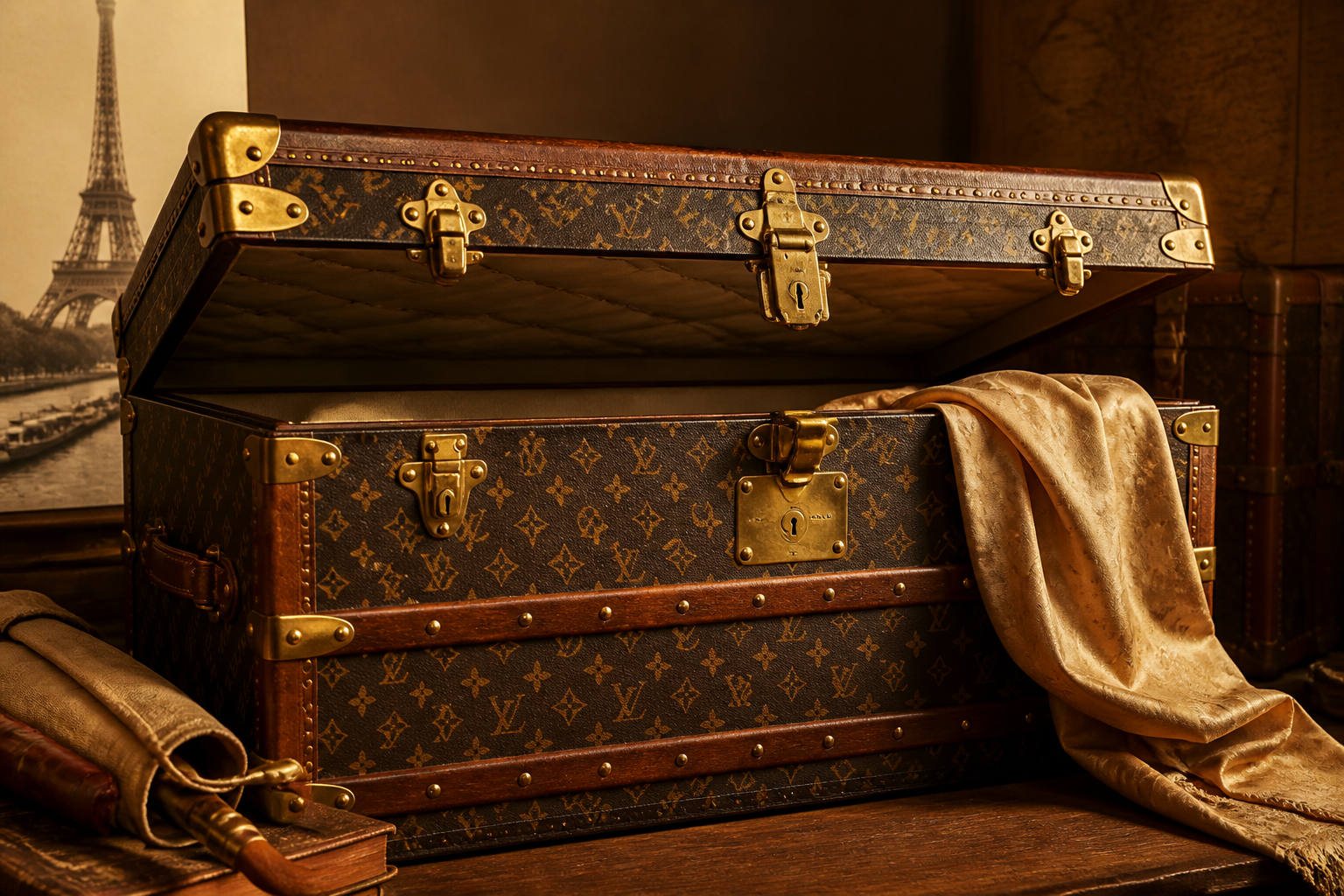
“Louis Vuitton does not merely sell things for travel. The house has turned movement itself — between cities, cultures, arts and statuses — into a lasting system of luxury.”
Editorial thesis
Reader question
How did a master packer and trunk-maker build a brand that outlived changes in transport, three generations of the family, the move to a public company, the creation of LVMH and the arrival of designers from fashion, music, architecture and art?
To trace the history of Louis Vuitton as a history of design, the technology of travel, the protection of intellectual property, global trade and modern cultural production; to show the contribution of the Vuitton family and the key creative leaders, separating verified facts from later brand mythology.
The core subject is Louis Vuitton Malletier: trunks, leather goods, ready-to-wear, footwear, accessories, watches, jewellery, perfumery, design and beauty understood as a single house system.
The material covers the period from the birth of Louis Vuitton in 1821 to the 2026 collections of Nicolas Ghesquière and Pharrell Williams.
The article is not a catalogue of every bag, collaboration and show. It includes the events that changed the product system, the visual language or the house’s position in the industry.
Financial figures are given only at the level of the publicly disclosed LVMH segment: Louis Vuitton’s individual revenue is not publicly disclosed.
The house’s official chronology is treated as a primary institutional source, but brand claims are supplemented by museum and independent material.
The precise dates of the early inventions require caution: different official pages date the flat trunk and the lock differently. The text distinguishes between development, public presentation and patent.
Short answer
Louis Vuitton began his career in 1837 as an apprentice to a Parisian packer and box-maker. In 1854 he opened his own workshop and tied his name to a new culture of mobility. Flat, stackable trunks, light waterproof canvas, the Asnières workshop, the locking system, Damier and Monogram created the house’s technical and visual core. Georges and Gaston-Louis Vuitton turned the family business into an international company and adapted it to cars, ocean liners and soft travel luggage. After the creation of LVMH in 1987, Louis Vuitton became the chief example of how a heritage brand can expand without abandoning its original craft. Marc Jacobs introduced ready-to-wear and the model of high-profile art collaborations; Kim Jones brought men’s luxury closer to global street culture; Nicolas Ghesquière built the women’s language on the architecture of form and travel through time; Virgil Abloh broadened the social and cultural idea of who could take part in luxury; Pharrell Williams develops the house as a stage for music, entrepreneurship and mass culture. By 2026 Louis Vuitton is no longer simply a luggage maker or fashion brand but a multi-layered cultural institution in which the trunk remains the founding grammar of almost every new product.
-
Before the founding of the house: Paris, packing and a new culture of travel
-
1854: a workshop of one’s own and a new type of luggage
-
The flat trunk as a design revolution
-
Asnières: craft, production and the family institution
-
Georges Vuitton: the lock, Damier, Monogram and international expansion
-
Gaston-Louis Vuitton: from the trunk to the modern culture of travel
-
Soft luggage icons: the Keepall, the Speedy, the Noé and the Alma
-
1959–1987: flexible Monogram, global retail and the birth of LVMH
-
Marc Jacobs: turning a luggage maker into a fashion house
-
Art as strategy: Sprouse, Murakami, Prince, Kusama and others
-
Kim Jones: menswear, travel and streetwear
-
Nicolas Ghesquière: architecture, time and the women’s Louis Vuitton
-
Virgil Abloh: a new audience and the redefinition of luxury
-
Pharrell Williams: Louis Vuitton as a Cultural Maison
-
Watches, jewellery, fragrances, design, hospitality and beauty
-
Visual codes and product icons
-
Louis Vuitton as a luxury business and cultural infrastructure
-
Critical questions: the logo, counterfeits, appropriation and sustainability
-
Conclusion: why Louis Vuitton retains its influence
Appendices: chronology, leadership periods, fact register, glossary, media plan, sources and release checklist
Most great fashion houses build their mythology around the body: the silhouette, the fabric, the image of a woman or a man. Louis Vuitton emerged around the objects that accompany the body in motion. The trunk, the suitcase and the bag do not shape the figure directly, but they organise its relationship with space, transport, property and status. That is why the history of Louis Vuitton belongs at once to fashion, industrial design, the architecture of storage and the history of mobility.
The house was founded in the middle of the nineteenth century, when railways, ocean liners and, later, the automobile were changing the rhythm of life for the wealthy. New travel demanded new objects: lighter, stronger, stackable and fitted to specific contents. Louis Vuitton answered that need not with a decorative style but with a series of constructive solutions. Later those solutions became aesthetic codes: slats, corners, the lock, stripes, the check, Monogram and brass hardware.
In the twentieth and twenty-first centuries the company repeatedly expanded its field of activity while preserving its original way of thinking. A new bag is treated as a portable trunk; a show becomes a journey to another place or time; a store becomes an architectural route; a collaboration becomes a transfer of codes between cultures; a book, a fragrance or a piece of furniture becomes one more companion to the modern person. Louis Vuitton should therefore be analysed not as a brand that once made luggage but as a house that continually redefines what luggage is.
1. Before the founding of the house: Paris, packing and a new culture of travel
Louis Vuitton was born on 4 August 1821 in the Jura, in eastern France. The details of his youth later grew into the legend of a self-reliant teenager who walked to Paris. The central fact is reliably confirmed: in 1837 the sixteen-year-old Vuitton arrived in the capital and began his apprenticeship with Monsieur Maréchal, a master box-maker and professional packer. He spent seventeen years in that workshop. [1]
The profession of layetier-emballeur involved more than making boxes. The craftsman assessed the client’s wardrobe and possessions, chose materials, designed the internal organisation and took responsibility for safe transport. In an age of elaborate dresses, hats, porcelain, documents and private collections, packing was a specialised service built on trust and on access to the client’s private life.
Paris of the 1830s to 1850s was experiencing the growth of consumption, trade and transport. The railway shrank distances, while court and bourgeois culture required ever bulkier wardrobes to be moved. Vuitton’s early success should be understood as the coincidence of craft skill with historical infrastructure. He did not invent travel, but he proved to be the right specialist at the moment when movement became a new social norm.
The connection with Empress Eugénie, the wife of Napoleon III, is often cited as an important source of Vuitton’s reputation among the elite. For this article it is more accurate to describe it as work within a circle of court clientele rather than as the single cause of his success: seventeen years of practice, an understanding of materials and the ability to work to individual commission were no less important.
2. 1854: a workshop of one’s own and a new type of luggage
In 1854, at the age of thirty-three, Louis Vuitton opened his first shop on the Rue Neuve-des-Capucines, near the Place Vendôme. The house’s official history gives the address 4 Rue Neuve-des-Capucines and associates the first production period with a workshop on the Rue du Rocher. [2]
The location was strategic. The district around the Place Vendôme concentrated hotels, fashionable businesses and wealthy international clientele. Vuitton offered not an impersonal product but individually designed luggage: for clothing, jewellery, books, tools and unusual objects. This ability to create a container for a specific client’s life would later become the basis of special orders.
At the same time he used the grey Trianon canvas, treated to protect against moisture. Compared with heavy leather, the material was lighter and visually more modern. The neutral grey was not yet a logo, but it already expressed an important Louis Vuitton principle: the surface must simultaneously protect, lighten and distinguish the object.
The house emerged at the boundary between craft and serial production. Each trunk was made by hand, yet the construction, the material and the recognisable surface allowed a standard of quality to be repeated. This combination of individual commission and repeatable code became a model for the modern luxury industry.
3. The flat trunk as a design revolution
Early travelling trunks often had a rounded lid from which water would run off. Such a shape was practical in open carriages, but it did not allow one piece to be stacked stably on another. Louis Vuitton proposed a flat top surface, a light wooden frame and a protective canvas. In railway carriages, steamship cabins and luggage holds, stackability became a decisive advantage.
The exact date requires caution. The V&A associates the introduction of the flat trunk to the French market with 1858, while different official Louis Vuitton pages mention 1854, the period around 1860 or a public presentation in 1867. The published version should therefore say that “in the late 1850s Louis Vuitton established the flat, stackable trunk as the new norm of travel luggage,” rather than assigning a single indisputable date of invention. [2] [3]
The significance of this decision goes beyond form. The flat trunk shows how Louis Vuitton turned a change in infrastructure into a product. The house observed not abstract fashion but how things are actually transported. The brand’s contemporary designers continue the same logic: the Soft Trunk, the Petite Malle or a cosmetic case do not literally copy the old trunk; they transfer its organising principles to a different scale and a different way of carrying.
The functional innovation quickly became aesthetic. The rectangular volume, the wooden slats, the metal corners and the rhythm of the rivets formed an architectural image that today reads even in soft leather goods. This is one of Louis Vuitton’s principal characteristics: construction gradually becomes ornament while continuing to recall its original function.
4. Asnières: craft, production and the family institution
Growing orders demanded expansion. In 1859 Louis and his wife Clémence-Émilie acquired land in Asnières-sur-Seine. The site had a direct rail link to Paris, stood beside the Seine and eased the delivery of the poplar used for the frames. The workshop began with around twenty workers; by 1900 there were about a hundred, and by 1914, 225. [4]
Asnières combined a factory, the family home and a laboratory for special orders. That arrangement created a physical centre of identity: the brand could expand around the world while preserving a concrete place of origin. Today the workshop continues to work on exceptional trunks and objects, and the family house serves as an archival and representational space.
The importance of Asnières cannot be reduced to a romantic image of handwork. It is also a story of production organisation. To maintain consistent quality, the house had to train craftsmen, distribute operations, store templates and control materials. Here luxury arises not as the opposite of system but as a system built around very high precision.
Louis Vuitton’s contemporary communication often shows craftsmen’s hands, seams and wood. Such imagery both informs and legitimises the price. Editorial analysis must hold two perspectives at once: craft is indeed the house’s technological core, but its public representation also operates as strategic brand capital.
5. Georges Vuitton: the lock, Damier, Monogram and international expansion
After Louis, his son Georges Vuitton played the key role. He took part in developing the stores, international expansion and the protection of products from theft and copying. In 1885 the house opened a shop in London — its first outside France. This was an important step: British travel and trade culture had its own strong luggage tradition, so a London presence confirmed the company’s international ambitions. [2]
The problem of security led to the creation of the multi-disc lock system. Official sources give 1886 as the moment father and son developed the system and 1889 as the year of Georges’s patent. Separating these dates resolves the apparent contradiction. The lock allowed a whole set of luggage to be opened with a single key and turned the trunk into a portable safe. [4] [2]
The fight against copying was no less important. The grey Trianon was being imitated, so striped surfaces appeared in the 1870s. In 1888 Louis and Georges introduced Damier — a brown-and-beige check bearing the words Marque L. Vuitton Déposée. Already here the ornament functioned as a trademark: it had to be recognisable from a distance and, at the same time, testify to authenticity.
In 1896, four years after the founder’s death, Georges created a composition with the LV initials and floral geometric motifs. The official history calls Monogram a tribute to the memory of Louis Vuitton. [5]
Monogram matters not merely as a logo. It is an endless repeat — a surface able to cover an object of any size, from a trunk to a wallet. It joins initials, florality and geometry, working at once as a signature, a decoration and an anti-counterfeiting tool. The paradox is that the very protection against copying produced one of the most copied patterns in the history of consumer culture.
6. Gaston-Louis Vuitton: from the trunk to the modern culture of travel
The third generation of the family, Gaston-Louis Vuitton, worked in the age of automobiles, aviation, ocean liners and Art Deco. His contribution went beyond managing the range. He collected books, hotel labels, typography and travel objects, strengthening the house’s intellectual and visual culture.
At the beginning of the twentieth century Louis Vuitton made the Wardrobe Trunk, the Bed Trunk, automobile cases, library and writing trunks. Each object demonstrated a single principle: luggage could become portable architecture in which space was pre-assigned to the user’s activities. The trunk opened up as a wardrobe, a bed, a writing desk or a bar.
In 1914 the house opened a building on the Avenue des Champs-Élysées. The official chronology gives the address 70 Avenue des Champs-Élysées and notes Gaston-Louis’s window displays. The store remained the house’s Paris address until 1954; Louis Vuitton returned to the avenue in 1998. [6]
This era shaped the idea of the Art of Travel — not simply the transport of things but an organised ritual. Even as real travel became more accessible and less formal, Louis Vuitton preserved the image of the journey as a cultural event requiring specially made objects.
7. Soft luggage icons: the Keepall, the Speedy, the Noé and the Alma
The shift from rigid trunks to flexible bags was not an abandonment of the heritage but an adaptation to faster forms of transport and to the changing wardrobe. In the 1930s the models appeared that would later become the basis of Louis Vuitton’s mass recognition.
The Keepall began as a light, flexible travel bag in a horizontal format. The official chronology gives its original name, Tientout, and dates the model to the 1930s. Its rounded volume, Toron handles and ability to fold inside larger luggage made it a product of the new mobility. [7]
The Speedy developed from the Express model, created as a compact reflection of the age of speed. In 1959, after the technological update of the flexible Monogram canvas, the bag gained a new urban life. The association with Audrey Hepburn strengthened the model’s cultural status, yet the story should not be reduced to a famous client: the chief innovation was the miniaturisation of a travel form for everyday carrying.
The Noé was created in 1932 in response to a request for a sturdy bag to hold five bottles of champagne. In time the functional sack became a city bag. That transition neatly demonstrates the house’s method: a specific engineering task produces a form that later separates from its original purpose and becomes a fashion icon. [7]
The Alma’s history is more complex than a single date. The official chronology connects it to the 1934 Squire Bag, the later names Champs-Élysées and Marceau, and the final name Alma in 1992. Its Art Deco arch and rigid construction make it the link between the trunk and the ladies’ handbag. [8]
These models matter as a product system. The house constantly changes sizes, materials and finishes while preserving a recognisable geometry. A Louis Vuitton icon is not an unchanging museum object but a stable template designed for endless variation.
8. 1959–1987: flexible Monogram, global retail and the birth of LVMH
In the late 1950s Claude-Louis Vuitton developed a way to make Monogram-coated canvas more flexible. That technical change allowed the production of bags and small leather goods to expand significantly. [7]
From that period on, the recognisable surface depended less and less on the rigid trunk. Monogram could cover a soft bag, a wallet or an accessory. The visual code became more mobile than the luggage itself and turned into a global sign of status.
In 1978 Louis Vuitton opened its first franchised stores in Tokyo and Osaka, and in 1981 its first directly managed store in Ginza. Japan became the most important market for European luxury and, at the same time, a cultural space where craft precision, packaging and brand collecting met with an especially strong response. [7]
In 1983 the partnership with the America’s Cup began. Sporting trophy trunks later became an established line: Louis Vuitton makes cases for major competitions, including tennis, football, rugby and the Olympic Games. Here the original profession — protecting a valuable object in transit — acquires a public, ceremonial scale.
In 1987 Louis Vuitton and Moët Hennessy merged, creating LVMH. Since 1989 the group has been led by Bernard Arnault. [9]
The creation of LVMH changed more than the size of the business. Louis Vuitton found itself inside a corporate system able to invest in stores, production, advertising, property, talent and global events, while the brand kept its own identity. That model — centralised capital alongside the autonomous mythologies of individual houses — became one of the principal organisational forms of the modern luxury industry.
9. Marc Jacobs: turning a luggage maker into a fashion house
In 1997 Marc Jacobs was appointed artistic director of the women’s and men’s collections. His task was radical: Louis Vuitton had to enter ready-to-wear without an archive of clothing comparable to that of the couture houses. The official Louis Vuitton chronology and the LVMH profile confirm Jacobs’s sixteen-year period, from 1997 to 2013. [10] [11]
The first collection, Fall–Winter 1998, was deliberately restrained. Instead of immediately turning Monogram into clothing, Jacobs proposed a minimalist wardrobe, allowing the accessories and the house’s reputation to sit beside the new fashion line. It was a strategically important decision: the brand did not look like a bag maker that had simply printed its logo onto dresses.
Over time the shows became more theatrical and the range wider. Jacobs created a language in which classic bourgeois elegance could meet grunge, pop culture, uniform, decor and irony. Louis Vuitton stopped being only a supplier of accessories for other houses’ fashion and became the maker of a complete look.
Jacobs’s principal institutional contribution is the model of the creative director as curator of a large cultural system. He was responsible not only for silhouettes but also for artists, store design, advertising imagery, runway spaces and the renewal of Monogram. That model became the standard for twenty-first-century luxury houses.
10. Art as strategy: Sprouse, Murakami, Prince, Kusama and others
Artistic collaborations had existed in Louis Vuitton’s history before, but under Marc Jacobs they became a key mechanism of brand renewal. In 2001 Stephen Sprouse sprayed graffiti over Monogram. The gesture worked through controlled violation: a surface created as a sign of authenticity and order was visually defaced, yet it was the house itself that sanctioned this “violation.” [12]
Takashi Murakami changed the Monogram colour system in the early 2000s, creating Multicolore, Cherry Blossom and characters that joined Japanese pop aesthetics, kawaii and global luxury. The collaboration became not an illustration for a bag but a new commercial world in which art, fashion and collecting supported one another.
Richard Prince used painting and text, Yayoi Kusama repeated dots, Jeff Koons reproduced canonical art. Each collaboration shifted the question of authorship: where does Louis Vuitton’s identity end and the artist’s language begin? The strongest projects did not mask the conflict but made it visible.
In 2025 the house released a large-scale re-edition of Louis Vuitton x Murakami, and for the 130th anniversary of Monogram it used Multicolore once again. This shows that collaborations themselves become an archive and can outlive their original period as an independent heritage. [13]
Art at Louis Vuitton performs several functions: it refreshes a familiar surface, attracts a new audience, creates scarcity, raises the product’s exhibition status and produces a media event. Editorial analysis should see this layeredness rather than choose between the formulas of “pure art” and “mere marketing.”
11. Kim Jones: menswear, travel and streetwear
Kim Jones headed Louis Vuitton’s menswear from 2011 to 2018. His experience of travel, collecting and British menswear allowed him to connect the house’s theme to the contemporary global wardrobe. Independent industry sources confirm the 2011 appointment; one of the current official Louis Vuitton chronologies also gives 2011 in its heading, although the accompanying text contains an editorial error citing 2013. For publication, the period 2011–2018 is used. [14]
Jones translated the travel heritage into light jackets, technical fabrics, relaxed tailoring and graphic motifs drawn from different geographies. His travel was not only a print theme: it determined the material, the way of packing and the combination of the formal with the functional.
Collaborations with the Chapman Brothers, Christopher Nemeth and, above all, Supreme in 2017 brought Louis Vuitton closer to streetwear culture. The Supreme project mattered not because luxury first noticed the street, but because two systems of scarcity and symbolic status recognised each other as equals. [15]
Jones’s period prepared menswear for the next stage: a Louis Vuitton designer had to understand not only the suit and the bag but also music, sneaker culture, communities, the secondary market and the global circulation of images.
12. Nicolas Ghesquière: architecture, time and the women’s Louis Vuitton
Nicolas Ghesquière became artistic director of the women’s collections in 2013 and still holds the position as of 5 August 2026. The house’s official profile stresses his ten-year and continuing journey, and the Spring–Summer 2026 collection confirms his current status. [16] [17]
His task differed from Jacobs’s. Ready-to-wear already existed, and collaborations and shows had become part of the brand; what was needed was a more enduring personal language. Ghesquière turned to the architecture of clothing, historical eras, technology and the idea of travel through time.
The Petite Malle from the debut Fall–Winter 2014 collection became a programmatic object: a miniature rigid trunk turned into an evening bag. It did not hide its origins and did not try to be purely functional. The object openly demonstrated that an archival container could become an adornment of the body.
The GO-14 refers to the internal quilted malletage pattern, the Twist uses a mechanical LV clasp, and the Archlight carries experimental architecture into footwear. In clothing Ghesquière combines historical details with futuristic proportions, sporty elements and complex construction.
Shows at the Louvre, the Fondation Maeght, the Miho Museum, the Salk Institute and other architecturally significant places make geography part of the collection. This is not merely an impressive backdrop: the space sets the relationship between the past, technology and the contemporary body. Spring–Summer 2026, shown in the apartments of Anne of Austria in the Louvre, rethought the home wardrobe through a historical interior and freedom of movement. [17]
13. Virgil Abloh: a new audience and the redefinition of luxury
Virgil Abloh was appointed artistic director of the men’s collections in 2018. His arrival had institutional significance: a designer of African descent and the founder of Off-White took one of the most influential positions in French luxury. The official Louis Vuitton history stresses his influence on streetwear, young audiences, inclusivity and diversity. [18]
The debut Spring–Summer 2019 show on the rainbow runway in the Palais-Royal functioned as a public statement about access and community. Abloh invited into the Louis Vuitton space musicians, artists, athletes and young creatives for whom luxury was not an inherited code of an old elite but a language of cultural production.
His method lay in a small alteration of a recognisable object: a shift of scale, material, colour or context could completely change the meaning. The Soft Trunk turned the trunk’s rigid geometry into a soft bag while keeping the corners, the chain and the rectangular memory of the form. [19]
Abloh did not destroy Monogram or the traditional codes. On the contrary, he showed that heritage could belong to an audience that had historically not seen itself in the advertising of European luxury. His death in November 2021 cut short a brief but significant period. Any assessment of the legacy must take into account both the design and the broader social effect: the change in the makeup of the audience, the language of the shows and the idea of a fashion house’s cultural power.
14. Pharrell Williams: Louis Vuitton as a Cultural Maison
In February 2023 Louis Vuitton announced Pharrell Williams as its new Men’s Creative Director. In the official statement the house called itself a Cultural Maison and stressed that Williams’s experience extended beyond fashion into music, art and entrepreneurship. [20]
The debut, Spring–Summer 2024 on the Pont Neuf, was staged as a large-scale urban event. Music, star guests, golden Damier and the image of Paris worked at once as a collection, a concert and a global broadcast. Williams did not arrive at the house as a traditional graduate of a fashion school; his competence is the ability to connect communities, sound, product and cultural attention.
Damoflage mixed Damier with camouflage, the Millionaire Speedy turned a familiar form into an object of extreme luxury, and constant musical and sporting connections increased the visibility of menswear. In these projects what matters is not only the novelty of the objects but a change of scale: the show becomes a platform of mass culture while remaining a tool for selling exceptional pieces.
As of August 2026 Williams continues to lead the men’s collections. Fall–Winter 2026 was presented on 20 January 2026 and was built around the idea of a future founded on a durable wardrobe and the master’s work. [21]
The period is still under way, so a final conclusion would be premature. What is already clear is that Louis Vuitton is testing a new model of creative director: not only a designer of form but a cultural entrepreneur able to organise an ecosystem of attention around the house.
15. Watches, jewellery, fragrances, design, hospitality and beauty
Louis Vuitton’s expansion is not a random accumulation of categories. Almost every line connects to travel, the container, material or the idea of a companion object.
In 2002 the Tambour appeared, with a case resembling a drum. In 2004 the first fine jewellery collection, Empreinte, was presented, and in 2009 the high jewellery line began under Lorenz Bäumer. The house transfers letters, locks, nails, ropes and Monogram geometry — elements of luggage construction — into jewellery. [22]
The first fragrance, Heures d’Absence, was released in 1927, but the historic line was interrupted. In 2012 Jacques Cavallier Belletrud became Master Perfumer and began building the house’s modern fragrance system at Les Fontaines Parfumées in Grasse. The bottles and travel cases once again connect scent to the art of movement. [23]
Since 2012 Objets Nomades has invited designers to create furniture and objects based on movement, folding, hanging and portability. The Campana Brothers, Patricia Urquiola, India Mahdavi and other authors extend the travel DNA into interior design.
The Fondation Louis Vuitton, opened in 2014 in Frank Gehry’s building, does not belong to the brand’s product line in the usual sense, but it strengthens the link between the name Louis Vuitton and contemporary art and architecture. Gehry drew on the lightness of late-nineteenth-century glass architecture; the building’s “sails” create an image of movement. [24]
In 2020 the house opened its first restaurant in the Maison Osaka Midosuji, later developing cafés and gastronomic projects in other cities. Such a step turns the brand from a shop of objects into an environment to inhabit. The client does not only buy a product but enters a spatially organised Louis Vuitton world.
In 2025 the house launched La Beauté Louis Vuitton under the creative direction of Dame Pat McGrath: lipsticks, balms, palettes and cases. Official communication stresses the refillable construction and treats the cosmetics as “precious objects.” [25]
Beauty continues the logic of the container: the formula matters, but no less important is the case that is stored, carried and refilled. This shows how far Louis Vuitton can extend its original competence in packaging without breaking its connection to history.
16. Visual codes and product icons
Monogram consists of the LV initials and three floral-geometric motifs. Its strength lies in the ability to preserve identity through changes of colour, scale and material. It can be a barely visible embossing or a dominant multicolore surface, yet it remains recognisable thanks to the rhythm of repetition.
Damier is not a secondary pattern but an earlier attempt to create a protected visual signature. Its check transfers easily into textiles, leather, stage design and digital graphics. Pharrell Williams’s Damoflage shows that the 1888 structure can be joined to the code of camouflage without losing its origin.
The natural pale VVN leather darkens under light, touch and time. Patina turns use into a visible biography of the object. For luxury this is an important counter-argument to the culture of disposable perfection: traces of life can increase an object’s emotional value, even if they do not always increase its market value.
The lock is at once a security technology and an ornament. The S-lock, brass clasps, nails and corners are constantly scaled and transferred to bags, jewellery, watches and footwear. The house makes visible a mechanical logic that other brands often conceal.
Malletage comes from the quilted inner system of old trunks. In its modern interpretation it becomes the surface of the GO-14 bags and a decorative motif in clothing. It is an example of an internal, almost invisible detail turned into an external code.
The Keepall, Speedy, Noé, Alma and Neverfull represent different modes of everyday mobility. The Capucines demonstrates leather savoir-faire without necessarily being covered in Monogram; the Petite Malle literally shrinks the trunk; the Soft Trunk translates it into a flexible form; the Twist is built around a mechanical sign; and the Neverfull turns a simple tote construction into a lasting platform for materials and artists.
A Louis Vuitton icon usually combines three qualities: a clear outline, a connection to an archival function and the possibility of repeated reissue. It is variability, not fixity, that ensures a model’s longevity.
17. Louis Vuitton as a luxury business and cultural infrastructure
The top tier of Louis Vuitton consists of special trunks, high jewellery, complicated watches, rare materials and limited collaborations. The middle tier comprises fashion collections, bags and footwear. A more accessible entry point is formed by small leather goods, fragrances, beauty, books and accessories. The categories differ in price and production volume but share common codes, allowing the client to enter the brand at different levels.
Louis Vuitton has historically relied on its own stores and controlled distribution. Such an approach allows it to manage price, service, presentation and client data. The boutique becomes not a neutral point of sale but part of the product: architecture, windows, packaging and service create a single experience.
LVMH does not disclose Louis Vuitton’s individual revenue. Public figures relate to the Fashion & Leather Goods segment, which includes several houses. In 2025 the segment reported revenue of €37.77 billion and recurring operating profit of €13.209 billion; these figures cannot be attributed to Louis Vuitton alone. [26]
Refusing false precision matters to VANSMITHLAB. Popular estimates of the brand’s value or revenue may be useful as an external indicator, but they must not be mixed with the group’s audited results.
Louis Vuitton uses the Maison, the temporary store, the exhibition, the restaurant, the book, the show and the digital campaign as connected formats. LV Dream, the Espaces Louis Vuitton, Fashion Eye and City Guides extend contact with the audience beyond the purchase of a bag. The official history dates the development of permanent exhibition spaces to 2006. [27]
Pietro Beccari has been Chairman and CEO of Louis Vuitton since February 2023; since January 2026 he has also led the LVMH Fashion Group. The current position must be dated, because the management structure may change. [28]
The modern Louis Vuitton rests on a division between creative and executive authority: Nicolas Ghesquière, Pharrell Williams, Pat McGrath and others lead individual creative fields, while the corporate team coordinates production, retail, communication and investment. This does not weaken authorship but reveals the house’s collective scale.
18. Critical questions: the logo, counterfeits, appropriation and sustainability
Monogram can confirm history and quality, but it can also turn an object into a pure social signal. Criticism of logo culture arises when visible brand belonging is valued above construction and material. Louis Vuitton answers this in two ways: it makes conspicuously logoed pieces and, in parallel, develops quieter leather lines in which value is proven by form and execution.
The house created the stripes, Damier and Monogram to protect against copying, but global recognition made them the main targets of counterfeiting. The fight against fakes makes legal and economic sense, yet culturally the fake shows that the Louis Vuitton sign long ago left the controlled audience and became a universal symbol of desired status.
A collaboration can be an equal dialogue, but it can also turn an artist or a cultural tradition into a decorative resource. For each case one must verify whether the author is named, how the rights are distributed, who receives the economic benefit and how much of the work’s context survives its transfer to a commercial object.
The travel heritage is bound up with mobility, aviation, tourism and the consumption of materials. A modern house must address the contradiction between the romanticisation of movement and the environmental cost of a global industry. Durability, repair, refillable beauty and quality can reduce the impact per unit of use, but they do not remove the questions of production volume, logistics and the constant renewal of collections.
Louis Vuitton stresses hundreds of operations and the craftsmen’s labour. At the same time the brand operates on a global industrial scale. A correct analysis does not oppose manual and machine labour but examines their organisation: which operations require a person, where technology is used, how staff are trained and how transparently the conditions of production are presented.
Virgil Abloh and Pharrell Williams made Louis Vuitton’s visual world more open to different communities, but the house’s products remain economically exclusive. Representation is not the same as accessibility. This does not cancel the cultural significance of the changes, but it demands precise wording: the house broadened symbolic participation without dismantling the luxury model of scarcity and high price.
19. Conclusion: why Louis Vuitton retains its influence
Louis Vuitton survived the transition from the carriage to the railway, from the ocean liner to aviation, from the family workshop to the public corporation, from the trunk to ready-to-wear and from the fashion show to the global entertainment platform. Such durability is explained not by conservation but by a system of translation.
Each generation translated the founding ideas into the language of its time. Louis Vuitton turned the new mobility into the construction of the trunk. Georges turned security and authorship into the lock and the pattern. Gaston-Louis turned travel into a cultural ritual. The postwar company turned rigid luggage into flexible leather goods. Marc Jacobs turned heritage into a fashion spectacle and collaborations with art. Kim Jones turned travel into a global menswear wardrobe. Nicolas Ghesquière turned the trunk into an architecture of time. Virgil Abloh turned a closed institution into a wider cultural community. Pharrell Williams turns creative direction into a multidisciplinary platform.
At the same time the house does not give up a few simple proofs of origin: rectangular geometry, protective hardware, a repeating surface, the precision of craft and the idea of an object that accompanies a person in motion. These codes are concrete enough to create recognition and abstract enough to transfer to clothing, a bag, a watch, furniture, a fragrance, cosmetics or a building.