research
MoMA and the making of modern design history
The museum did not only collect modern design; it taught the public to treat design as cultural history.
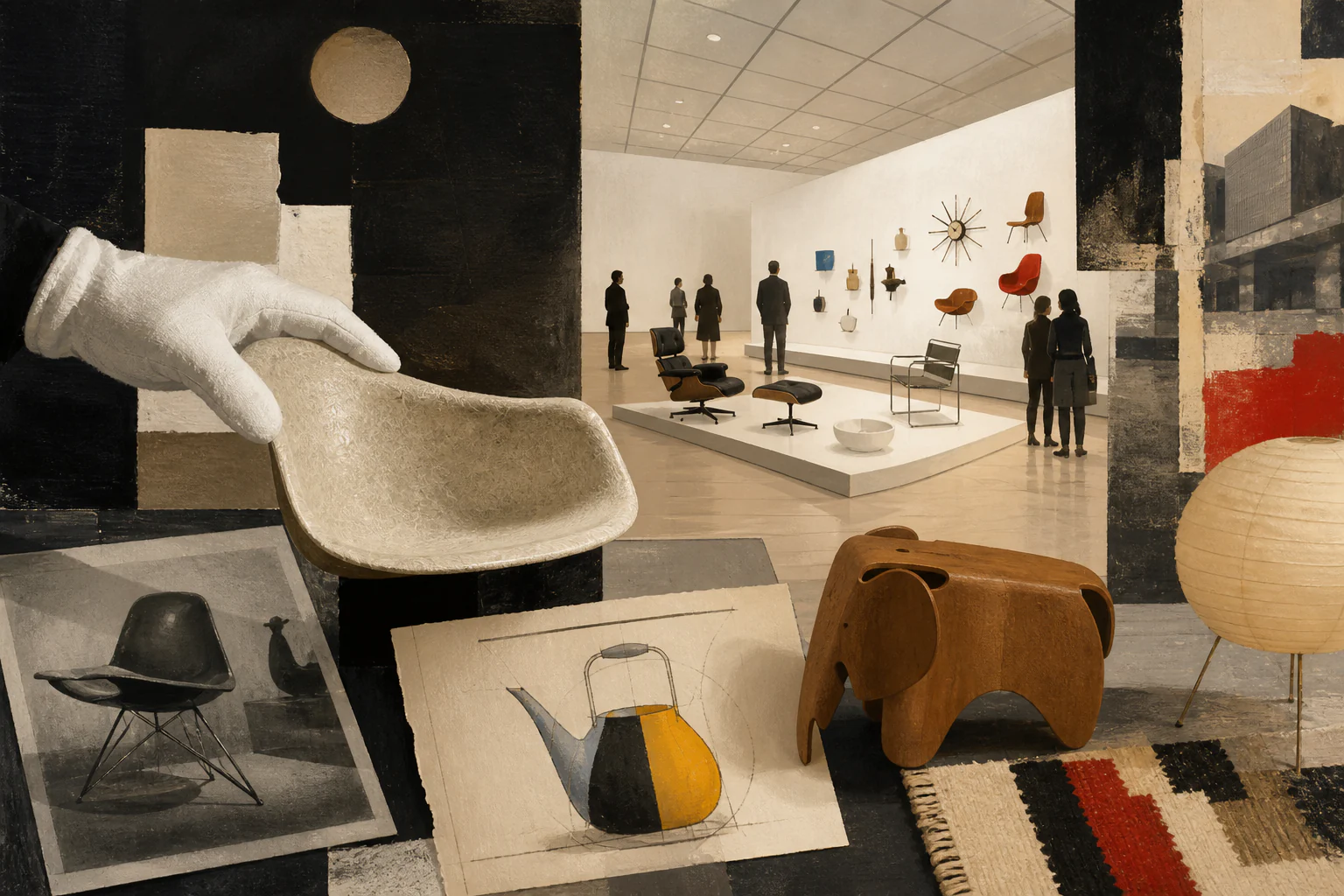
MoMA matters as an institution that not only collected modern design but shaped how the public learned to treat design as cultural history.
1. Research thesis
The museum is interesting not for the composition of its collection but because it created a frame within which an industrial object could be discussed as a cultural phenomenon at all. The frame proved more influential than any particular acquisition.
2. Why this is more than a collection history
The list of exhibits is available and explains little on its own. What is substantive is the procedure: how selection worked, by what criteria, how a label was worded, and how the public was told why a chair belongs beside painting.
3. Historical setup
The institution was founded in 1929, and a dedicated department concerned with architecture and design appeared in the early 1930s. It was the first case of a museum establishing design as an independent curatorial field.
4. The institution as a system
Collection, exhibition, catalogue, store, and education programme worked as one chain. A judgement stated in a gallery was fixed by publication and distributed through retail — a rare completeness of coverage.
5. The exhibition as an act of canonisation
The key instrument is not acquisition but display. An exhibition declares that something deserves attention, and does so publicly, before market or history has confirmed the judgement.
6. Selecting the industrial object
Early exhibitions presented machine parts, laboratory glass, and ball bearings as objects of aesthetic judgement. The operation was radical: it asserted that beauty can be a by-product of engineering calculation.
7. Criterion instead of taste
What mattered was not which objects were chosen but that a criterion was stated: fitness to function, honesty of material, absence of the superfluous. A public criterion can be contested — and that is its value.
8. The good design programme
The postwar programme that selected household objects and linked the museum with retail took the model to its conclusion: the institution did not merely assess but directed purchase. It is the most contested episode in the department’s history.
9. The museum store
Retail of reproductions and selected objects extended the display. It distributed judgement further than any catalogue and simultaneously raised the question of the boundary between assessment and sale.
10. The label as a genre
The museum label taught the description of an object through author, date, manufacturer, and material. That format left the museum and became the standard for describing design everywhere.
11. Attributing the industrial object
Assigning a serial product to a named author was a non-trivial decision. It carried into industry a model of authorship borrowed from art, and it still provokes disputes about the role of engineers and manufacturer.
12. Media and publication
Catalogues turned temporary displays into permanent texts. It was publication rather than the gallery that secured long-term influence: an exhibition is remembered through its book.
13. Expanding the category
Over time the collection took in objects with no physical body: typefaces, interfaces, typographic signs, video games. Each such inclusion reopens the question of what a design object is.
14. The immaterial exhibit
Acquiring a typeface or a sign means acquiring a right and a description rather than an object. This forced the institution to revise the very procedure of conservation and display.
15. Archive and reproducibility
The exhibition history is documented and accessible, so the institution’s judgements can be checked and revised. The publicity of the archive is what keeps the canon contestable.
16. Where the myth begins
The myth begins with the idea of neutral selection. Selection was positional: it advanced a particular version of modernism and left whole traditions, regions, and authors outside the frame.
17. Where the myth blocks analysis
The idea of neutrality prevents design history being read as a result of decisions. It is more useful to treat the canon as a published position with authors, a date, and circumstances.
18. First key example
The architecture and design department is worth analysing as an organisational invention. Creating a curatorial post for the industrial object is the act from which the discipline began.
19. Second key example
The programme selecting household objects is worth analysing as an experiment in joining institutional authority to the market. Its consequences are visible in any museum store today.
20. Comparison with adjacent systems
Unlike a corporate collection, there is independence from the manufacturer here but no access to production. That yields greater freedom of judgement and less technical depth.
21. Link to fashion
Costume collections followed the same path later and met the same questions: how to attribute a serial object and how to display something designed for movement.
22. Link to the image
Museum object photography developed its own genre: even light, neutral ground, absence of context. That genre became the standard image of design and influenced advertising photography.
23. Link to architecture and space
Route and adjacency in the gallery determined meaning as much as the label. Display decisions are part of the argument, though they are rarely recorded in histories.
24. Link to technology
Including digital objects required resolving questions of emulation, format obsolescence, and rights. Conserving the immaterial proved technically harder than conserving furniture.
25. Link to materials
Restoring industrial objects raises the question of permissible replacement: a replaced part preserves appearance but changes the object’s documentary status.
26. Market and logistics
Institutional recognition affects price directly: inclusion in a collection changes auction valuation. The museum does not trade, but its judgement has a monetary expression.
27. Critique and limits
The critique is justified and well documented: the canon was geographically narrow, gender-skewed, and served a particular version of history. Acknowledging this does not void the frame’s value but requires its revision.
28. What has changed today
The monopoly on judgement is gone: platforms, independent researchers, and corporate foundations build reputations in parallel. The institution has become one voice among many, which is on balance healthy.
29. What to connect next
The material links to the entries on the museum, the exhibition, canonical objects, and corporate collections. A separate treatment of the history of canon revision would be useful.
30. Editorial conclusion
The institution created not a list of significant objects but a way of speaking about them: attribution, criterion, label, and public dispute. The method outlived the particular judgements and remains a working instrument.
31. How to read this case today
On meeting a claim about an object’s significance, look for who made it and on what grounds. Design history consists of such claims, and each of them can be checked.