research
Schiaparelli: surrealism as a method for a fashion house
The house that first made artistic collaboration a working procedure rather than a promotional exercise.
Editorial thesis
Schiaparelli matters for carrying the logic of the surrealist object into clothing: an object must violate the expectation of its own category while remaining wearable.
Reader question
How did a house closed for nearly sixty years return with its code intact and recognisable?
Short answer
Because the code was object-based rather than silhouette-based: colour, motif, and device document and reissue more easily than cut. Founded 1927; key figure Elsa Schiaparelli; context Paris.
1. Origin: not a dressmaker but an author of motifs
Elsa Schiaparelli had no dressmaking training and entered fashion from an artistic circle. Her contribution lies in motif, colour, and object, while construction was executed by ateliers — a division of labour characteristic of the whole house.
2. The trompe-l’œil sweater
Recognition began with a knitted sweater of the late 1920s on which a bow was not attached but knitted as an image of a bow. The trompe-l’œil device set the house’s programme: clothing depicts what it is not.
3. Founding the house
The house was founded in Paris in 1927 and quickly took a position opposed to the prevailing line of restrained elegance. The rivalry was substantive: the argument was not about taste but about whether clothing should be witty.
4. Pink as brand property
A saturated pink was established as the house colour with a name of its own. It is an early example of a brand appropriating a colour — a device that became standard in luxury only decades later.
5. Collaboration with artists as procedure
Work with artists of the surrealist circle was organised as regular practice rather than a one-off event. The artist supplied a motif, the atelier solved construction, the house answered for wearability — a distribution of roles the industry still reproduces.
6. Objects as arguments
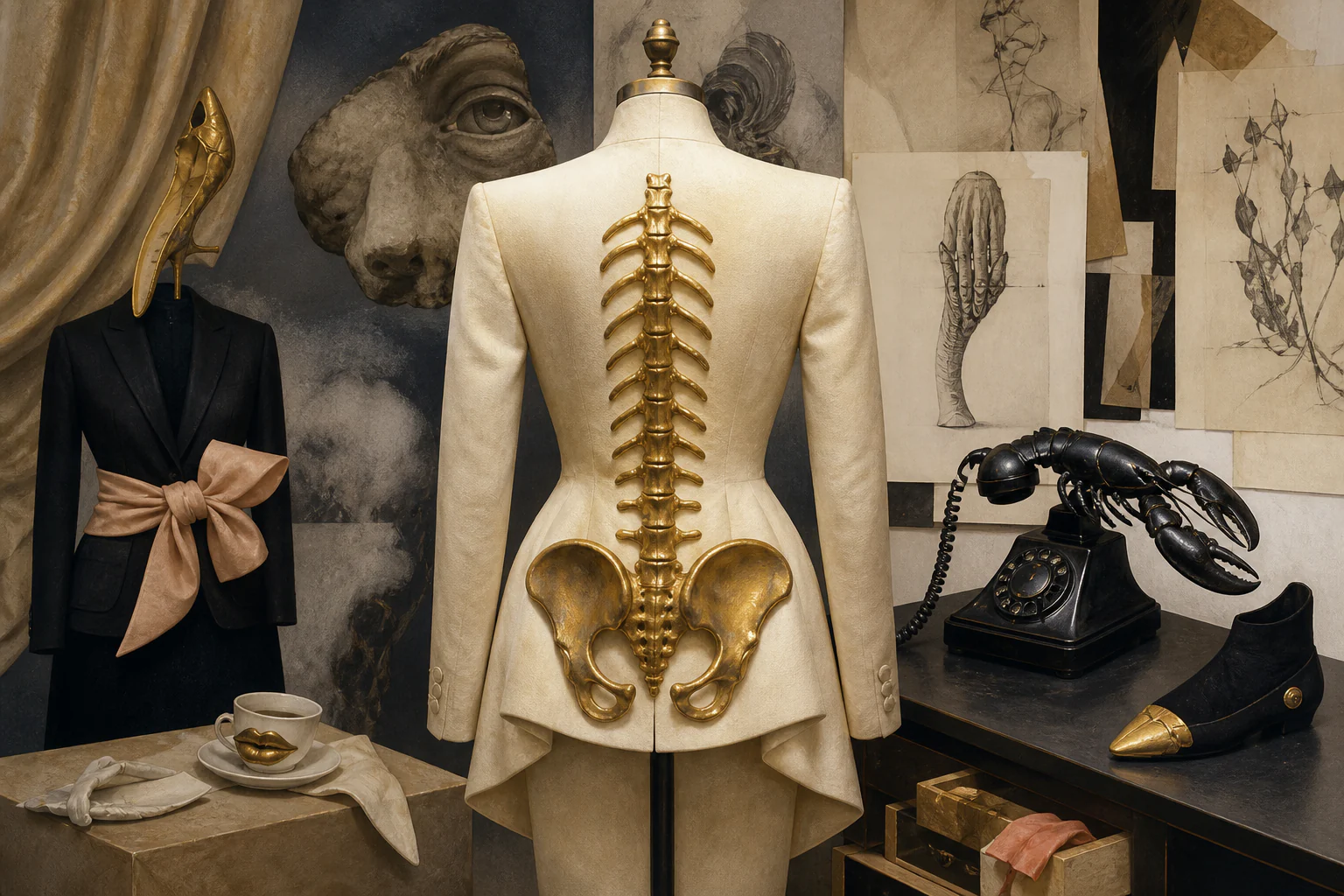
A dress printed with a lobster, a hat shaped as a shoe, and a dress with trompe-l’œil tears operate as surrealist objects: they retain function while destroying categorical expectation. That is why they read as statements rather than as costume.
7. The button as a site of experiment
The house used fastenings as a field of play: buttons shaped as insects, musical instruments, and household objects. A small component proved convenient for radicalism because it does not break a garment’s construction.
8. The evening dress as carrier
Most experiments occur in evening wear, and not by accident: an evening wardrobe permits non-functionality. The category was chosen as the least resistant.
9. The craft base
Behind the wit stands embroidery and atelier work of the highest level. A joke holds exactly to the degree that it is flawlessly executed — otherwise it reads as a defect.
10. Closure
The house ceased operations in the mid-1950s. Postwar taste shifted toward constructive elegance, and wit as a primary strategy stopped finding a buyer.
11. The archive as a condition of return
The long interruption did not destroy the brand because objects survived in museum collections, along with photographs and documentation. The return was made possible by the archive rather than by memory.
12. Revival in the 2010s
The house was relaunched by an Italian owner in the early 2010s. The first seasons ran as a series of guest authors, an honest strategy: the code was tested for transferability before permanent leadership was appointed.
13. The current direction
From the end of the 2010s creative direction has been held by Daniel Roseberry. His line strengthened the sculptural and jewellery component and returned the house to a position in the haute couture schedule.
14. Why the code survived the interruption
A silhouette dates; a motif does not. The house rests on devices applicable to any silhouette: trompe-l’œil, the anatomical detail, the appropriated colour. This explains its durability better than any appeal to the founder’s genius.
15. Critical questions
The critique is justified: the surrealist device easily degenerates into an attraction for the camera, and the house’s contemporary couture functions largely as a machine producing red-carpet imagery. The wearable part of the range stays in the shade.
16. How to read this house today
Separate motif from execution. A surrealist device is tested not by its idea but by its seam: if a piece is witty and flawlessly built, the method is working; if it is only witty, what is working is a prop.