research
The Face
Youth culture, style and the magazine as a visual laboratory
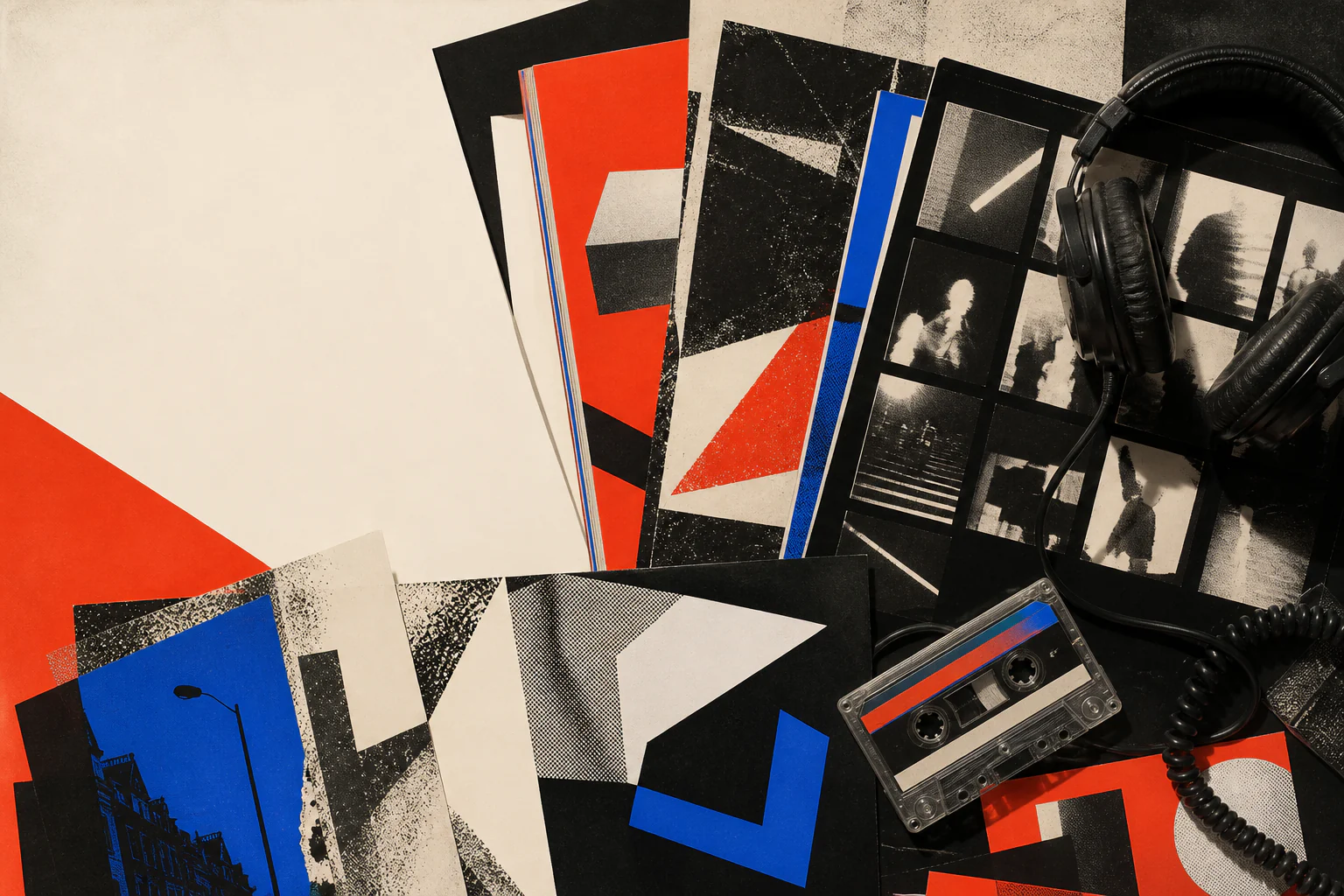
The Face turned the magazine into a radar for youth culture: music, fashion, photography, typography, club life and social subjects gathered into one visual system.
Editorial thesis
The Face matters not because it was “cool”, but because it turned the magazine into a radar for youth culture: a printed system where music, fashion, photography, typography, club life and social questions formed one living visual language.
Reader question
How can a magazine not merely describe style, but create the way an era sees music, youth, clothing and the face of culture?
Short answer
The Face created a magazine model in which style became a way to analyze society. Nick Logan gave the format an editorial frame, Neville Brody turned typography into voice, photographers and stylists made youth culture visible, and the archive now shows how the printed page could operate before the digital feed.
alt_note: Alt text describes the visual function: typography, portrait, youth scene, cover, spread or diagram.
1. 1980: Nick Logan launches a magazine between music, style and the street
The Face appeared in May 1980 as Nick Logan’s project after NME and Smash Hits. He was not simply making another music magazine in a narrow sense. The central idea was that youth culture no longer fit inside one discipline: music turned into clothing, clubs into photography, street style into graphic language, and pop stars into part of a wider visual economy. From the start, The Face was therefore not just a title but a way of reading culture as a network of signals.
2. After NME and Smash Hits: why The Face had to be different
Logan’s experience matters: NME gave him an understanding of music journalism and audience; Smash Hits gave him an understanding of mass pop format; The Face became the attempt to assemble a more adult, visually ambitious magazine. Its reader did not necessarily want only a record review; they wanted to understand how the moment looked. The editorial model was therefore built around intersections: what people listened to, where they danced, how they dressed, which films they watched, and which images began to feel new.
3. The first issue: music as the core, but not the border
The first issue of The Face appeared as a magazine with music at its center, but without the usual border between music and the rest of culture. The Face’s own archive stresses the first issue date of May 1980. This matters for VANSMITHLAB: the magazine was not a late reaction to the gloss of the 1990s, but emerged when post-punk, New Romantic culture, club life and independent publishing energy were still forming a new visual vocabulary.
4. The style magazine: a new genre rather than a standard music title
The Face is often described as a style magazine, but style here does not mean clothing alone. It is a system of signs: hair, posture, district, record sleeve, nightclub, typography, photography, slang and attitude toward power. The Face became important because it made style a serious subject of reading without turning it into an academic lecture.
5. London after punk: culture is assembled from clubs, shops and images
London after punk was not a backdrop for the magazine, but a production environment. Culture was made in clubs, shops, small studios, music scenes, fashion colleges and by people who could simultaneously be musicians, models, stylists, photographers or promoters. The Face did not simply describe this environment; it helped it see itself. The magazine became a mirror, but an active mirror: it did not only reflect the signal, it amplified it.
6. Neville Brody: typography becomes the voice of a generation
Neville Brody joined The Face in 1981 and sharply changed the feeling of the magazine. His typography was not a neutral container for text: letters became event, rhythm, conflict and voice. A key precision is that Brody did not make the magazine “chaotic” in a simple sense. He created a new order in which rupture, scale, displacement and tension functioned as compositional discipline. Because of him, The Face became recognizable before it was even read.
7. The grid breaks, but discipline remains
The modernist grid did not entirely disappear in The Face; it was put under pressure. Headlines could behave as graphic objects, columns could violate expectation, and empty space could become an active pause. But all of this was held by editorial intention. The Face should therefore be read not as anti-design, but as a magazine testing how far familiar rules could be moved so that the page came closer to music, club and street.
8. The cover as a sign of the moment, not just a celebrity portrait
The cover of The Face often worked not as an official celebrity portrait, but as a sign of a cultural moment. The person on the cover became an entry point into a broader mood: a new sound, a new body type, a new gesture, a new conflict or a new subculture. The same figures looked different in The Face than in traditional gloss. The magazine did not merely confirm fame; it changed its visual temperature.
9. The Face and the language of new British photography
In The Face Magazine: Culture Shift, the National Portrait Gallery emphasized the magazine’s role in creating contemporary culture and in launching the careers of photographers and stylists. For the history of the image, this is crucial. The Face was not simply a place to publish ready-made fashion pictures; it created conditions in which photographers could radically reshape the language of fashion photography, portraiture and youth documentation.
10. Nick Knight: fashion photography becomes a dramatic system
Nick Knight was one of the photographers through whom The Face brought fashion closer to theatre, drama and experiment. His images for the magazine combined styling, hard light, unconventional posture and the sense that clothing is part of a staged event. Unlike calm catalogue presentation, fashion photography here became a field of tension. Model, clothing, background and page graphics worked together as one visual system.
11. Ray Petri and Buffalo: style as casting, posture and social code
Ray Petri and Buffalo became one of The Face’s most important examples of how style could be built not from above, by a fashion house, but from below: through casting, bodily attitude, mixed cultural codes and street energy. Buffalo was not merely a look or trend; it was a system of relations among models, styling, race, class, club culture and photography. The magazine made that system visible and influential.
12. Kate Moss and the image of a new 1990s model
In the early 1990s The Face helped shape the visual perception of Kate Moss as a new kind of model. Her image differed from the monumentality of the preceding supermodel era: less distance, more everydayness, fragility, uncertainty and documentary feeling. This should not be reduced to one face. The Face was working with a broader shift: fashion was less often an unreachable stage and more often a picture of young people inside real urban culture.
13. Corinne Day, Elaine Constantine and the anti-gloss of everyday life
Photographers such as Corinne Day and Elaine Constantine strengthened the magazine’s anti-gloss line. Their images could feel closer to life, leisure, bodily awkwardness, the beach, street, room or chance encounter. That did not mean a lack of style; rather, style became less polished and therefore more convincing. The Face showed that fashion photography could be alive, noisy, imperfect and still extremely precise.
14. The magazine as a school for photographers, stylists and writers
The Face often worked as a school without an official curriculum. Photographers, stylists, writers, designers and editors were given room to experiment because the magazine needed not safe illustration but a new way of seeing. The National Portrait Gallery listed more than 80 photographers in its exhibition, including Sheila Rock, Stéphane Sednaoui, Corinne Day, David Sims, Elaine Constantine and Sølve Sundsbø. That shows the magazine’s scale as a production environment.
15. Music, fashion, film and politics on the same page
One of The Face’s central distinctions was its ability to place music, fashion, film, club life, politics and social questions on the same editorial plane. It did not maintain a rigid division between the serious and the supposedly unserious. A story about style could speak about class, race, sexuality or the city; a piece on music could become a piece on clothing; a photograph could be document, advertising seduction and cultural criticism at once.
16. Coventry 1981: social reporting inside a style magazine
The archive story This Town, on Coventry in 1981, shows that The Face was not limited to the surface of style. The magazine could enter questions of racial tension, youth violence, 2 Tone and urban politics. This is an important corrective to the myth of the magazine only as a machine of cool. Its strength was that style was not separated from social reality: clothing, music and street energy were read as symptoms of the time.
17. New Life in Europe: the magazine thinks as an international network
In 1983 The Face published New Life in Europe, an international issue created with several European magazines. This episode matters as an early model of network thinking: the magazine understood youth culture not as a purely British story but as an exchange of signals between cities. The Face saw Europe through music, fashion, design and club life: cultural infrastructure before digital platforms.
18. 1988: issue 100 and the self-awareness of an archive
The 100th issue in 1988 showed that The Face had already become aware of itself as an archive. It did not only continue its monthly rhythm; it could look back at its own covers, figures and visual codes as cultural material. For VANSMITHLAB this is an important threshold: the magazine becomes a historical object before it has closed. It already understands that it is creating not only news, but memory of how an era looked.
19. Lee Swillingham, Stuart Spalding and the later visual era
In the 1990s the magazine’s visual line was developed by Lee Swillingham, Stuart Spalding and other editorial authors. That era should not disappear behind Brody’s shadow. If the 1980s are often tied to a typographic explosion, the 1990s strengthened the photographic, club and fashion dimensions. The Face remained a laboratory, but the laboratory shifted from graphic revolution toward images of rave, Britpop, a new model and globalizing youth culture.
20. The 1990s: club culture, Britpop, rave and a new youth map
In the 1990s The Face became a map of shifting scenes: acid house, rave, grunge, jungle, Britpop, new fashion, new photographers and new ways to speak about body and fame. The magazine did not merely list trends; it showed how they intersected. That is what separated it from a fashion catalogue or a music paper. The Face was an editorial mixer: it combined the incompatible until it began to look like the language of the time.
21. Why The Face was not merely “cool”
The word “cool” is too narrow for The Face. The magazine was not only about attractive distance. It was also about risk, awkwardness, social conflict, sexuality, class, racial visibility and visual experiment. Its influence did not depend on declaring something fashionable, but on recognizing a future cultural form before it became safe and marketable.
22. 2004: the end of a cycle of printed youth authority
The closure of The Face in 2004 marked the end of a particular cycle of printed youth authority. By then the media environment was already changing: the internet, audience fragmentation, pressure on magazine business models and the rise of faster digital channels altered how culture circulated. The Face did not close because its language suddenly became obsolete, but because the infrastructure that made a monthly magazine a primary cultural radar was changing.
23. Remembering the magazine: The Story of The Face
Paul Gorman’s The Story of The Face: The Magazine That Changed Culture fixed the magazine as an object of historical analysis. Thames & Hudson presents it as a magazine that changed culture, not just as a successful title. This is a moment of canonization: The Face moved from the newsstand and teenage bedroom into the space of books, archives, museums and research conversations about visual culture.
24. 2019: Wasted Talent returns The Face to print and online
In 2017 Wasted Talent acquired the rights to The Face, and in 2019 the magazine returned online and in print. That relaunch was risky: a brand with strong mythology can easily become a nostalgic souvenir. The central question for the new The Face was therefore not whether it could repeat the 1980s, but whether it could again create an editorial environment that detects young culture before it is fully commercialized.
25. The relaunch as a multimedia platform
The 2019 relaunch was not conceived only as the return of a printed magazine. The new The Face worked through a website, print issue, video, audio, social channels and commercial collaborations. This does not cancel print; rather, the printed issue becomes a rarer, collectible and slower object inside a multi-format system. The magazine returns as a platform, but it must keep proving that a platform is not merely a content feed.
26. Matthew Whitehouse and the contemporary editorial tone
On The Face website in 2024-2025, Matthew Whitehouse is identified as editor-in-chief in editor’s letters and materials around the print issues. This article records that with a check date, because contemporary mastheads can change. The current The Face should not be personalized too rigidly: it operates as a collective editorial system in which print, site, fashion, music, photography and commercial partnerships work at once.
27. 2025: The Face Magazine: Culture Shift and museum recognition
In 2025 the National Portrait Gallery staged The Face Magazine: Culture Shift. It covered photographs from The Face between 1980 and 2004, included more than 200 images, and featured the work of more than 80 photographers. This museum recognition shows the magazine’s double fate: once a device for detecting the present, it has itself become archival and exhibition material. The risk is obvious: the radical magazine becomes cultural heritage.
28. The archive as a living visual library
The archive of The Face lives not only in the museum vitrine. It continues to function as a visual library for designers, photographers, stylists, publishers and AI image-makers. Covers, spreads, typography, casting and tone offer material for studying how a magazine creates a scene. But the archive should not be used as a set of effects. The social energy must be understood first; only then can the visual signs be used intelligently.
29. The risk of legacy: can a canonized magazine remain radical?
The main danger of The Face’s legacy is that it can be turned into style without risk: large typography, rough photography, young faces and club references. But the magazine was not powerful because it had a set of tricks. It was powerful because those tricks answered a real cultural speed. After canonization, the task becomes harder: do not copy The Face; understand where an equally unstable and still-unformed signal is emerging now.
30. The central legacy: a cultural radar before the digital feed
The central legacy of The Face is the magazine as cultural radar before the digital feed. It assembled people, scenes, faces, clothes, music, design and social questions into one montage that helped the reader understand what was happening now. For VANSMITHLAB it is a key node between graphic design, fashion, photography, music and media: The Face shows that a magazine can be not a container for content, but a machine for detecting culture.