research
Ulm: design after heroic modernism
An attempt to replace the heroic gesture of modernism with method, research, communication, and designer responsibility.
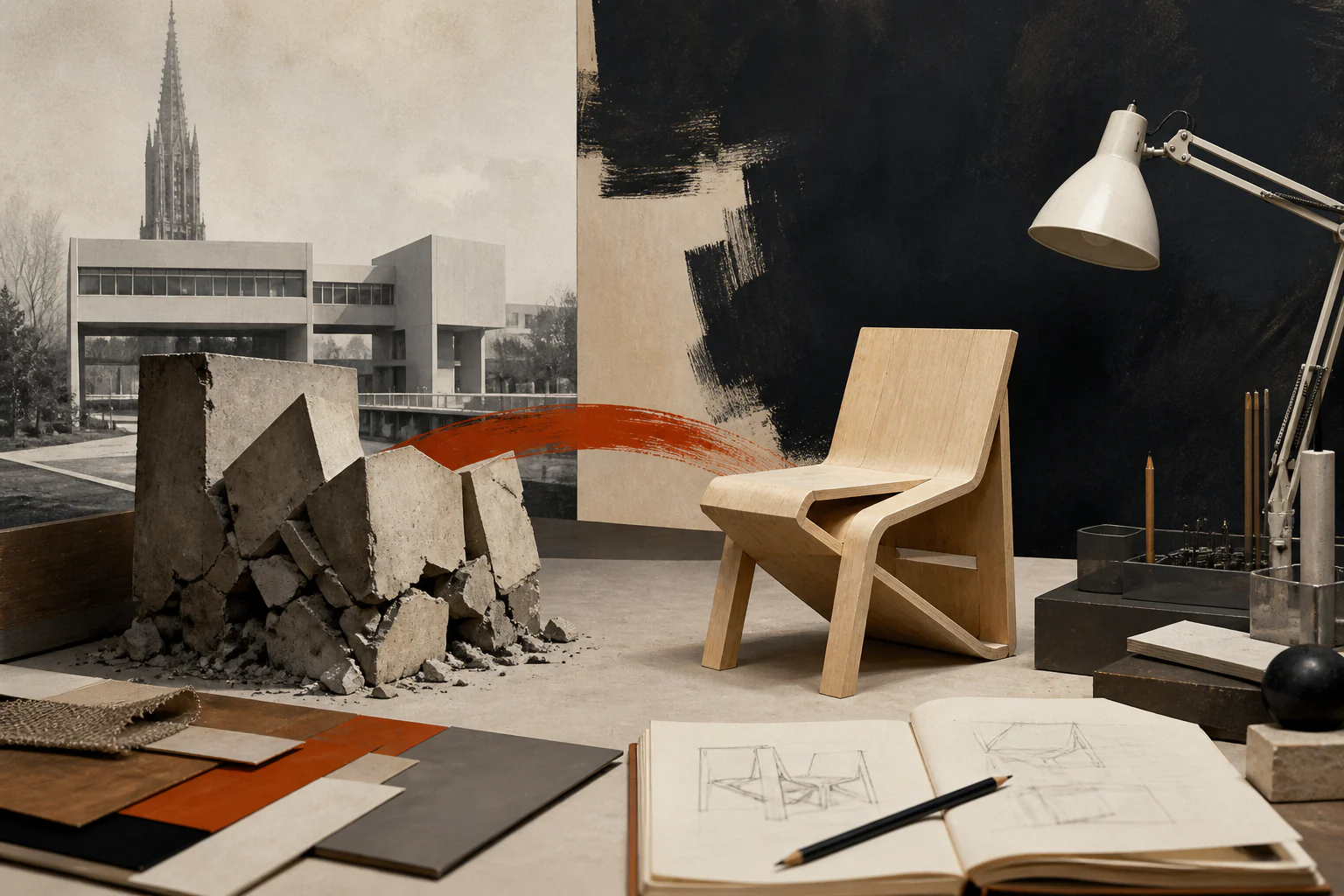
Ulm matters as an attempt to replace the heroic gesture of modernism with method, research, communication, systems, and designer responsibility.
1. Research thesis
The Ulm school is interesting as a deliberate attempt to strip design of authorial heroics. Instead of intuition it proposed method, measurement, and justification — and the school tested whether the profession could survive such a rebuild.
2. Why this is more than an episode in school history
The school operated for roughly fifteen years and closed. But its programme described a conflict that remains unresolved: whether a designer should be an author or a researcher.
3. Historical setup
The school was founded in the early 1950s in postwar Germany and closed at the end of the 1960s. Its founding was connected to the memory of resistance to Nazism, which gave the project a distinct ethical dimension.
4. Inheritance and rupture
The first rector came from the tradition of the earlier school, and at first the programme continued it. Then came a rupture: the artistic component was displaced by a scientific one, prompting the resignation of some founders.
5. The school as a system
The curriculum included mathematics, ergonomics, sign theory, sociology, and economics alongside design. A designer was expected to justify a decision in the language of adjacent disciplines.
6. Method instead of gesture
The central idea: a design decision should be derived from analysis rather than offered as a discovery. This sharply reduced the role of taste and raised the role of procedure — and therein lay the school’s main provocation.
7. Sign theory in design
Introducing semiotics allowed an object to be discussed as a message: what exactly the form of a button, a scale, or a housing signifies. That vocabulary later proved necessary for screen interfaces.
8. Ergonomics as a required discipline
Measuring the body and its capacities moved part of the decision-making into verifiable territory. Where proportion had been argued about, a table appeared — and the argument changed character.
9. The object layer: the stool as programme
A multifunctional stool developed in the mid-1950s served as seat, stand, shelf, and tray. It was less an object than a demonstration of the principle of economy of means.
10. The information department and communication
The strand concerned with communication treated a message as a designed system: sign, sequence, channel, and receiver. This anticipated the contemporary understanding of information design.
11. The link to production
Collaboration with an industrial manufacturer gave the school a rare opportunity to test its method in serial production. Without that link the programme would have stayed academic.
12. Sign systems for public space
Work by graduates and teachers on sign systems demonstrated the method’s strength in tasks where unambiguity matters more than expression. Here the research approach yielded a clear advantage.
13. Media and publication
The school published its own journal in which the method was set out and debated. Publication ensured the programme spread beyond a small number of graduates.
14. The economy of form
The method promised reduced risk: a justified decision less often needs redoing. But it also lengthened and raised the cost of the research stage, which sat badly with market schedules.
15. Canon and museum
The legacy is preserved in a specialised archive and in museum collections. It is less spectacular than that of the preceding school and therefore less known to a wide public.
16. Archive and reproducibility
Curricula, diploma projects, and correspondence are available, so the programme can be studied as a document rather than as recollection. For a methodological school that is especially appropriate.
17. Where the myth begins
The myth begins with an image of pure rationalism. In fact the school was shaken by ideological conflicts, and some decisions were made on exactly the taste-based grounds it rejected.
18. Where the myth blocks analysis
A reputation for dryness obscures the fact that the school raised the question of designer responsibility earlier than most. That contribution matters more than its formal language.
19. First key example
The stool is worth analysing as an argument about multifunctionality: one object instead of four, arrived at by analysing uses rather than by searching for a form.
20. Second key example
Sign systems are worth analysing as a case where the method won outright. In navigation problems verifiability matters more than authorial signature, and the school proved it.
21. Comparison with adjacent systems
Compared with the preceding school, the difference lies in the source of a decision: there, workshop and material; here, research and justification. The second transmits better and inspires less.
22. Link to fashion
The method takes poorly in fashion, where the unjustified decision is precisely what is valued. But its ergonomic and sizing component transferred completely and operates in garment manufacture.
23. Link to the image
The demand for unambiguity shaped the language of the pictogram and the diagram. It is the direct ancestor of contemporary information graphics.
24. Link to architecture and space
The school building was designed by its own principles: clear structure, no representational gesture, priority to the working process. The building illustrated the programme.
25. Link to technology
The school’s systems thinking became relevant precisely when complex technical products appeared. Its vocabulary served the generation that designed interfaces.
26. Link to materials
The attitude to material was applied: it was chosen for measurable properties rather than for expressiveness. This distinguished the school from the craft tradition.
27. Market and logistics
An orientation to serial production required costing and tooling to be counted from the start. Economics entered the brief rather than assessing the result after the fact.
28. Critique and limits
The critique is justified: the method did not abolish taste-based decisions but hid them behind procedure; the school could not secure stable funding; and its output had no broad market success.
29. What has changed today
The research stage has become normal in digital design: testing, metrics, and hypothesis justification. The school’s programme was largely realised in an industry that did not exist in its lifetime.
30. What to connect next
The material links to the entries on the Bauhaus, on product systems, on pictograms, and on design systems. An analysis of the boundary between justified and taste-based decisions would be useful.
31. Editorial conclusion
The school posed the right question and gave a partial answer. Method does transmit better than taste, but it does not replace a decision — it only makes the decision discussable.
32. How to read this case today
When reading any "research-led" design process, check where the research actually affected the decision. Often it dresses a decision taken earlier — and the school demonstrated that too.