research
Valentino: the Roman atelier as a couture system
The house that proved couture standing can rest on a craft base outside Paris.
Editorial thesis
Valentino matters as a case of couture’s geographical independence: a Roman atelier and Roman embroidery tradition gave the house a standing that normally requires a Paris address.
Reader question
What holds together a house whose founder left nearly two decades ago and whose leadership has since changed three times?
Short answer
The atelier, the colour, and embroidery technique — a production base rather than an authorial signature. Founded 1960 by Valentino Garavani and Giancarlo Giammetti; context Rome.
1. Origin: Paris training, Roman base
Valentino Garavani trained and worked in Paris and opened his house in Rome. That combination determined everything: a French school of cutting was laid over Italian craft and embroidery infrastructure.
2. The role of the business co-founder
Giancarlo Giammetti took on the commercial and institutional side. From the outset the house was structured as a pair — author and manager — and that construction explains its longevity better than any individual collection.
3. Red as an appropriated colour
A saturated red is established as the house shade with a name of its own. This is not a promotional device: a specific red demands particular work with dyeing and with show lighting.
4. The white collection as statement
An entirely white collection at the end of the 1960s showed the reverse strategy: abandoning colour altogether to present cut and finish. The house demonstrated command of both colour and its absence.
5. The atelier as load-bearing structure
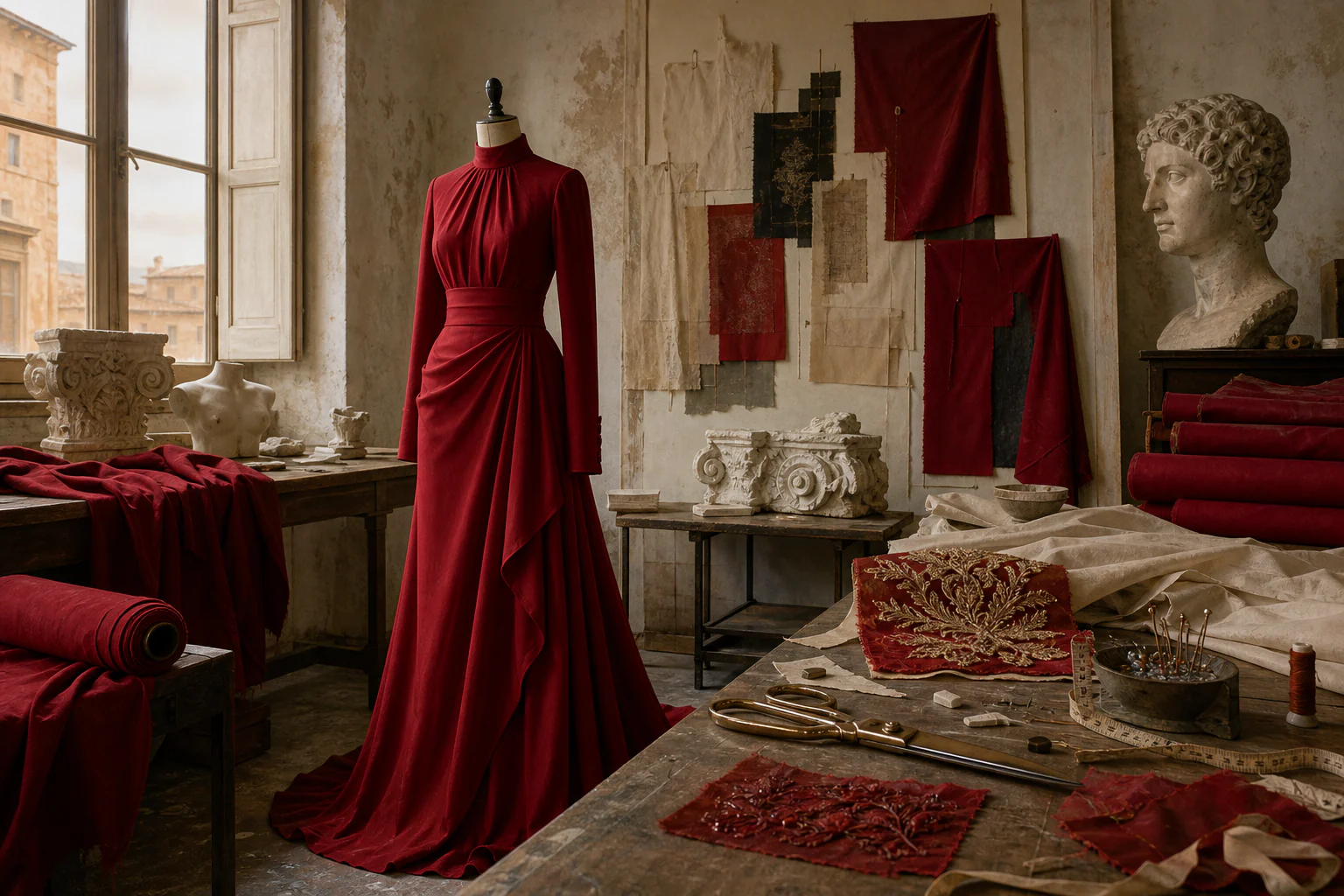
A couture atelier with a permanent staff of makers is the house’s principal asset. It outlives creative directors, holds technique, and guarantees reproducible quality regardless of who draws the collection.
6. Embroidery and hand techniques
Pleating, appliqué, lace, and hand embroidery form the house’s technical vocabulary. These operations are measured in hours per garment, and they constitute the difference between couture and expensive ready-to-wear.
7. Clientele as a production condition
Couture exists while there are clients prepared to accept fittings and lead times. The house’s Roman position gave it a client base of its own, not overlapping with the Parisian one — a commercial rather than a stylistic independence.
8. The red carpet as channel
The house began working with the film industry early, and the evening dress became the principal carrier of reputation. It is a channel with high return and high risk: one image makes or breaks a season.
9. The founder’s departure
Garavani left the house at the end of the 2000s. The moment was arranged as a controlled handover rather than a crisis, which distinguishes the case sharply from houses that lost an author abruptly.
10. The duo as a transitional form
The next leadership was a pair: Maria Grazia Chiuri and Pierpaolo Piccioli worked together for nearly a decade. The paired structure lowered the risk of a break with the atelier and allowed techniques to be preserved.
11. Sole leadership and a colour shift
After the duo split, Piccioli led the house alone and in the early 2020s presented a collection built entirely on a single saturated pink. The device repeated the logic of the house red, applied to a new shade.
12. A change of ownership and capital structure
The house passed to a Qatari fund, and in the early 2020s a major French group acquired a significant stake. The change in capital structure preceded the change in creative leadership, and the order is telling.
13. The current direction
From 2024 Alessandro Michele has been appointed creative director. His arrival marks a turn toward decorative excess and citation, notably diverging from the preceding line of austere colour and volume.
14. Why the house outlives its authors
Continuity is secured not by a signature but by three transferable assets: the atelier, the technique, and the appropriated colour. All three are documented and transmissible, so a change of author alters the surface rather than the foundation.
15. Critical questions
The critique is justified: dependence on the red carpet makes the house vulnerable to shifts in the celebrity system, and frequent leadership changes under new owners raise the question of who actually sets the line — the author or the shareholder.
16. How to read this house today
Look at the atelier rather than the signature. A couture house’s durability is measured by its number of makers and the survival of its techniques; a collection is what can be assembled from them in a given season.