research
Vogue
Fashion, Photography, and the Magazine as an Editorial System of Influence
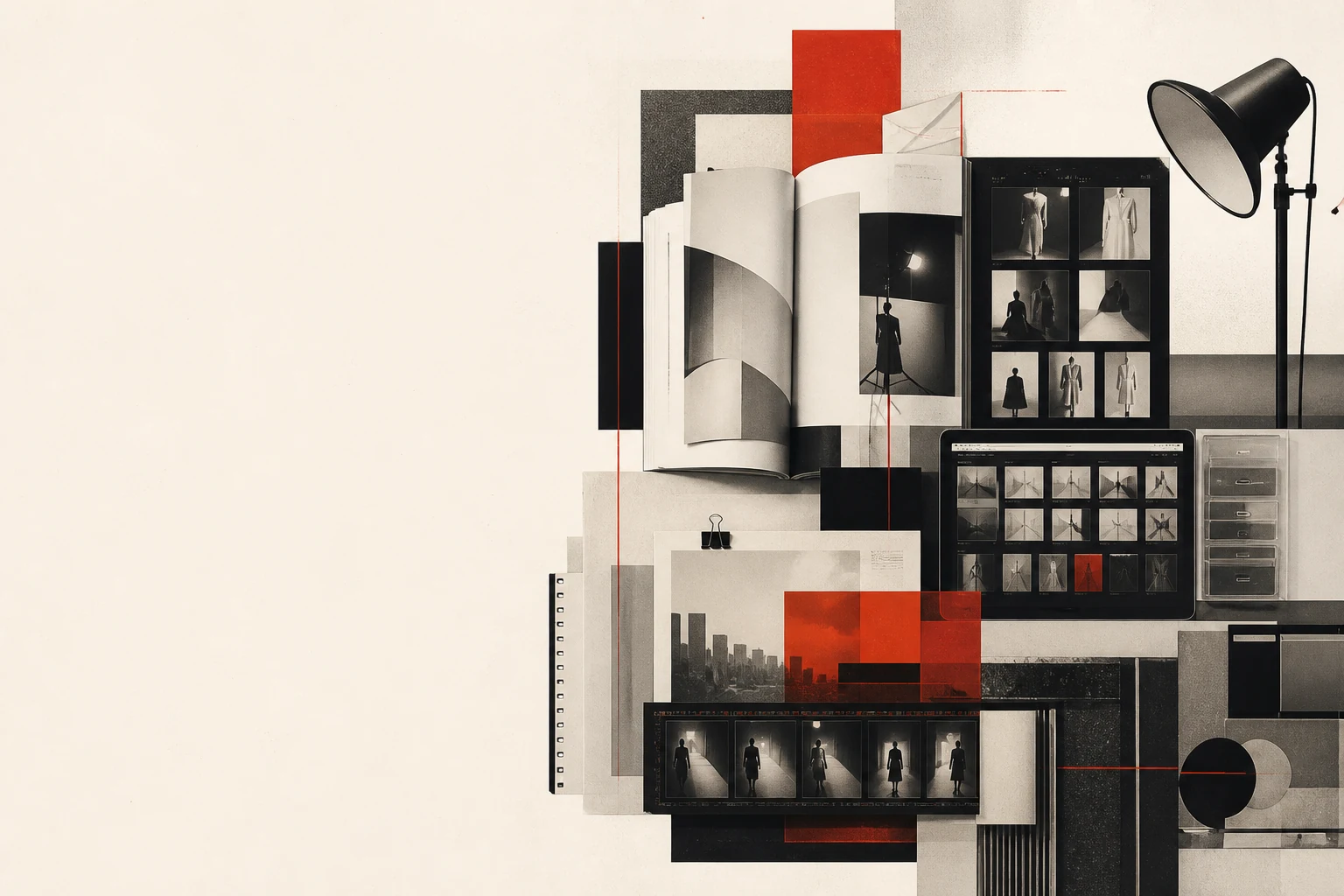
Vogue matters not only as a fashion magazine. Across more than 130 years it became a machine for selecting, producing, and distributing images—connecting fashion, photography, graphic design, advertising, celebrity culture, archive, digital databases, and public events. Its history shows how an editorial system can turn seasonal content into cultural memory.
Editorial thesis
Vogue is best studied not as a sequence of famous covers but as editorial infrastructure. Its influence emerges from the connection between publishing economics, print technology, photography, fashion editing, art direction, talent systems, advertising, and later digital platforms. [source]
Reader question
When does a magazine stop being merely a carrier of images and begin deciding which images society considers important?
Short answer
When an editorial organization connects production, selection, repetition, archive, and the allocation of attention into one system. Vogue did this through print and photography, then through global editions, digital publishing, Runway, archive, and events. [source]
1. 1892: Vogue begins not with the runway but with New York society
The first issue of Vogue appeared on December 17, 1892. It was a weekly journal of New York society, manners, leisure, and dress rather than a specialist report on a modern fashion industry. 14 That origin matters: early Vogue is useful as a document of a social system in which clothing signaled class, ritual, belonging, and a way of life.
2. Josephine Redding and the early voice: the magazine already argues with fashion
Vogue’s first editor, Josephine Redding, did not treat fashion as an unquestionable truth. Vogue’s own archive recalls her sharply mocking the artificial “humps” of late-nineteenth-century silhouettes. 14 The critical instinct is important: authority came not only from showing a trend, but from claiming the right to judge it.
3. 1909: Condé Nast buys Vogue and changes the economics of attention
In 1909 Condé Montrose Nast bought Vogue and made it the nucleus of a new publishing model. Condé Nast describes the acquisition as the beginning of the company, while MoMA emphasizes Nast’s focus on an informed, affluent, visually demanding audience. 14 This was more than a change of owner: Vogue became special-interest media, where a smaller but deeply engaged readership could be commercially and culturally more valuable than mass circulation.
4. Print as prestige technology: paper, bleed, and illustration
For Vogue, printing technology was part of the brand long before digital platforms. Condé Nast’s timeline specifically marks its pioneering use of bleed printing in 1924, allowing the image to run beyond the page edge instead of feeling inserted into text. 14 Paper, color, illustration, and reproduction quality produced a physical sense of luxury: editorial design worked alongside editorial content.
5. 1916: British Vogue and the birth of an international model
British Vogue launched in 1916; Condé Nast calls the company the first publisher to establish international editions. 14 The significance is not expansion alone. Vogue began operating as a network in which one brand translated fashion across markets, languages, and local cultural codes.
6. 1920: Paris Vogue turns the network into cultural exchange
The Paris edition launched in 1920, strengthening Vogue’s connection to the city where haute couture shaped the international fashion calendar and its hierarchy. 14 Yet an international model did not mean total uniformity. Strong local editions became laboratories in their own right, so Vogue is better understood as a family of editorial interpretations than a single magazine in translation.
7. The age of illustration: the cover becomes an artwork in its own right
Before photography became dominant, Vogue built visual authority through artists and illustrators. The Condé Nast archive and later histories preserve work by Helen Dryden, George Wolfe Plank, Eduardo Garcia Benito, Salvador Dalí, and others. 14 A cover did not need to document a dress literally; it could invent the mood of a season, a type of woman, or an autonomous visual world.
8. Photography enters Vogue: Edward Steichen and a new credibility
Edward Steichen helped make fashion photography a central language of Vogue. MoMA treats the magazine as a pioneer in publishing modern photography, while the V&A links the rise of fashion photography to the growth of illustrated magazines in the early twentieth century. 14 The camera brought presence and material detail, but quickly proved it could be as constructed and theatrical as drawing.
9. 1932 and 1936: photographic cover and full color are two different milestones
Vogue dates its first photographic cover to July 1932, when Edward Steichen photographed a swimmer with a beach ball. 14 Condé Nast’s corporate timeline separately identifies 1936 as the first full-color photographic cover. [source] Those claims should not be collapsed: photography on a cover and full-color photographic reproduction are distinct technological milestones.
10. Surrealism in the magazine: fashion meets the avant-garde
In the 1920s and 1930s Vogue actively brought modern art into its pages. The V&A notes the proximity of fashion to Salvador Dalí, Giorgio de Chirico, Man Ray, and Surrealist photographic techniques. 14 Fashion imagery could now be more than product communication: it could operate as optical puzzle, dream, absurdity, or cultural quotation.
11. Edna Woolman Chase: the editor as discipline and standard
Edna Woolman Chase led American Vogue for decades and helped establish a culture of strict editorial responsibility. Histories of fashion photography preserve her insistence that artistic effect should not obscure the dress. 14 That tension remains fundamental: the image must be strong enough to become culture and clear enough to remain fashion communication.
12. The magazine does more than show clothes: theater, literature, art, and society
MoMA emphasizes that under Condé Nast, Vogue published not only couture but writing and imagery about contemporary art, theater, literature, and photography. 14 That model survived changing eras: fashion becomes a lens through which the magazine views a wider world. Vogue is therefore most powerful not as a clothing catalogue but as a cultural montage.
13. Alexander Liberman: modernism becomes editorial infrastructure
Alexander Liberman arrived at Condé Nast from European magazine culture and made modernism an operating method. Vogue remembers him as art director and later editorial director, combining Constructivist discipline with the pragmatics of a large publishing organization. 11 His influence was not a single page style; it was a system for selecting photographers, images, layouts, and talent.
14. How an image is made: photographer, fashion editor, and art director as a system
V&A archival footage of Horst at American Vogue shows image-making as a collective process: model, photographer, assistants, fashion editors, art director, and layout team make interdependent decisions. 8 This corrects the myth of the lone genius. Strong magazine photography is often the output of a well-tuned editorial machine.
15. Irving Penn: studio, silence, and a new intellectual luxury
Irving Penn began working with Vogue under Alexander Liberman and remained connected to the magazine for roughly six decades. The Met shows how his controlled studio, attention to gesture, surface, and composition turned fashion imagery into an independent photographic culture. 11 In Penn, luxury rarely depends on excess decoration; it emerges from precision of seeing.
16. Fashion photography sells not an object but an imagined life
The V&A quotes Penn’s description of fashion photography as “selling dreams, not clothes.” 14 The phrase helps explain Vogue’s influence: the magazine sells not only a particular dress but a scenario of personality, body, space, and time. That is why a fashion editorial can outlive the product season and persist as a cultural image.
17. Jessica Daves: the 1950s, ready-to-wear, and a broader view of modernity
Jessica Daves led Vogue from 1952 to 1962. Vogue describes her editorship as more realistic and attentive to ready-to-wear, technology, culture, and women’s changing lives. 13 Against the golden age of couture, this was an important adjustment: the magazine learned to connect high fashion with the modernization of everyday life.
18. Diana Vreeland: Vogue becomes a theater of fantasy and cultural scale
Diana Vreeland joined Vogue in 1962 and became editor in chief of the American edition in 1963. Her era intensified travel fantasy, exotic locations, youth culture, theatrical image-making, and risk-taking fashion narratives. 14 She demonstrated that a fashion editor could do more than respond to culture: she could stage a cultural arena in which designers, models, and ideas became significant.
19. The magazine as a talent machine: whom Vogue sees, the industry begins to see
For decades Vogue has acted as a filter and amplifier for photographers, models, stylists, writers, and designers. The careers of Frances McLaughlin-Gill, Irving Penn, and many others show the role of editors and art directors in creating opportunity. 10 The magazine is therefore not a neutral mirror of the industry: its selections can accelerate the making of a canon.
20. Grace Mirabella: the working woman changes the editorial tone
Grace Mirabella led Vogue from 1971 to 1988. Vogue’s own retrospective connects her era with practicality, American ready-to-wear, careers, health, and an image of women living beyond the social ritual of fashion. 15 The move from Vreeland to Mirabella shows how radically a magazine can change tone without changing its name.
21. 1988: Anna Wintour’s first cover breaks the old formula
Anna Wintour’s first cover as editor appeared in November 1988: Michaela Bercu wore a Christian Lacroix couture jacket with Guess jeans, photographed by Peter Lindbergh. 16 The high-low combination, movement, and less formal framing looked unfamiliar enough that the printer reportedly asked whether there had been a mistake. The cover announced a livelier, mixed fashion reality.
22. Model, designer, celebrity: Vogue connects fashion and mass culture
Over time the Vogue cover increasingly became a meeting point between fashion imagery and celebrity culture. Vogue notes that the first Hollywood star appeared on the American cover in 1940, while celebrities later became regular cover subjects. 14 The shift widened the audience but also changed the balance: a fashion magazine now competed for cultural recognition as well as visual authority.
23. The September issue: the magazine as a seasonal economic ritual
The September issue became a symbol of synchronization between editorial planning, advertising, and the fashion calendar. Vogue records that the September 2012 issue reached 916 pages, the largest in the American edition’s history. 14 Its thickness was not only an editorial achievement; it exposed how tightly magazine culture was connected to advertising economics and the seasonal rhythm of the industry.
24. Editorial power: Vogue does not only reflect fashion—it allocates attention
Any influential magazine creates visibility: it chooses who gets a cover, which designer becomes the “moment,” which photographer receives a major commission, and which subject becomes the conversation of a season. 14 Vogue’s history is therefore also a history of gatekeeping. Its power lies less in predicting everything than in concentrating attention around a limited set of images.
25. Representation and blind spots: authority requires revising its own norms
Vogue’s long history records not only the expansion of visual language but also the limitations of the fashion industry: which bodies, races, classes, and ways of living were considered worthy of the central image. Today Vogue publicly states commitments to inclusivity, creativity, and community, while projects devoted to underrepresented voices attempt to reframe older canons. 14 A critical reading needs both layers—the achievement and what remained outside the frame.
26. The archive as memory infrastructure: 1892 becomes digitally accessible
The Complete Vogue Archive provides access to issues dating back to 1892, while partnerships with Google Arts & Culture have opened tens of thousands of archival images to new forms of browsing. 7 The archive changes the status of the magazine: an issue stops being a disposable seasonal object and becomes a searchable dataset of fashion, photography, advertising, language, and society.
27. Vogue.com: the magazine stops being only a periodic object
Digital Vogue no longer works on a monthly rhythm alone: news, culture, beauty, shopping, video, podcasting, social media, and archive material coexist continuously. Vogue’s own description calls it a multiplatform title. 14 The editorial architecture changes with that shift: the cover story is no longer the only entrance to the brand, and the issue is no longer the only unit of publication.
28. Vogue Runway: editorial work becomes a fashion database
Vogue Runway launched in 2015 by combining live show coverage with an archive extending back to the 1999–2000 seasons and more than a million runway, backstage, detail, and street-style images. 18 This is a different form of editorial power: not only selecting the best image, but building the infrastructure through which the industry studies collections and compares history.
29. Vogue World: media leaves the page for city, stage, and livestream
Beginning in 2022, Vogue World moved editorial storytelling into the format of a public event, fashion show, urban stage, and global livestream. Condé Nast framed the first edition as a way to bring the September issue to life, and later editions turned it into an international platform. 14 The magazine becomes event, commerce layer, broadcast, and cultural production at once.
30. 2025–2026: a new leadership structure and Vogue’s central legacy
Since September 2025 Chloe Malle has led American Vogue as Head of Editorial Content, while Anna Wintour remains Condé Nast’s Chief Content Officer and Vogue’s Global Editorial Director. The July 2026 masthead confirms that structure. 19 Vogue’s central lesson is not that one style wins forever, but that an editorial system can be rebuilt repeatedly—from weekly society paper to global, searchable, event-driven media network.