encyclopedia
Kinetic Art
Movement, mechanism and space
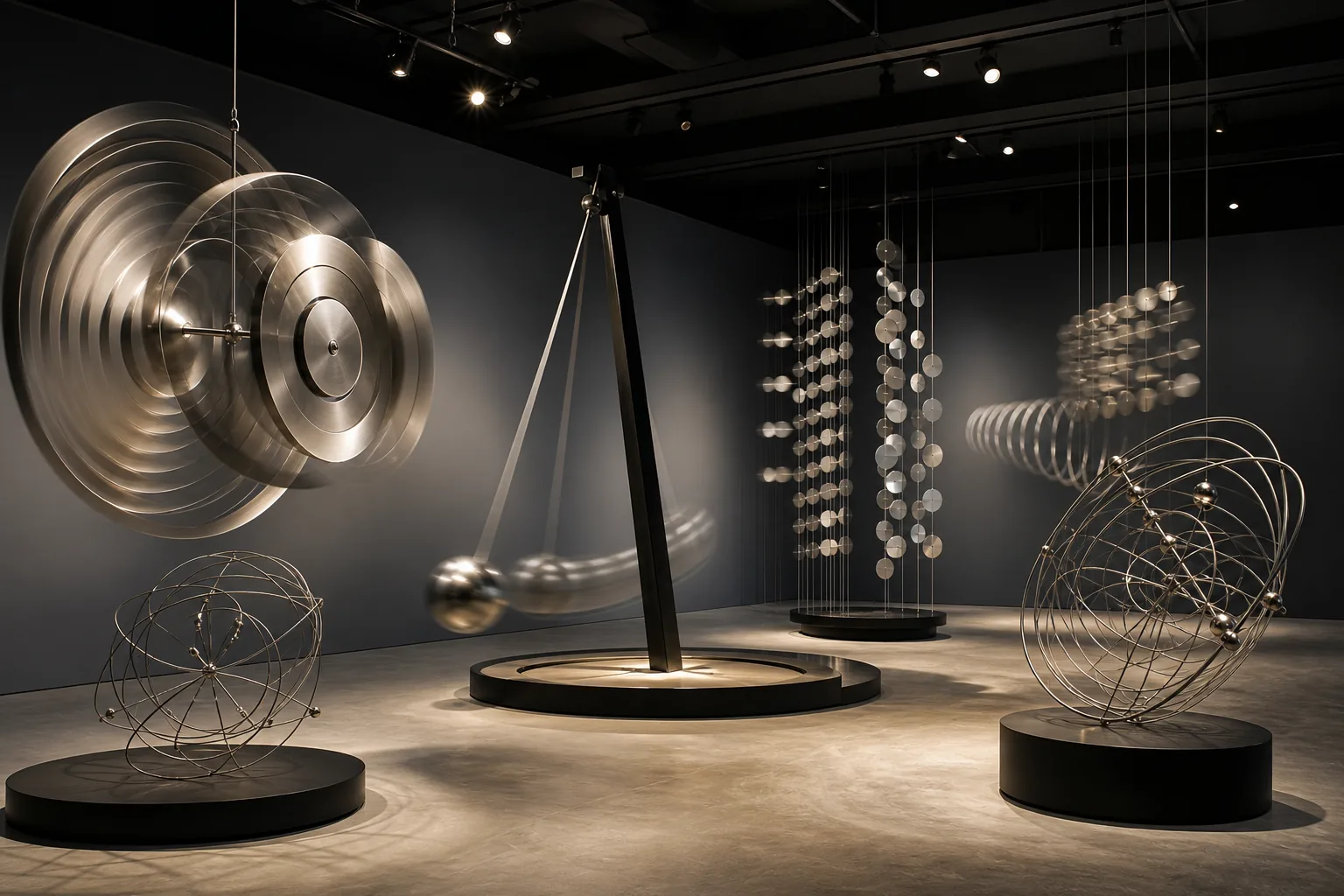
Kinetic art does to form what classical sculpture long avoided: it allows it to change before our eyes. A motor, wind, gravity, light, a magnetic field or simply the movement of the viewer turns an object from a finished thing into an event.
Editorial thesis
Kinetic art turns movement from subject matter into material. It designs not one final image but a system of states: form can be moved by a motor, wind, gravity, light, a magnetic field or the viewer. Its deepest legacy therefore lies not in "moving sculptures" but in the idea that form can behave over time. 1
Reader question
When did art stop depicting movement and begin to move for real - and why does that turn still matter to architecture, fashion, photography and digital environments?
Short answer
In the twentieth century artists began to introduce real time into the work: vibration, rotation, balance, light, air and the participation of the viewer. From the experiments of Naum Gabo and Moholy-Nagy to Alexander Calder's mobiles and postwar kineticism, form became an event - it no longer had to look the same every second. 1
1. When sculpture stopped standing still
Imagine a museum gallery where an object cannot be memorised in a single glance. As you approach, it has already turned; as you walk around it, the shadow has shifted; while you read the label, a thin metal plate trembles in a current of air. Kinetic art begins here - with the refusal of the idea that a work must have one stable state. 1
For centuries painting depicted movement: a horse could gallop, fabric could billow, the sea could rage. Kinetic art takes a more radical step by introducing real time into the construction of the work itself. The work exists not only in space but in a sequence of states. It is no longer a "thing with an effect" but a small system of behaviour.
2. What kinetic means: real and apparent movement
The term kinetic comes from the Greek kinesis, meaning movement. In art history it generally describes works in which movement is a fundamental part of the work: physical, mechanical, airborne, luminous or produced by the viewer's movement. Tate explicitly includes both real and perceived movement, which is why the historical boundary between kinetic art and Op Art remains porous. 12
It is useful to distinguish two modes. In the first, the object truly changes position: it rotates, swings, vibrates or folds. In the second, the viewer moves and the object changes optically through relief, transparency, reflections or overlapping lines. In both cases the stationary "ideal viewpoint" loses its authority.
3. Before the motor: Futurism, Constructivism and the idea of dynamics
Kinetic art did not suddenly appear in the 1950s. Futurists had already tried to convey the speed of the modern street, machine and body, while Constructivists began literally dismantling the traditional mass of sculpture into planes, lines, suspensions and spatial frameworks. Alexander Rodchenko's suspended spatial constructions of the early 1920s could respond slowly to currents of air, replacing the heavy pedestal with an almost weightless system. 1
But the image of movement and movement itself must be kept distinct. A Futurist painting can look fast while remaining completely still. A kinetic work makes time part of the material - much like concrete, glass or metal. From this point the question is no longer only "what does the form look like?" but "what happens to it?"
4. Naum Gabo: Standing Wave and time as material
One of the key early episodes is Naum Gabo's Kinetic Construction (Standing Wave), made in 1919-1920. A thin metal rod was driven into rapid vibration and visually transformed into a volumetric wave. Tate describes the work as one of the earliest motorised sculptures and a major early example of kinetic art. 12
The effect is almost scientific. Physically there is very little material - just a thin line. But speed makes the eye assemble an imagined volume from it. The sculpture is produced not only by metal but by time. Stop the motor and a significant part of the form disappears. This principle would become fundamental to kineticism: a work can be not an object but a process.
5. Realistic Manifesto: space and kinetic rhythm
In 1920 Naum Gabo and Antoine Pevsner published the Realistic Manifesto. The document marked a break with traditional ideas of volume and treated space and time as full artistic elements. The fact that the manifesto and Kinetic Construction appeared at almost the same moment shows that movement was not a technical toy for Gabo but part of a new understanding of sculpture. 1
This was an important shift for twentieth-century design culture as a whole. Form no longer had to be massive, whole and "finished forever". It could be built from emptiness, trajectory, transparency, tension and temporal change. Those ideas would later intersect naturally with architecture, exhibition design and interactive environments.
6. Duchamp: rotation, Rotoreliefs and vision
Marcel Duchamp approached movement from another direction - through optical provocation. His Rotoreliefs, published in 1935, were printed graphic discs designed to spin on a record player. In motion, the flat drawings could appear concave, convex or receding into depth. 1
There is no heroic machine here. All that is needed is paper, printing and rotation. But the effect is fundamental: the work cannot be understood by looking at a still disc. It exists in the combination "object + speed + eye". Duchamp thus demonstrates one of kineticism's central laws: movement can be not the content of an image but the condition under which the image appears.
7. Moholy-Nagy: Light-Space Modulator - light as machine
László Moholy-Nagy turned a kinetic construction into a laboratory of light. His Light Prop for an Electric Stage, later known as the Light-Space Modulator, was developed through the 1920s and completed around 1930. Metal, transparent elements and a motor organised moving reflections and shadows; Moholy-Nagy later investigated the same apparatus in the film A Lightplay: Black White Gray. 1
What makes the work distinctive is that its main result is not the machine itself but the space around it. Light slides across walls, shadows break apart and the viewer stands inside a constantly changing composition. This is a direct prehistory of light installation, media art and exhibition environments in which a device produces not an object but an atmosphere.
8. Alexander Calder: the engineer who set sculpture free
Alexander Calder trained as an engineer, and that background is visible in the way he thinks about equilibrium, weight and movement. In the early 1930s he began making abstract constructions with moving parts, initially operated by hand or by motor. Marcel Duchamp suggested the word mobiles for them - in French the term relates both to movement and to motive. 1
The real revolution came when Calder removed the motor. Instead of predetermined movement, he entrusted the work to air, gravity and chance. Sculpture stopped displaying a mechanism and began behaving like a living balance: slowly, unpredictably, sometimes almost imperceptibly.
9. Mobile: balance, air and chance
A good Calder mobile resembles an equation that is solved again every second. Every plate has weight, every arm has length, every suspension point has a role. Yet the result is never mechanically identical: the slightest current of air changes the relationship between the parts. The Guggenheim emphasises the importance of gravity, air circulation and chance in Calder's works. 1
That is why a mobile cannot be replaced by a beautiful still photograph. Photography fixes one frame from an endless sequence. The work itself exists between frames: in the pause, oscillation, acceleration and unexpected equilibrium. For a designer, the important idea is controlled freedom - the system defines boundaries without dictating a single result.
10. Stabile: a stationary form with kinetic logic
Paradoxically, alongside the mobile Calder developed the stabile - a term proposed by Jean Arp for his stationary constructions. They do not move physically, yet they demand movement from the viewer. Planes intersect at different angles, openings cut fragments out of space, and the silhouette changes radically as one walks around it. 1
This significantly broadens the theme. Kinetic logic does not always require a motor. Sometimes it is enough to make form dependent on a person's route. In architecture the principle is especially clear: a building can be completely stationary yet be perceived as a sequence of changing frames. In that sense, the viewer's movement becomes a hidden drive.
11. Le Mouvement 1955: the moment movement recognised itself
In 1955 the Paris gallery Galerie Denise René staged Le Mouvement, one of the key landmarks of postwar kineticism. Different generations and different ideas of movement met there, from Duchamp and Calder to Yaacov Agam, Jesús Rafael Soto and Jean Tinguely. Centre Pompidou describes the exhibition as an important point of departure for the renewed rise of kinetic art. 8
From this moment kineticism becomes not a solitary experiment with a motor but an entire field: mechanics, optics, light, viewer participation, seriality and programming. It is therefore more useful to understand "kinetic art" not as one visual style but as a family of methods united by one idea - form should happen in time.
12. Jean Tinguely: the machine that works too humanly
If Calder makes the mechanism disappear into the poetry of balance, Jean Tinguely does the opposite: he puts the machine on stage. His constructions are deliberately mechanical - wheels, rods, motors, wire, shaking, noise. The Guggenheim links Tinguely to kinetic art and highlights his interest in movement as both a key element and a metaphor for change. 1
These machines often seem serious and absurd at the same time. They move, but do not necessarily "produce" a useful result. That is their strength: the industrial logic of efficiency turns into a theatre of behaviour. The machine no longer promises a flawless future; it stumbles, repeats, rattles and almost acquires a personality.
13. Yaacov Agam: the picture the viewer assembles by moving
Yaacov Agam makes the viewer's movement part of the composition. His relief surfaces change the image according to angle: one set of colours and forms appears from the left, another from the right, with a sequence of transitions in between. The Guggenheim describes viewing his work as an adventure in which the spectator must discover the different images contained within a single object. 1
This is almost an interface before the digital interface. The work does not reveal all its information at once. It demands action: walk past, turn, return. Viewing time becomes part of the construction. For contemporary space the principle is especially important - a visual system can be designed not for one frontal frame but for a route.
14. Jesús Rafael Soto: the viewer as motor
Jesús Rafael Soto often needed no mechanical motor at all. In Spirale of 1955, two spiral structures separated by distance and a transparent plane begin to shift optically as the viewer moves. Centre Pompidou records Soto's crucial idea: he used the eye as the motor rather than an electrical or mechanical engine. 8
This is one of kineticism's most elegant turns. The viewer becomes the machine. Standing perfectly still limits the effect; take a step and the form comes alive. The approach connects kinetic art with Op Art while adding an important dimension: the image changes not only because of the physiology of vision but because the body actually moves through space.
15. Julio Le Parc: light, mirror and instability
In the late 1950s and early 1960s Julio Le Parc combined optical and kinetic methods with light. MoMA describes Double Concurrence-Continuous Light, 2 as a system of suspended plastic elements, mirror, filters and illumination in which the slightest movement alters reflections and the pattern of light. 1
The key word here is instability. A classical object promises control: it looks the way its author made it. With Le Parc, the result depends on light, oscillation, the viewer's position and the environment. The artist designs not a single image but a range of possible images. Today that sounds almost like a description of responsive design.
16. Takis: magnetism as invisible sculpture
The Greek artist Takis made an artistic material out of something we cannot see directly: the magnetic field. Tate describes him as a sculptor of magnetism, light and sound; in his "tele-magnetic" works, metal elements could be held or moved by magnetic force. 12
Kineticism thus moves beyond the visible mechanism. A gear at least explains itself: we can see what pushes what. A magnetic field acts without obvious contact. The space between two parts suddenly stops being empty and becomes an active zone of force. This is an important lesson for contemporary design: sometimes the principal material of a system is not a surface but an invisible interaction.
17. George Rickey: wind, steel and precise freedom
From the 1950s onward George Rickey developed kinetic sculpture with particular attention to light, movement and the action of natural forces. The MoMA archive identifies him as a significant practitioner of kinetic sculpture whose work explored effects of light and motion. 1
His steel elements often look almost engineer-like in their dryness: thin blades, axes, counterweights. But wind turns precision into unpredictability. This is the characteristic kinetic paradox: the more precisely the system is calculated, the more freely it can behave within its constraints. Not chaos, but disciplined chance.
18. Motor, gravity, air: three ways to set form in motion
Kinetic art has no single "engine". A motor provides programmable movement: speed, cycle, repetition. Gravity creates balance and pendulum motion. Air makes movement dependent on the environment. Magnetism and electromagnetism introduce invisible force, while the viewer adds a human variable.
For a designer it is useful to think of these sources as different characters. The motor says "I control". Wind says "I respond". Gravity says "I seek equilibrium". The viewer says "without me the work is incomplete". Choosing a source of motion is no longer an engineering detail; it is part of the meaning.
19. Light and shadow: when movement escapes the object
A kinetic object almost always produces a second work: its shadow. Sometimes the shadow is visually stronger than the construction itself. With Moholy-Nagy, rotating metal became a projection of light; with Le Parc, reflection multiplied through mirrors; in contemporary installations, light can replace the material body altogether.
This changes the usual hierarchy. The object is no longer the sole protagonist, and the wall is no longer merely background. Light, surface and distance become co-authors. Kinetic art therefore feels especially at home in architecture and exhibition design: it takes over not only its own volume but the surrounding space.
20. Sound: the kinetic work you can hear
Movement is rarely completely silent. Metal rings, a motor hums, wire vibrates, one plate strikes another. Calder experimented with gongs and sound elements, Tinguely turned mechanical noise almost into a character, and Takis connected electromagnetic processes with sound. 1
In a traditional gallery, sound is often treated as interference. In a kinetic work it can be evidence of action. We not only see that the system is alive; we hear its state. For exhibition space this adds another responsibility: acoustics becomes part of the composition, and neighbouring works can literally interfere with one another.
21. The viewer: from observer to mechanism
Kineticism steadily removes the viewer from the comfortable role of someone who simply stands in front of a work. One must walk along Agam, change angle in front of Soto, enter Le Parc's light environment, circle a Calder stabile. The work unfolds in time and often depends on the human trajectory.
Today this feels natural because of interfaces, interactive screens and sensors. But in the mid-twentieth century the principle itself was radical: the viewer stopped being the final consumer of a finished image and became a variable in the system. Modern cultures of interactive, responsive and participatory environments grow directly from this shift.
22. Kinetic art and Op Art: where the boundary lies
Kineticism and Op Art constantly overlap, but it is useful to distinguish them. Op Art can create a sense of motion on a completely stationary plane. Kinetic art more often introduces physical change, temporal sequence or dependence on the viewer's position. Tate and museum collections frequently place the two side by side precisely because both investigate the instability of perception. 12
A simple test: if you switch off the movement, does the work itself change? With Calder, yes. With Tinguely, radically. With Soto the answer is more complex: the object may not move physically, but without your step part of the effect disappears. In classic Op Art the work remains the same while the "motor" sits inside the visual system.
23. Architecture: facade, door and roof begin to move
When kinetic logic enters architecture, it is no longer a small sculpture that moves but part of the building. In discussing Santiago Calatrava, MoMA has noted mechanised solutions in which door and wall form a single transformable element and moving roof components become part of the architectural image. 1
Here movement has a dual nature: functional and theatrical. It can regulate light, open a passage, create a canopy or change ventilation, while simultaneously declaring that the building is not a static box. A good kinetic facade differs from an attraction because its movement is tied to spatial logic rather than added for effect.
24. Interior and exhibition: space as a scenario of response
In an interior, a kinetic principle does not necessarily mean a motorised wall. It is enough to create an environment that changes with the route: translucent layers, rotating panels, light filters, reflective surfaces, suspended elements. The visitor then does not merely look at the space - they activate it.
For exhibition design this is an especially powerful tool. Instead of "rooms with objects", one can build a sequence of states: narrow passage -> reflection -> shadow -> moving element -> pause. Such a scenario works more like film editing than a traditional static display.
25. Fashion: Chalayan and clothing as a mechanical system
Fashion is rarely described as kinetic art directly because clothing already moves with the body. Hussein Chalayan, however, made movement a technological subject. The Met holds his Remote Control and describes Chalayan's practice as a fusion of conceptual ideas, materials, technology and forms that often approach sculpture; in his technological works, garments could incorporate mechanical components and actuators. 1
The difference is fundamental: fabric moving as someone walks is the natural kinetics of clothing. A mechanically transforming silhouette turns a garment into a system. The body becomes a platform for moving parts, and the fashion show becomes a demonstration of how the object behaves over time.
26. Graphic design and motion: the principle of movement after the printed page
A printed poster is physically stationary, but kineticism taught graphic design to think in sequence, phase and change. This logic becomes especially visible on the screen: a logo can move from one state to another, a grid can respond to sound, typography can change scale and position, an interface can answer a gesture.
The kinetic principle should not be confused with animation in general. Movement becomes meaningful when it explains a system: revealing connection, response, hierarchy or transformation. If an element simply flies across the screen, it is decoration. If its motion reveals structure, it becomes design in time.
27. Photography: how to photograph a form that never repeats
The photographer faces a paradox: a kinetic work exists in time, while photography usually extracts a single moment. The task is therefore not merely to "freeze it beautifully" but to decide what the frame must explain: amplitude, mechanism, trajectory, scale, viewer participation or a trace of light.
Sometimes a short exposure is needed to fix the construction. Sometimes a long exposure is more honest because it turns movement into a line. Sometimes a sequence of three photographs works better than one. Good documentation of a kinetic work should leave the sense that something continued before and after the frame.
28. Digital and generative: kineticism without a physical motor
Digital environments carry the kinetic idea to a point where a physical motor is unnecessary. An algorithm can generate a continuously changing form, sensors can introduce human movement, sound or weather, and a screen can become a surface that never repeats the same frame. At MoMA, Refik Anadol's Unsupervised changed in real time and used environmental data - light, movement, acoustics and weather - as part of its constantly changing image. 1
This does not mean every generative visual is an heir to kineticism. The connection appears when change is the structure of the work rather than an endless screensaver. The main question remains the one Gabo posed in practice: what exists only because time is passing?
29. Common mistakes: when "movement" becomes a special effect
The first mistake is to assume that kineticism equals rotation. Putting an object on a motor and making it spin is not enough. The second is to overload movement: if everything flashes, swings and reacts at once, the viewer stops seeing the system. The third is to hide a weak form behind an effect.
A strong kinetic work usually has a clear rule. One source of motion, one logic of response, one reason to look for longer than five seconds. The clearer the system, the more strongly its change can be felt. Kineticism welcomes complexity of behaviour but rejects random visual noise.
30. The main legacy: form no longer has to be finished
The main legacy of kinetic art is not the mobile, not the motor and not even interactivity. It is a new model of form: a work can be unfinished at every individual moment and still be complete as a system. It does not have to possess one correct appearance.
From Gabo and Calder to light installations, kinetic architecture and generative environments runs one continuous line: the designer or artist defines the rules and time produces the variations. That is why kineticism remains contemporary. Increasingly, we design not static objects but behaviour - of an interface, a facade, an image, a space and even clothing.