encyclopedia
Concrete
Architectural and visual material
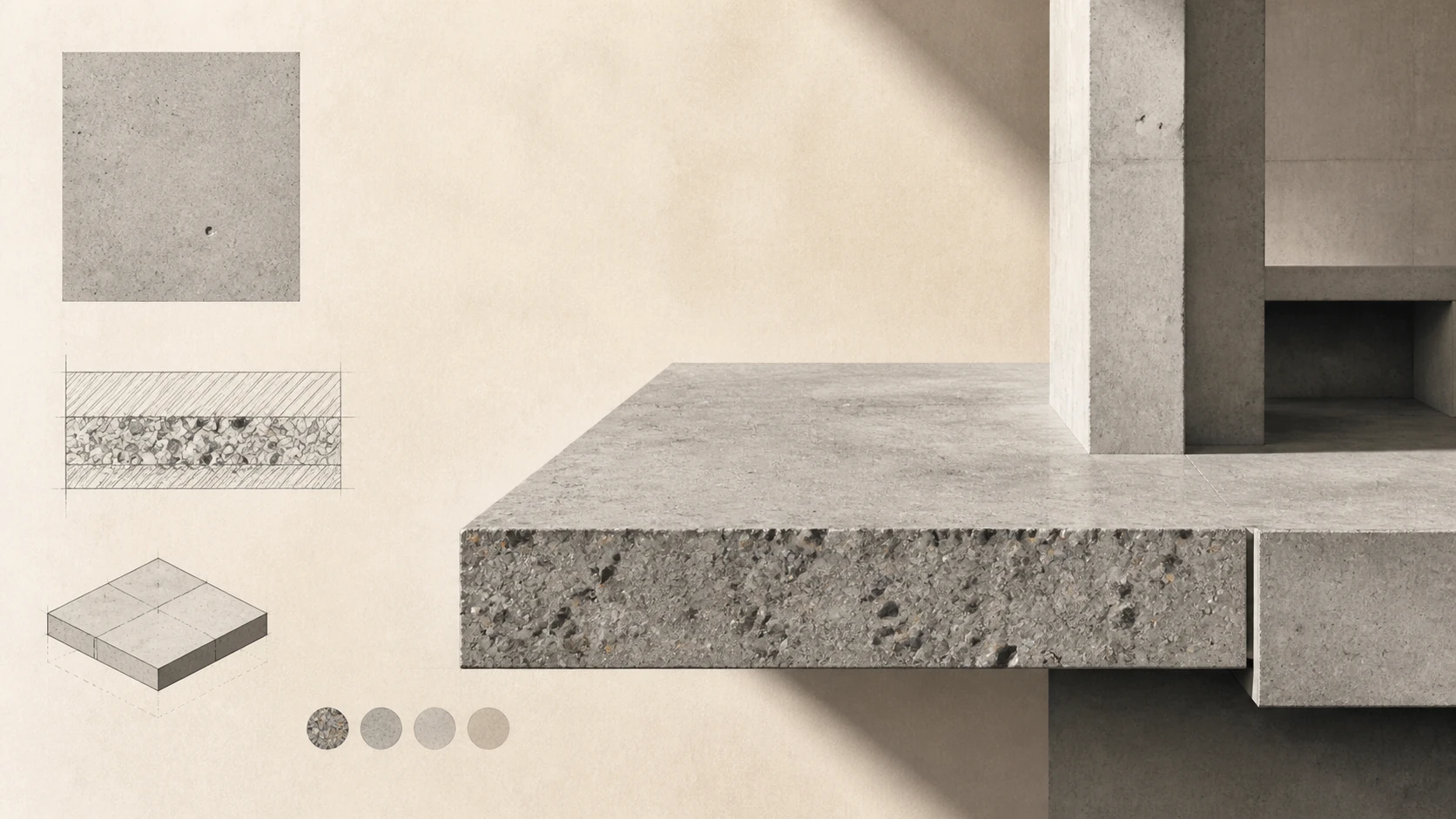
Concrete remembers everything: water, pressure, timber formwork, the speed of work and years of rain. Its surface is not background but a record of production and time.
Editorial thesis
Concrete is often called an honest material, yet it reveals nothing automatically. Its surface is the result of dozens of decisions: mix design, moisture, formwork, tie layout, placement speed, vibration, temperature and curing. What appears to be raw naturalness usually demands almost jeweller-like discipline.
Concrete remembers everything. Timber leaves its grain, trapped air becomes a bughole, excess water forms a weak chalky skin, and early stripping damages an edge. Architectural concrete must therefore be designed as one system: structure, surface, light and future ageing. 1410
Reader question
Why does one concrete surface feel heavy and rough, another almost silky, and a third resemble polished natural stone?
This article treats concrete not as a neutral grey background but as a material able to collect light, sound, scale and traces of time.
Short answer
Concrete is a composite of cementitious binder, water and aggregate. Strength and appearance form at the same time: water-cement ratio affects porosity, formwork transfers pattern, vibration releases air, curing retains moisture for hydration, and grinding or aggregate exposure opens the internal structure. 118
Cast-in-place concrete records the sequence of work on site; precast concrete offers controlled repetition in a factory. Both can be expressive, but they require different tolerances, joints and attitudes towards inevitable variation.
1. Concrete — a composite that pretends to be stone
In a finished wall concrete appears to be a monolithic mineral mass, yet it is made from cement paste, sand, coarse aggregate, water and admixtures. Its “stone” quality is not given by nature; it emerges after mixing, placing and hydration. 11
This duality makes the material expressive. It looks ancient but is produced industrially; it appears uniform while holding countless particles, voids and boundaries.
2. Cement paste, water and aggregate
Cement is not concrete but the binder. Mixed with water it forms a paste that coats sand and stone, then binds them into a solid system. Excess water makes placing easier, yet after evaporation it leaves pores and weakens the surface. 11
Aggregate gives the material its body. When hidden by paste concrete looks calm; after grinding or etching the stones emerge and the artificial composite begins to resemble a geological conglomerate.
3. Admixtures and blended cements
Plasticisers, retarders, accelerators and air-entraining agents alter workability and timing without simply increasing water. They remain invisible, yet determine whether the mix fills complex formwork and whether colour stays even.
Slag, pozzolans, limestone and other components can reduce clinker content while changing heat evolution, colour and strength development. Lower-carbon concrete is not a colour or one product but a carefully tuned recipe. 1
4. From ordinary to high-performance concrete
Ordinary structural concrete must first transfer loads safely. Architectural concrete adds another demand: the visible surface becomes part of the project. Lightweight concrete reduces mass, high-strength mixes carry greater loads, and self-consolidating concrete fills dense reinforcement with little vibration.
A class name does not describe the visual result. Even an expensive mix can look poor when formwork is weak and curing is careless.
5. Reinforcement and prestressing
Concrete performs well in compression but less well in tension. Steel reinforcement carries tensile forces and makes slabs, beams and thin shells possible. Prestressing introduces compression in advance, extending spans and controlling cracking.
Reinforcement is hidden, yet it affects the surface: dense bars complicate placing, cover depth controls durability, and later corrosion can literally split the concrete.
6. Cast-in-place and precast concrete
Cast-in-place concrete is poured on site. It can bind walls, floors and stairs into a continuous spatial system, but it records weather, pour sequence and the human rhythm of work.
Precast elements are made under controlled conditions and repeat more accurately. Factory smoothness does not eliminate joints: connections, tolerances and transport limits shape the architectural language. 1
7. Formwork — the negative of the future surface
Fresh concrete has no form of its own. It accepts every irregularity of the shell that holds it. Formwork becomes the negative of the future wall — temporary architecture governing a permanent result.
Surface pattern cannot simply be added later. It is designed through sheet layout, joints, ties, sealing and placing direction. 410
8. Plywood, boards, steel and elastic liners
Plywood creates large calm fields and a fine veneer trace. Board formwork transfers grain, knots and board width, turning concrete into a mineral memory of timber. Steel gives a smoother, cooler plane.
Elastic liners can reproduce complex relief, but they easily reduce concrete to decorative imitation. The material is strongest when texture explains production rather than disguising it.
9. Ties, joints and release agents
Tie holes are often read as the signature of architectural concrete. Their rhythm, however, comes from actual formwork loads, so decorative copies without structural logic quickly feel false.
Sheet joints, pour breaks and release agent remain visible as well. Uneven application can create stains and bugholes; attempts to hide the process often make it more obvious. 1
10. Placing and vibration
The mix must enter the form without segregation, move around reinforcement and release trapped air. Excessive free fall separates components; work that is too slow creates cold joints.
Vibration densifies concrete, but too much is also harmful: heavy aggregate settles, paste rises and the surface loses uniformity. A good result comes from precise rhythm rather than brute force.
11. Bugholes, honeycombing and laitance
Small bugholes are traces of air at the form face. Their number depends on workability, form geometry, vibration and release agent. Honeycombing is no longer character but an area where the mix failed to fill the space and aggregate remains poorly bound.
Laitance forms a weak cement skin, while bleeding carries water upward. These effects may look like colour or texture, yet they can also signal a technological problem.
12. Curing, temperature and stripping
After placing concrete does not merely “dry”; cement continues to react with water. Curing retains moisture and temperature so that a dense structure can form. Wind, heat and cold change the rate of the process and the surface colour. 8
Stripping too early damages edges; leaving formwork too long may change tone and complicate work. Time becomes a finishing tool.
13. Concrete is never simply grey
Colour depends on cement, sand, stone, water, admixtures, moisture and light. Even one mix can appear warmer, cooler or darker in different locations. White cement expands the palette, while integral pigments colour the entire mass. 1
Surface stains create more living variation but require understanding of the substrate chemistry. Perfectly uniform colour often contradicts the nature of the process; the real question is which range of difference the project can accept.
14. Exposed aggregate, honing and polishing
Removing the upper cement skin reveals aggregate. Light exposure creates grain; deeper exposure turns the surface into a mosaic of stones.
Grinding levels the plane and polishing gradually increases reflection. Polished concrete feels luxurious not because it imitates marble but because the material’s internal structure begins to work with light. 1
15. Mechanical texture, coatings and sealers
Bush hammering, sandblasting and abrasive treatment break the upper skin and create roughness. The surface becomes lighter, more tactile and less slippery, but it also collects dust more readily.
Impregnating sealers reduce absorption; coatings create a separate film. They can protect concrete but may alter sheen and colour depth. Invisible protection is almost always slightly visible.
16. How concrete works with light
Frontal diffuse light softens pores and reveals overall tone. Grazing light does the opposite, turning millimetres of relief into long shadows. In sun concrete becomes dramatic; under overcast sky it reveals subtle colour differences.
Natural light changes a wall throughout the day. A deep opening, reflected ceiling or narrow light cut can make heavy mass appear almost weightless.
17. Mass, temperature, sound and touch
Concrete feels heavy before we understand the structure. Wall thickness, reveal depth and joint scale tell the body about mass.
High thermal inertia can smooth temperature swings, yet a cold surface may feel uncomfortable. Hard planes reflect sound, while roughness only partly diffuses it. Touch must be considered where people actually meet the material.
18. Concrete in interiors and on walls
In an interior concrete may be a structural wall, a cladding panel or a thin imitation. These can look similar in photographs but age and repair very differently.
An exposed wall requires sockets, joints, fixings and interfaces to be planned in advance. After stripping, accidents are harder to hide than on a plastered surface.
19. Floors, furniture and wet areas
A concrete floor can unite a large room as one continuous plane, but it needs movement joints, controlled flatness and a defined polish level. Every wheel mark and grain of sand gradually enters the patina.
In furniture mass becomes part of the image, yet thickness, reinforcement and edges require control. In wet areas falls, sealing and drainage are essential — concrete is not automatically waterproof.
20. Dialogue with timber, metal and glass
Timber softens concrete’s coldness and repeats the hidden history of formwork. Metal strengthens industrial precision but can leave rust stains. Glass opposes mass with transparency and makes structural thickness more visible.
Material combinations are convincing when the joint is not concealed. A shadow gap, visible fixing or precise separation lets each material age independently.
21. Cracks as defect and information
Cracks result from shrinkage, thermal movement, foundation change, overload or corrosion. Some are expected and controlled by joints; others require engineering diagnosis.
Romanticising every crack is dangerous. It may become a beautiful line of time, but first it must be understood as a message from the structure.
22. Carbonation, corrosion, efflorescence and water
Carbon dioxide gradually lowers concrete alkalinity. When the carbonation front reaches reinforcement, steel loses protection and begins to corrode in the presence of moisture. Expanding rust then spalls the cover. 1
Efflorescence leaves white salts, leaks draw dark lines, and permanent damp supports biological growth. The pattern of ageing often begins not on the façade but in poorly resolved drainage.
23. Repair and patina
Repair mortar almost always differs in colour, porosity and ageing rate. Attempting to make a patch completely invisible can expand intervention beyond the damaged area itself.
Concrete patina includes worn edges, damp shadows, metal traces and microcracks. Yet not every change is noble: good patina begins with access for inspection, maintenance and honest repair.
24. Joseph Aspdin, Joseph Monier and a new material
In the nineteenth century Joseph Aspdin patented a hydraulic binder named Portland cement, referring to the resemblance of the hardened material to Portland stone. Modern cement has changed greatly, but the idea of a standardised binder opened the path to mass concrete. 1
Joseph Monier developed iron-reinforced cement tanks and structures, showing how metal could compensate for concrete’s weakness in tension. The composite changed from mass into a spatial system. 1
25. Le Corbusier and béton brut
In Le Corbusier’s later work formwork traces and unfinished surfaces stopped being defects. Béton brut preserved the process of making and turned it into architectural language. 1
Brutalism grew from this logic — not one uniform style and not a love of roughness, but a broad interest in mass, structure and the social expression of material. 1
26. Louis Kahn: concrete that reflects light
At the Kimbell Art Museum concrete does not oppress through mass; it acts as a calm instrument of light. The museum describes numerous trial pours and a soft grey with a lavender undertone coordinated with travertine. 13
Kahn’s precision shows that architectural concrete requires more than correct strength. It demands long observation of how colour lives beside natural light.
27. Tadao Ando: the discipline of the smooth plane
In Tadao Ando’s work concrete appears almost immaterial: even fields, a disciplined tie grid and soft light create silence. The Pritzker Prize highlights the role of high-quality timber formwork and surface control. 1
This smoothness is not “simple minimalism”. It requires a precise mix, sealed forms, consistent placing and a willingness to accept small differences as part of a living material.
28. Nervi and Mendes da Rocha: force becomes form
Pier Luigi Nervi explored reinforced concrete through ribbed shells and structures whose surface pattern follows the flow of forces. The forms look sculptural but emerge from engineering logic. 1
Paulo Mendes da Rocha used concrete and steel for large public gestures. Monumentality comes from span, support and shared space rather than applied decoration. 1
29. Mock-ups, tolerances and photography
A full-scale mock-up should repeat the mix, formwork, ties, edges, curing and finish. A small sample cannot predict the pressure of a large wall or its behaviour in real light.
Phrases such as “smooth concrete” or “minimal pores” must be translated into visible criteria. A photographer must also decide what the image explains: mass, board grain, aggregate, damp patina or smoothness. Side light reveals relief; soft frontal light clarifies colour.
30. Lower-carbon concrete and durability
Reducing embodied carbon involves clinker content, blended cements, structural efficiency, local aggregate and service life. GCCA and the American Cement Association describe decarbonisation as a system of decisions rather than one “green” product. 181
Concrete is a process frozen into form. Its environmental and architectural value depends on how much material is truly needed, how long it serves and whether the building can be repaired or adapted. Durability is not an excuse for impact; it is an essential part of the calculation.