encyclopedia
Contact Printing
The image at negative scale
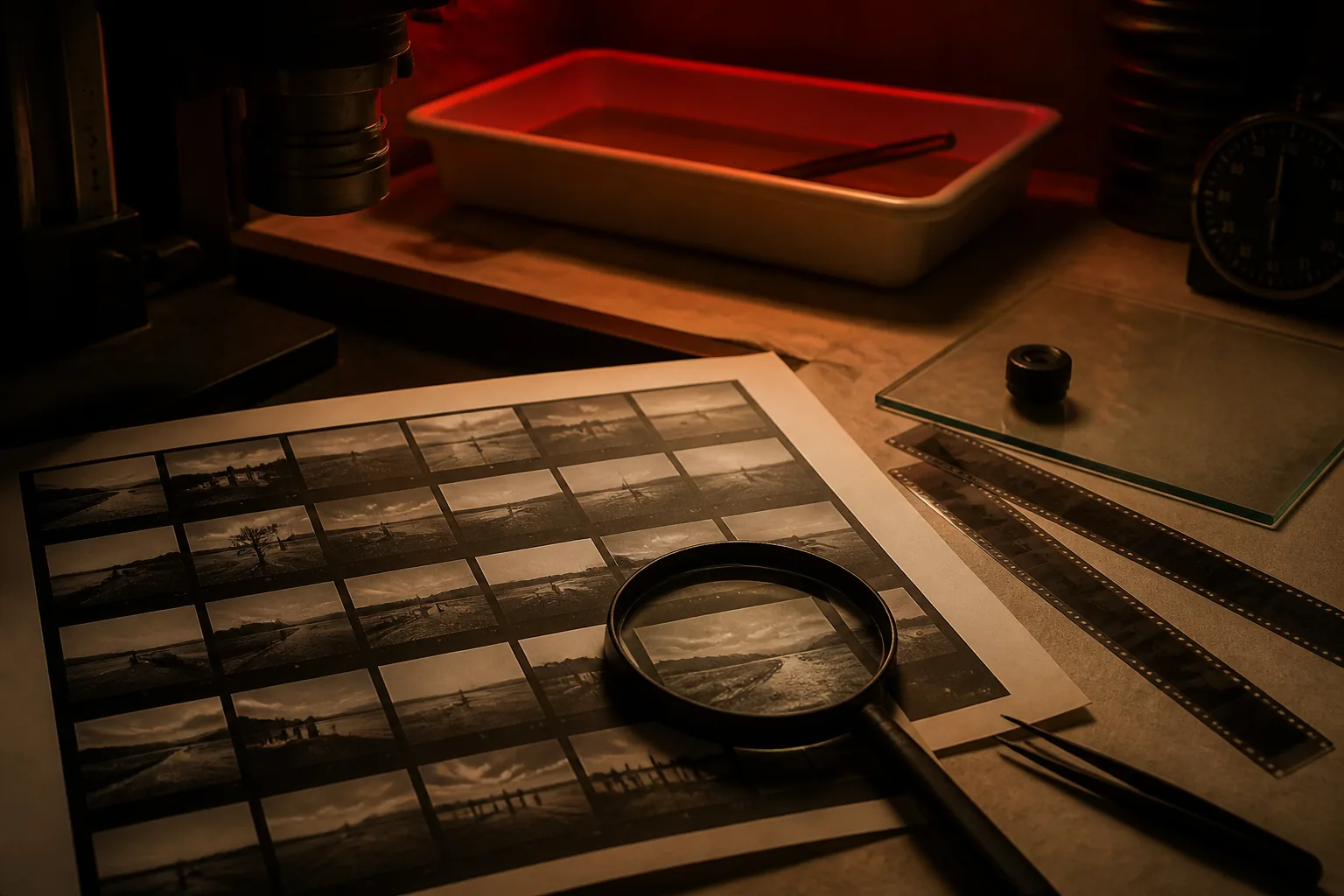
A contact print does not enlarge the photograph; it returns the image to the scale of the matrix with which it began. Negative touches paper, light passes through density, and the finished sheet preserves both the image and the physical measure of the camera.
Editorial thesis
Contact printing is built on an almost stubborn simplicity: the negative is placed directly on light-sensitive paper, held under glass and exposed so that light passes through the image. No projection lens stands between negative and print, allowing scale, edge and minute detail to move to paper with very little mediation.
The method matters as more than an old printing procedure. It shows that image size may be decided in the camera and that printing can become a material continuation of the negative rather than an enlargement. In the contact sheet, the same principle becomes a thinking tool: the photographer sees not one successful frame but the route towards it.
Reader question
Why can a small print the size of its negative feel more convincing than a large enlargement, and why can a contact sheet reveal more about a photographer than the selected final image?
Because contact printing preserves a physical one-to-one relationship. It does not amplify the image through scale but asks the viewer to move closer. The contact sheet, meanwhile, restores hesitation, repetition, movement and editorial choice that the finished photograph normally conceals.
Short answer
A contact print is made by placing the negative emulsion-to-emulsion against light-sensitive paper and exposing the two in direct contact. The image is the same size as the negative; sharpness depends on negative quality, pressure, cleanliness, light and processing. 12
A contact sheet is a working form of contact printing in which several film frames are printed on one sheet for viewing, selection, comparison and indexing. It does not have to be a beautiful final object, yet it often becomes the clearest document of how a photographer thought.
1. Contact printing: the image at one-to-one scale
A contact print neither enlarges nor reduces the image. Negative and positive share the same geometric scale: one centimetre on film becomes one centimetre on paper.
This creates a distinct discipline. Camera format is no longer merely a technical specification but part of the finished work. An 8×10-inch negative already contains the future width of the gesture, density of detail and viewing distance.
2. Negative and paper touch
For an accurate print, the negative is placed with its emulsion facing the emulsion of the photographic paper. Light passes through clear and dense areas of the negative to form the reversed tonal structure on paper.
The word contact is literal. Even a thin air gap changes an edge and reduces local sharpness, making cleanliness, flatness and pressure part of the image rather than minor preparation.
3. Scale is decided before printing
In enlargement, size is selected in the darkroom. In contact printing, it is fixed by the negative before the film is even processed. Small format produces a miniature; a sheet-film camera produces an object that may already exist as a finished print.
The method therefore demands advance thinking about scale. A large negative requires a heavier camera, tripod, holders and slower working method, but offers a final size without optical enlargement.
4. How contact differs from enlargement
An enlarger projects the negative through a lens onto paper. This allows changes of size, cropping and local control, but adds projection optics, distance and the possibility of losing some micro-detail.
Contact printing is less flexible but binds the print more firmly to the negative. It is not automatically superior; it establishes a different relationship between exposure and print.
5. Talbot and the negative–positive logic
William Henry Fox Talbot’s system was crucial because a paper negative allowed multiple positive prints. The Met describes this negative–positive logic as the basis of almost all photography before the digital era. 14
The early print was not an enlargement. The negative was held against prepared paper and printed at the scale of the original sheet, turning contact into the mechanism of reproduction.
6. Salted paper and printing by sunlight
Salted paper formed the image within the fibres of the sheet. Under sunlight, negative and sensitised paper sat in a printing frame, and image density could be observed during the printing-out process.
The softness of the paper negative and the texture of its support made the image less clinical. Contact did not guarantee absolute sharpness: the negative material itself acted as a visual filter.
7. Albumen paper and the culture of editioning
Albumen paper gave the nineteenth century a smoother, glossier and more detailed surface. It supported the mass circulation of portraits, views and albums, with contact printing from glass negatives becoming a production norm.
Editioning depended not on enlargement but on repeated contact between one negative and fresh sheets. Each print could still vary in tone, exposure and chemical condition.
8. The glass negative and the promise of sharpness
A glass negative remained flat and lacked the fibrous structure of paper. With good contact it produced a clearer rendering of fine detail, particularly in architecture, botany and studio portraiture.
Critical context
Sharpness should not be treated as a neutral synonym for quality. Glass could record more detail, but a paper negative, soft print or defect may hold equal historical and visual value: different processes create different ways of seeing.
9. Large format as a printing strategy
Large format is often described through negative quality, but contact printing reveals a more radical reason for using it: the camera produces not merely raw material for enlargement but an almost finished matrix for the final object.
At 4×5 inches the print remains intimate; 8×10 can hold complex surface detail; 11×14 or 20×24 turns exposure into an architecture of production. Camera scale becomes paper scale.
10. The contact printing frame
A contact printing frame holds negative and paper beneath glass and an elastic back. Split back panels allow a printing-out image to be inspected without disturbing the entire sheet.
Heavy glass can perform a similar function in the darkroom, but a frame gives more even pressure and protects against accidental movement. It remains central to many alternative processes.
11. Emulsion to emulsion
Emulsion sides face one another to minimise the distance between the negative image and the sensitive layer of the paper. If the negative is reversed, the thickness of the base introduces a slight gap and may soften detail.
Correct orientation also determines laterality. A contact positive normally restores the scene to its familiar direction when the camera negative carries the reversed image.
12. Pressure, flatness and evenness
Uneven pressure appears as local softness: one part of the print is crisp while another is slightly blurred. Curled film, wavy paper or a particle of dust can create a microscopic separation.
Flatness matters especially with sheet film and large digital negatives. The mechanics of the frame become the equivalent of precise focusing.
13. Sunlight, gaslight and the enlarger
Early printing-out papers were exposed by sunlight. Later gaslight papers were designed for comparatively weak artificial illumination; Kodak AZO became a well-known contact paper for domestic and professional printers. 1
A modern silver-gelatin contact sheet can be exposed with an enlarger used only as an even light source: the head is raised to cover the sheet while the negatives are held beneath glass.
14. Exposure and the test strip
Exposure is established with a test strip or stepped test. The aim is to produce a deep black through the clear film rebate while retaining differences in frame density. ILFORD presents the contact sheet as a foundation for evaluating the negative. 17
Too little exposure leaves the sheet pale and conceals weak negatives. Too much turns dense frames into heavy rectangles. A useful test does not beautify the material; it makes it legible.
15. Negative density and print tone
A dense part of the negative transmits less light and creates a lighter area in the positive; a clear area darkens more quickly. The contact print therefore becomes a rapid diagnosis of film exposure and development.
Underexposure, overexposure, changing light and uneven processing are visible together on one sheet. Contact printing does not repair the negative; it reveals its character without enlargement as camouflage.
16. Paper contrast and filtration
Variable-contrast paper allows the relationship between shadows and highlights to be adjusted through filters. ILFORD recommends approximately normal contrast for an ordinary contact sheet and a softer setting for unevenly exposed film so that more information remains visible. 1
Yet a work sheet should not become a competition in tonal beauty. Its purpose is to provide comparable information across the roll so that the next decision is based on the frame rather than accidental paper density.
17. Development, fixing and washing
After exposure, silver-gelatin paper passes through developer, stop bath, fixer and washing. Time and temperature affect repeatability, while inadequate fixing or washing shortens the life of the image.
A contact print may look simple, but its chemical discipline is the same as that of an exhibition enlargement. Working status does not remove the need to process and label the sheet properly.
18. Sharpness without a projection lens
The Center for Creative Photography notes that the greatest resolution available from a negative is achieved in a contact print, where the negative directly touches the photographic paper. 8
This does not mean the viewer automatically sees more. A small format requires close viewing, good light and time. Detail becomes intimate rather than demonstrative.
19. Dust, scratches and Newton rings
Dust between negative and paper appears as a light or dark point depending on position. A scratch, fingerprint or drying mark transfers with unforgiving precision.
When two very smooth surfaces touch, Newton rings may appear as interference patterns produced by a thin air layer. Anti-Newton glass and clean, dry film reduce the risk, although the technical fault may sometimes become part of the object.
20. Film edge, perforations and the complete negative
Printing the whole negative reveals its border, perforations, frame number and sometimes the manufacturer’s markings. This is not merely a decorative frame but a statement that the image has not been cropped at the printing stage.
Yet a full frame does not guarantee honesty. The moment of exposure, lens and viewpoint have already limited reality. The black edge identifies a printing decision but does not erase authorship.
21. Contact print and contact sheet are not the same thing
A contact print may be a final photograph made from a single negative. A contact sheet brings several frames—usually a whole roll or group of sheets—onto one page for comparison.
The formats share one physical principle but serve different editorial purposes. The first asserts an individual image; the second preserves sequence and helps decide which image deserves a separate print.
22. The 35mm and medium-format contact sheet
A 35mm sheet presents small rectangles with perforations and frame numbers. Medium format produces fewer but more legible frames: 6×6 forms a grid of squares, while 6×7 creates a calmer rhythm.
Negative size changes not only future print quality but the act of editing. Tiny 35mm frames are read with a loupe, while 6×7 images can sometimes be judged without magnification.
23. Editing as reading a sequence
The contact sheet reveals time. Adjacent frames show a subject turning, the photographer moving closer, a shift from vertical to horizontal or a missed moment.
Editing becomes more than choosing the “prettiest picture”. It becomes reading rhythm: where the sequence gathered tension, where repetition exhausted itself and where one frame begins to work because of the images around it.
24. Pencil, grease pencil and the editor’s trace
Contact sheets often carry circles, crosses, numbers, arrows and crop rectangles. Pencil or grease pencil turns the sheet into a field of negotiation between photographer, editor, art director and laboratory.
These marks form a second layer of authorship. They show that the final image was created not only at exposure but through selection, cropping and preparation for printing.
25. Magnum: the image inside a sequence of attempts
Magnum describes contact sheets as direct prints of sequences of negatives that were central to viewing, editing and indexing before digital photography. They reveal the photographer’s movement towards the selected composition. 110
Interpretation
The contact sheet complicates the myth of a single magical “decisive moment”. Even when the final frame appears instantaneous, neighbouring images often reveal rehearsal of vision, repetition and editorial discipline.
26. The contact sheet as archive and evidence
A contact sheet can confirm frame order, the existence of alternatives and the degree of intervention in the final image. In an archive it connects negative to caption, date, assignment and later publication.
Critical context
An archival sheet is not neutral or complete truth. A photographer may have cut a negative, destroyed a frame, changed strip order or withheld material. The contact sheet is strong evidence of process, but not absolute proof of intention.
27. Work sheet and final print
A working contact sheet is usually printed quickly and evenly without elaborate local dodging and burning for every frame. A final print may require dozens of tests, masks and precise tonal interpretation.
A photograph should therefore not be judged solely from its contact. The sheet shows a negative’s potential and working sequence, but it does not replace the authored print in which material receives its final scale and light.
28. Edward Weston: the 8×10 negative and intimate detail
Edward Weston’s prints are often close to the scale of his 8×10-inch negatives. Works in the NGA collection have image dimensions around 19×24 centimetres, consistent with the contact logic of a large-format camera. 112
This size does not seek to conquer the wall. A pepper, dune or stone asks the viewer to approach, and the richness of surface comes from negative density rather than physical enlargement.
29. The large negative and the small gesture
A large negative can record micro-detail, but the contact print translates that information into a quiet object. The greater the technical capacity for description, the less need there may be to shout through scale.
This is an important visual lesson: monumentality can exist inside a small sheet when form, tone and the tactility of paper hold attention.
30. Platinum and palladium as contact processes
Platinum and palladium printing are traditionally contact processes: positive image size matches negative size. Getty documents the wide use of platinotype from the late nineteenth century, while teaching materials describe negative, paper and printing frame as one system. 114
The matte tone and image embedded in paper fibres make scale especially material. A large platinum print requires a large camera negative or digital negative, turning production choice into aesthetics.
31. Cyanotype, salted paper and alternative printing
Cyanotype, salted paper, Van Dyke brown and many other processes use contact because their sensitive layers are designed for ultraviolet exposure and do not function like ordinary enlarging paper.
In these methods contact printing joins photography to the craft of the sheet: paper is selected, coated, dried, exposed and washed by hand. The image becomes not only tone but a condition of surface.
32. The digital negative returns to physical contact
A digital negative is inkjet-printed on transparent film and used as a physical matrix for cyanotype, platinum, palladium or salted paper. It allows a large negative to be prepared from a digital file or small film original.
Critical context
A digital negative does not make the process less material, but it changes the structure of authorship. Curve calibration, printer resolution and software processing become part of the print and should be described as honestly as paper and chemistry.
33. Paper, surface and material character
Glossy silver paper intensifies clarity and deep black; matte paper softens reflection; fibre-based stock adds thickness and a fibrous edge. In alternative processes, the texture of fine-art paper remains visible within the image.
Surface is particularly evident in contact printing because scale does not distract from it. The viewer reads not only photographic subject but gloss, whiteness, thickness, curl and the trace of processing.
34. Storage, labelling and conservation
Negatives and contact sheets should be stored separately in archival enclosures, labelled with stable materials and protected from dust, moisture, heat and intense light. The Library of Congress recommends stable relative humidity with minimal daily fluctuation. 15
The contact sheet is especially vulnerable as a working document: it is written on, folded and repeatedly handled. Early labelling, roll number and a clear link to the negative matter more than decorative presentation.
35. What photographers, designers and art directors can use
For the photographer, contact printing is a discipline of exposure and editing: it reveals what happened on film and forces frames to be compared in context.
For the designer, it offers a ready-made grid of time in which repetition, perforations and handwritten marks become a visual system. For the art director, it demonstrates that frame selection, cropping and sequence are independent acts of authorship.
36. Conclusion: the image that does not ask to be enlarged
Contact printing does not compete with enlargement or digital output. Its strength lies elsewhere: negative and paper briefly become one object, and image size retains the memory of camera or matrix size.
In an age of files that can be stretched to any format, contact restores a boundary. Sometimes an image becomes stronger not when enlarged, but when allowed to remain exactly as large as it was recorded.