encyclopedia
Prototyping — design as a testable hypothesis
A prototype is valuable not for resembling a product but for which question it allows to be closed.
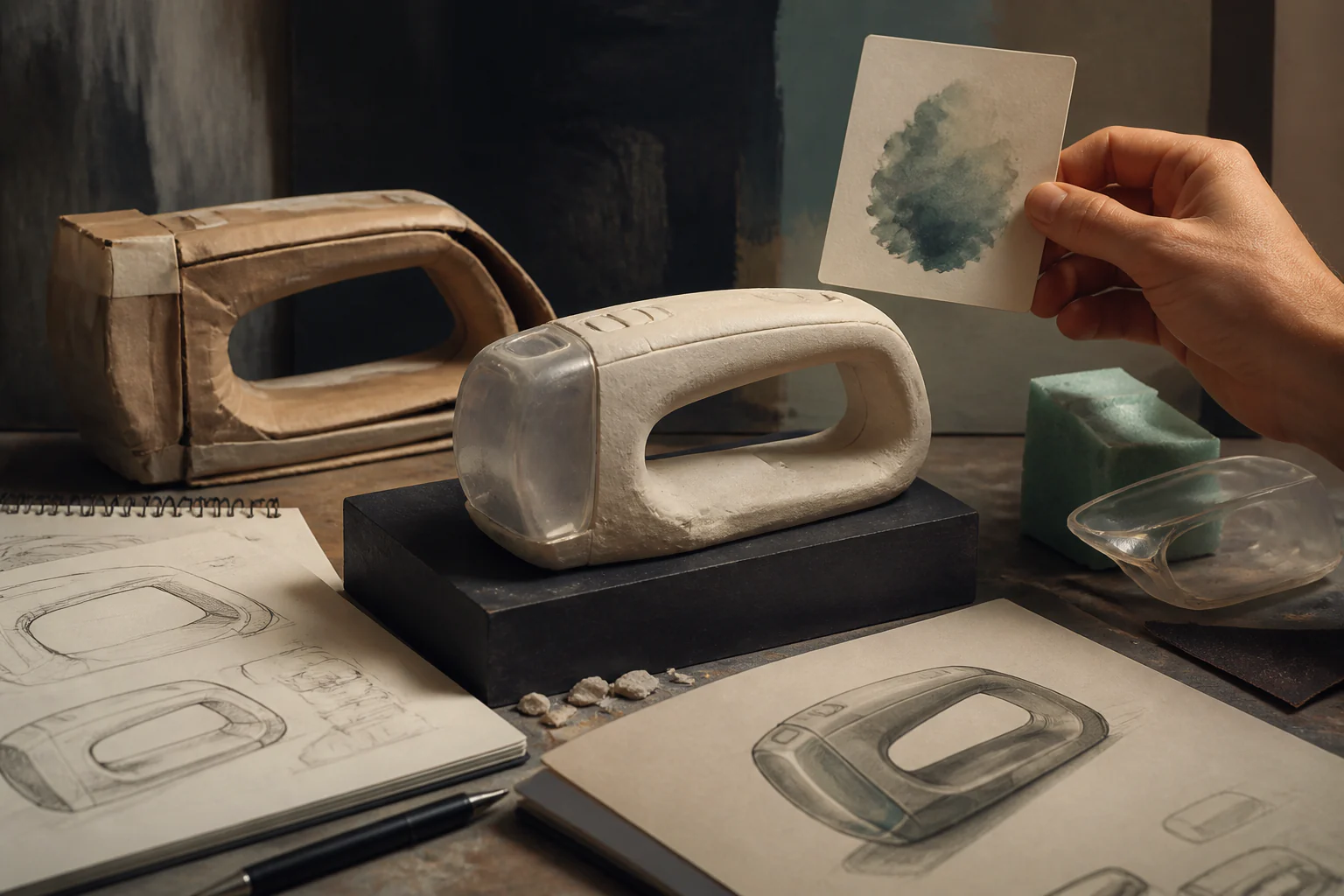
Editorial thesis
A prototype should be judged not by fidelity but by the question it tests: a model answering everything at once usually answers nothing.
Reader question
Why make an object that will certainly not go into production?
Short answer
To obtain an answer that reasoning cannot supply: about weight, fit, assembly order, or material behaviour under load.
1. Definition and boundaries
A prototype is a physical or digital embodiment of part of an intention, made in order to test. What defines it is the intent to test, not the degree of completion.
2. The question before the model
Work begins with a formulation: what exactly is unknown. A prototype without a question produces an impression rather than knowledge, and therefore does not reduce risk.
3. Types by purpose
A distinction is made between appearance models, functional samples, structural prototypes, and production prototypes. Conflating the types is the most frequent and most expensive error.
4. The appearance model
Answers questions of proportion, colour, and feel while not working at all. It may be carved from a block and share nothing with the eventual construction.
5. The functional sample
Tests a mechanism’s operation and usually looks nothing like the product. Appearance here is superfluous and merely raises the cost of testing.
6. Fidelity as a decision
The higher the fidelity, the more expensive the model and the harder it is to change. The correct level is the lowest that closes the question asked.
7. Paper and cardboard
A quick rough model in available material answers questions of dimension and reach within minutes. It is the discipline’s most underrated instrument.
8. Foam and block
Working soft material yields a volume that can be held and corrected with a knife. Tactile verification of proportion is not replaced by a screen.
9. Additive printing
Printing shortened the cycle from idea to object to hours and made iteration routine. It also produced the temptation to print instead of thinking.
10. Limits of the printed sample
A printed part differs from a moulded one in strength, surface, and behaviour under load. It cannot be used to verify anything dependent on the manufacturing process.
11. Digital verification
Stress analysis and assembly simulation close some questions without a physical sample. They do not close questions of perception: weight and fit remain bodily.
12. User testing
Watching an unfamiliar person pick up an object yields data unavailable to its author. The author knows the intention and therefore cannot serve as a subject.
13. What is measured
Observable quantities are useful: time to complete, number of errors, points of hesitation. An opinion about whether an object is liked has almost no predictive power.
14. The negative result
A prototype that shows a solution does not work has fully performed its task. Treating that outcome as failure is an organisational problem, not a design one.
15. Number of iterations
Quality of outcome correlates not with talent but with the number of cycles completed. It is the discipline’s most robust regularity and the hardest for a budget.
16. The cost of change over time
A correction on a model costs pennies, on tooling thousands, on a released batch a recall. A prototype buys the right to be wrong cheaply.
17. The prototype as a means of communication
An object in the hand settles disagreement faster than any presentation. Many models are made not for knowledge but for approval — and that is a legitimate purpose.
18. The prototype as argument in architecture
A full-scale facade fragment tests what a model cannot: the joint, the tolerance, material behaviour in sunlight. Full scale is irreplaceable.
19. The prototype in fashion
A sample garment tests fit on a living body in movement. A flat pattern and a three-dimensional fitting always diverge, and the divergence appears only on a person.
20. The prototype in interface design
A clickable model tests a route rather than an appearance. Substituting a demonstration of styling for a test of the route is a typical error in digital design.
21. First turn: the model separated from the product
Accepting that a test sample need not resemble the result freed testing from production requirements. This made knowledge cheaper.
22. Second turn: the cycle became short
Rapid fabrication turned the prototype from an event into a routine. What changed was not model quality but the frequency of recourse to it.
23. Third turn: testing became continuous
In digital products testing runs on a live service. The boundary between prototype and product has blurred, and with it responsibility for the unfinished.
24. What is usually misunderstood
The error is to pursue maximum realism. An expensive realistic model closes the same questions as a rough one but costs more and discourages discarding it.
25. Counterargument
The objection is that iterative testing leads to averaging: decisions verified on many lose their edge and reduce to a common denominator.
26. Where the counterargument holds
It holds when subjects are asked about preference. Surveying taste genuinely pulls results toward the mean and squeezes out the unfamiliar.
27. Where it fails
It fails when testing feasibility. The question of whether the lid can be opened has no dimension of taste, and answering it averages nothing.
28. The prototype as museum object
Surviving samples show rejected branches and therefore explain a result better than a finished object. Institutions collect them precisely as evidence of process.
29. Current state
Physical prototyping has become cheap, digital testing continuous, and the bottleneck remains the formulation of the question. Tools have outrun the discipline of asking.
30. How to read the subject today
Ask not how closely this resembles the product but what this model proved. A prototype for which the second question has no answer was a demonstration.