encyclopedia
Glass
Transparency, reflection and the architecture of light
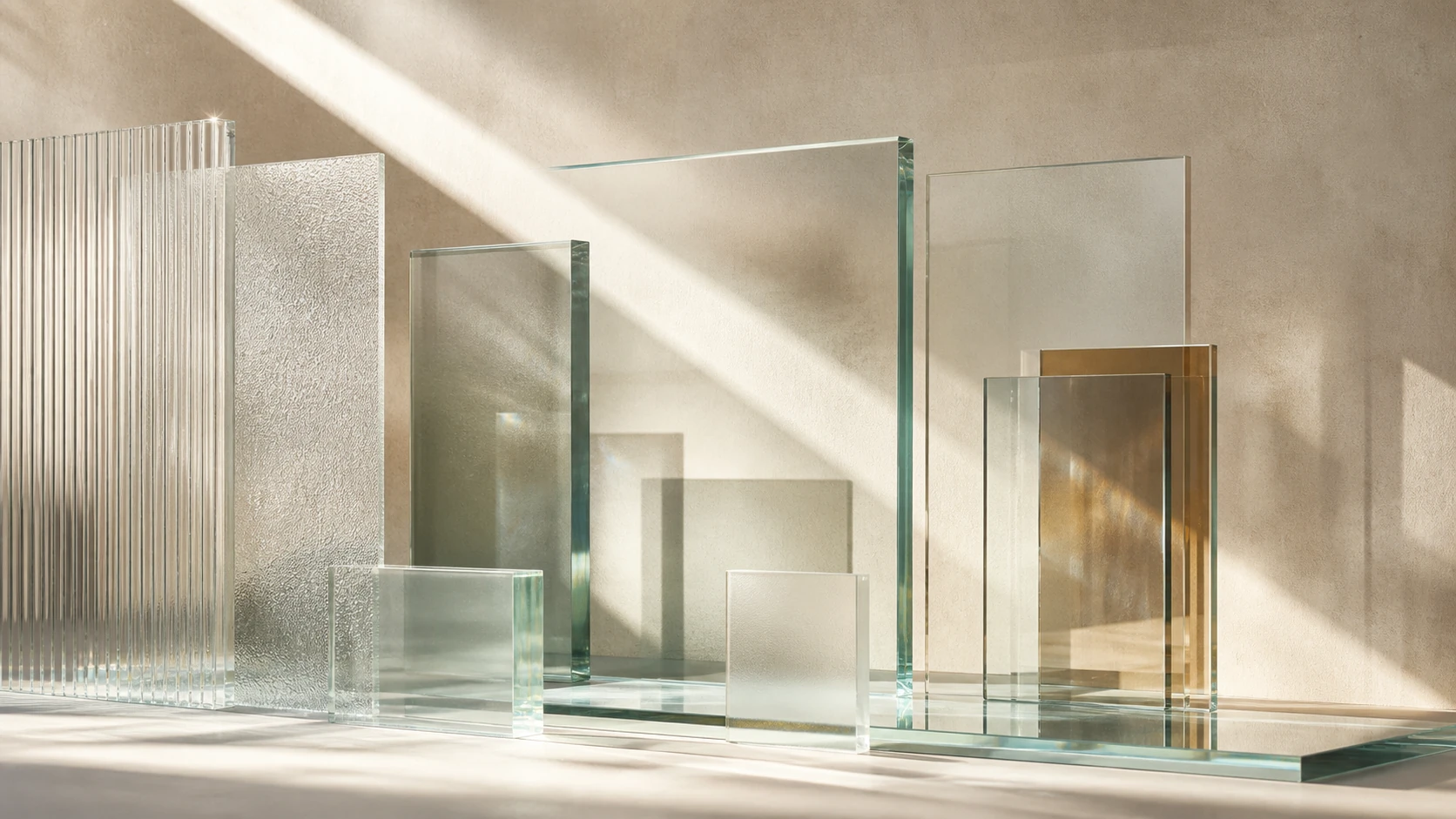
Glass promises to disappear, yet it never disappears completely. It returns the sky, doubles the room, conceals its thickness until the edge reveals it, and turns light into a visible construction.
Editorial thesis
Glass is often described as transparent, as though it simply releases the view. In reality it constantly edits space: reflecting sky, darkening interiors, doubling lights, tinting white surfaces, splitting images between layers and revealing its thickness at the edge.
Its visual language comes from a system rather than a single property: composition, heat treatment, lamination, coating, geometry, fixing, orientation and light. A strong project does not demand that glass disappear. It decides precisely when glass should act as window, mirror, filter, luminous screen or physical boundary.
Reader question
Why does one glass plane appear almost absent, another become a cold mirror, a third diffuse light softly, while a fourth reveals a cheap green edge and a wavering reflection?
The answer sits between chemistry, manufacturing and the direction of light. Even a perfectly made pane changes character with thickness, background, time of day and the position of the observer.
Short answer
Architectural glass commonly begins with a soda-lime composition and the float process, but its final behaviour is created by later operations: annealing, tempering, lamination, low-e or solar-control coating, frosting, printing, insulating-glass assembly and edge work. 13
A specification therefore cannot stop at clear glass. It should define substrate, thickness, colour, iron level, heat treatment, interlayer, coating and coating surface, edge work, fixing, safety requirements, acceptable optical variation and maintenance.
1. Glass is not emptiness but an active surface
Glass appears to be the most neutral material: it promises to transmit the view and disappear. Change the angle of the sun, the background or the lighting, however, and the transparent plane suddenly becomes a mirror, a grey membrane or a sharp band of glare.
A project therefore does not simply specify a glazed opening. It directs the relationship between what is seen through the pane, what is reflected on it and what remains concealed. Thickness, composition, coating, edge and distance to the background alter that scene more profoundly than the word clear in a schedule.
2. Composition: sand, soda, limestone and a precise recipe
Most architectural glass belongs to the silicate family. In common soda-lime glass, silica forms the network, soda lowers the melting temperature and lime improves chemical durability. The Corning Museum of Glass gives typical ranges of about 60–75 per cent silica, 12–18 per cent soda and 5–12 per cent lime. 1
The recipe looks simple only on paper. Sand purity, iron content, cullet, furnace temperature and atmosphere influence colour, optical homogeneity and the behaviour of the melt. A modern transparent plane begins with invisible discipline in the raw materials.
3. Amorphous structure: a solid without crystalline order
Glass is an amorphous solid: its atomic structure has no repeating crystalline lattice. It therefore has no single sharp melting point, but gradually softens as it moves from rigid solid to viscous material.
Visual lightness does not remove brittleness. Microscopic surface flaws concentrate stress, and a crack can grow faster than the eye can understand its origin. In glass, the beauty of an apparently perfect plane always sits beside engineering sensitivity to edges and scratches.
4. Iron, colour and the myth of perfectly colourless glass
Ordinary clear glass often carries a green tint, most visible at a thick edge. Iron impurities in the raw materials create it. In a thin window the colour may almost disappear; in a multi-layer showcase, table top or substantial partition it becomes part of the palette.
Low-iron glass reduces this shift and renders whites, skin tones and jewellery more accurately. Saint-Gobain describes DIAMANT as an extra-clear glass with very low iron content and high optical neutrality. 1 Complete invisibility still does not exist: reflection, thickness and the boundary of the material remain.
5. The float process: turning melt into a level plane
Before the mid-twentieth century, producing large flat panes required rolling, grinding and polishing. The float process transformed the industry: molten glass flows continuously over molten tin and forms a level ribbon of near-optical quality.
Pilkington describes the journey from a furnace at roughly 1500 °C to the tin bath, where the ribbon leaves as a solid at about 600 °C. 3 The invention turned glass from an expensive polished plate into a mass architectural surface and made the modern glass façade technically possible.
6. Annealing and internal stress
After forming, the ribbon must cool in a controlled way. Rapid or uneven cooling leaves internal stresses that can appear during cutting, drilling, solar heating or accidental impact.
Annealing takes place in a long lehr where temperature falls gradually. The stage is almost invisible in the final object, yet it makes the sheet predictable. Calm transparency is the result of carefully managed cooling.
7. Annealed glass: the base material and its limits
Annealed glass is the basic flat material after float forming and annealing. It offers good optical flatness and can be cut before further processing, but when broken it forms large sharp fragments.
It is not appropriate for every location. The closer the pane is to people, impact, temperature differences or significant load, the more important it becomes to move from a visual decision to a safety calculation. Thickness alone does not turn monolithic annealed glass into safety glazing.
8. Heat strengthening and tempering
Heat-strengthened and fully tempered glass are heated near the softening range and then cooled. Surface compression increases resistance to mechanical and thermal loads. Fully tempered glass breaks into relatively small particles and is used as safety glazing. 1
Strength brings an optical cost. Roller wave, local distortion and anisotropy can become visible in reflection or polarised light. The NGA stresses that the strain pattern is an inherent characteristic of heat-treated glass rather than a colour defect. 1
9. Laminated glass: breakage without immediate disappearance
Laminated glass bonds two or more lites with an interlayer, commonly PVB. When the glass breaks, fragments tend to remain attached, reducing fallout and preventing the opening from disappearing at once. 1
Lamination also changes sound, ultraviolet transmission, colour and the visual depth of the edge. A clear interlayer can be almost invisible; a translucent one creates soft privacy; a coloured one turns light into material. Exposed edges need care because moisture and incompatible sealants can cause haze or delamination. 1
10. Insulating glass units: a transparent multi-layer construction
An insulating glass unit is not simply two sheets placed together. Sealed lites, spacer, desiccant, gas cavity, primary seal and secondary seal operate as one construction.
Optical lightness conceals a complex perimeter. Airtightness, durability and heat transfer are decided at the edge. The thinner the frame and the stronger the desire to dissolve the IGU, the more precise drainage, support and edge-seal protection must become.
11. Low-E and solar-control coatings
A low-emissivity coating reduces radiant heat transfer by reflecting long-wave thermal radiation. Solar-control coatings also manage visible light and solar energy. They allow a façade to admit daylight without turning the interior into an overheated display case.
The US Department of Energy notes that low-e windows can reduce energy loss substantially compared with regular glazing. 1 Yet coatings also affect colour: a neutral pane under one sky may appear blue, grey or bronze under another. Energy modelling and visual mock-up belong in the same process.
12. Clear, low-iron, tinted and reflective glass
Clear glass retains a slight green tone; low-iron glass seeks colour neutrality; body-tinted glass colours the entire mass; reflective glass increases mirror effect and reduces inward visibility when lighting conditions favour the exterior.
These categories cannot be selected from a small sample alone. A façade is seen from many angles and reflects sky, neighbouring buildings and ground. A sheet that looks quiet on a table can become saturated blue or almost black at height.
13. Patterned, channel and block glass
Patterned glass is rolled to create a permanent relief. It transmits light while blurring the image. U-shaped channel glass forms long translucent envelopes, while glass block combines light transmission with physical depth.
Pilkington describes texture glass as rolled patterned glass and Profilit as a translucent U-shaped cast profile. 1010 These materials are useful where literal transparency is too exposed: they preserve daylight while giving the wall back some density.
14. Etching, frosting and diffused light
Sandblasting, acid etching and translucent interlayers scatter directional light. The surface stops behaving as a conventional window and becomes a luminous field.
Frosting hides detail but not always silhouette. It also records grease, water and cleaning marks differently. If the pane sits near hands, showers or kitchens, the sample must be tested after real contamination as well as under light.
15. Ceramic frit and printing on glass
Ceramic frit is applied as pattern or solid layer and fused into the surface during heat treatment. It can reduce glare and solar gain, conceal non-vision façade zones, create gradients or establish graphic rhythm. 1
Dots, lines and grids look two-dimensional only in a drawing. On a building they create moiré, change visibility with angle and cast patterns onto floors. Strong frit design operates simultaneously as façade, solar control and interior atmosphere.
16. Mirror: glass that returns the room
A mirror begins with a glass substrate, but its character comes from the reflective backing and protective layers. Surface flatness determines whether the room is returned precisely or slightly deformed.
A mirror enlarges a room only in plan. Perceptually it creates a second inaccessible volume, multiplies light sources and makes the edge critical. A careless joint or misaligned reflection breaks the illusion faster than a visible seam in an ordinary wall.
17. Edge, thickness and the green line
The edge reveals what the frontal surface tries to conceal: thickness, body colour, lamination layers and quality of workmanship. A polished edge can become a decorative line; an unfinished one remains a source of risk and accidental glare.
Green colour intensifies in thick glass, which is why low-iron material becomes particularly noticeable in table tops, display cases and butt joints. For the designer, the edge is not waste from cutting but a second façade of the material.
18. Curved glass and the architecture of radius
Glass can be shaped by hot bending or cold bent within a calculated system. Radius changes reflection: a straight line becomes a moving highlight, while the surroundings stretch and compress as the observer moves.
Curved glass demands disciplined tolerances, moulds, lamination and support. Optical irregularity becomes more visible because the surface is already designed to distort space. Intended geometry and acceptable living reflection must be separated in the brief.
19. Holes, notches, fittings and the vulnerable edge
Glass does not forgive improvisation after tempering: holes, notches and edge work are completed beforehand. Stress concentration around a sharp internal corner or damaged edge can cancel the benefit of heat treatment. 1
Hardware must transfer force through gaskets and engineered zones rather than accidental metal-to-glass contact. The more minimal a point fixing appears, the more engineering is hidden in the small circle around the bolt.
20. Façade: transparency is never neutral
A glass façade always shows two worlds: the interior and the reflected exterior. By day under a bright sky it often becomes a mirror; at night the illuminated interior rises to the surface and turns the building into a display.
Transparency is therefore tied to privacy, energy, orientation and time of day. The same façade can dissolve in the morning, look metallic at noon and reveal everything at night that the architecture attempted to hide.
21. Interior partitions and controlled privacy
Inside, a glass partition physically separates space while preserving the visual volume. This helps daylight and orientation, but acoustics, reflections and psychological privacy may prove more complicated than the plan suggests.
Reeded, frosted, laminated and switchable glass allow visibility to be tuned. The design must define what needs to disappear: a face, movement, text on a monitor or only fine detail. Privacy is not a percentage of haze; it is a specific viewing distance and angle.
22. Retail, showcases and museum display
In retail, glass should disappear in front of the product while withstanding touch, load and daily cleaning. Low-iron glass preserves the colour of white textiles and metals, while anti-reflective coatings reduce distracting reflections in museum and jewellery cases. 1
The more valuable the object inside, the more visible the quality of edge, silicone, joint and lighting becomes. A display rarely feels premium because of low-iron glass alone; the effect comes from the precision of the entire invisible construction.
23. Glass as an instrument of light
Glass does not produce light, but it changes direction, spectrum and density. A clear pane gives glare and a faint shadow; relief fragments a beam; colour filters the spectrum; frosting turns a source into a field.
Sunlight reveals properties that even studio lighting may hide: caustic patterns, double reflections, tempering iridescence, dust and roller wave. The material must be watched in motion and at different hours, not only under the even light of a showroom.
24. How to photograph glass
To photograph glass is to control what it reflects. The camera often sees not the sheet itself but a white card, black flag, window, ceiling and photographer. Moving a source by a few centimetres can redraw the entire contour.
Transparency needs a readable background and a deliberate edge; reflection needs a large controlled surface; relief needs side light. A polarising filter is not a universal solution: it may reduce some glare but cannot remove multilayer reflections or tempering anisotropy.
25. Cleaning, scratches, coatings and real use
Dust, mineral deposits and scratches become especially visible in backlight. The wrong scraper or abrasive can damage a coating, while aggressive chemistry can attack sealant or an exposed laminate edge.
Good maintenance begins by identifying which surface carries the coating and whether it is accessible to the user. Large façades must include not only an appearance concept but cleaning routes, equipment access, panel replacement and an agreed tolerance for visible marks.
26. The Glass House: living inside a reflective boundary
Philip Johnson's Glass House, completed in 1949, makes the transparent wall a condition of everyday life. The official site presents it as an influential International Style residence integrated with its landscape. 1
Yet the glass does not remove the boundary. By day it reflects grass and trees; at night it turns the occupant into a lit figure within a dark landscape. The house shows that transparency can be both freedom of view and a radical loss of shelter.
27. The Louvre Pyramid: transparency as a political and visual gesture
The Louvre Pyramid uses glass not as a quiet addition but as a new centre within the historic courtyard. I. M. Pei sought exceptional transparency so the palace façades would remain visible; the Louvre notes that developing the extra-clear glazing required two years. 1
Its power lies in contradiction: the geometry of the pyramid is unmistakable, while the material attempts to disappear. By day it gathers sky and stone; by night it glows from within. Transparency becomes a way to confront history without imitating an old wall.
28. Fondation Cartier: layers of glass and a disappearing boundary
Jean Nouvel's Fondation Cartier on Boulevard Raspail works not with one transparent plane but with a sequence of screens, façades and garden reflections. The Fondation describes the glass-and-steel building as blurring the boundary between interior and exterior. 1
As layers overlap, it becomes difficult to locate a tree: in front of the façade, behind it or inside a reflection. Glass stops functioning as a window and becomes an edit of real space. Architecture emerges from a delay in perception.
29. Energy, reuse and recycling
Glass can theoretically return to production many times, but an architectural product rarely consists of one clean material. Coatings, interlayers, sealants, spacers and contamination complicate closed-loop recycling.
Glass for Europe stresses the value of cullet because it reduces virgin raw material and melting energy. 16 High-quality flat-glass recycling, however, requires dismantling, sorting and cleaning. Environmental responsibility begins not with the phrase glass is recyclable, but with design for disassembly and a real material route.
30. How designers, photographers and art directors should read glass
A designer should read glass as a layered specification: substrate, thickness, heat treatment, lamination, coating, position within the IGU, edge work, fixing, tolerances, cleaning and replacement. A full-size façade mock-up is more useful than a hand sample.
A photographer must decide what the image is about: transmission, reflection, distortion, edge, condensation or patterned light. An art director should avoid using glass as an automatic symbol of the future. It can speak of control, vulnerability, publicity, sterility, luxury, laboratory conditions or a disappearing boundary.