encyclopedia
High-Tech
Structure, engineering and the aesthetics of the technological envelope
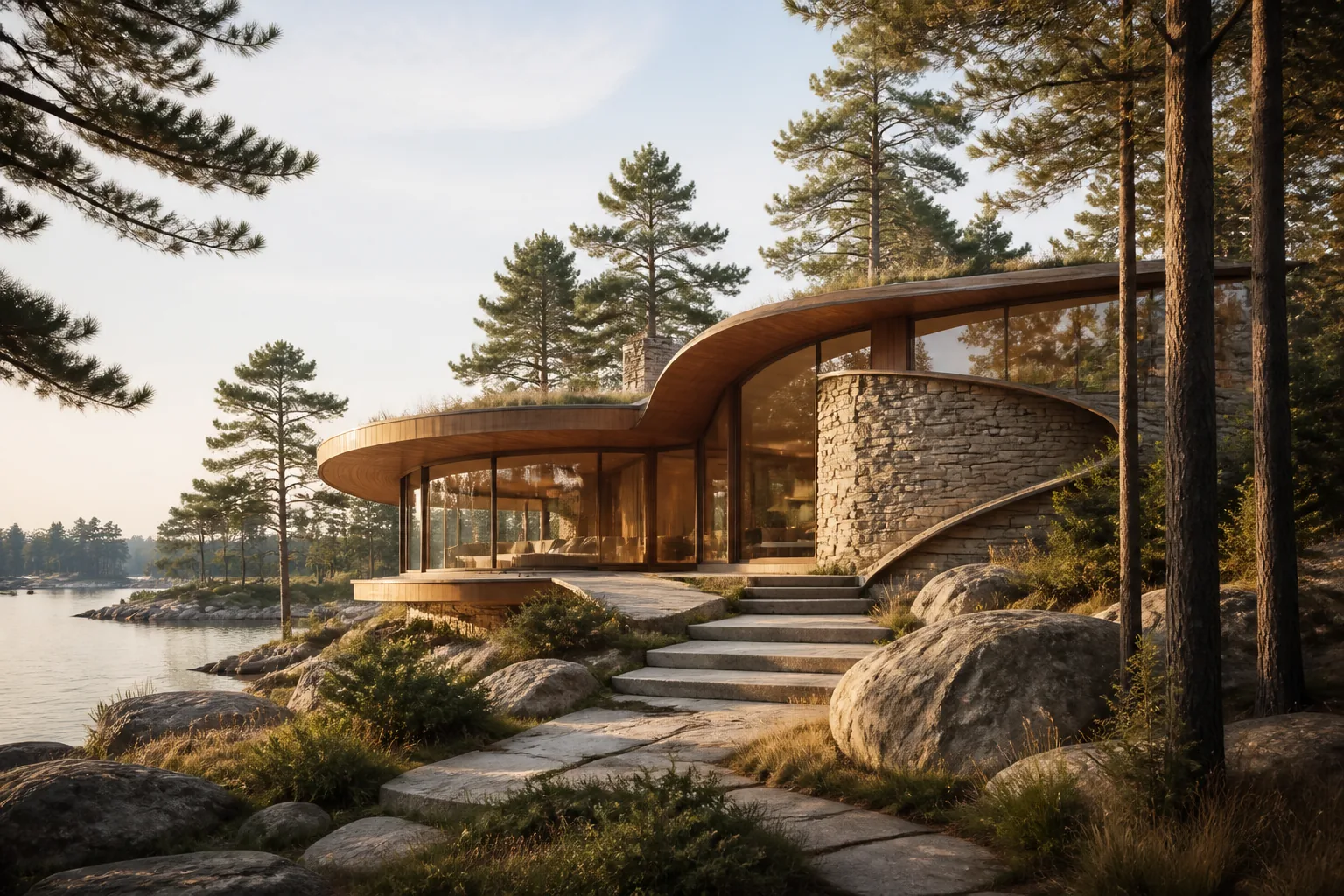
High-tech presents the building as a working instrument: it breathes through pipes, holds itself through trusses, glows through glass and refuses to hide its own technical anatomy.
Editorial thesis
High-tech design presents not only a building, but the idea of a building as a working machine. Structure, services, joints, bridges, ducts and envelope stop being hidden technical layers and move to the surface as visual language.
Reader question
Why does high-tech design look rational, theatrical and almost futuristic at the same time?
Short answer
Because it turns technology into an image. Where modernism often aimed for clean universal form, high-tech exposes fixings, trusses, pipes, escalators, hangers and modular elements. It does not hide process; it turns process into style.
What high-tech is
High-tech is a late-modern movement in which architecture and design begin to speak the language of engineering. It is recognisable through exposed structure, metal frames, glass envelopes, visible services, modularity and the sense that an object can be disassembled, maintained and assembled again.1
The historical moment: from industry to the image of technology
In the 1960s and 1970s technology was no longer only a factory tool. The space race, aviation, electronics, new materials and mass infrastructure changed public imagination. High-tech took the language of machines and moved it into museums, offices, airports, shops and interiors.1
The main gesture: turning the inside out
Classic high-tech often works like an anatomical drawing: what is normally hidden inside the wall becomes visible. Stairs, lifts, trusses, pipes, ducts and service towers take on the role of facade. The building stops pretending to be a monolith and shows what makes it work.1
Centre Pompidou: the building as a living organism
Centre Pompidou in Paris became one of high-tech architecture’s most recognisable gestures. Renzo Piano and Richard Rogers moved circulation, colour, services and metal structure outward. The building is not a closed box for art, but an urban machine that people can enter, climb, watch from and be seen within.1
Lloyd’s Building: the office as industrial mechanism
The Lloyd’s Building in London is radical because it turns the corporate office into vertical infrastructure. Lifts, stairs and service elements are externalised, freeing interior space and making maintenance part of the building’s image.1
HSBC in Hong Kong: flexibility as architectural programme
Norman Foster’s Hongkong and Shanghai Bank Headquarters shows another form of high-tech: not only exposed technology, but a large system of flexible space. The building works through suspended structures, open levels, light, modularity and the idea of the headquarters as a reconfigurable financial machine.3
Sainsbury Centre: pavilion, hangar and cultural envelope
The Sainsbury Centre translates technological aesthetics into a calmer register. It is not an aggressive urban machine, but a large lightweight volume where museum, university setting and engineered envelope form a clear spatial instrument.1
Steel as skeleton
In high-tech, steel rarely remains neutral. It shows load, direction, connection and scale. Bolts, braces, trusses and columns become not just structure but a graphic of force: the eye reads where weight travels and how the object holds itself together.1
Glass as technological skin
Glass in high-tech does more than admit light. It reveals the building’s inner life, reflects the city and intensifies the feeling of a transparent system. Through the glass envelope, technology begins to look public, almost demonstrational.1
Services as ornament
In traditional architecture, ornament was often applied over structure. In high-tech, engineering takes on the role of ornament: ducts, cable runs, colour codes, stairs, grilles, hangers and technical towers.1
Colour coding
High-tech uses colour less as decoration than as diagram. Bright pipes, circulation elements and service systems can be differentiated by function. Colour helps the building read like a map: air, water, movement and structure each become legible.1
Modularity and repetition
High-tech thinks of the object as a system of repeatable parts. Panels, sections, joints and bays create a rhythm close to industrial production. This rhythm gives precision, but can also become cold when human scale disappears.1
Flexible space
One of high-tech’s strongest motives is the liberation of interior volume. If services are externalised or collected in separate zones, the inside can become a freer space, adaptable to exhibitions, offices, retail or public programmes.1
The building as product
High-tech brings architecture close to industrial design. A building begins to read like a large product: it has an envelope, details, assembly, servicing, technical logic and a visual demonstration of production quality.1
Links to aviation and transport
Images of airports, hangars, bridges, ships and aircraft constantly run through high-tech. Hence the light trusses, large spans, metallic clarity, suspended elements and the feeling that the building is ready for movement even when it stands still.1
High-tech interiors
In interiors, high-tech appears through exposed ceilings, metal staircases, visible routes, glass partitions, technical lighting, framed furniture and surfaces that do not hide their industrial nature.1
Product design: from frame to interface
In product design, high-tech favours honest assembly: visible screws, aluminium, steel, glass, mesh, rubber, hinges and moving parts. The object reads not as a seamless decorative body, but as a tool with a clear logic of use.1
Fashion and the technological envelope
In fashion, high-tech is not only about futuristic fabrics. It is also constructive seams, zips, utilitarian pockets, membranes, technical jackets, protective layers, reflective surfaces and the feeling of clothing as personal architecture.1
Graphic design and interface logic
High-tech graphics are built from grids, diagrams, pictograms, technical lines, digital typography and interface logic. They do not simply decorate a message; they turn it into a navigation system.1
Photographing high-tech
High-tech should be photographed not as a pretty facade, but as a system of tensions. Diagonals, joints, metal shine, glass reflections, human scale beside structure, night light and the sense that technology keeps working inside the still frame all matter.1
Light: daylight, artificial light, emergency light
In high-tech, light often reveals not volume but organisation. Daylight passes through glass and trusses, artificial light marks corridors and service zones, and night lighting turns the building into an urban instrument.1
The publicity of technology
High-tech makes technology visible and almost democratic: the viewer can understand that the building is not magic but an assembled system. Yet this openness can also be theatre - a display of control, resources and technological power.1
Criticism: expensive, complex, cold
High-tech is often criticised for expensive operation, complex maintenance, visual aggression and coldness. Its honesty can become an expensive performance: to show technology, that technology has to be kept in perfect condition.1
From high-tech to sustainable tech
Today high-tech cannot be read without ecology. Glass, metal, large volumes and building systems must answer not only to an aesthetic of progress, but to energy, climate, repair, reuse and carbon impact.1
Why high-tech matters to luxury
Luxury uses high-tech when it wants to signal precision, innovation and technical superiority. A boutique, watch, car, gadget or sneaker can speak the same language: not hiding complexity, but turning it into a sign of value.1
How to distinguish high-tech from simple futurism
Futurism can be pure formal fantasy. High-tech requires legible engineering logic. If an object looks technological but does not show structure, module, service, material or assembly principle, it is closer to a sci-fi image than to high-tech.1
Visual markers
Look for exposed frames, metal trusses, glass envelopes, visible pipes, external lifts, colour coding, large joints, industrial stairs, modular panels, long spans and the feeling of a serviceable system.1
Mistakes in styling
The most common mistake is to replace high-tech with grey metal and neon. Without engineering clarity, it becomes decoration. High-tech should look as if every line has a job: bearing, connecting, moving, ventilating, lighting or servicing.1
Contemporary legacy
Even when the term sounds historical, its logic survives in airports, museums, data centres, laboratories, showrooms, techwear, gadgets, sports design and digital interfaces. The world still loves to see how technology works.1
A short formula
High-tech is the aesthetics of the serviceable system. It makes structure visible, turns engineering into language and offers an image of the future where beauty comes not from hiding the mechanism, but from demonstrating its precision.1