encyclopedia
Marble
Origin, types, finishing and visual language
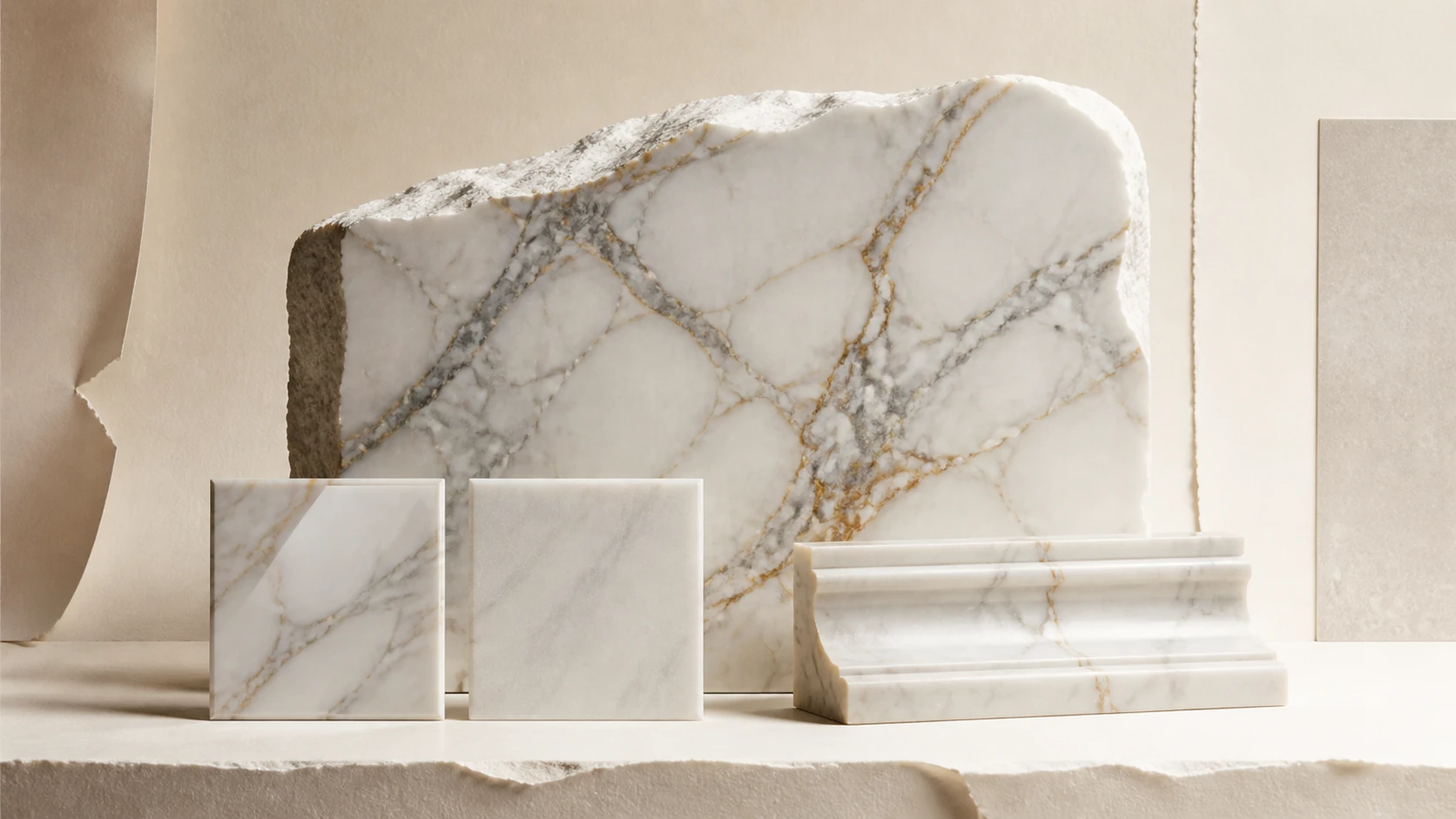
Marble appears motionless, yet all of its expression comes from transformation: sediment becomes crystal, mountain becomes block, block becomes plane, and light turns the plane into depth.
Editorial thesis
Marble is often reduced to whiteness, veining and the shorthand of an expensive interior. Its real character is more complex. It begins as limestone or dolostone and is reorganised by heat, pressure and fluids into a crystalline mass. This is why marble can feel both solid and strangely luminous from within. 12
In design, the material continues to change. The quarry determines block scale; cutting reveals or interrupts the figure; polishing deepens the image; a honed finish quietens it; layout turns an accidental vein into architectural rhythm. Marble is not a ready-made symbol of luxury. It is a material that must be directed.
Reader question
Why can one white slab feel soft and almost translucent, another appear cold and graphic, while a third quickly acquires dull marks from water, wine or lemon?
This article reads marble as geology, production process and visual language. It focuses on the connection between crystalline structure, trade names, cutting direction, finish, light, use and ageing.
Short answer
In strict geological terms, marble is a metamorphic rock made predominantly of recrystallised calcite and/or dolomite. Heat and pressure erase much of the original carbonate texture and interlock new crystals into a dense mass. 12
The stone trade, however, uses the word marble more broadly for some limestones, breccias, serpentinites and other stones that accept a polish. A persuasive trade name is therefore not a specification. A project needs samples, technical data, information about resin and repairs, and a clear understanding of how the exact stone responds to acids, water, frost, load and light. 14
1. A stone born twice
Marble does not begin as marble. Its precursor is usually limestone or dolostone, formed through carbonate deposition and, often, the accumulation of marine remains. The crust then carries that rock into conditions where pressure, heat and reactive fluids reorganise it. 2
This second life erases much of the earlier grain and creates a network of interlocking crystals. Recrystallisation explains the stone’s density, its ability to take a polish and its peculiar sense of depth. What we see is not a sedimentary surface but the record of geological transformation.
2. Calcite, dolomite and crystalline structure
Calcitic marble is based mainly on calcium carbonate; dolomitic marble contains calcium-magnesium carbonate. The distinction affects hardness, fabrication, colour and service behaviour, although both groups contain a wide range of stones. 11
Crystal size matters visually. Fine-grained marble can appear calm and continuous; larger crystals break reflection into a sugar-like shimmer. Polishing does not invent the image. It makes the stone’s internal organisation visible.
3. Geological marble and the commercial name
A geologist calls a recrystallised carbonate rock marble. The dimension-stone industry often uses the word more broadly: a limestone, breccia or serpentinite may be marketed as marble if it can be cut into slabs and accept a polish. 14
This produces useful contradictions. Some commercial marbles are not metamorphic, while two true marbles may perform very differently. Petrography, testing and documented use are more reliable specifications than a familiar catalogue category.
4. Veins: not pattern but a record of impurities
A vein can look as though it was drawn onto a finished stone, yet it developed during the rock’s transformation. Clay, iron oxides, graphite, silica and other impurities become lines, clouds and ruptures inside the crystalline mass.
A vein may be purely visual, or it may signal a change in structure and strength. The more dramatic the figure, the more carefully cracks, resin, backing mesh and edge behaviour should be examined. Marble’s beauty often coincides with its engineering difficulty.
5. Whiteness, colour and inner depth
White marble is never simply white. It carries blue-grey, milky, warm cream or cool silver undertones. Colour shifts with thickness, moisture, finish, adjacent materials and the colour temperature of light.
Clean crystals allow a small amount of light to enter before it returns to the eye. A thin edge or carved detail can therefore feel softer than an opaque stone of the same colour. This inner depth is one reason marble can suggest skin so convincingly.
6. Carrara: the mountain as cultural infrastructure
The Carrara basin in the Apuan Alps has been worked at large scale since Roman times. Here the quarry is not an isolated industrial site but an entire cultural system: roads, workshops, transport, sculpture schools and civic identity developed around the white stone. 16
The quarry can appear deceptively pure. White terraces read like abstract architecture, yet they are produced through removed mountain mass, water, dust, noise and the difficult movement of blocks. Marble’s history always joins elevated form to physical labour.
7. Carrara, Calacatta and Statuario without marketing confusion
In the trade, Carrara is often associated with a softer grey-white ground and frequent fine veining; Calacatta with larger, higher-contrast movement; Statuario with a bright ground and decisive grey veins. These terms do not form a universal hierarchy of quality.
Names vary by quarry, supplier and block. Even slabs from one lot can differ dramatically. Professional selection begins with the full slab layout and an agreed range, not with the promise of the “rarest grade”.
8. Greek marbles and Mediterranean light
Pentelic, Parian and other Greek marbles shaped the visual language of ancient architecture and sculpture. They were valued not only for pale colour but for grain, carving response and behaviour under intense sun.
Archaeometric analysis can now connect historic objects to probable quarry sources. “White marble” was never a neutral category: origin influenced cost, transport, technique and meaning. 1
9. Makrana and the white language of the Taj Mahal
The Taj Mahal was built in Agra between 1631 and 1648 as an immense white-marble mausoleum. Its image depends not only on symmetry but on a pale surface that changes through dawn, noon and evening light. 1
The stone acts as a screen for shadow, inlay and atmosphere. From a distance the complex seems almost immaterial; close up, it reveals joints, carving and coloured inserts. Monumentality is achieved through surface precision rather than visual heaviness.
10. The quarry: selection begins inside the mountain
Stone is selected long before a polished slab exists. Geologists and quarry teams read bedding direction, fractures, colour zones and potential block size. One area may support monumental panels, another only small components.
A successful block must survive extraction, transport, sawing, drying, resin treatment, finishing and installation. The larger the project and the stricter its consistency, the more important it becomes to reserve material from one quarry zone.
11. From block to slab
Diamond wire, gang saws and circular saws turn a multi-tonne block into a sequence of slabs. It is like opening a book: each cut reveals the next page of one geological event.
Kerf, feed rate, water and tool condition affect surface quality. Slabs are dried, calibrated, sometimes reinforced and only then ground and polished. What appears natural in a showroom has already passed through an exacting industrial edit.
12. Cutting direction and slab character
Block orientation decides whether the image becomes linear, cloudy or fragmented. The same deposit may produce a quiet slab with a single vein or a tense composition in which lines travel across the entire surface.
Cutting direction must be considered at architectural scale. A figure that works on a tabletop may become chaotic across a five-metre wall. Mock-ups should show the whole plane, including actual joints, not an isolated sample.
13. Bookmatching and the architecture of repetition
Bookmatching opens neighbouring slabs like pages and creates a mirrored composition. An accidental vein becomes an axis, wing, wave or almost figurative image. It is one of stone design’s most dramatic techniques.
Mirror symmetry can also become a decorative trick. A strong layout responds to doors, fittings, furniture and viewing positions. The centre of the figure should belong to the room, not merely to the geometric middle of a wall.
14. Resins, mesh and hidden engineering
Many expressive marbles require reinforcement. Mesh is bonded to the back, voids and microcracks are filled with resin, and individual zones may be repaired before polishing. This is not automatically evidence of poor stone; sometimes it is what makes a rare figure usable as a safe slab. 4
The issue is transparency. Resin can reflect differently, yellow under ultraviolet light or respond differently to heat. Specifications should state acceptable repair, resin type and the appearance of the finished sample.
15. Polishing: a mirror made of crystals
Polishing progressively reduces the abrasive trace until the crystalline surface produces directional reflection. Colour deepens, veins sharpen and dark areas can approach the visual density of glass.
High gloss amplifies both perfection and damage. Scratches, etching, fingerprints and uneven joints become more visible. Polished marble demands not only maintenance but disciplined lighting: hard sources can turn minor differences into obvious patches.
16. Honed, brushed and other matte finishes
A honed finish keeps the surface smooth while removing mirror reflection. Colour softens, veins become quieter and diffuse light feels more natural. Brushed, sandblasted and leathered finishes introduce relief and stronger tactility.
Matte marble is often described as more “natural”, although it too is the result of precise fabrication. It is not immune to acids or stains; traces simply compete less with a strong specular highlight.
17. How marble works with light
Marble does more than reflect. Some light enters the upper crystal layer, scatters and returns, creating softness and a sense of internal illumination. On white marble this is especially visible in raking daylight.
Frontal light flattens the surface and strengthens colour; side light reveals micro-relief and crystal; backlight can illuminate a thin edge. Lighting should explain the stone rather than turn it into a uniformly bright background.
18. Cold, weight and sound
Marble feels cold at first touch because it conducts heat away from the skin quickly. Weight and stiffness reinforce permanence: even a small stone top can feel like a piece of architecture rather than a lightweight object.
Sound matters too. Footsteps become sharp and reflected, a dropped object rings, and a large stone-lined room may feel acoustically hard. A luxurious surface does not automatically produce bodily comfort.
19. Strength cannot be read from a name
The word marble does not state exact flexural strength, absorption, abrasion resistance or soundness. Differences between quarries and even beds within one quarry can be substantial. The Natural Stone Institute emphasises test data and project conditions. 4
It is particularly risky to transfer a successful interior application directly to a façade or thin exterior panel. Thermal cycling, moisture, anchors and panel size change the problem. A beautiful precedent does not replace engineering.
20. Floors and stairs
On a floor, marble reveals the scale of its figure and slowly records movement. Polishing reflects windows and bodies; a honed finish quietens the room; slab direction can lengthen a route or gather a space around a centre.
Practical questions are equally important: wet slip, abrasion, entrance grit, stair thickness, edge treatment and local repair. Patina is persuasive only when the construction remains safe.
21. Walls, cladding and façades
On a wall, marble becomes an image. Large slabs read as a continuous landscape; small modules turn the same stone into a rhythm of joints. Thickness, substructure and attachment determine how freely the figure can be composed.
Exterior cladding requires particular caution. Moisture, frost, salts and thermal expansion act on both the crystalline structure and the anchors. Getty treats marble weathering as a complex system rather than the simple loss of gloss. 114
22. Bathrooms and wet areas
A bathroom exposes marble to everything that changes its appearance: water, soap, cosmetics, mineral deposits and repeated wet-dry contrast. A polished slab darkens when wet, while corners and joints reveal the quality of waterproofing.
Sealer reduces absorption but does not make calcite acid-proof or correct a bad slope. Showers require slip-conscious finishing, compatible adhesives, a sound substrate and a construction that can dry.
23. The kitchen: acid against the perfect surface
Lemon, vinegar, wine and many foods react with calcite. The result is etching: a chemically dulled area where the surface itself has changed. It is not necessarily a stain and ordinary cleaning will not remove it. 112
Choosing marble for a kitchen is not a mistake if the client accepts living patina. The mistake is promising permanent mirror perfection. A honed finish, boards and rapid cleaning reduce contrast, but they do not change the nature of the stone.
24. Furniture and objects
In furniture, marble receives an unfamiliar task: a heavy stone must appear exact and almost weightless. A thin edge, concealed metal frame or balanced support creates tension between mass and line.
Vein scale must suit the object. On a small table, a large figure can look like an arbitrary offcut; on a long console, the same line becomes movement. A strong object is designed around an actual slab, not an abstract stone name.
25. Sculpture: the form that seemed to wait inside the block
Sculptors value marble because it can move from rough mass to delicate surface. Its crystalline body accepts point, chisel, abrasive and polish, allowing skin, hair, fabric and deep shadow to coexist in one material.
Michelangelo’s David demonstrates the scale of that transformation: the figure, more than five metres high, emerged from a block already considered difficult and partly worked by earlier sculptors. Its surface is now monitored and cleaned with great caution. 1
26. Barcelona Pavilion: marble as spatial montage
In the Barcelona Pavilion, glass and steel are joined by Roman travertine, green Alpine marble, ancient green Greek stone and golden onyx. These materials do not decorate a completed box; they organise movement and direct the gaze. 1
Marble walls operate as independent planes. Their figure changes with distance, reflects in water and enters into dialogue with chrome and glass. Luxury is produced through the precise montage of unlike surfaces, not through decorative quantity.
27. Adolf Loos: luxury as material precision
Adolf Loos argued against applied ornament, not against material richness. In his interiors, stone, timber, textile and metal create complexity through their own surfaces, proportion and position within the Raumplan.
Villa Müller demonstrates this logic: an austere exterior conceals a carefully staged interior. Marble is not a loud sign of price but a means of marking transition, weight, room hierarchy and bodily proximity to surface. 1
28. Stain, etching and sealing
A stain occurs when a substance enters pores and changes colour. Etching occurs when acid dissolves calcite and changes microtexture. They can look similar but require different responses. 112
Sealer slows absorption; it does not create a glass shield. Neutral cleaners, soft cloth and prompt removal are safer than aggressive “deep cleaning”. Every treatment should first be tested in an inconspicuous area.
29. Ageing, repair, climate and environmental cost
Over time, marble loses uniform gloss and acquires scratches, microcracks, dirt and salt traces. Outdoors it also faces heat cycles, frost, water and pollution. Conservation begins by diagnosing the cause rather than applying a universal coating. 114
Long service life can justify a high material cost only when the stone is well designed. Quarrying removes mountain mass, sawing creates slurry and consumes water and energy, and transport moves exceptional weight. A more responsible approach uses precise cutting, offcuts, repairability and resistance to replacement driven by short-lived trends.
30. How designers, photographers and art directors should read marble
A designer should verify more than name and colour: petrography, slab range, repairs, finish, layout, joints, edges, light and service conditions all matter. Decisions belong to real slabs rather than a small sample.
A photographer should identify the central property: inner glow, mirror highlight, powdery matte surface, crystal, vein or scale. An art director should resist marble as an automatic luxury symbol. A white slab, green breccia and dark stone with gold movement speak different languages. The material becomes expressive when it is chosen consciously and shown without cliché.