encyclopedia
Mid-Century Modern
Postwar home, furniture and mass production
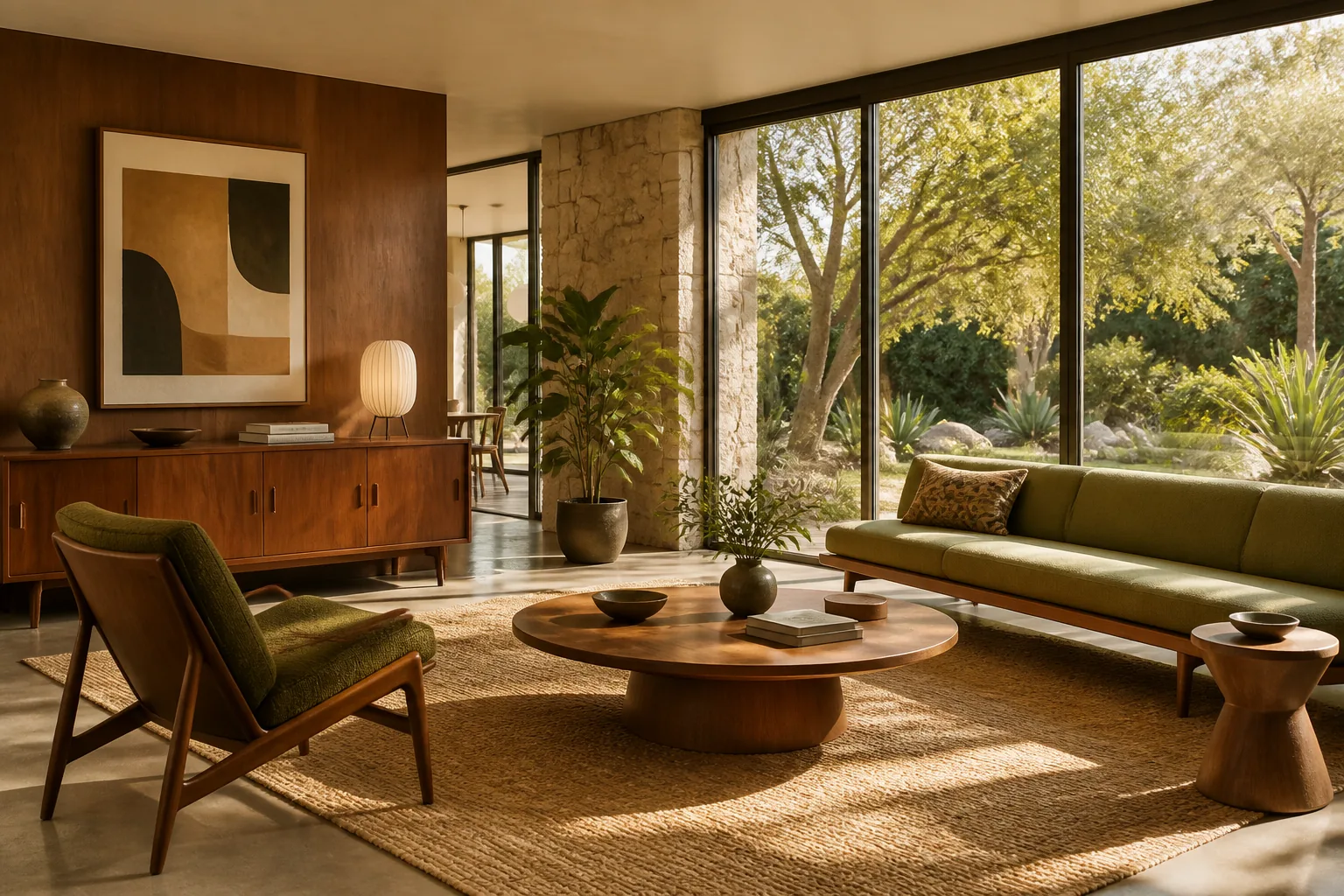
Mid-century modern made modernism livable: the new home, lightweight furniture, plastic materials, open planning and mass production turned modern style from a manifesto into a way of life.
Editorial thesis
Mid-century modern matters not as a catalogue of iconic chairs but as the moment modernist ideas learned to live inside the mass home, office, shop and everyday object. Its real subject is the agreement between industry, body, space and a new culture of consumption. 1
Reader question
Why do furniture and houses from the 1950s still look modern — and where does historical mid-century modern end and today's styling of it begin?
Short answer
Because the strongest work of the period was not built from retro decoration but from systems: new materials, serial production, human ergonomics, open space and coordinated visual environments. Those principles survived the fashion for any particular silhouette. 1
1. What we call mid-century modern — and why its boundaries shift
Mid-century modern is a useful but retrospective umbrella. It describes not one school with a manifesto but a family of postwar practices, especially visible from the 1940s to the mid-1960s: architecture, furniture, graphics, textiles and domestic objects that tried to combine modernist clarity with real everyday life. 1
That is why museums and historians use slightly different dates. The more important shift is conceptual: modern form stops being only an avant-garde declaration and enters the home, office, shop, magazine and mass-production line.
2. After the war: the home becomes a project for a new normal
World War II radically altered manufacturing, materials and the scale of construction. After 1945, millions of families needed housing, furniture and infrastructure, while industry had to redirect wartime capacity toward civilian life. Design became a mediator between technology and the new everyday. 1
This is where the period's optimism comes from: not a promise of a perfect future, but a belief that a good chair, a rational kitchen, a lightweight house and a clear storage system could make modernity easier to live with. Mid-century modern is most convincing when a large idea is tested by a small everyday object.
3. Good Design: when the museum explains what to buy
The Good Design program, organised by the Museum of Modern Art and the Merchandise Mart between 1950 and 1955, presented 'progressive' goods already available on the market. This matters because the museum was not only preserving design after the fact; it was helping shape taste and showing how a modern object could appear in a shop and at home. 4
Good Design linked curatorship, industry and consumption. A chair became a cultural argument, and a kettle or textile became evidence that modernism could be serial, purchasable and domestic. Modernity acquired a price tag, a catalogue and a manufacturer's address.
4. California: climate turns modernism into a way of life
California modernism made a rigorous European idea more informal. A mild climate, car culture, open lots and the desire to live between house and garden turned glass walls, terraces and free plans from abstract composition into everyday scenarios. LACMA describes California midcentury as a material culture spanning architecture, furniture, ceramics, metalwork, fashion, textiles, industrial and graphic design. 1
This produces the period's instantly recognisable atmosphere: lightness, sun, low furniture, wood beside steel, objects that can be rearranged, and an interior that does not fight the landscape.
5. The Case Study House Program: an experiment in affordable modern living
In 1945, Arts & Architecture magazine launched the Case Study House Program to investigate a modern, relatively affordable house for postwar America. Architects were invited to work not on palaces but on prototypes for a new everyday life. 1
The method matters as much as the buildings. The house was treated as a system of materials, standard components, furniture, light and lifestyle. Many projects remained one-offs, but the program created a powerful media template: the modern house should be an experiment that could be shown, photographed and debated as a possible norm.
6. The Eames House: an industrial system becomes an intensely personal home
Case Study House #8, better known as the Eames House, was completed in 1949. Its steel structure and modular panels create an almost industrial grid, yet the interior is full of books, toys, textiles, folk art and traces of Charles and Ray Eames's daily life. 1
That is precisely why the house is a key to mid-century modern. A system does not erase personality. Instead, the strict frame becomes a background for collecting, working and ordinary disorder. The modern home is not a sterile machine but a flexible support for changing life.
7. Plywood: the material that learned to bend
Molded plywood became a laboratory for Charles and Ray Eames. Wartime commissions for lightweight plywood splints and years of pressing experiments helped them understand how a flat sheet could become a strong three-dimensional shell. 1
This matters more than the external 'retro silhouette'. Mid-century modern loves a material that responds to a production process while becoming more plastic. Plywood allowed forms to become thinner, lighter and closer to the body, making manufacturing technique part of the aesthetic.
8. LCW and the Shell Chair: the chair as a mass-production problem
The 1946 LCW shows how a chair can become a set of precisely calculated plywood elements. Instead of heavy solid timber, thin shells are joined so that seat and back support the body. Later plastic and fiberglass shell chairs continued the same logic: one shell could work with different bases and situations. 1
One of the period's central ideas appears here — the family of components. Design becomes a system of variations rather than a single precious object.
9. The Eames Lounge Chair: an industrial object with the memory of a club chair
The 1956 Eames Lounge Chair and Ottoman looks more luxurious than the early plywood experiments, but its logic remains industrial: molded veneered shells, separate cushions, a metal base and serial assembly. 1
This is a productive mid-century paradox. Comfort does not require decorative heaviness, and an industrial object can carry the memory of a traditional club chair. Modernity is not ascetic here; it simply rebuilds a familiar type through different materials and construction.
10. Eero Saarinen: furniture as sculpture without excess structure
Eero Saarinen treated furniture almost as small-scale architecture. His chairs are not assembled from the conventional vocabulary of legs, seat and back but conceived as unified volumes in which silhouette matters as much as construction. Knoll emphasises his habit of working through many models and full-scale mock-ups. 12
Functionalism gains a sculptural dimension. The object must be comfortable, but it also shapes the void around itself. A chair becomes a point that organises the room.
11. The Pedestal Collection: a war on the 'slum of legs'
The 1957 Pedestal Collection grew from Saarinen's irritation with the visual clutter of legs beneath tables and chairs. He wanted to gather the object around a single central support and achieve formal unity. 1
The Tulip Chair shows the difference between minimalism and mere simplification. Its form looks simple only after a great deal of engineering. A clean silhouette is the result of complex work on base, shell, stability and production.
12. Florence Knoll: the interior stops being decoration
Florence Knoll insisted that her work was not decoration. Her method came from architecture: plan, circulation, function and relationships between zones came first, followed by furniture, textiles, colour and detail. 12
For mid-century modern, this is a decisive shift. The interior is no longer assembled as a collection of attractive things. It is designed as a coordinated system in which desk, chair, partition, light and graphics support the same scenario of use.
13. The Knoll Planning Unit: the office as a total spatial system
The Knoll Planning Unit, established in the mid-1940s, became a laboratory for the modern corporate interior. The team worked on office planning, furniture specification, textiles and the visual discipline of space for major American companies. 12
Modernism moved from the private home into the workplace. The office began to express corporate values spatially: rationality, order, flexibility and contemporaneity. Today this feels ordinary, but at the time such coordination represented a new professional model.
14. George Nelson and Herman Miller: design as a corporate method
George Nelson helped Herman Miller turn a furniture assortment into a culture of the modern object. From the late 1940s his office worked not only on individual products but also on corporate graphics, showrooms, storage systems and ways of presenting products to the public. 20
Mid-century modern becomes a brand system here. Object, catalogue, logo, shop interior and photography begin to speak the same language. It is almost a contemporary design system — only physical.
15. Isamu Noguchi: a table on the border between art and everyday life
Isamu Noguchi's IN-50 table, conceived in the 1940s and later manufactured by Herman Miller, consists of two sculptural wooden supports and a glass top. The simplicity of the construction makes the void between the parts part of the object. 20
Noguchi demonstrates that the border between sculpture and furniture can be productive. An object does not have to choose between art and function; it can remain domestic while changing how the surrounding space is perceived.
16. Danish Modern: craft meets industry
Danish Modern added a distinctive combination to postwar modernism: industrial rationality without abandoning cabinetmaking culture. Designmuseum Danmark connects the golden age of Danish design with the 1950s and 1960s and treats the chair as a primary carrier of that history. 15
Modernism becomes warmer. Wood keeps its visible grain, joints are not hidden merely to create a smooth shell, and proportions are tested by hand and body. This line is essential to understanding why mid-century modern still feels 'human' today.
17. Hans J. Wegner: the chair as engineering for the human body
Hans J. Wegner treated the chair as an almost endless problem. The 1949 Round Chair shows his method: structure is clear, wood works honestly, and backrest and arms form a continuous line around the body. 1
Wegner does not try to turn furniture into a technological trick. His modernity is built from precision of craft. Danish Modern is therefore not the opposite of industry; it is an attempt to make industrial production respect human scale and the quality of a joint.
18. Arne Jacobsen, Poul Kjærholm and Verner Panton: three paths beyond functionalism
Arne Jacobsen, Poul Kjærholm and Verner Panton show how different postwar modernism could be. Jacobsen integrates architecture and object into a complete environment; Kjærholm treats steel almost as a craft material; Panton uses plastic and colour, moving toward the more radical culture of the 1960s. 1
Mid-century modern cannot therefore be reduced to a set of tapered legs. Wood and plastic, restrained neutrality and saturated colour, hand precision and experimental seriality all coexist within the period.
19. Materials of the era: plywood, fiberglass, aluminium, foam and laminate
The materials of mid-century modern tell a story of technological mobility. Molded plywood provides curvature, fiberglass a lightweight shell, aluminium a thin structure, foam new forms of comfort, and laminate a durable coloured surface. 1
The point is not the list but the change in logic: a material is selected not because it is inherently 'noble' but because it solves a problem of production, weight, repetition, tactility or maintenance. Beauty becomes the consequence of a well-tuned system.
20. Alexander Girard: colour returns to modernism
Alexander Girard breaks the myth that mid-century modern must be beige, woody and quiet. Leading Herman Miller's textile program in the 1950s, he produced hundreds of fabrics, prints and interior ideas using strong colour, geometry and an interest in folk art. 20
This is an important lesson: modernism can be disciplined and emotional at the same time. Colour does not have to reduce an interior to decoration; it can function as navigation, rhythm and human warmth inside rational architecture.
21. The open plan: fewer rooms, more scenarios
The open plan in mid-century modern is not simply the absence of walls. It changes behaviour. Living and dining spaces connect, interior flows toward the terrace, and furniture stops clinging to the perimeter and begins to organise zones within a common volume. 1
That is why furniture of the era often looks light and autonomous. It has to work from every side because it stands inside space rather than against a wall. Silhouette becomes almost as important as a building facade.
22. Lighting and domestic objects: small architecture for everyday life
A lamp, clock, serving object or storage system in the postwar home can take on almost architectural importance. Such objects organise rhythm, light and movement nearly as much as walls do. Mid-century modern values an object that solves a specific function without disappearing visually. 1
This helps explain the affection for objects that look like small constructions: thin supports, joints, grids, suspensions and precise housings. Everyday life becomes a field of engineering culture.
23. Graphic design, catalogues and showrooms: how modern life was sold
Modern furniture would not have become a cultural phenomenon without catalogues, exhibitions, showrooms and graphic communication. Herman Miller and Knoll presented not isolated objects but images of modern life: how furniture sits, which textiles accompany it, how it is lit and who uses it. 20
Graphic design therefore does not simply service the product after its creation. It participates in meaning. A catalogue teaches the viewer to see a system, while the showroom becomes a spatial magazine.
24. Julius Shulman: photography turns architecture into desire
Julius Shulman's photographs made California modernism almost cinematic. His images staged architecture through evening light, glass, city views and carefully positioned people. Getty notes that these photographs promoted the careers of modern architects and turned the modern house into a desirable lifestyle image. 1
Photography is not a neutral document here. It explains how to inhabit a building. Many of our ideas about mid-century modern survive not only because of the houses themselves, but because of how they were photographed.
25. Fashion and lifestyle: modernity becomes relaxed
Postwar fashion moved alongside architecture as materials, production standards, leisure and the image of the modern body changed. In the California context, LACMA explicitly places fashion and textiles beside furniture, ceramics, cars and graphic design. 1
For VANSMITHLAB, the point is not to search for a single 'mid-century dress' but to understand the shared scenario: modernity becomes more mobile and informal. Home, clothing, car, magazine and object begin to form one lifestyle image.
26. Mid-century modern is not only American
The American version of mid-century modern became the most internationally recognisable, but postwar modernism was never purely American. Danish Modern developed wood and craft; Italy combined industry with engineering invention; Japan reinterpreted modernism through its own spatial and material traditions. 1
It is more accurate to think in terms of a network of exchanges than a single style exported from California. Mid-century modern is a useful map, but it contains many local routes.
27. How mid-century modern differs from the International Style
The International Style is primarily associated with architectural modernism: frame construction, open planning, the rejection of historical decoration and a universal logic of the building. Mid-century modern is broader and more domestic. It includes furniture, interiors, textiles, graphics and concrete scenarios of everyday life. 1
If the International Style asks what modern architecture should look like, mid-century modern more often asks what modernity should feel like at home, in the office and in the shop.
28. Why the style returned and became a market label
Interest in mid-century modern grew sharply in the market for collectible and reissued design at the end of the twentieth and beginning of the twenty-first century. Manufacturers brought many models back, while auctions and media turned the term into a powerful commercial label. Herman Miller itself notes the popular resurgence of mid-century modern around the turn of the twenty-first century. 20
Success produced cliché: walnut veneer, a mustard sofa, 'atomic' clocks and tapered legs became an instant kit. But the style loses meaning when only the silhouette is copied and the logic of material, production and space disappears.
29. How to photograph and visualise mid-century modern without retro décor
To visualise mid-century modern convincingly, build the space before adding décor. Low horizontality, a clear structural frame, natural light, a relationship to landscape, one or two strong furniture forms and believable materials work better than a dozen 'vintage' accessories. 1
In photography, distance matters. Show how an object organises the room, how a leg meets the floor, how wood catches soft light and how a person actually uses the furniture. If the frame looks like a themed 1950s restaurant, the main idea has already been lost.
30. The main legacy: modernity should be livable
The main legacy of mid-century modern is not a set of icons but an agreement between industry and everyday life. A good modern object should be manufacturable, legible, durable, bodily comfortable and neutral enough to survive real use. 1
That is why the best objects of the period still do not feel like museum props. They were designed not as images of the future but as working tools for the present. Modernity became convincing when one could sit in it, place a cup on it and live an ordinary day.