encyclopedia
Modernism
Form follows function
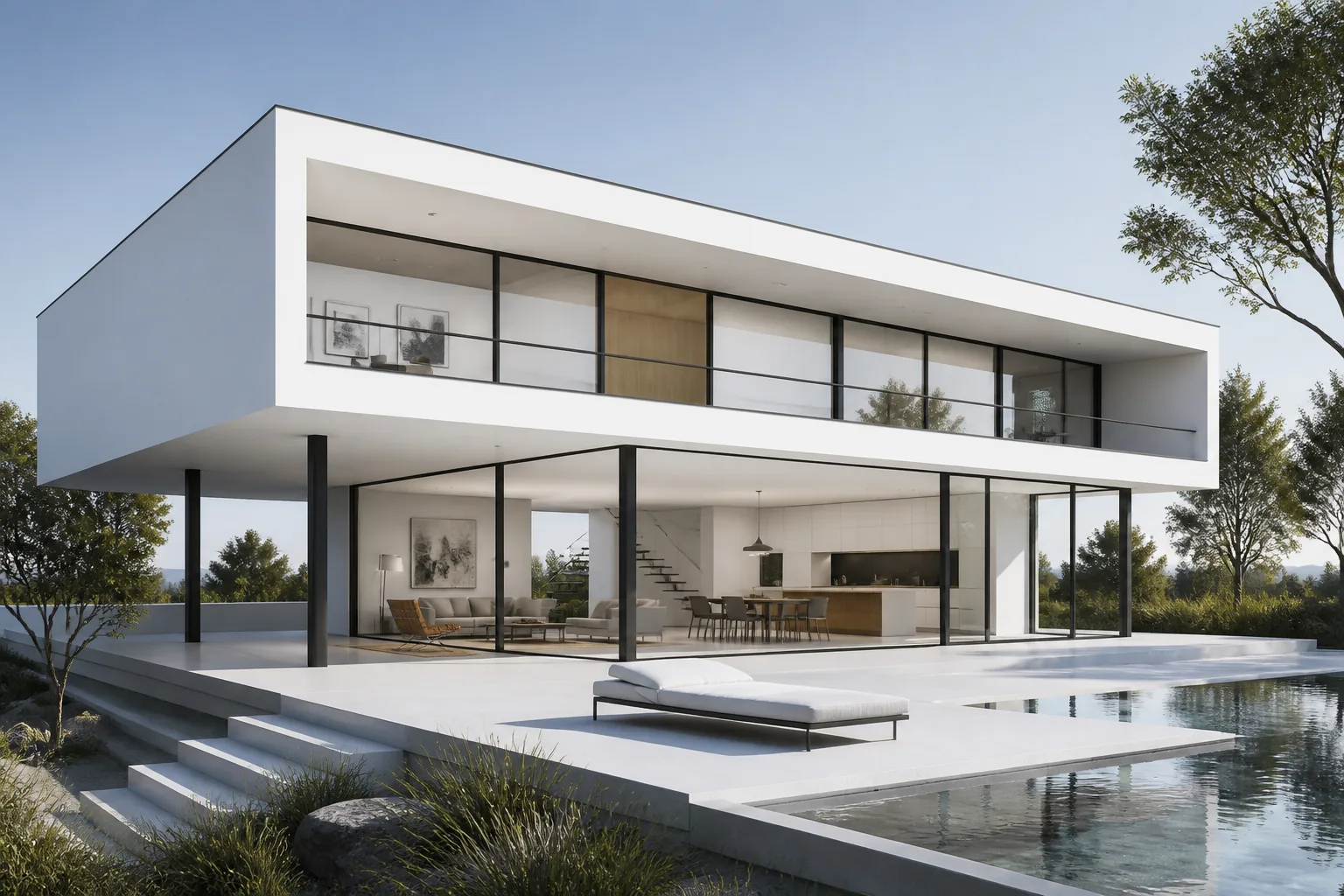
Modernism did not remove beauty from the world — it moved it from ornament into structure, light, proportion, material and the scenario of life.
Editorial thesis
Modernism was never simply a taste for white walls, straight lines and the absence of decoration. It emerged as an attempt to rebuild the world after industrialisation, war, social fracture and the acceleration of urban life. Its language promised honest construction, clear function, accessibility, hygiene, light and rational form. 12
Yet modernism was always more contradiction than rule. It wanted to free objects from historical disguise, but quickly became a recognisable style itself. It spoke about function while producing powerful visual codes: the flat roof, the ribbon window, the steel frame, the free plan, the grid, the sans serif typeface and photography as the language of new speed.
Reader question
Why does modernism still feel modern when its main ideas were formed in the first half of the twentieth century?
Because modernism changed more than the appearance of buildings and objects. It changed the logic of design itself: form should not imitate the past but respond to structure, production, bodily movement, urban density, mass communication and a new culture of light.
Short answer
Modernism is a broad movement in architecture, design, art and visual culture associated with the rejection of historical ornament, an interest in industrial materials, functionality, abstraction and social reform. The V&A links it to the avant-garde belief that art, design and technology could help create a new world after the upheavals of the early twentieth century. 1
In architecture, modernism appeared through steel, reinforced concrete, glass, free plans, flat roofs and open façades. MoMA describes the International Style as plain, unadorned rectilinear architecture built of steel, reinforced concrete and glass. 12 In graphic design it produced the grid, typographic clarity and montage; in furniture, tubular steel, standardisation and a new sense of lightness; in fashion, functional cut, simplicity and the rejection of unnecessary historical casing.
1. Historical rupture: why modernism appeared
Modernism did not begin as a calm desire to make things simpler. It was fed by war, industrialisation, dense cities, new materials, factories, transport, mass printing and a fatigue with historical styles that no longer explained modern life.
After the First World War, the decoration of the past looked to many avant-garde artists less like heritage than like the dust of an old order. The V&A emphasises that the modernist avant-garde imagined a world freed from history and tradition, where design and technology could transform society. 12
2. Form follows function: slogan and trap
The phrase form follows function became a useful password for modernism, although the real history is more complex than any slogan. It does not mean that a building must be dull or a chair stripped of character. In a strong modernist object, function does not hide behind a façade; it organises form.
The trap begins when function is understood too narrowly. A building also has climate, entry ritual, sound, light, social distance, maintenance, ageing and memory. Modernism remains interesting because it constantly expanded and narrowed the meaning of function itself.
3. Rejecting ornament does not mean rejecting image
Modernism is often retold as a war against ornament. That is true, but incomplete. It rejected not all beauty, but decoration detached from structure, material or production.
Instead of mouldings and historical quotation, modernism proposed other sources of expression: proportion, plane, shadow, joint, module, frame, white wall, smooth tube, glass surface and the visible system of movement.
4. The machine as aesthetic model
For modernism, the machine was not only a tool but also a metaphor for a new clarity. The car, ocean liner, aircraft, factory and camera suggested forms in which every line seemed linked to a task.
This view could easily romanticise technology. At its best, however, it helped designers remove the accidental and understand an object as a system: load, motion, material, assembly and maintenance working together.
5. Architecture: volume instead of façade mask
Modernist architecture stopped treating the façade as a decorative mask. Volume, plan, structural grid, light and the movement of the body through space became more important.
MoMA connects the new architectural language with the rejection of ornament and the use of machines, industrial buildings, form and function. 12 The wall increasingly became not a heavy boundary but a plane, screen, frame or membrane between inside and outside.
6. Materials of modernism: steel, glass and reinforced concrete
Steel gave span and slender structure. Reinforced concrete allowed freer work with planes, columns and cantilevers. Glass turned the façade into a filter of light while also exposing the vulnerability of transparency.
In MoMA’s definition, the International Style used rectilinear forms and industrial materials: steel, reinforced concrete and glass. 12 A modernist object is therefore best read not as a white image, but as an assembly of technological possibilities.
7. The free plan and a new interior life
The free plan changes more than wall placement. It changes the script of living: the room stops being a closed box, and space becomes a sequence of zones, openings, views and routes.
In a good modernist plan, emptiness is not leftover space. It is a material: it carries light, lets furniture define use and makes movement part of the composition.
8. The window as an instrument of modernity
The modernist window is no longer simply a hole in a thick wall. Ribbon glazing, glazed planes, glass corners and curtain walls change the body’s relationship to the city: the viewer is no longer looking from a protected niche, but standing inside a luminous skin.
Glass is never neutral. It gives light and view, but also glare, heat, loss of privacy and dependence on climate. Modernism continually balanced the dream of transparency with the real physics of the envelope.
9. Bauhaus: the school as a laboratory of life
The Bauhaus matters not only as a style of chairs, lamps and posters. It was a school where architecture, craft, industry, theatre, photography, typography and colour tried to become one educational system.
UNESCO describes the Bauhaus buildings in Weimar, Dessau and Bernau as fundamental representatives of Classical Modernism directed towards a radical renewal of architecture and design. 1 Bauhaus made modernism not only an aesthetic, but also a pedagogical model.
10. Dessau: glass workshop and public programme
The Bauhaus building in Dessau became almost a life-size textbook of modernism. It displays different functions not through one symmetrical façade, but through wings, bridges, glass planes and working volumes.
The Bauhaus Dessau Foundation notes that the steel and glass façade of the workshop wing marked the beginnings of modern architecture in Dessau. 1 The building does not hide the school behind a ceremonial envelope; it makes production, learning and collective work into a public image.
11. International Style: when modernism became exportable
MoMA’s 1932 Modern Architecture: International Exhibition helped fix the image of modernism as an international language. That language was convenient for museums, criticism and export: plain forms, smooth surfaces, no ornament, frame, glass and whiteness.
MoMA links the term International Style to Henry-Russell Hitchcock and Philip Johnson and to European architecture of the 1920s and 1930s. 1212 Yet internationality was always contested: climate, culture, economy and habits do not disappear because a façade becomes glass.
12. Le Corbusier: plan, surface and the discipline of volume
Le Corbusier made modernism sharp, persuasive and sometimes dangerously confident. For him architecture was a system of volume, surface and plan; MoMA identifies those ideas as central to his thinking on modern architecture and urbanism. 12
His legacy should be read without worship and without caricature. He offered powerful tools: the free plan, pilotis, ribbon window, roof garden and precise proportion. But his belief in universal order often collided with the real complexity of the city and of everyday life.
13. Mies van der Rohe: less as tension, not poverty
In Mies van der Rohe, reduction does not mean emptiness. His architecture depends on proportion, joint, reflection, material and boundary. Polished stone, glass and metal do not fall silent: they create a quiet, almost ceremonial tension.
MoMA describes Mies as one of the leading figures of modernist architecture, whose work from tubular steel furniture to office buildings influenced generations of architects. 12 His lesson is that minimal form demands maximum control.
14. Barcelona Pavilion: space as a sequence of planes
The 1929 Barcelona Pavilion, designed by Mies van der Rohe and Lilly Reich, matters not as a glass box but as a space where walls no longer only carry or close. They direct the view, reflect the body, delay movement and turn marble, water, metal and glass into an architectural score.
Fundacio Mies van der Rohe states that the pavilion was the German national pavilion for the 1929 Barcelona International Exposition. 11 Its modernity lies not in the absence of decoration, but in the way material itself becomes the event.
15. Furniture: lightness, standard and a new way to sit
Modernist furniture changes not only the appearance of a room but the behaviour of the body. Tubular steel, plywood, leather, canvas and serial construction suggest that a chair can be lifted, moved, repeated and integrated into a new lifestyle.
Instead of a heavy chair as a small throne, modernism offers an object that shows frame and air. Furniture becomes not interior decoration but part of the spatial logic of modernism.
16. Graphic design: grid, typography and message clarity
In graphic design, modernism appeared through the rejection of decorative overload and an interest in grids, asymmetry, sans serif type, photomontage and clear hierarchy. The poster became not an image with text, but an organised system of attention.
Modernist graphics are not necessarily cold. Their energy comes from the precise collision of scale, emptiness, photography, diagonal movement, a red accent, a number or a short line. Where ornament disappears, rhythm becomes visible.
17. Photography: the machine’s new eye
Photography became a natural ally of modernism. The camera could look from above, below, nearby, sharply, serially and without academic posture. The new view made ordinary things strange: a staircase became a diagonal, a factory an abstraction, a face a construction of light.
Herbert Matter shows this modernist connection especially clearly. MoMA describes him as a Swiss-born designer, photographer and filmmaker who worked with posters, brochures, catalogues, advertisements and covers. 12
18. Fashion: function, movement and the rejection of heavy casing
In fashion, modernism cannot be reduced to one silhouette. It appears in the freeing of the body from heavy historical construction, in sportiness, simplicity, technical fabrics, straight cut, clear fastening and respect for movement.
The key question of modernist dress is not whether it is minimal enough, but how it lives on the body. A strong modernist silhouette does not suppress the person; it allows the body to move through office, transport, city and travel.
19. Interior: light, built-in systems and disciplined emptiness
The modernist interior is often mistaken for lack of comfort. Its real task is to reorganise relationships between light, storage, furniture and surface. A built-in cabinet replaces the heavy sideboard; an open wall becomes a plane of light; there are fewer objects, but each becomes more visible.
Emptiness should not be sterile. It should help us read proportion, route, material and function. When emptiness becomes only an expensive white pause without human use, modernism turns into decorative minimalism.
20. The colour of modernism: not only white
The popular image of modernism is often white, grey and glassy. Historical modernism, however, worked actively with colour: Bauhaus, De Stijl, posters, objects and architectural details used colour as a system of orientation, rhythm and contrast.
The white wall became a powerful instrument, but not the only one. Colour could emphasise structure, separate functions, compose a surface or turn a plane into a graphic sign.
21. Social programme: light, hygiene and mass housing
Modernism wanted to be more than a style for elites. It promised better housing, sunlight, ventilation, standardisation, accessible furniture and rational planning. That was its ethical force.
The same programme could also become rigid: a universal plan did not always listen to local habits, poverty, climate, family complexity or the informal life of the courtyard. The critique of modernism begins not because it wanted too little, but because it sometimes claimed to know too confidently how others should live.
22. The city: speed utopia and the problem of scale
The modernist city dreamed of clarity: separating flows, lifting housing towards light, freeing the ground, making room for transport and air. On paper this looked convincing: clean zones, large roads, repeatable blocks.
In the real city, such logic could lose small scale: the corner shop, accidental meeting, tree shade, courtyard noise and slow movement of an elderly body. A contemporary reading of modernism must see not only the beauty of the diagram, but also the cost of its simplifications.
23. Tropical modernism: when a universal language meets climate
Tropical modernism shows that modernism was never fully universal. In hot climates, the glass box does not work as in northern Europe: shade, cross-ventilation, deep eaves, screens, verandas and porous walls become essential.
The V&A describes Tropical Modernism as architecture in which modernist ideas were adapted to climate and to the political contexts of decolonisation. 1 The example matters because a style becomes stronger when it stops pretending to be the same everywhere.
24. How to recognise modernism visually
Modernism can be recognised through several signs: absence of historical decoration, clear geometry, open plan, industrial materials, flat roof, large glass planes, modularity, light furniture, sans serif type, grid, photography and asymmetrical composition.
Real analysis begins after recognition. Does the form truly connect to function, or does it only imitate a modernist look? Does the material behave honestly, or pretend not to age? Does the space help life, or merely look clean in a photograph?
25. Modernism and minimalism: related but not identical
Minimalism often inherits from modernism, but it is not the same thing. Modernism is tied to industrialisation, social programmes, production and a new constructive logic. Minimalism may be an art strategy, a luxury language or a commercial aesthetic of calm.
A contemporary interior does not become modernist simply by removing everything. Modernism begins when reduction is tied to life, material and construction, not only to visual silence.
26. Critiques of modernism: coldness, universalism and the power of the plan
Modernism has been criticised for coldness, destruction of historical fabric, inattention to local cultures, authoritarian planning and distrust of ornament. This critique does not cancel modernism; it makes it more useful.
Today it is best understood not as a religion of correct form, but as a set of tools. Function, material honesty, light, standardisation and the removal of the unnecessary remain powerful when used attentively rather than dogmatically.
27. Why modernism keeps returning
Modernism returns whenever visual culture becomes tired of noise. It promises order, air, clarity, a clean line and a version of the future that has not yet become exhausted.
Contemporary returns often aestheticise only the surface: a white villa, a glass wall, a vintage chair, a strict logo. The deeper interest begins when we return not to the look, but to the question: what is truly necessary here?
28. How to use modernism today
For a designer, modernism is useful as a method of clarifying the task. Define function, scenario, material, technology, budget, maintenance and light, then remove what does not help those conditions.
But modernism must not become a ban on complexity. Life is not always rectilinear. Sometimes the needed function is memory, ritual, softness, shade, local ornament or permission for an object to remain imperfect.
29. How to photograph modernism
When photographing modernism, it is important to show not only the clean façade but the work of light, rhythm of columns, thickness of planes, human route, glass reflection and the building’s relation to the ground. Modernist architecture often reveals itself in the corner, joint and shadow rather than the postcard view.
For fashion and editorial work, modernism is especially strong as disciplined background. It should not merely make the frame look expensive. The space should explain the clothes: straight cut, technical fabric, silhouette, step, pause, gesture and the body’s relationship to scale.
30. How art directors should read modernism
An art director should not use modernism as a quick symbol of intelligence, purity or status. A white wall, concrete, glass and a tubular steel chair guarantee nothing by themselves.
A stronger approach asks: which function became form, which material tells the truth, where does light build space, how does a person reveal scale, and what kind of future does this object still contain — utopian, corporate, domestic, museum-like or already slightly tired?