encyclopedia
Neofuturism
flow, parametrics and the image of the future
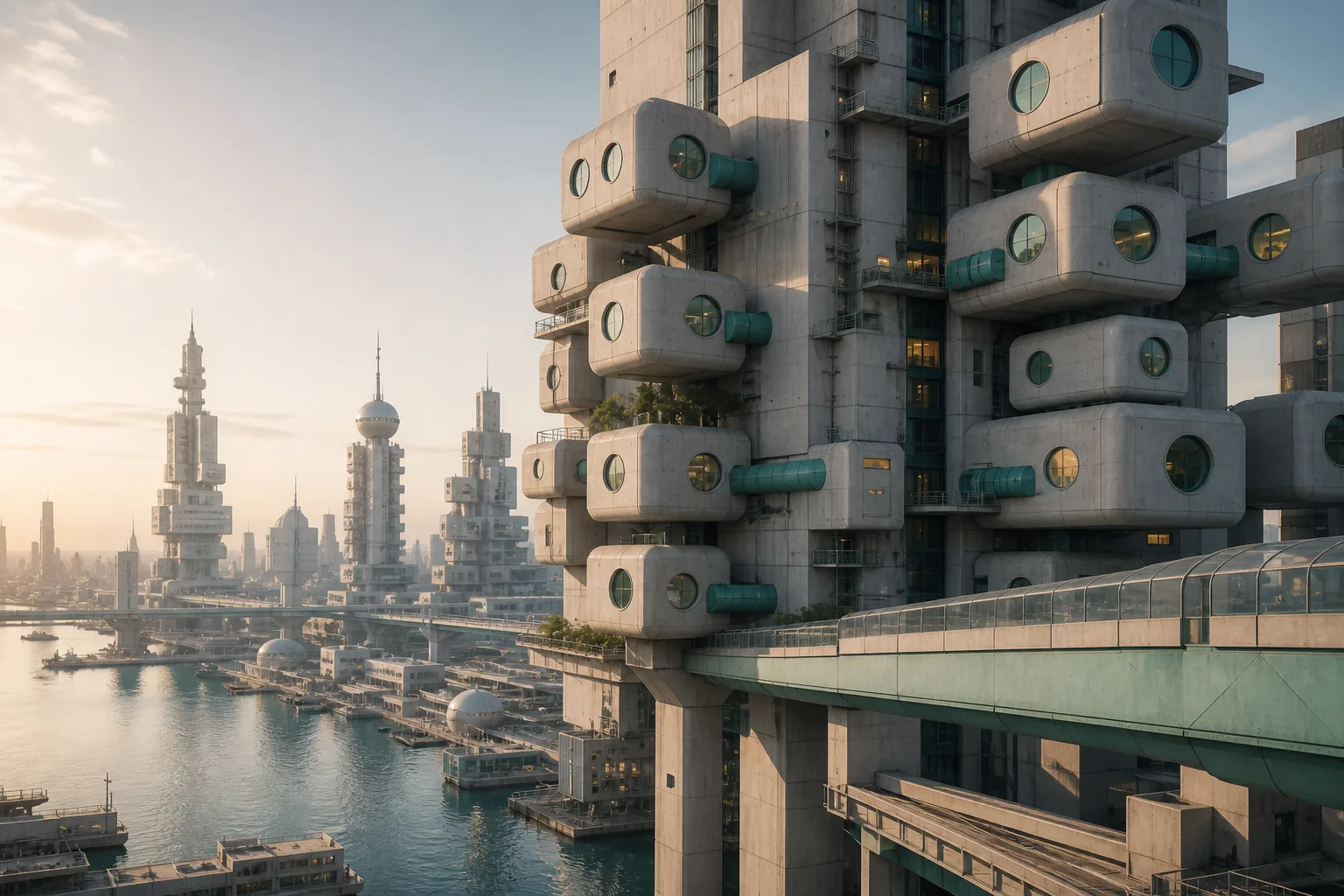
Neofuturism designs not only form, but also the sensation of accelerated time: the building becomes a route, the surface an interface, and the city a stage for the future.
Editorial thesis
Neofuturism matters not because it looks “space-age.” Its strength lies elsewhere: it turns movement, data flow, engineered skins, infrastructure and digital modelling into a language of form. Where modernism sought clear function, neofuturism often seeks a scenario of the future: the city as organism, the building as flow, the facade as skin, the object as acceleration. 1 1
Reader question
Why do some buildings, objects and visual campaigns look like the future, even when they have already been built, published or technically surpassed? 2
Short answer
Neofuturism is a late twentieth- and twenty-first-century movement and visual logic in which architecture, design, fashion, graphics and media use fluid lines, parametric surfaces, engineered skins, digital design and technological optimism. It inherits modernism’s belief in the new, but replaces the right angle with flow, the static box with an envelope, and universal form with a complex behavioural system. 2
1. From Futurism to neofuturism: what changed
Early twentieth-century Futurism celebrated speed, the machine and rupture with the past. Neofuturism inherits that excitement for the new, but works in another reality: computer modelling, global cities, airports, iconic museums, branded spaces and digital images have become its natural environment. 3
2. Why the word “future” became a form
In neofuturism, the future is not always tied to actual technology. It is often a carefully constructed visual effect: the line accelerates, the surface flows, the structure seems too complex to have been drawn by hand. The form tells the viewer: this is not the past, but a projected tomorrow. 5
3. Flow instead of the box
The classical modernist box stands still. Neofuturist form moves even when fixed. It bends, opens, twists, guides the visitor through a route and creates the feeling that the building is still being assembled before the viewer’s eyes. 6
4. Parametrics as a new tool of imagination
Parametric design matters not as a fashionable label, but as a way to connect many conditions: geometry, structure, light, climate, pedestrian flow and component production. Visually, it produces complex repeated systems where every line appears to belong to an algorithm rather than to a single gesture. 4
5. Zaha Hadid: the line that became space
Zaha Hadid became a key figure of neofuturist imagination. Her architecture translates avant-garde diagonals and pictorial dynamism into real spaces: walls, floors and roofs stop behaving like separate planes and become continuous fields of movement. The Pritzker Prize describes her work through new spatial concepts, intensified urban landscapes and design ranging from urban scale to furniture. 5
6. Frank Gehry and the digital skin of the building
In Frank Gehry’s work, the future often appears not as smooth speed but as a fragmented envelope. Digital tools made it possible to calculate complex curved surfaces with precision, so the building could become a constructed wave of metal, light and reflections. 9
7. Santiago Calatrava: structure as bodily movement
Santiago Calatrava often builds the image of movement through structure that evokes wing, rib, skeleton or body. The Oculus in New York, designed by Calatrava, shows how transport infrastructure can become a symbolic space rather than only a node of circulation. 6
8. Future Systems and the capsule-object
Future Systems worked with the capsule, the envelope, aerospace imagination and compact utopia. Their language helps explain neofuturism: the future can be not only a tall tower, but also a small object that looks like a device for another way of living. 11
9. Blob, envelope and smooth surface
The blob became one of the recognisable signs of late digital design. It removes the sharp corner, dissolves the classical facade and turns the building into a volume that seems grown, inflated or poured out of a digital environment. 12
10. Aerodynamics as visual metaphor
Neofuturism often borrows the language of transport: aircraft, train, spacecraft, racing bodywork, tunnel. Even when the object does not move, its surface can look as though it has been calculated by wind. 13
11. Infrastructure as the new temple
Airports, stations, transport hubs and cultural centres became natural stages for neofuturism. Large flows of people require clear routes, while the city seeks a new symbol of speed, openness and global connection. 14
12. The future museum and the iconic building
In neofuturist logic, the museum of the future is often not a neutral box for art but a media image in its own right. MAXXI by Zaha Hadid Architects in Rome is described as a campus for art where wall lines create complex routes and intersecting flows. 7
13. Glass, metal and composite envelope
Neofuturist materials behave as skins: glass dissolves boundaries, metal catches light, composites allow curvature, concrete becomes plastic. The important thing is not a single material but the sensation of continuous surface. 2
14. White, light and sterile utopia
White is often used as a sign of the future: purity, medical precision, light, sterility, cosmic neutrality. But in strong projects white is not flat: it collects shadows, ribs and curves, making the form legible. 3
15. Dark neofuturism and technological shadow
Neofuturism is not always white and optimistic. In its dark version it becomes a language of technological anxiety: black metal, glossy surface, deep shadow, cold light and controlled force. 4
16. The city as interface
The city in neofuturism resembles an interface. Wayfinding, facade, media screen, bridge, station and commercial space connect into a single signal system. The building does not simply stand in the city; it guides the user. 5
17. Interior: continuous surface and route
The interior is often organised as a continuous route: ceiling flows into wall, stair becomes sculpture, reception desk resembles a device housing. The person inside a neofuturist space does not merely occupy it, but moves through a scenario. 6
18. Product design: the object as vehicle
In product design, neofuturism appears through smooth shells, hidden joints, aerodynamic silhouettes and technical precision. The object looks as though it could drive, fly or switch on. 7
19. Fashion: the body as architectural carrier
In fashion, neofuturism turns the body into an architectural carrier. Shoulders can become structure, fabric a shell, shoes an engineered module, and silhouette a line of speed. What matters is not only material but the feeling of a future worn on the body. 8
20. Photography: how to shoot neofuturism
Neofuturism is best photographed not frontally and calmly, but through route, diagonal, reflection, wide angle, low viewpoint, cold light and controlled scale. The frame should show not only the object, but also the tension of movement around it. 9
21. Graphic design: grid, flow and digital sign
In graphics, neofuturism uses grid, gradient, digital typography, fine lines, technical annotations and dynamic composition. The main mistake is replacing a system with random “cyber” elements. Strong neofuturism is always structured. 10
22. Motion design and neofuturist rhythm
Motion design strengthens the style through acceleration, smooth transformations, interface unfolding, light trails and scale shifts. Movement should not be decorative but logical, as if the form itself explains how it works. 11
23. Luxury and the image of technological superiority
Luxury uses neofuturism to project superiority: technology, rarity, precision, clean light and material without visual noise. The language fits cars, watches, beauty-tech, high jewelry and premium real estate. 12
24. Retail and experience spaces
In retail and experience spaces, neofuturism creates not a shop but a route of impression. The window becomes a portal, the fitting room a capsule, light a navigation tool, and the product part of a technological stage. 13
25. Neofuturism in Asia and the Middle East
Asia and the Middle East have become important territories for neofuturist imagery: rapid urban growth, cultural institutions, airports, museums, towers and new districts demand signs of the future readable from the air, on screen and at street level. 14
26. Ecology: promise and problem
The ecological question remains complex. Neofuturism often promises lightness, energy performance and smart skins, but complex forms may require expensive production, demanding maintenance and substantial resources. Sustainability must therefore be checked by facts, not by impression. 1
27. Critique: expensive, spectacular, not always sustainable
Criticism is justified where the image of the future becomes more expensive than its meaning. A spectacular form may age badly, operate poorly, be difficult to maintain or turn the city into a collection of isolated icons without social connection. 2
28. How to distinguish neofuturism from high-tech
High-tech displays structure and services as aesthetics. Neofuturism more often hides engineering logic under a smooth envelope or transforms it into flow. High-tech says: “look how this is assembled.” Neofuturism says: “look where this is moving.”
29. How to use the style in AI visuals
In AI visuals, neofuturism is strongest when built from specific parameters: type of space, route, envelope material, light, human scale, degree of smoothness, engineering details and cultural context. Otherwise it becomes generic “futurism” without character.
30. Why neofuturism remains a powerful visual language
Neofuturism remains powerful because it works with the desire to see the future before it becomes normal. It can be naive, expensive and controversial, but its visual energy still helps design speak about speed, change and technological hope.