encyclopedia
Patina
Controlled ageing of material
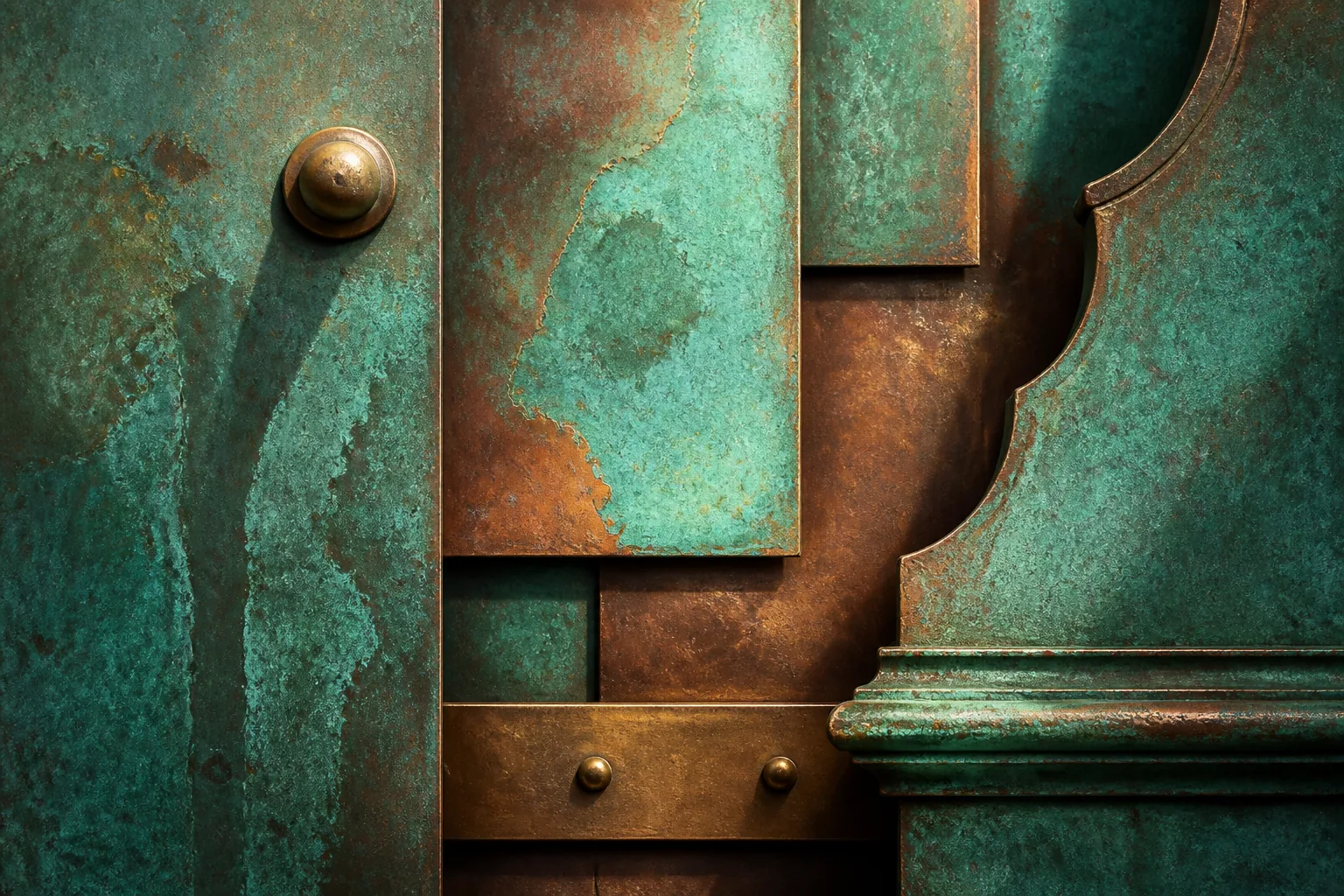
Time does more than change surface colour - it records air, water, touch and maintenance. Patina becomes expressive when we see not an effect of age, but a precise history of how a material has lived.
Editorial thesis
Patina is often sold as a quick way to give an object age, depth and status. A genuine surface of time is more complicated than decorative darkening: it may be a chemical reaction, an authored finish, a sheen polished by hands, a deposit of dirt or the beginning of material failure.
A strong project does not romanticise every irregularity. It asks how the colour formed, whether the layer is stable, what touch and cleaning will do to it and whether the material is meant to keep changing. Patina matters not because it looks old, but because it makes the history of a surface legible.
Reader question
Why is a green layer on one bronze protected as part of the work, treated as dangerous corrosion on another, while a new brass wall may be deliberately darkened at the factory?
Because the same colour does not mean the same process. Alloy, environment, rate of change, adhesion, artistic intention and object function all matter. Patina begins as a surface phenomenon, but its value is always decided by context.
Short answer
In its narrow sense, patina is a naturally formed or deliberately produced surface layer on metal, especially copper and its alloys. In broader design language, the word also describes changes produced by time, light, touch, oxidation, polishing and use on wood, stone, leather and other materials. 12
Patina may be stable and aesthetically significant, but it may also conceal active corrosion. It cannot be judged by colour alone: chemistry, structure, rate of change and intention are decisive. Conservation aims to retain meaningful surface evidence while stopping damage, not to make every object look new. 15
1. Patina: layer, trace or cultural judgement
Patina does not describe one material or one reaction. In museum practice it may mean a thin corrosion layer on bronze; in furniture it may be the sheen produced by wax, light and hands; in architecture it may describe the weathering of stone, metal or timber.
The word therefore always needs qualification. Name the material, the origin of the layer and its condition. The phrase “beautiful patina” without these three details says more about the observer’s taste than about the surface itself.
2. Natural and artificial patina
Natural patina develops through air, moisture, pollutants, light and touch. Artificial patina is produced with chemical solutions, heat, smoke, pigments, oils or several processes used in sequence.
An artificial layer is not automatically less authentic. On bronze sculpture, patination may have been part of the artistic intention from the moment of manufacture. The problem begins when a new finish is presented as historic without disclosure, or when its behaviour has not been tested in the real environment.
3. Stability and beauty are not the same thing
An even green copper surface may be stable, while a small pale-green spot may signal rapidly developing corrosion. Conversely, a visually rough archaeological layer may be stable and preserve important information about manufacture and use.
Beauty and material safety overlap, but they are not identical. Decisions about cleaning must consider powdering, adhesion, humidity, salts, cracks and the rate at which new corrosion products appear, not colour alone. 1
4. Copper and bronze: the surface as a chemical landscape
Copper and bronze react with oxygen, moisture, carbon dioxide, sulphur compounds and salts. Their surfaces become layered systems in which different compounds form sequentially or at the same time.
The system is never completely static. One area receives rain, another sits beneath an overhang and a third is constantly touched. A large bronze door or facade rarely ages as one colour because the architecture itself distributes different chemical conditions across the surface. 1
5. Why patina can be red, brown, black, blue or green
Red and brown tones are often associated with early oxide layers or organic finishes; black may be produced chemically or with heat; green and blue develop in different atmospheric and burial environments. A single colour can contain several compounds.
Designers must look beyond the 10-centimetre sample. Across a large plane, water draws vertical tracks, joints create darker zones and exposed edges are polished by rain and touch.
6. Cuprite, carbonates and sulphates: colour depends on environment
Cuprite contributes red and dark underlayers, copper carbonates often occur in green and blue formations, while urban atmospheres can introduce sulphate compounds. Composition depends on environment and object history, so there is no universal recipe for “green patina”. 1
Attempting to reproduce a museum colour with one chemical usually creates only the first impression. Depth develops through sequential layers, rinsing, drying, repeated application and later ageing.
7. Verdigris: a beautiful word but an imprecise diagnosis
Verdigris has historically described green copper products and pigments, but in contemporary practice it is too broad to function as a diagnosis. It does not tell us whether a layer is stable, what it contains or why it formed.
Precise description is safer: dense green patina, loose pale-green powder, blue-green streaks or remains of an artificial finish. Accurate language protects a project from beautiful but hazardous generalisations.
8. Active corrosion and bronze disease
Active corrosion on copper alloys may appear as fresh pale-green powder that returns after cleaning. In archaeological bronze, chlorides can sustain a cyclic process commonly known as bronze disease. 11
Such a layer should not be preserved merely because it is green. Patina here stops being an aesthetic category and becomes a condition diagnosis. Humidity control, salt assessment and specialist treatment are required.
9. Brass: darkening, pink surfaces and dezincification
Brass darkens, records fingerprints and may gradually turn brown. During dezincification, zinc is lost from the surface, leaving a copper-rich red or pink colour; severe attack can weaken and perforate the object. 1
A pink area on a plumbing component and a deliberately reddish patina on a decorative panel may look similar but mean opposite things. The first requires technical assessment, while the second requires a verified recipe and protective system.
10. Silver: a thin black film rather than a green crust
Silver does not usually develop a green patina. Its characteristic darkening is mainly associated with sulphide films that suppress mirror reflection and become especially visible in recesses. 1
On a decorative object this contrast may strengthen relief, but repeated polishing removes metal together with tarnish. Every return to “newness” gradually softens fine edges and engraving.
11. Iron: when rust does not become patina
The word patina is often used too casually for iron. A dense dark finish produced by controlled oxidation and protected with wax or oil differs from loose rust that retains moisture and continues to consume the metal.
A romantic orange surface is especially risky on thin sheet, fixings and structural parts. Design may accept colour change, but it should not accept loss of section as natural beauty.
12. Zinc, lead and aluminium: other ageing scenarios
Zinc commonly develops grey surface films; lead dulls and can form pale corrosion products; aluminium is protected by a thin oxide film, but staining and contact with incompatible metals alter the scenario.
The general word patina conceals these differences. Each metal requires its own approach to humidity, compatible fixings, cleaning and coatings. Universal “aged metal” chemistry is almost always a compromise.
13. Chemical patination in the workshop
In the workshop, patina is applied to carefully prepared metal. Degreasing, abrasion, surface temperature, solution concentration, contact time and rinsing matter as much as the name of the reagent.
The work is built in layers. The maker observes the response, neutralises residues, dries the object and decides whether to repeat the process. Good patina does not disguise poor preparation: scratches, grease and welding zones will still emerge.
14. Heat, smoke and layered colour
Heat accelerates reactions and changes the way solutions flow and dry. Smoke, soot and organic compounds can add brown and black layers, while later rubbing exposes warmer highlights.
Temperature patterns are difficult to repeat across large panels. When a sample is handmade but the object is produced in series, the specification needs an agreed tolerance for variation. Otherwise a living surface becomes an endless dispute about defects.
15. Masking, rubbing and controlled irregularity
Masks, local application, rubbing and polishing allow patina to operate like an image. Recesses remain dark, projections are opened, edges are emphasised and handles can be designed as future zones of shine.
Controlled irregularity needs a logic of scale. Random marks may look convincing on a small sample but become visual noise on a wall. Their rhythm should follow form, joints and anticipated touch.
16. Wax, lacquer and oil: stopping time or pausing it
Wax deepens colour and produces a soft sheen, lacquer isolates the surface more strongly, while oil behaves differently on metal and wood. No coating stops time permanently; it changes the rate of reaction and the maintenance cycle. 5
Local wear through lacquer often appears harsher than natural ageing. For doors, worktops and handrails, the project must decide whether the finish will be regularly renewed or whether gradual exposure of the metal is accepted.
17. Touch: handles, handrails and the surface of use
Touch produces one of the most convincing forms of patina. Raised areas polish, oils and moisture darken recesses, and repeated human routes become visible without graphics.
Interior design can use this deliberately: a rail, handle or table edge becomes a map of movement. Marks in unintended places - around a switch, beside a sink or across a door leaf - may read as neglect unless the entire material system supports them.
18. Wood: hand polish, wax, light and small damage
On wood, patina combines oxidation, ultraviolet exposure, wax, oils, dust, fine scratches and thousands of touches. A lacquered surface ages differently from open timber: one develops a network of damage while the other slowly acquires polish.
Furniture conservation balances evidence of life against damage that accelerates deterioration. Surface history is valuable, but spilled liquid, delamination and active biological growth do not automatically become virtues. 1
19. Leather and textiles: the extended meaning of patina
On leather, patina describes darkening, shine, creasing and colour change produced by light and use. The term is more cautiously applied to textiles: fading and wear may be historically meaningful but often represent irreversible loss of fibre and dye.
The extended meaning is useful as a visual metaphor, but it must not erase material differences. Darkened leather, worn velvet and oxidised bronze require different technologies even when all three suggest time.
20. Stone: skin, polish, soiling and protective surface
Stone may develop a denser outer skin, dark atmospheric deposits, streaks, foot-polish or roughness through weathering. Some surface layers protect the substrate; others retain salts and moisture.
Abrasive cleaning can remove not only dirt but original tooling and protective patina, leaving stone more vulnerable. This is why a test area matters more than the promise to restore the original colour. 1
21. Lichen and biofilm: not every sign of age is valuable
Lichen, moss and biofilm can give stone a picturesque age, but they may also retain moisture, hide cracks or contribute to decay. A black crust may be industrial pollution rather than a noble trace of time.
Judgement depends on the object. Biological growth may support the image of a garden wall, yet on a fine carved element or memorial inscription it can destroy legibility and accelerate loss.
22. Light: matte depth and shine on raised areas
Patina changes light more profoundly than a colour chart suggests. Matte green bronze spreads and absorbs a highlight, polished projections return almost mirror-like points, while a waxed surface creates a deep, slow gradient.
Raking light reveals layers, streaks and polishing. Soft frontal light can flatten a complex surface. Lighting design should test not only the new sample but also the anticipated condition after several years.
23. How to photograph patina
Photographers need to separate colour from texture. Neutral white balance and a colour reference prevent green copper from becoming a fashionable turquoise filter, while side light reveals whether a layer is dense, powdery or polished.
A wide view explains the distribution of ageing, macro reveals structure, and a travelling highlight distinguishes wax, lacquer and bare metal. Hand marks work best when the viewer first sees the object and only then discovers the map of touch.
24. Luxury interiors: expensive material or expensive history
In luxury interiors, patina often replaces direct display of expense. Dark bronze, aged brass and gently worn timber suggest materials that existed before the project and may outlast it.
An expensive atmosphere does not come from random stains. It requires a good alloy, precise joints, controlled finishing, intelligible maintenance and coordination with stone, textile and light. Patina amplifies craft; it cannot replace it.
25. A new object with a past: the ethics of artificial ageing
Artificially aged objects can be honest design when the production method is disclosed. They become problematic when they imitate historical rarity, museum provenance or years of human use that never occurred.
The ethical issue is not the effect itself but clarity. A new object may carry a complex dark surface, but invented history should not be used as evidence of value.
26. Cleaning: where care ends and erasure begins
Cleaning always edits history. Too little leaves harmful salts and deposits; too much removes finish, tool marks and accumulated sheen. Even gentle polishing gradually changes the geometry of detail. 11
Good practice begins with investigation and a test in a discreet location. The goal must be defined: remove active corrosion, lift loose dirt, improve legibility or prepare a protective coating. “Make it look new” is too crude a brief for a significant surface.
27. The Statue of Liberty: patina as protective skin and image
The copper skin of the Statue of Liberty was brown when completed in 1886 and became green over the following decades. The National Park Service attributes the colour to natural oxidation and notes that the resulting patina protects the copper from further weathering. 1
The example shows how chemical change can become an object’s identity. Returning the statue to bright copper would not restore it; it would remove both a familiar image and a protective skin.
28. Renaissance bronze: patina as an authored finish
On Italian Renaissance bronzes, patina could be a carefully authored finish rather than an accidental result of centuries. Research published by The Met describes organic and multilayered surfaces that shaped colour and gloss from the time of manufacture. 1
Such an object is not bare metal plus age. Its surface belongs to the artist’s and workshop’s technology. Polishing to bright bronze may remove not dirt but the work itself.
29. Benin bronze: the surface as a historical document
The red-brown surface on some Benin bronzes was long described as adhering soil. Conservation research at The Met found the layer to be hard, complex and connected to the history of the object rather than ordinary dust. 1
Patina becomes documentary evidence: it can retain traces of making, ritual use, storage and displacement. Removing it to reveal a familiar bronze colour would erase knowledge together with colour.
30. How designers, photographers and art directors should read patina
Designers should ask what forms the layer, whether it is stable, where it will be touched, how it meets a joint and how it will be cleaned. A full-scale mock-up should be aged, wetted, handled and lit rather than approved from a catalogue alone.
Photographers should show the distribution of time rather than intensify it with a filter. Art directors should resist turning patina into an automatic code for heritage, wabi-sabi or quiet luxury. A specific surface story is stronger: material, process, touch and honestly accepted change.