encyclopedia
Photogram
The cameraless image constructed through light, contact and time
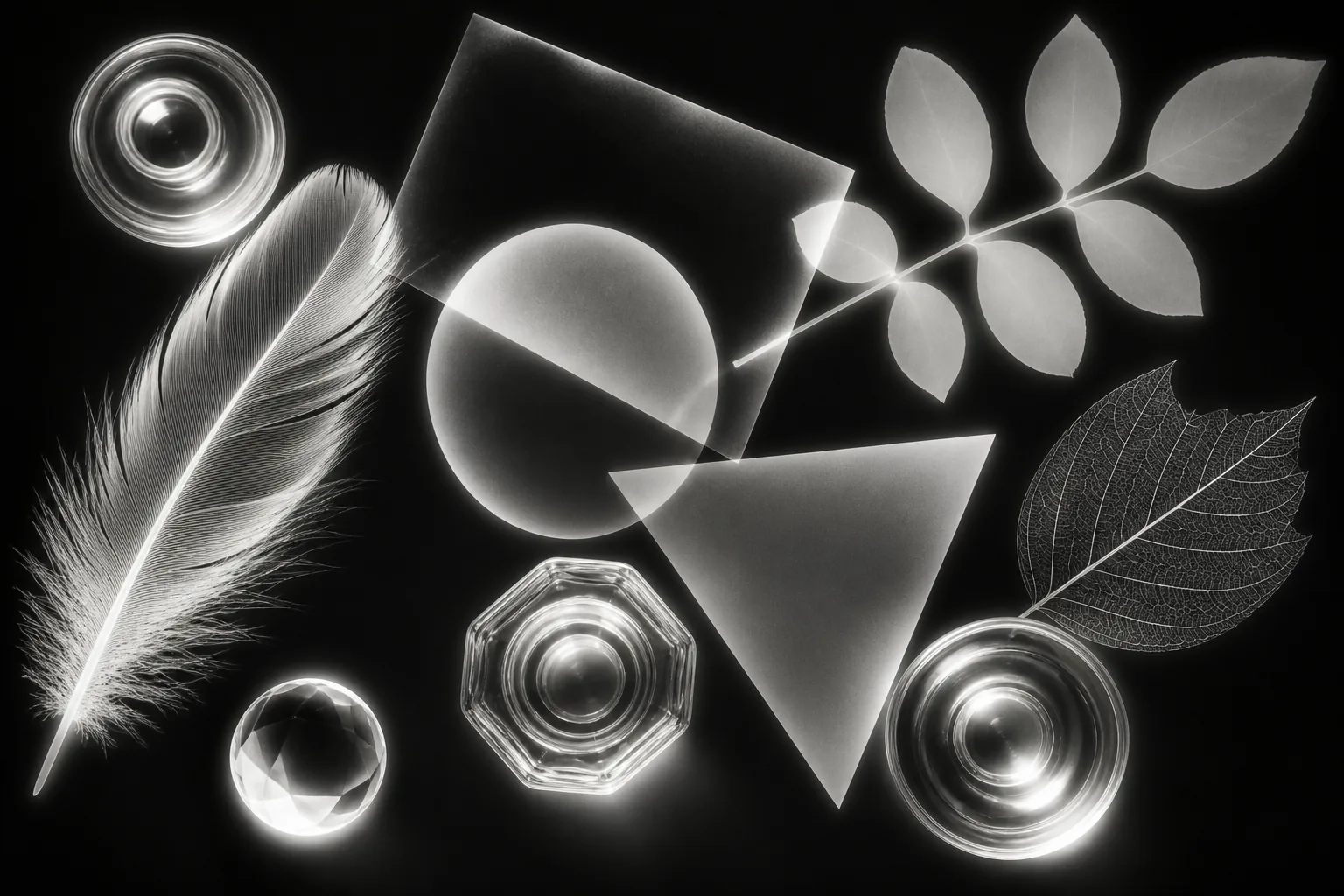
A photogram begins where an object touches a light-sensitive surface or hovers just above it. It is not simplified photography but a direct agreement between matter and light: contour becomes document, transparency becomes tone, and a few seconds of exposure become space.
Editorial thesis
A photogram returns photography to its simplest and strangest condition: light, a sensitive surface and an object that briefly becomes subject, negative and mask at once. The camera disappears, yet the image becomes no less photographic; it is produced as a direct physical consequence of contact.
The process has no conventional perspective or lens, but it creates another kind of space: millimetres of separation, softness of edge, material transparency, movement of the hand and duration of exposure. A photogram does not merely describe an object; it reveals how that object blocks, transmits and redirects light.
Reader question
Why can the silhouette of a leaf, glass vessel or human hand placed on photographic paper appear more mysterious than a carefully staged camera image?
Because the photogram removes the usual distance between object and image. The subject is not represented through optics; it intervenes directly in the exposure, leaving a trace of its opacity, thickness, movement and position in relation to the light.
Short answer
A photogram is a photographic image made without a camera, usually by placing objects on a light-sensitive surface and exposing it to light. Areas covered by opaque objects receive less exposure and remain lighter, while transparent and translucent materials create intermediate tones. 12
The result depends on the paper, spectrum and direction of the light, exposure time, distance between object and emulsion, and the developing and fixing process. A photogram may therefore become a strict contact print, a layered abstraction, a record of movement, a chemical event or a spatial composition of light.
1. Photogram: the image as physical trace
A photogram is not photography “without technique”; it is a technique in which the surface itself becomes the camera. Light-sensitive paper receives not a projection of the world but its immediate presence: edge, weight, transparency and even slight movement become tone.
The image therefore appears precise and unfamiliar at once. We recognise a fork, plant or piece of glass, yet without perspective and scale these objects become signs, almost architectural plans of light.
2. The camera disappears, light remains
A camera normally organises the image through lens, viewpoint and rectangular frame. In a photogram, the paper and the direction of light take over those functions. Composition is built directly on the future print rather than in front of a camera.
This makes the process bodily: objects must be placed, lifted, turned, held or moved above the emulsion. Gesture matters as much as chemistry.
3. Contact, shadow and inversion
An opaque object acts as a mask. Where it touches the paper, light cannot reach the emulsion and a pale silhouette remains after processing. Exposed areas receive more light and darken.
Yet a photogram rarely reduces itself to simple black-and-white contrast. A slightly raised edge, thin cloth or scratch in glass creates gradations that turn shadow into a map of distance.
4. Talbot and the “photogenic drawing”
In the 1830s and 1840s William Henry Fox Talbot called such images “photogenic drawings”. His early works with lace, leaves and seaweed demonstrated that photography could arise through direct contact between an object and prepared paper. 14
Critical context
Talbot should not be turned into the sole “inventor” of the photogram. Experiments with light-sensitive substances predated the public establishment of photography. It is more accurate to say that his system made the direct print part of the documented history of paper photography.
5. Botany as an early archive of form
Plants were ideal subjects for early photography: flat, intricately outlined and filled with translucent veins. In a contact print, a leaf became both scientific specimen and near-abstract drawing.
Such an image recorded neither natural colour nor habitat but morphology—contour, branching, thickness and rhythm. Photography began to operate as an archive of form.
6. Anna Atkins: specimen, book and sequence
Anna Atkins used cyanotype for Photographs of British Algae: Cyanotype Impressions, begun in 1843. The V&A describes it as the first book illustrated with photographic images. 1
Her sheets matter not only to the history of women in early photography. Atkins showed that a cameraless image could function as a publishing system: specimen, caption, page, classification and book.
Critical context
Cyanotype and the silver-gelatin photogram are related cameraless contact processes, but they are not identical. They use different light-sensitive chemistry and produce different colour, contrast, sensitivity and processing requirements.
7. Light-sensitive paper
The most accessible material is ordinary black-and-white photographic paper. ILFORD notes that both resin-coated and fibre-based papers can produce photograms; the choice affects surface, tonal range, processing and drying. 1
Glossy paper intensifies deep black and reflection, while matte paper makes the image more graphic. The support is not neutral; it participates in the character of the trace.
8. The silver-gelatin emulsion
In silver-gelatin paper, light-sensitive silver compounds sit in a gelatin layer. Light creates a latent image that appears in developer and is stabilised in fixer.
The emulsion looks smooth but responds to pressure, water, scratches and temperature. The photogram reveals that a photographic surface is not a passive screen but a physically vulnerable substance.
9. The opaque object
Metal, dense card, a key or stone blocks almost all light. In contact, it creates a clear pale contour that is easily read as a sign.
Yet a literal silhouette quickly becomes decorative. Interest emerges when the choice, scale and position of the object create tension between recognition and abstraction.
10. Translucency and the tonal scale
Glass, plastic, fabric, leaves and liquids transmit light unevenly. Instead of a white silhouette, they produce a tonal scale in which bubbles, veins, edge thickness and folds become the image.
Translucency is essential to complex photograms because it restores volume without perspective. The object remains a flat trace, yet depth appears within that trace.
11. Distance from the paper
An object resting on the paper creates the hardest contact edge. Lift it by a few millimetres and light begins to enter beneath the form, producing a soft halo.
Distance functions like a form of focusing without a lens. It controls not the sharpness of an entire scene but the transition between light and shadow.
12. Edge sharpness and penumbra
Penumbra is the region reached by only part of the light. Its width depends on source size, source-to-paper distance and object height. A small distant source produces a sharper edge; a large nearby source produces a softer, more spatial one.
This simple geometry allows the image to be designed almost like an architectural lighting model: precise contour, diffused boundary or several intersecting shadows.
13. Direction of light
Frontal light emphasises contact and silhouette. Side light lengthens the shadow, reveals thickness and can separate the visible form from the point of contact.
With several sources, duplicated edges and tonal or colour separations appear. Light ceases to be merely exposure and becomes the primary subject.
14. Multiple exposure
Multiple exposure allows objects to be changed between flashes of light. Each stage further darkens uncovered paper and leaves a new layer of masks.
Man Ray used this approach to build complex rayographs in which hands, faces and darkroom objects exist not in one moment but as a montage of light events. 1
15. Movement as a record of time
When an object moves during exposure, its edge becomes gesture. Slow movement creates a fan of tones, a quick shift produces repetition and rotation creates concentric structure.
The photogram records not the object itself but the distribution of time. It resembles long exposure, except that movement occurs almost directly against the surface.
16. Glass, liquid, smoke and vapour
A glass vessel refracts light, water produces highlights and shadows, smoke scatters the beam and vapour condenses on the surface. These materials do not simply block exposure; they change the path of light.
The resulting photogram may appear cosmic or microscopic although its source remains domestic: a glass, a drop, a cloud of smoke.
17. Transparency, negatives and printed film
Transparent film, printed negatives and cut masks introduce second-order images. Typography, a photographic fragment or a digital drawing can be contact-printed while preserving the cameraless nature of the final exposure.
The technique therefore sits between photography and printmaking: the image is not captured with a camera during printing, yet it may include material created optically or digitally.
18. The darkroom workflow
The basic workflow requires safelight, photographic paper, a light source, timer and processing trays. The composition is assembled under safelight, exposed and then carried through chemical processing.
The main difficulty is not equipment but repeatability. A small change in height, angle or time can produce a different image.
19. Developer, stop bath, fixer and washing
Developer makes the latent silver image visible. Stop bath halts development, fixer removes remaining light-sensitive compounds and washing reduces chemical residue. ILFORD stresses that without fixing an exposed image will continue to darken and disappear. 1
Chemistry determines not only permanence but also tone. Temperature, solution freshness and processing time become part of the visual language.
20. Test strips and exposure discipline
A test strip divides the paper into areas of different exposure. It reveals where deep black appears, where half-tone survives and where transparent detail disappears. ILFORD recommends stepped exposures as the basis of print control. 1
The paradox of the photogram is that freedom works better with rigorous notes. Time, height, enlarger aperture and object position may not reproduce the image exactly, but they reveal why it happened.
21. Uniqueness, repeatability and editioning
A photogram is often unique because the arrangement is dismantled and no reusable negative exists. Yet uniqueness is not absolute: a template can be preserved, transparent film reused or a layout repeated.
Editioning should therefore describe the process accurately. One print may be a singular object, a series may consist of variations, and contact printing from a fabricated negative may be reproducible.
22. Man Ray and the rayograph
Man Ray began actively making cameraless images in Paris in 1922 and called them rayographs, combining his name with the word photograph. MoMA notes that he did not invent the process historically, but transformed it artistically. 1
Everyday things lose their function in his work. A spiral, drawing pin or glass vessel becomes a light stage in which chance appears not as error but as collaborator.
23. Champs Délicieux: the photogram as book
The 1922 album Champs Délicieux turned individual rayographs into a sequence. MoMA notes that the book included a preface by Tristan Tzara and connected the process to Dada. 1
The page matters as much as the image: pause, order, repetition and changing density turn cameraless prints into editorial rhythm.
24. Dada, chance and the found object
Dada valued the found object, chance and refusal of academic composition. The photogram suited this position perfectly because it could build an image from things not regarded as artistic.
Yet chance in Man Ray never meant absence of choice. The artist selected the moment, light, scale and result to keep. Spontaneity always passed through editing.
25. László Moholy-Nagy: light as material
László Moholy-Nagy treated the photogram as a way of working directly with light. Objects may nearly disappear from his compositions, leaving gradients, transparent circles and spatial intersections. The Met connects these works to the experimental culture of the Bauhaus. 1
Where Man Ray often preserved the mystery of the found object, Moholy-Nagy sought a new visual grammar in which light became constructive material.
26. Bauhaus and learning to see without a camera
At the Bauhaus, cameraless practice was not an exotic technique but a teaching method. It forced students to analyse fundamental relationships: light and surface, transparency and mass, chance and control.
The lesson remains current. A photogram quickly demonstrates that images are made not by the camera as a device but by a system of decisions before, during and after exposure.
27. Ei-Q and Japanese abstraction
In the 1936 series Reason of Sleep, Japanese artist Ei-Q used the photogram as a synthesis of photographic possibilities. MoMA holds works from the series and cites his description of sensitive paper as an active generator of the image. 1
His compositions combine silhouettes, cut forms and Surrealist logic, showing that cameraless modernism extended beyond Paris and the Bauhaus.
28. The body as object and an ethical boundary
A hand, profile, hair or entire body may participate directly in the exposure. Contact creates an intense sense of presence: not a portrait of a face but a trace of proximity to the surface.
Critical context
Work involving the body requires consent, safe light, clean materials and respect for personal boundaries. Historical precedent does not release a contemporary author from the ethics of production and publication.
29. Adam Fuss: water, smoke and living matter
Adam Fuss expanded the photogram to the scale of the body and event. In Now! (1988), a splash of water over a large sheet recorded waves and droplets as an instant cosmology; The Met describes the work as recording time and energy rather than material form. 1
In other series he used smoke, animals and organic matter. The photogram becomes not a quiet silhouette but an arena in which life directly alters the image.
30. Large scale and immersion
Large scale changes the viewer’s relation to the cameraless print. A small sheet is read as an object on a table; an image at human scale begins to operate as an environment.
Scale intensifies the materiality of paper: grain, chemical irregularity, liquid trace and exposure boundaries become visible rather than dissolving into tone.
31. Marco Breuer: paper as a physical body
Marco Breuer works on photographic paper after exposure and development, cutting, scratching, burning and puncturing it. MoMA describes Pan (C-279) as revealing the physical layers of colour emulsion. 1
Here cameraless photography is no longer only a record of light. The paper becomes a body, and the image emerges through damage, resistance and material depth.
32. Liz Deschenes and the image without an object
Liz Deschenes creates works in which the object may disappear altogether. For Tilt/Swing she exposed photographic paper to moonlight and then silver-toned it, turning the image into a changing reflective surface. 1
Such practice brings the photogram close to architecture: the print responds to the viewer’s position, gallery light and time spent in front of it.
33. Photograms in graphic design and fashion
In graphic design, the photogram offers a direct connection between object and sign. A letter, package, textile or piece of jewellery may leave a trace that looks both documentary and abstract.
In fashion, the technique is strongest when material genuinely participates: transparency of cloth, mesh, hardware and fold become structures of light rather than a decorative filter added to conventional photography.
34. Digital simulation and material truth
Digital editing can easily reproduce a pale silhouette, blur and inversion. Visual resemblance does not make an image a photogram: in the material process, tone results from actual distribution of light and chemical reaction.
Interpretation
Digital simulation may be a valid artistic decision. The issue is not the use of software but the substitution of one origin for another: effect and process should be named honestly.
35. What photographers, designers and art directors can use
Photographers should begin not with the object but with light behaviour: what must be sharp, translucent or moving. Designers should think in sequences and systems of masks. Art directors should ask where a direct trace strengthens the concept and where it becomes superficial “analogue” styling.
For preservation, correct fixing, washing, neutral storage materials and limited intense light are essential. Getty treats photographic process and storage conditions as one conservation problem. 1
36. Conclusion: why the photogram remains contemporary
The photogram remains contemporary because it resists automation. Its means are simple, but it does not supply a ready-made result: every millimetre of distance and every second of exposure changes the image.
In an age of infinitely reproducible files, the direct trace of light matters again not as nostalgia but as a way of giving the image cause, matter and an irreversible event.