encyclopedia
Stainless steel
Architecture of reflection, surface precision and durability
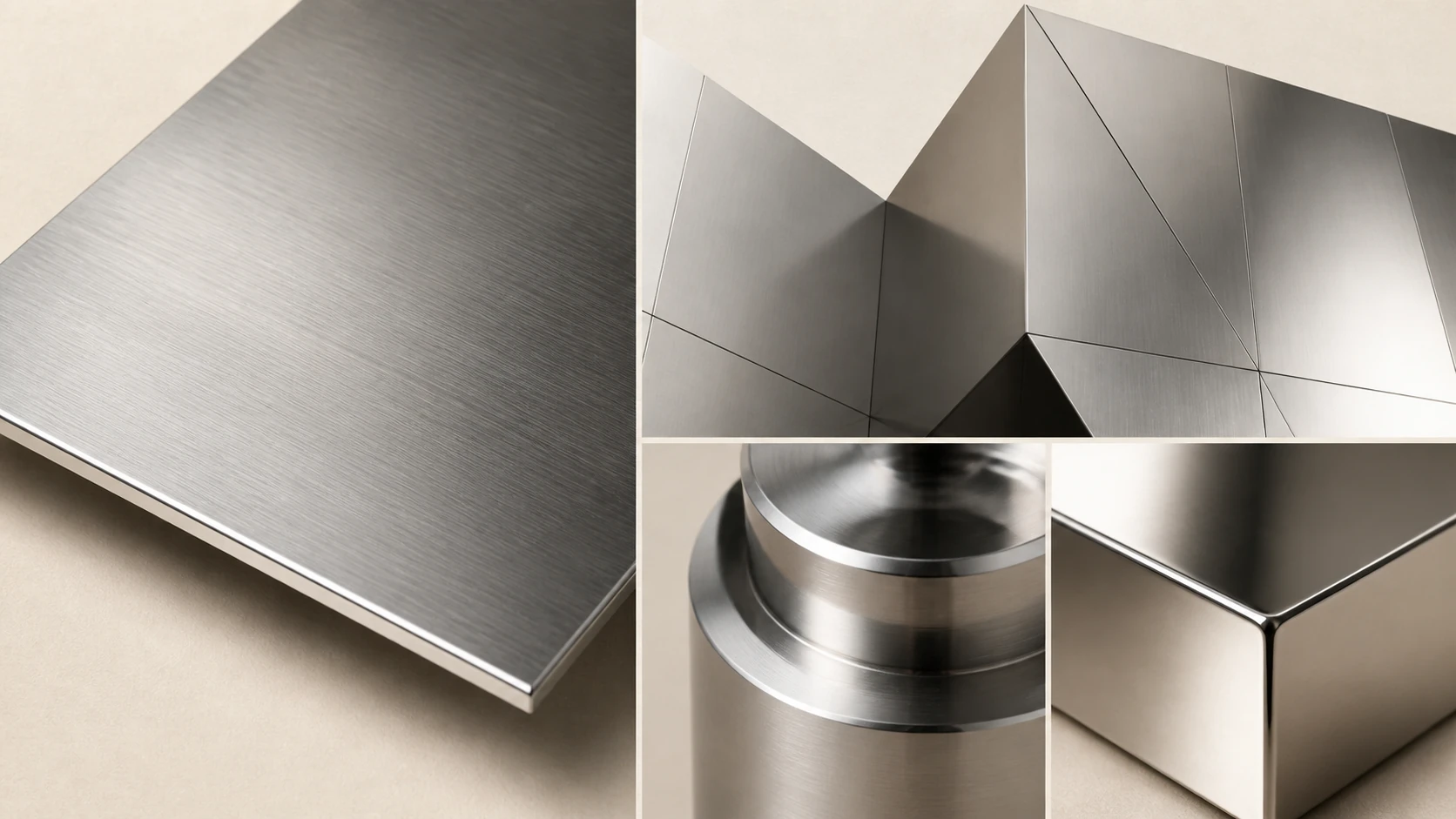
Stainless steel is rarely neutral: it gathers light, people and space into its surface. Its expression begins when alloy, finish, radius and seam operate as one system.
Editorial thesis
Stainless steel appears simple until it is placed in real light. Then the “silver surface” reveals many identities: milky matte, directional satin, almost black, mirror-bright or subtly coloured. Its character comes not only from chemistry but from rolling, abrasion, grain direction, bend radius, welding and the choreography of touch.
The material’s central quality is not shine but controlled interaction with its surroundings. It reflects neighbouring materials, bodies, sky and movement, so it rarely exists alone. Stainless steel becomes precise only when the designer knows what the surface should reflect, suppress or emphasise.
Reader question
Why can two stainless-steel panels look like entirely different materials — one dissolving softly into a room, another producing glare, a third collecting every fingerprint and a fourth remaining visually calm for years?
The answer lies in the meeting of metallurgy and visual direction: grade controls performance, while finish, grain direction, geometry, installation and maintenance determine what people actually see and feel.
Short answer
Stainless steel is a family of iron alloys containing at least 10.5% chromium. Chromium forms a thin passive film that can re-form in the presence of oxygen and greatly slows corrosion. Nickel, molybdenum, nitrogen and other elements modify formability, weldability, strength and resistance in specific environments. 126
The visual result, however, is controlled by the surface. 2B diffuses light, BA produces a cleaner reflection, satin creates directional rhythm, mirror polishing turns the metal into an optical object, and textured or bead-blasted finishes break the highlight. A specification must therefore define grade, thickness, finish, direction, acceptable variation and installation requirements — not merely “stainless steel”.
1. An alloy, not a silver colour
Stainless steel is not one material and not one shade. It is a large family of alloys with different microstructures, magnetism, strength, ductility and environmental resistance. Two panels may look identical in a showroom yet behave differently beside the sea, around a pool, in a kitchen or in a dry interior. 12
The word stainless encourages a false sense of absolute protection. Professional selection begins with a more useful question: what must the material resist — moisture, chlorides, acids, heat, abrasion or constant touch?
2. Chromium and the self-healing passive film
A minimum chromium content allows the surface to form an extremely thin chromium-rich oxide layer. It is not a coating and cannot be seen, yet it is what separates stainless steel from ordinary carbon steel. After minor damage and with access to oxygen, the film can reform. 1
This protection is not magic. Iron contamination, closed crevices, salt water and aggressive chemicals can destabilise it. Surface quality and joint design therefore matter as much as the alloy certificate.
3. Nickel, molybdenum and nitrogen
Nickel helps stabilise the austenitic structure and improves ductility, formability and weldability. Molybdenum raises resistance to localised attack in chloride environments, while nitrogen can increase both strength and corrosion resistance. 16
These elements are almost invisible. That is why selection from a photograph is dangerous: the surface cannot reveal whether it will tolerate salt air or an aggressive cleaning regime. The most important part of the material is often hidden in its chemistry.
4. Austenitic, ferritic, martensitic and duplex stainless steels
Austenitic grades dominate architecture and product design because they combine ductility with good weldability. Ferritic grades are usually magnetic and can be economical in less aggressive environments. Martensitic grades are valued for hardness, while duplex grades combine high strength with strong corrosion resistance. 21
The family name does not replace a specific grade, but it explains behaviour during bending, welding and service. Microstructure becomes visible through thickness, radius, deformation and long-term surface quality.
5. 304 and 316: similar appearance, different environments
304 is one of the most common austenitic grades for interiors, equipment and moderate environments. 316 contains molybdenum and performs better in chloride exposure, making it a frequent choice for coastal sites, pools and more demanding exterior conditions. 261
316 is not universal insurance, and 304 is not simply a cheaper version. Salt concentration, cleaning frequency, contamination, temperature, component geometry and crevices all matter. The correct grade belongs to a specific scenario, not to the prestige level of a project.
6. Corrosion-resistant does not mean invulnerable
Pitting creates local points of attack, crevice corrosion develops where solution stagnates and oxygen is restricted, and tea staining appears as brown surface discolouration, especially in marine atmospheres. Stainless steel can look stained long before structural capacity is affected. 61
Good detailing helps the material remain clean: water drains, horizontal ledges are limited, joints are accessible and the surface is not contaminated with carbon-steel particles. Corrosion resistance is designed, not purchased with a grade name alone.
7. Sheet, coil, plate, tube and mesh
Thin coil and sheet suit cladding and formed panels; plate carries load and creates mass; tube builds frames and handrails; mesh and perforation filter light, ventilate and create semi-transparent screens. One chemistry becomes several architectural instruments.
Product form controls joint size, bend limits, finish direction and transportation. Design should begin with real manufacturing dimensions; otherwise an apparently endless plane breaks into arbitrary seams.
8. Rolling as the beginning of the surface
The surface begins at the rolling mill. Pressure between rolls determines flatness, gauge and initial texture. Annealing, pickling and skin passing do more than clean the metal: they prepare the optical base for later finishing. 11
Even an industrial mill finish has visual character. At architectural scale, wave, direction and batch variation become visible. A mock-up should therefore use a full-size sheet, because a small coupon hides the behaviour of the plane.
9. 2B and BA: industrial restraint and a clean highlight
2B is a smooth cold-rolled finish with moderate, diffuse reflection. It feels technical and restrained, accepts further finishing well and does not try to become a mirror. BA, bright annealed, produces a brighter, cleaner surface through annealing in a controlled atmosphere. 1
The contrast becomes especially clear on curved components. 2B gathers soft gradients, while BA quickly describes windows, luminaires and bodies. The choice is not between low and high quality but between different optical behaviours.
10. Satin, brushed and hairline finishes
Abrasive finishing creates directional scratches that stretch a highlight along the surface. Satin steel is calmer than mirror finish, yet its grain direction is visually active: vertical grain raises a panel, horizontal grain emphasises length. 1
Hairline is not one universal standard but a commercial description of a fine linear finish. Grain and gloss vary between suppliers. Direction should be marked on drawings with the same precision used for timber grain.
11. Mirror finish
Mirror-polished steel reduces the visibility of the material itself and amplifies everything around it. The object boundary dissolves, the room doubles and the viewer becomes part of the composition. Even slight sheet waviness turns a straight line into fluid distortion.
A convincing mirror requires progressive grinding and polishing, controlled welds and careful protection during installation. It is unforgiving of fingerprints, scratches and uneven substrates. Mirror steel is one of the most labour-intensive finishes, not the simplest.
12. Bead-blasted, embossed and textured steel
Bead blasting creates a matte, fine-grained surface and reduces harsh glare. Embossing and patterned rolling add a third dimension: light catches ridges, disappears in recesses and the sheet gains stiffness. 1
Texture helps disguise minor damage and fingerprints, but it can complicate cleaning. In retail and public interiors, it is a negotiation between visual depth, tactility and actual maintenance.
13. Electropolishing, colouring and PVD
Electropolishing removes microscopic peaks in a controlled way and can improve cleanliness and corrosion performance. Chemical colouring and PVD coatings introduce bronze, gold, graphite and other tones while preserving a metallic response to light. 11
A coloured layer does not turn metal into paint. Hue changes with viewing angle, substrate and illumination, and damage may reveal another layer. Specifications need samples after bending, welding and the intended cleaning procedure.
14. Reflection is controlled by geometry
A flat panel returns an organised image, a cylinder stretches it, a convex surface compresses the room and a concave one enlarges and reverses it. The same finish on different radii becomes a different visual material.
Reflection cannot be judged from a flat coupon alone. A mock-up should include actual curvature, seams and the distance to light sources. In metal, form and surface are effectively designed at the same time.
15. Scale, distortion and viewing distance
On a small object, mirror steel can feel like a jewel-like detail; on a façade it becomes part of the sky and city. Increasing scale reveals deflection, thermal movement and mismatch between neighbouring panels.
From a distance we read the rhythm of highlights; close up we see grain, fingerprints, joints and edges. A successful surface works across several distances rather than from one ideal rendering viewpoint.
16. Fingerprints, scratches and the honesty of use
Steel records touch quickly, especially in dark or mirror finishes. A fingerprint does not necessarily indicate poor quality; it reveals the optical difference between clean passive film, skin oil and directional light. On a handrail or cabinet front, it belongs to the daily behaviour of the object.
Anti-fingerprint coatings, matte finishes and defined cleaning zones can help. Yet sometimes an even patina is more convincing than the promise of sterile perfection in a place of constant contact.
17. Bending, radius and springback
During bending, the outside stretches, the inside compresses and the metal partly returns after the load is released. Minimum radius depends on grade, thickness, condition and rolling direction. 1
An overly tight bend can disrupt the finish or change reflection. In an architectural panel, radius is not only structural: it sets the width of the light gradient and the perceived softness of the metallic form.
18. Welding and the disappearing seam
Welding locally changes structure, colour and geometry. The seam may remain visible as evidence of assembly, or be ground and polished until it nearly disappears. The second approach demands exceptional control of heat distortion and surface finishing.
Invisible seams are crucial in mirror objects, where a line breaks the continuity of reflection. Poor attempts to erase a weld can produce a broad cloudy patch that is more visible than the original joint.
19. Fasteners, joints and galvanic couples
A screw, rivet, concealed bracket and bonded joint create different surfaces and repair strategies. Exposed fasteners can become an honest rhythm; a poorly resolved hidden system can create waviness and shadow gaps.
Contact with another metal in the presence of an electrolyte can establish a galvanic couple. Compatibility, isolation, drainage and fastener grade must be considered. The most expensive panel can be compromised by the smallest incorrectly specified screw. 1
20. Façades and roofs
On a façade, stainless steel changes with weather. It may look cold and pale in the morning, dissolve into the sky at noon and darken toward evening. Matte finishes stabilise the image; mirror finishes make the building dependent on the city around it.
Exterior use requires correct grade, grain orientation, rain washing, drainage, marine-distance assessment and maintenance access. Architectural guidance repeatedly shows that durability belongs to the complete detail system, not to the sheet alone. 11
21. Interiors and retail spaces
Inside, steel can enlarge a room, collect display lighting and connect clothes, leather, glass and concrete within one visual system. It is especially effective in retail because the same surface can change character with each collection and lighting scheme.
Excess reflection, however, creates noise: the customer sees the product, themselves, other people and every luminaire at once. Strong retail design uses metal as an editing device — highlighting a key object, concealing service zones or directing movement.
22. Kitchens, laboratories and public areas
A smooth non-porous surface, durability and the ability to withstand intensive cleaning explain the material’s presence in kitchens, laboratories, healthcare and transport. In these environments, the aesthetic grew from hygiene and service requirements. 1
A “professional” appearance can easily become decoration. A working kitchen requires appropriate radii, closed seams, drainage slopes and compatible cleaning products. Cleanliness is produced by construction and routine, not by a shiny sheet alone.
23. Furniture and object design
In furniture, metal balances apparent thinness with a sense of weight. A polished tube can almost disappear, satin sheet can turn a cabinet into a quiet monolith, and a bent plate can make visible the force holding the form together.
The edge is decisive: exposed cut, hemmed return, welded box and fine bevel communicate very different levels of precision. In product design, stainless-steel luxury often resides in the quality of the edge rather than the amount of shine.
24. History: from cutlery to architecture
Corrosion-resistant chromium steels were developed and patented in the early twentieth century after a long sequence of metallurgical experiments. Early commercial uses were associated with tools and cutlery, where cleanliness and surface durability were immediately valuable. 1
Architecture recognised another quality: the metal could remain exposed without a heavy protective coating. Stainless steel entered the visual language of modernity — precise, machine-made and capable of reflecting the scale of the new city.
25. Gateway Arch: surface as structure
Eero Saarinen’s Gateway Arch rises 630 feet and spans the same distance between its legs. The exterior is faced with stainless steel; above the 300-foot level, the outer stainless skin and inner carbon-steel skin participate in carrying the load. 110
Here surface cannot be separated from form. Vertical grain stretches the arch, the reflected sky reduces its visual weight and welded sections combine into a continuous curve. Monumentality comes from shell precision rather than stone mass.
26. Walt Disney Concert Hall: light across a curved skin
Frank Gehry’s Walt Disney Concert Hall is recognised by its curved stainless-steel “sails”. The surface breaks sunlight into long moving gradients, making a large volume appear to change continuously. 1
The project also illustrates the risk of reflective architecture. Curvature can direct light in unexpected ways, while locally brighter finishes become much more intense than adjacent panels. Reflection must be studied as part of the city, not only as an attractive rendering effect.
27. Cloud Gate: reflection without a visible seam
Anish Kapoor’s Cloud Gate is assembled from highly polished stainless-steel plates but reads as one liquid mass. Skyline, sky and visitors travel across its surface, stretch and disappear beneath the object. 1
The technical achievement lies not only in the form but in the near-erasure of welded joints through multi-stage finishing. The sculpture turns fabrication precision into public experience: people understand the material by moving through its reflection.
28. Cleaning, tea staining and maintenance
Regular mild cleaning removes salts, dust and contamination that retain moisture. Directional finishes should be cleaned along the grain; abrasive or chlorine-based products can damage the surface and promote local attack. 1
Tea staining is often aesthetic rather than structural, but it shows that environment and cleaning frequency were underestimated. A maintenance plan should be designed with the project, especially near the sea, pools and heavily trafficked streets.
29. Durability, recycling and environmental cost
Stainless steel is durable and retains high scrap value. worldstainless reports that around 95% of end-of-life stainless steel is collected and recycled into new material without loss of its fundamental qualities. 1614
Recyclability does not erase the energy, alloy mining and carbon footprint of production. Responsible design reduces mass, selects a sufficient rather than excessive grade, enables disassembly and uses long service life instead of replacement driven by short-lived aesthetics.
30. How designers, photographers and art directors should read stainless steel
A designer must examine grade, environment, thickness, product form, finish, direction, radius, joints, fasteners, tolerances, protective film and maintenance at the same time. A small sample does not replace a full-scale mock-up in real light.
A photographer should decide what matters most: a sharp highlight, long gradient, environmental reflection, micro-scratch or evidence of use. An art director should resist the automatic code “steel equals future”. Stainless steel can speak of laboratory precision, kitchen work, infrastructure, jewellery, minimalism or street hardness — context makes the language.