encyclopedia
Surrealism
Dream, object and the logic of the impossible
Surrealism does not decorate reality with fantasy. It makes the ordinary thing suspicious: a cup gains fur, clocks lose rigidity, a dress exposes bones, and photography begins to prove what could not have happened.
Editorial thesis
Surrealism matters not because it added strange objects to art. Its force lies in changing the logic of the visible: the ordinary thing stopped obeying, the body became an architecture of anxiety, dream began to operate as a method of montage, and photography learned to prove the impossible.
For VANSMITHLAB, Surrealism should be read as a system of operations: collision of incompatible things, displacement of function, change of scale, tactile conflict, double meaning, automatism, the seam of collage and precise light that makes absurdity look real. 1
Reader question
Why does the Surrealist image still work in fashion, photography, advertising and design, even though its historical group emerged a century ago?
Because Surrealism does not depend on one set of motifs. It works wherever an object is recognisable but no longer behaves correctly; where material creates bodily anxiety; where an image looks clear but the thought inside it is impossible. 2
Short answer
Surrealism formed in Paris in 1924 around Andre Breton and the first Manifesto of Surrealism. The movement connected Dada, psychoanalysis, automatic writing, dream, chance, collage, photography and the object in order to move art beyond rational composition. 14
In visual culture, Surrealism produced several durable methods: hyper-real impossibility in Dali, clear philosophical paradox in Magritte, tactile conflict in Meret Oppenheim, photographic experiment in Man Ray and the transformation of couture into a theatre of absurdity in Schiaparelli. 569
1. 1924: the manifesto and the beginning of an organised movement
Surrealism became an organised movement in Paris in 1924, when Andre Breton published the first Manifesto of Surrealism. Yet the movement did not appear out of nowhere: behind it were the trauma of the First World War, Dada rejection of bourgeois logic, psychoanalysis and the desire to find a language stronger than ordinary rational order. 1
Breton defined Surrealism as a way to connect dream and reality into a higher form of experience. For a designer, the key point is not only the date but the gesture: the movement declared imagination, chance, error, dream and automatic writing to be creative methods rather than side effects. 4
2. After Dada: from negation to a new logic
Dada attacked the authority of art, language and political rhetoric through absurdity, collage, provocation and the refusal of stable meaning. Surrealism inherited that energy but redirected it: not only against systems, but into image, desire and the unconscious.
Surrealism therefore cannot be read as merely a strange style. Its aim was more ambitious: to show that the world already contains cracks, mismatches and hidden connections. The artist does not invent the impossible from outside; they pull it out of the ordinary room, ordinary body and ordinary object. 5
3. The unconscious as a production space for images
Surrealists treated the unconscious not as a medical label but as a working territory. Dreams, slips of the tongue, accidental associations and obsessive images became material in the same way as paint, paper, fabric or photographic emulsion.
In visual culture this changes the task of composition. An image must be more than beautiful or persuasive. It must trigger an internal conflict: the viewer recognises the object, but can no longer return it to its former place. 6
4. Automatism: the hand moves before control
Automatic writing and automatic drawing tried to bypass the censorship of consciousness. The hand, line and sentence were meant to move before reason could bring them into order. This did not mean the absence of form; form appeared as the trace of an inner impulse.
For design, automatism matters as a first layer. It produces unexpected lines, associations and rhythms, but strong work begins when the raw material of dream is not left random, but edited into a precise visual construction. 7
5. Dream: not night as illustration, but daylight logic broken
The Surrealist dream is rarely a soft haze. More often it is a daytime scene in which one element behaves incorrectly: clocks melt, the body becomes furniture, a stone floats in a room, a face is covered with cloth, an object suddenly acquires skin or fur.
Dream works here not as subject matter but as a principle of montage. It keeps details clear while breaking cause and effect. The impossible therefore looks not fantastical but almost documentary. 8
6. The encounter of incompatible objects
One of Surrealism’s strongest devices is the collision of incompatible objects. The more precisely the objects are recognised separately, the stronger the effect of their illogical encounter. Umbrella, sewing machine, eye, telephone, lobster, glove or cup do not lose their everyday specificity; that is what makes the image dangerous.
For an art director this is a practical lesson. Surrealism does not require endless fantasy. Often it is enough to take two very real things and alter the relation between them: scale, function, material, place or bodily association. 9
7. The Surrealist object: a thing that stops obeying
The Surrealist object is not sculpture pretending to be a thing, but a thing that has stopped fulfilling its old role. An iron with tacks, a fur cup, a metronome with an eye or a telephone with a lobster disturb the normal contract between hand, object and action. 57
This object is especially important for product design and fashion. It shows that function can be psychological tension as well as comfort. The object begins to ask: can it be drunk from, held, worn or trusted?
8. Photography: reality as the best material for the impossible
Photography gave Surrealism a special force because the camera has long been associated with evidence. When the impossible looks photographed, the viewer experiences a double disturbance: the image seems to testify, but it testifies to the impossible.
Man Ray, Brassai, Claude Cahun, Dora Maar and others worked with solarisation, rayographs, montage, double exposure, staging and fragmentation of the body. The camera stopped being a neutral eye and became a mechanism for exposing the strangeness of the existing world. 8
9. Collage and photomontage: the seam as meaning
Collage makes the break between fragments visible. Surrealist montage does not always try to hide the seam; the seam is where a new logic appears. A newspaper cutting, anatomical engraving, advertising model, architectural interior and animal can meet on one plane without explanation.
In contemporary visual systems this principle works in moodboards, campaigns, AI images and editorial design. The task is not simply to mix images, but to build a point of tension: what exactly should not have happened in this connection? 12
10. Salvador Dali and hyper-real impossibility
Dali made the impossible almost tangible. His painting used academically precise detail, clear light, sharp perspective and smooth surfaces so that dream did not look misty but convincing. This is the power of The Persistence of Memory: the soft watches are not painted as an abstract symbol; they lie in a dry landscape as real, though impossible, objects. 6
For luxury visual language and advertising, Dali matters not only as a figure of eccentricity. He showed that an irrational image becomes stronger when it is made with cold technical precision.
11. Rene Magritte: a clear picture, an impossible thought
Magritte built Surrealism not through painterly hysteria but through almost calm clarity. His rooms, suits, windows, apples, stones, clouds and faces look familiar, yet are combined so that the image begins to argue with language and vision. 11
Magritte is especially important for graphic design and conceptual advertising. He shows that a strong image can be very simple: not overloaded with detail, but built on one exact displacement of meaning.
12. Max Ernst: rubbed surfaces and found worlds
Max Ernst developed frottage, grattage and other techniques in which the image is pulled out of texture. Wood, floor, leaf, accidental relief or scraping became not background but an image generator. Surrealism here comes from matter, not only from subject.
This method is close to contemporary material design: surface is not illustrated, it produces the image. Stone, fabric, metal, timber and even digital noise can become the starting point for imaginary architecture. 15
13. Joan Miro: biomorphic line and a cosmos of signs
Miro opened another branch of Surrealism: not object-based but sign-based. His lines, stains, stars, organs, insects and cosmic forms do not always name a specific object, but they create the feeling of a living alphabet.
For contemporary visual language this is an important alternative to literal Surrealism. One does not always need to place a lobster on a telephone. Sometimes it is enough to create a system of signs that looks as though language has just been born and has not yet become grammar. 1
14. Leonora Carrington and the female mythology of Surrealism
The history of Surrealism was long told through male names, but the movement cannot be understood without Leonora Carrington, Dorothea Tanning, Remedios Varo, Meret Oppenheim, Claude Cahun and others. They expanded Surrealism from the male view of the muse toward autonomous mythologies of body, animal, house, magic and inner transformation. 1213
Their contribution is especially important for fashion and visual storytelling. The female body here is not only an object of desire or mystery; it can be a laboratory of form, a ritual, a mask, a creature and the subject of its own dream.
15. Meret Oppenheim: the fur cup and tactile anxiety
Meret Oppenheim’s fur cup became one of the most famous Surrealist objects precisely because it remains simple. Cup, saucer and spoon were purchased as ordinary things, but lining them with fur turns the act of drinking into a bodily conflict. 5
Surrealism works here through touch. We do not only look at the object; we almost feel it on the lips. This is a lesson for design: material can change function more powerfully than form.
16. Man Ray: eye, metronome and photographic fetish
Man Ray worked between photography, object, painting and experiment. His metronome with an eye shows how a mechanical thing can become an emotional and almost hostile presence. MoMA describes versions of the object through the history of 1923, 1932 and later replicas. 7
In this object, time gains a gaze. Rhythm is no longer neutral: the metronome seems to watch, judge and return memory. For visual culture this is almost a ready-made formula: add an organ of perception to an instrument of measurement and function becomes psychological.
17. Surrealism and fashion: the body as a site of impossibility
Fashion became a natural territory for Surrealism because clothing already works at the boundary of body, image, desire and social sign. Surrealism does not simply decorate a dress with a strange motif; it changes the relation between body and thing.
In Schiaparelli this principle becomes especially clear: the Skeleton dress brings bones outside, the Shoe Hat turns footwear into headwear, and the Lobster dress transfers a food and erotic image onto a white evening surface. 910
18. Elsa Schiaparelli: couture as a stage of absurdity
Schiaparelli understood couture as a system of ideas, not only silhouettes. Her collaborations with Dali, Cocteau, Giacometti and other artists turned clothing into a space of visual jokes, anxieties and sharp cultural gestures.
Unlike pure theatre, these works kept the discipline of dressmaking. That is why Schiaparelli’s Surrealism remains strong: the impossible idea is built into real cut, fabric, embroidery, trapunto, hat, fastening and the gesture of wearing. 6
19. Surrealism in display, advertising and luxury communication
Surrealism quickly became useful for windows, magazines and advertising because it knows how to stop the eye. An object removed from its normal scenario instantly becomes an event: a bottle becomes a body, a bag becomes an animal, an eye becomes a logo, an interior becomes a dream.
Weak Surrealist advertising limits itself to strangeness for its own sake. Strong work builds a precise relation between product and impossible image: strangeness should reveal a quality of the object, not disguise the absence of an idea. 7
20. Surrealism and graphic design
In graphic design, Surrealism appeared through collage, scale displacement, impossible spaces, the play of word and image, double meanings and visual riddles. It gave the designer permission to use dream logic as a communication tool.
A poster, cover, magazine or campaign can be Surrealist without complex illustration. Sometimes it is enough to make the headline an object, the shadow the protagonist, empty space a trap, and the photograph evidence of the impossible. 8
21. Interior: a room where objects argue with purpose
A Surrealist interior does not have to be a dream set. It can be an almost ordinary room in which scale, reflection, mirror, door, fabric or furniture behaves incorrectly. The key is not overload, but one controlled fault.
For interior design this approach should be used carefully. Surrealism easily becomes a themed restaurant. A stronger route is a precise object, unexpected proportion, mirror trap, object with double function or a material that disturbs the expected touch. 9
22. Architecture and Surrealist space
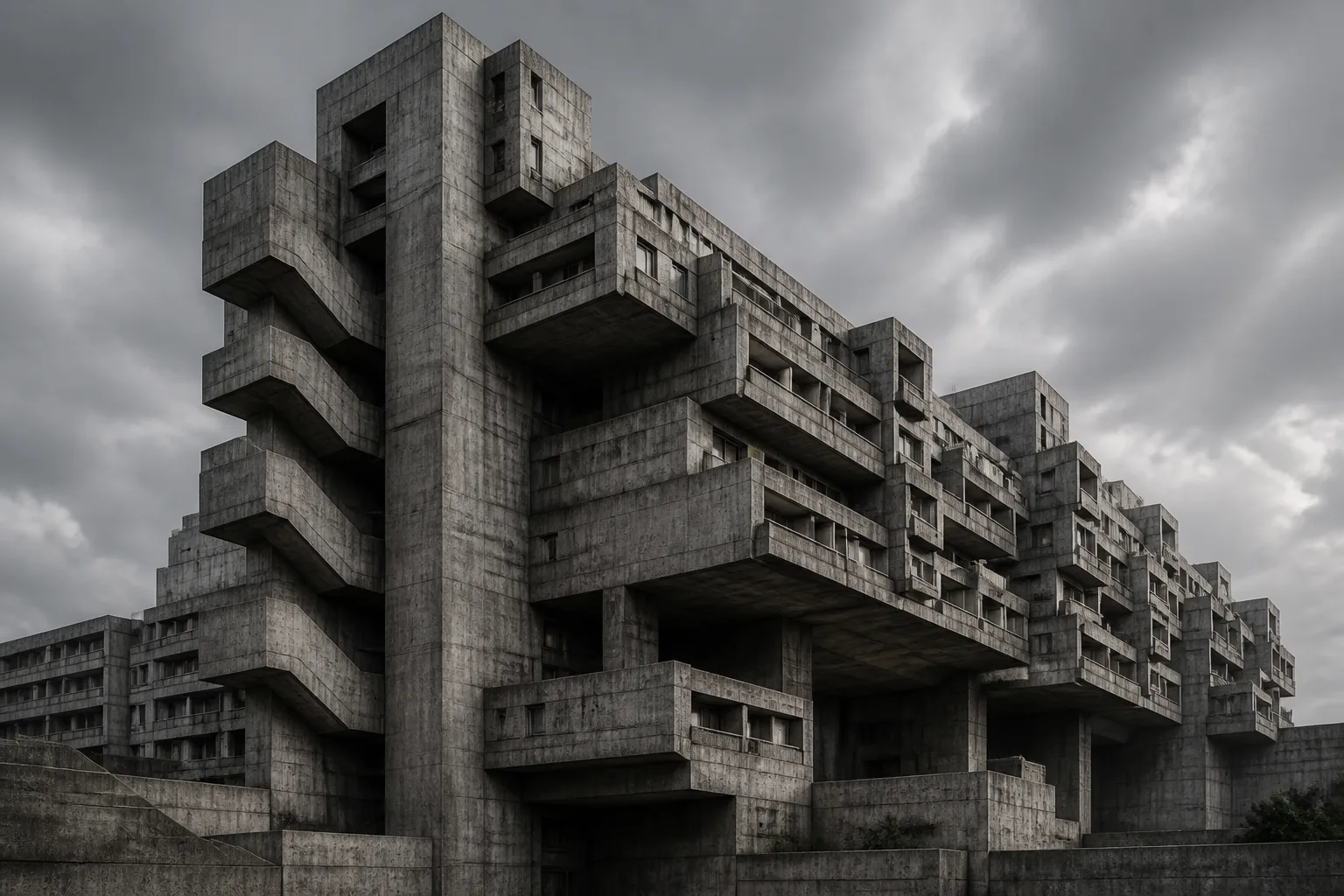
Surrealism did not create a single architectural style like Modernism, but it gave architecture a language of psychological space. A long corridor, empty square, impossible scale, closed door, too-smooth wall or house as body can work Surrealistically.
In architectural photography and cinema this is especially visible: space becomes not only the stage of action, but a participant in anxiety. A building can feel too familiar and foreign at the same time. 10
23. Cinema: dream montage and the logic of suddenness
Cinema gave Surrealism movement, sharp montage and the possibility of turning the impossible into an event in time. In Bunuel and Dali, the frame does not simply show strangeness; it attacks the viewer’s expectation and often refuses causal explanation.
For contemporary video and fashion film this is an important lesson. A Surrealist effect does not come only through VFX, but through editing: what is shown before, what after, where the cut falls and which detail suddenly becomes central. 11
24. Colour, light and material in Surrealism
Surrealism has no single palette. In Dali, light is dry and almost museum-precise; in Magritte, the sky can be cold and clear; in Schiaparelli, shock pink appears; in photography, the black-and-white scale turns skin, fabric and object into enigma.
Material is often more important than colour. Fur, glass, leather, metal, mirror, fabric, plaster, wax, paper and photographic emulsion create the bodily presence of Surrealism. The impossible must have a surface. 12
25. How to separate Surrealism from fantasy
Fantasy builds another world. Surrealism more often breaks this world from within. Its strength lies in the fact that door, hand, sofa, clock, window, dress or cup remain recognisable but no longer obey the old contract.
If an image fully moves into a fictional universe, it may be fantastical, but not necessarily Surrealist. Surrealism loves reality because the fault is more visible there. 13
26. Styling errors: lobsters, eyes and meaningless strangeness
The most common error is to reduce Surrealism to a set of icons: eye, lips, hand, lobster, cloud, melting clock. These motifs work only when they have an internal necessity.
For VANSMITHLAB, Surrealism should be read as a method. The right questions are: which expectation has been broken, which function displaced, which material made bodily, what does the viewer recognise and why can it no longer be used as before? 14
27. Surrealism after the 1940s: dispersal across the world
War, exile and international exhibitions changed the geography of the movement. Surrealism moved beyond Paris and began to work in Mexico, the United States, the Caribbean, Egypt, Japan and other contexts. Recent exhibitions increasingly emphasise this expansion. 15
This matters for editorial accuracy: Surrealism cannot be reduced to the Paris group and a handful of male names. It became a network of methods, translations, conflicts and local mythologies.
28. Legacy in contemporary fashion and AI imagery
Contemporary fashion, beauty, jewellery, advertising photography and AI imagery constantly use Surrealist devices: impossible scale, hybrid body and object, mirror trap, animated accessory, object with skin, interior without physical logic.
But AI very quickly turns Surrealism into decorative noise. A strong prompt must define not simply strangeness, but the rule of impossibility: what remains real, what is broken, where the bodily anxiety sits, which object changes function.
29. How to photograph a Surrealist image
A photographer should not hide the impossible inside general spectacle. Light, perspective, depth of field and material must make the viewer believe the object before realising that the object is impossible.
The discipline of a real shoot works best: readable shadow, physical contact, exact edge, plausible surface. The more confidently light behaves, the stronger the disturbance of meaning.
30. How designers and art directors should read Surrealism
Designers should read Surrealism not as a mood but as an operation: function substitution, material transfer, scale shift, collision of incompatible things, visible seam, double meaning, bodily anxiety or logical break.
An art director must hold clarity. A Surrealist image should be strange not because it is chaotic, but because it is precisely constructed. Good Surrealism resembles a dream that remembers the rules of light, fabric, weight and surface.