encyclopedia
Travertine
Origin, properties and applications
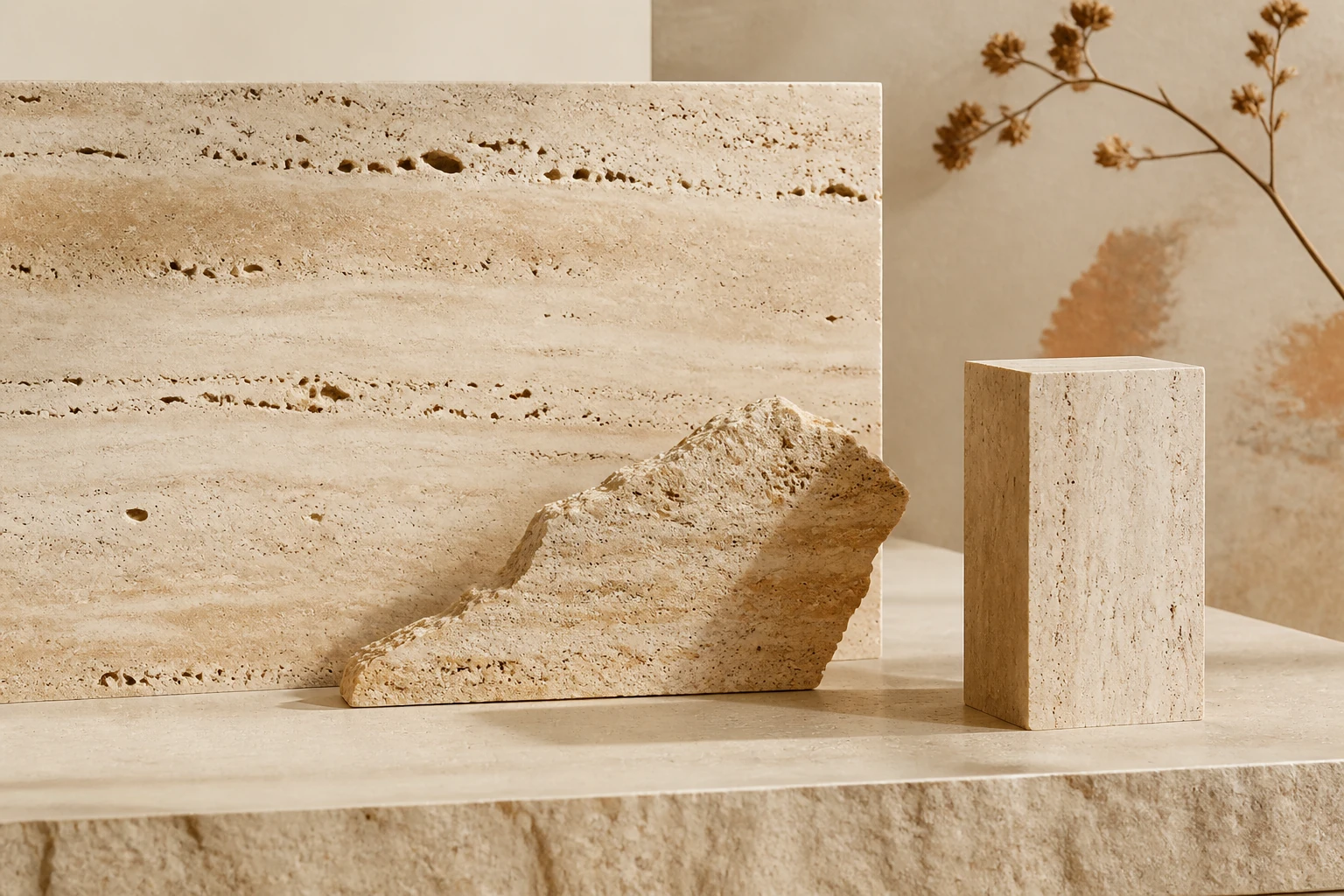
Travertine looks as though stone has learned to remember water. Its layers preserve flow, escaping gas, mineral pauses and time, so one block reads as a quiet plane while another becomes an almost geological drawing.
Editorial thesis
Travertine is valued for more than its warm beige colour. Its true character comes from porosity, layering and the direction of the cut. Voids collect shadow, a vein cut turns geological strata into disciplined bands, and a cross cut opens them into a cloud-like field. Filling, honing and polishing can either preserve this natural irregularity or turn the stone into an almost seamless architectural skin.
The question 'what colour is the travertine?' is therefore too narrow. A project must also ask where the block came from, how the bedding is oriented, what fills the cavities, which finish is specified and how the surface will age in a particular light and climate. These decisions determine whether the stone becomes a quiet background, a monumental envelope or the main visual event of a space. 16
Reader question
Why does one travertine read as a soft cream plane, another as a graphic striped stone, and a third as though it has already been weathered for centuries?
This article approaches travertine as a geological process, a building stone and a visual instrument. Its focus is not a catalogue of colours but the relationship between formation, cutting, finishing, light, scale and durability.
Short answer
Travertine is a freshwater carbonate rock formed when water rich in calcium and bicarbonate reaches the surface, releases carbon dioxide and precipitates calcium carbonate. Water flow, temperature, microorganisms, vegetation and the speed of deposition shape the layers and voids that later become the stone's recognisable texture. 11
After quarrying, the material continues to change through design decisions. A vein cut emphasises the direction of the strata, while a cross cut reveals them across the bed; filling produces a calmer surface, whereas open pores deepen shadow and texture. Travertine may become a façade, floor, wall, piece of furniture or small detail, but each application requires its own decisions about thickness, fixing, moisture, acids and maintenance.
1. A stone that begins as water
Most building stones are imagined as the result of immense pressure, heat or slow accumulation on a seabed. Travertine forms differently: it can be observed almost at the moment of birth. Mineral water flows across a surface, releases carbon dioxide and leaves behind a thin layer of calcium carbonate. One layer settles over another until water gradually constructs its own terrain. 1
This history matters to the designer because it explains the material's visual behaviour. Bands are not a decorative print but a sequence of deposits. Voids are not random defects; they record gas, plants, twigs, flow direction and uneven crystallisation. Travertine appears alive because its structure was once in motion.
2. How calcium carbonate precipitates
Underground water dissolves carbonate rock and carries calcium and bicarbonate. When it reaches the air, pressure falls, carbon dioxide leaves the solution, pH rises and calcium carbonate becomes less soluble. It precipitates as crusts, ledges, pools and layered masses. The USGS compares the process to opening a carbonated drink: the loss of gas changes the chemical equilibrium of the water. 1
The mechanism sounds simple, but its results are never entirely uniform. Temperature, flow rate, slope, spring chemistry and biological activity alter crystal form and bedding. Travertines from different deposits can therefore vary not only in colour but also in density, pore direction, strength and response to finishing.
3. Voids: memory, shadow and a technical problem
Porosity is travertine's most recognisable visual code. Small cavities break light into fine variations, larger ones create deep shadows, and elongated voids emphasise the movement of the strata. From a distance the plane can appear calm; up close it becomes a complex relief that changes the perceived scale of the stone.
The poetic quality is also a technical problem. As porosity and pore connectivity increase, water absorption, freeze-thaw performance, fixing and resistance to contamination become more important. Research shows that pore structure strongly affects travertine strength and durability, which is why a sample should never be specified from a photograph or trade name alone. 114
4. Travertine, limestone, tufa and marble
Travertine is a carbonate sedimentary rock composed mainly of calcite or aragonite. In the stone trade it is often grouped with limestone and marble, yet the materials differ in origin and structure. Marble has undergone metamorphism and usually displays a recrystallised fabric; travertine preserves evidence of precipitation from water.
The terms travertine and tufa are not used with complete consistency. Recent geological literature often reserves travertine for denser deposits associated with warm or hot hydrothermal water, and tufa for softer, more biogenic deposits from cooler water. The boundary depends on the classification system, so professional writing should state the context rather than present the distinction as a universal law. 14
5. Colour is the result of minerals and time
Classic travertine is associated with cream, sand and warm grey-beige tones. Iron can introduce gold, rust and red; organic material can produce grey and brown; local mineral chemistry can create cooler or darker bands.
Colour cannot be judged from a small chip alone. One block may contain quiet fields beside strong veins; wetting deepens the tone, polishing increases contrast, and diffuse daylight softens it. A sound specification includes several slabs, an agreed range of variation and a clear laying strategy.
6. Tivoli and Roman travertine
Travertine's bond with Rome begins in the quarries around Tivoli and Guidonia, where lapis tiburtinus — 'Tiburtine stone' — was extracted. The modern word travertine derives from this geographic name. Proximity to Rome, the transport of large blocks and the combination of durability with workability made the material part of the city's identity.
Roman travertine rarely reads as ostentatious luxury. Its power lies elsewhere: warm pale mass, architectural scale and an ability to accept sun, dust and age without losing dignity. In that sense, it is closer to the voice of the city than to a precious finish. 6
7. Pamukkale and a landscape that builds itself
At Pamukkale, calcite-rich water has formed white terraces, pools and petrified cascades on a cliff almost two hundred metres high. UNESCO recognises the site as an exceptional union of natural process and cultural landscape, with the ancient spa city of Hierapolis developed above the travertine formations. 1
For designers, Pamukkale matters less as a colour reference than as a demonstration of material logic. Travertine is not formed in a single gesture but through countless repetitions: water crosses an edge, leaves mineral behind, shifts its path and fixes the next layer. It is architecture produced by accumulation.
8. The quarry: selection begins before cutting
In the quarry, travertine appears as a sequence of beds rather than a finished decorative slab. Blocks differ in bedding direction, void content, colour and soundness. A large project requires more than ordering square metres; it requires selecting lots and understanding how individual blocks will form one continuous surface.
Modern extraction uses diamond wire saws, drilling and heavy lifting equipment, yet the decisive question remains visual: where is the strongest figure and how should the future cut be oriented? Active Tivoli quarries still combine ancient geological mass with precision fabrication for specific architectural commissions. 6
9. Vein cut: strata become graphics
A vein cut runs parallel to the sedimentary bedding. The slab reveals long bands that can resemble sand movement, timber grain or a horizon. This cut gives the stone a clear direction: it can visually lengthen a wall, emphasise a counter or establish a disciplined rhythm across a façade.
The graphic effect demands control. Adjacent slabs must be coordinated by direction, band height and contrast. Careless setting breaks the flow; precise setting turns natural irregularity into an architectural system.
10. Cross cut: cloud instead of stripe
A cross cut passes across the bedding. Long bands give way to rounder, cloud-like or mottled patterns. The material reads as softer and less directional, making it easier to use across large floors or walls where strong striping might compete with the space.
The same block can look like two different stones depending on the cut. Selection should therefore be based on actual slabs with a declared cutting orientation, not merely on the quarry or product name.
11. Filled and unfilled travertine
Open pores create maximum depth and reveal the origin of the stone. They are especially effective on vertical planes and furniture, where cavities hold gentle shadow. On a floor, in a shower or beside food preparation, the same voids can trap water and dirt.
Filled travertine uses cementitious material, resin or another compatible compound before honing. The plane becomes calmer and more practical, but loses some relief. Filling quality should be judged not only at installation but by how its colour and ageing relate to the stone over time. 1
12. Honed, polished, brushed and aged
A honed finish leaves a matte or silky plane and often expresses travertine's quiet depth most clearly. Polishing increases reflection, saturates colour and strengthens pattern contrast, but it also makes scratches, etching and differences in filler more visible.
Brushed, sandblasted and tumbled finishes deepen relief, soften edges and evoke older architecture. Yet an 'aged' finish should not become an automatic sign of authenticity. Precise contemporary geometry can reveal travertine more convincingly than artificially distressed surfaces.
13. How travertine works with light
Matte travertine does not return light as one bright streak. It breaks it into many low-intensity responses: pale mineral mass produces a general glow, bedding gives direction and pores create micro-shadows. This is why the stone can feel warm even within a neutral palette.
Raking side light reveals relief and cavity depth; frontal light flattens the surface; edge light emphasises slab thickness. Travertine is particularly expressive beside large windows, where its pattern changes over the day instead of being frozen by one decorative lighting effect.
14. Mass, temperature and sound
Travertine is perceived through more than sight. It feels cool at first contact, carries visual and physical weight, and shifts in touch from smooth edges to a rough porous core. These qualities produce a sense of permanence that is difficult to reproduce with a thin printed surface.
Stone cladding reflects sound, although an open porous face may scatter some higher frequencies. This does not make travertine an acoustic material, but slab scale, joints, furniture and nearby soft finishes all affect the overall sound of the room.
15. Strength cannot be read from appearance
Travertine may look monolithic, but its mechanical behaviour depends on porosity, bedding orientation, moisture and local cavities. Material from different deposits, and even different zones of one block, can show a wide range of performance. 114
Slab thickness, panel size, anchoring and allowable spans must therefore be based on tests and engineering for the actual lot. The durability of Roman monuments is not a universal guarantee for every contemporary thin tile.
16. Façades: the stone must become a system
On a façade, travertine becomes an envelope exposed to wind, water, temperature cycles and pollution. A ventilated build-up, mechanical fixing, bedding orientation and rear-face quality matter more than the decorative impression. Porous stone cannot be treated as an image detached from its details.
Research on stone cladding shows that porosity and water permeability influence adhesion and durability. Exterior use requires laboratory data, a designed fixing system and verification for the local climate. 1
17. Floors: beauty that accepts traces
On a floor, travertine connects space through one continuous mineral field. Cross cut creates calm; vein cut directs movement. Large formats reduce joints but demand a flatter substrate, more careful sorting and more disciplined installation.
A floor will receive scratches, matte paths and local stains. A strong project anticipates this: it chooses a finish capable of ageing, provides effective entrance matting and accepts that natural stone becomes a record of use rather than remaining a catalogue image.
18. Bathrooms and wet areas
Water visually intensifies travertine: colour deepens, bands become stronger and pores more visible. Yet wet zones demand the greatest technical care. Filling, falls, substrate waterproofing, grout, sealed junctions and maintenance must work as one system.
A sealer can slow absorption but does not make the stone impermeable or compensate for poor detailing. Slip resistance must also be assessed: a polished finish that is effective on a wall may be inappropriate on a shower floor.
19. Kitchens and acids
Travertine consists mainly of calcium carbonate and is vulnerable to acids. Lemon juice, vinegar, wine and some cleaning products can cause etching — a matte mark where the surface has chemically changed. It is not ordinary dirt that can simply be wiped away.
Used as a kitchen worktop, the material requires an informed client. It can be appropriate when patina and traces are accepted, but it should never be promised to behave like granite or engineered quartz. Design must connect aesthetics with the actual pattern of use.
20. Furniture and objects
In a table, console or plinth, travertine allows mass to be treated almost sculpturally. A thick top creates a monolithic impression even when the construction is lightened internally; vein cut directs the eye along the object, while cross cut makes the form feel more unified.
The weak point often lies not in the centre of a slab but at a thin edge, corner, opening or fixing point. Radii, backing, hidden frames and transport must be designed together with the external geometry.
21. The Colosseum: travertine as civic construction
The Flavian Amphitheatre, known as the Colosseum, was built with concrete and substantial travertine facing and elements. Here the stone is not interior luxury but part of an enormous engineering and public machine. 1
Its current surface is far from original: blocks were removed and reused, metal was extracted, edges were damaged and pollution altered the colour. This history reveals travertine's ability to retain architectural presence even after the loss of a perfect envelope.
22. Barcelona Pavilion: stone and flowing space
In the pavilion by Mies van der Rohe and Lilly Reich, Roman travertine sits beside glass, chrome-plated steel, green marble and golden onyx. The floor continues beyond the glass line, connecting the interior and reflecting pool in one horizontal system. 1
Travertine is not merely a background for more precious stones. Its repeated module holds the space, accepts reflected water and light, and makes complex materials part of one architecture. It shows how a neutral stone becomes active through proportion.
23. Getty Center: warm mass in California light
Richard Meier selected Italian travertine for the Getty Center, opened in 1997, linking a contemporary museum complex to the history of public architecture. Getty emphasises the stone's warmth, colour and sense of permanence. 1010
Some surfaces are worked to reveal rough relief and fossil inclusions, while others are assembled as precise panels. In the bright light of Los Angeles, travertine softens the complex's white geometry: it does not glare but holds sunlight within its texture.
24. Contemporary luxury and the danger of cliché
Travertine has become an almost universal code for calm luxury interiors: beige walls, rounded furniture, matte stone and warm light. The material genuinely supports this atmosphere, yet repetition has turned it into a visual formula.
To avoid cliché, work with the specific stone rather than the word 'travertine'. Choose a forceful vein cut instead of a soft cross cut, leave selected pores open, set the stone against black steel, coloured glass or coarse textile, or use it as one precise volume rather than covering the entire room.
25. Cleaning: neutrality matters more than strength
The Natural Stone Institute recommends neutral cleaners, stone soap or mild detergent with warm water, followed by thorough rinsing and drying. Too much product may leave a film and streaks. 16
Acidic cleaners, limescale removers and abrasive powders are particularly risky for carbonate stone. Before treating an unknown stain, its nature should be identified and the method tested in an inconspicuous area.
26. Sealing: protection, not an invisible shield
Impregnating sealers can slow the absorption of water and contaminants but do not make travertine stain-proof. The choice depends on porosity, finish, location and use. 16
Topical coatings can alter gloss, colour and touch, and may create a surface layer less durable than the stone itself. The Natural Stone Institute notes that sealing is not automatically appropriate in every case; the decision should follow testing. 16
27. Ageing, repair and refilling
Over time, filler may loosen locally, polish may dull and open pores may collect dust. This does not necessarily end the service life. Travertine can often be cleaned, refilled, honed and repolished when the intervention is compatible with the stone.
A good repair does not attempt to erase age into a showroom-new surface. It restores integrity and safety while allowing a legible difference between historic material and new intervention.
28. Freeze-thaw, salts and climate
Outdoors, water enters pores while freezing and salt crystallisation generate internal pressure. Durability depends not only on the total void percentage but also on pore size, shape and connectivity. Tests on porous carbonate stones show that visually similar samples may weather differently. 1
For Almaty and other climates with pronounced freeze-thaw cycles, verified data for the actual lot, effective drainage and the avoidance of moisture traps are essential.
29. Quarrying, waste and sustainability
Natural stone can last for decades, but extraction, sawing and transport consume energy and generate offcuts and slurry. Sustainability cannot be inferred from natural origin alone.
A more responsible strategy includes accurate cutting, using smaller pieces from remnants, choosing regional supply where quality is comparable, designing for repair and considering reuse. The most sustainable travertine is not necessarily the nearest stone; it is the one correctly specified and not replaced after a few years.
30. How designers, photographers and art directors should read travertine
A designer should request more than name and colour: quarry, cut direction, lot range, porosity, filler, finish, thickness, test data and fixing guidance. A full-scale mock-up reveals more than a tray of small samples.
A photographer must decide which property needs to be explained: bands, pores, soft glow or monumental mass. Raking light reveals relief, a large soft source preserves tone, and overly frontal light reduces the stone to a flat beige background.
An art director should remember that travertine carries several codes at once: ancient Rome, modernism, hotel luxury, wellness and contemporary quiet luxury. A strong image selects one of them or deliberately sets several in tension instead of using the stone as a generic sign of an 'expensive interior'.
Travertine remains convincing when treated not as a trend but as water movement made solid. Its beauty lies between architectural discipline and geological imperfection, and the strongest projects preserve both.