architect profile
Arata Isozaki
The ruin, time and the architecture of cultural translation
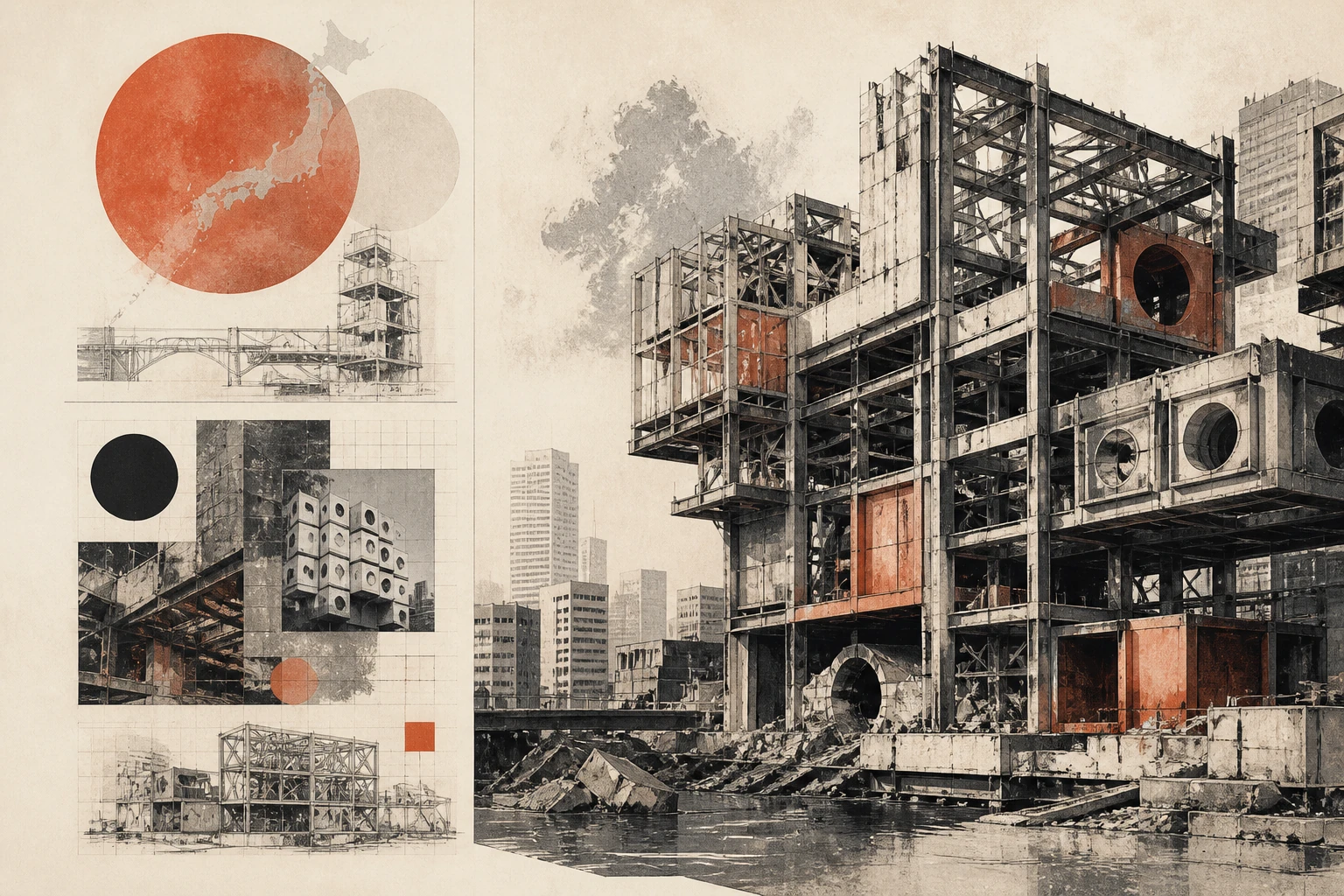
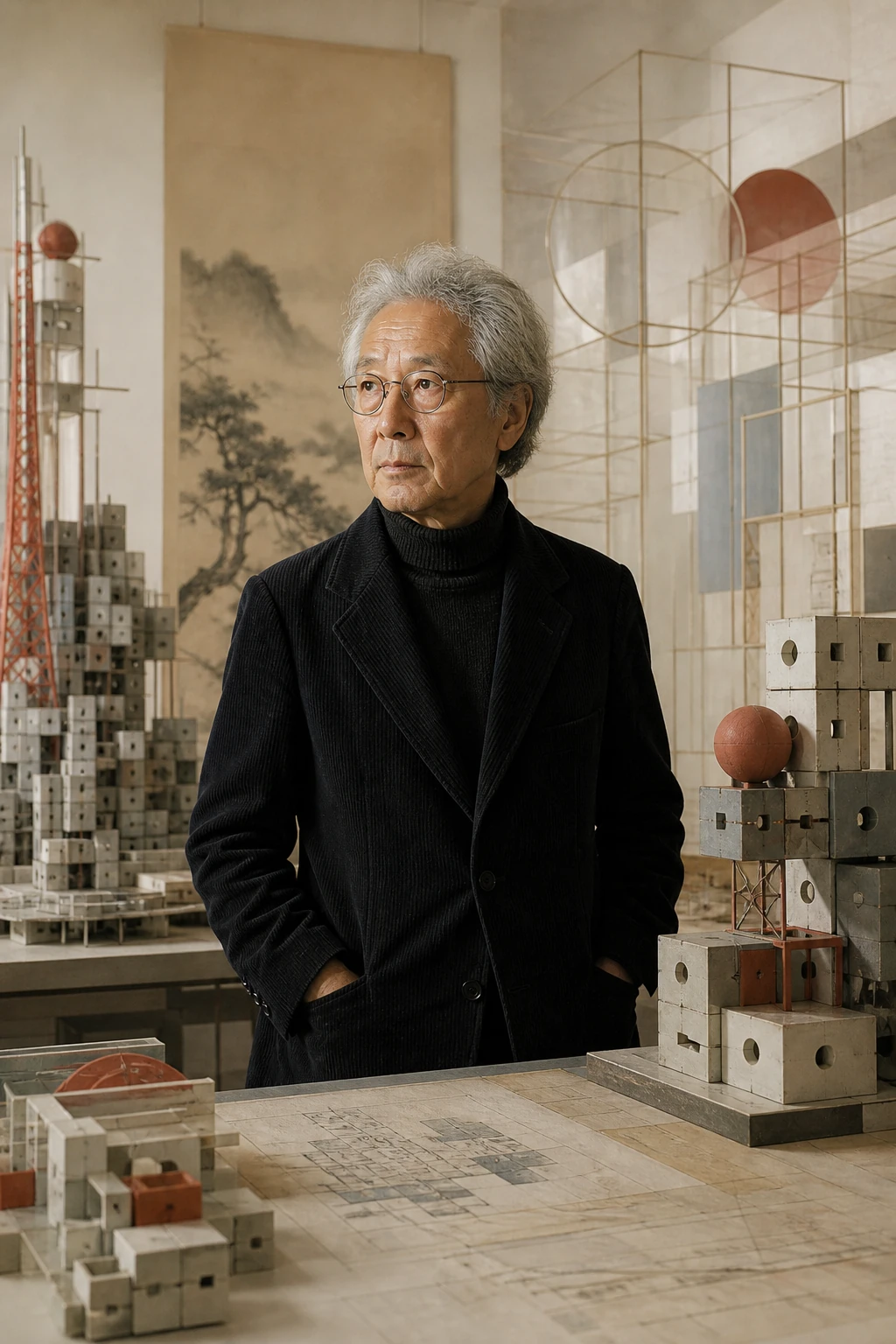
Isozaki treated architecture not as a stable style but as an intellectual system capable of changing along with culture, technology and historical time.
Editorial thesis
Arata Isozaki's significance rests on the radical mutability of his method. He moved freely from Brutalism and Metabolism to postmodernism, high-tech engineering and cultural symbolism.
Reader question
How did a Japanese architect turn the ruin, uncertainty and cultural translation into instruments of an international architectural practice?
The core subject is Arata Isozaki: his architecture, theory, curatorial and international activity.
Metabolism is treated as a context of the early career, not as a single identity.
Postmodernism is analysed as a strategy of cultural translation, not only as a decorative style.
The international projects are examined with regard to local partners and engineering teams.
The author died in 2022; current information concerns the study of his legacy.
Archival drawings, projects and photographs require a separate rights review.
Short answer
Arata Isozaki was born in Oita in 1931. He graduated from the University of Tokyo, worked in the studio of Kenzo Tange and founded his own practice in 1963.
The Oita Prefectural Library, the Gunma Museum of Modern Art, the Tsukuba Center, MOCA Los Angeles, the Palau Sant Jordi, the Nara Centennial Hall and the Qatar National Convention Centre show the breadth of his method. In 2019 Isozaki received the Pritzker Prize.
1. Oita, war and the image of the ruin
Arata Isozaki was born in Oita on the island of Kyushu in 1931. His youth fell during the war years and the destruction of Japanese cities.
He later wrote that his first image of architecture was connected not with construction but with the ruin and emptiness.
This theme defined his interest in temporality, disappearance and the impossibility of a final form.
2. The University of Tokyo and Kenzo Tange
Isozaki graduated from the architecture faculty of the University of Tokyo in 1954.
He continued his studies and worked in the laboratory of Kenzo Tange.
In this environment he took part in the discussion of Japan's large-scale modernisation, infrastructure and a new urban order.
3. Metabolism and distance from the movement
Isozaki was close to the Metabolist circle but did not sign their manifesto as an official member.
He was interested in megastructures and the growth of the city, yet he kept a critical distance from the optimistic belief in endless development.
In his projects the future often stands beside the image of destruction.
4. City in the Air
The City in the Air project of the early 1960s proposed raising urban structures above the existing fabric of Tokyo.
Large cylindrical supports and horizontal elements formed a changeable system.
The project remained utopian, but it became an important expression of the postwar discussion of density, infrastructure and the megastructure.
5. Oita Prefectural Library
The Oita Prefectural Library was completed in 1966.
A concrete structure, large beams and a modular organisation reflect the early Brutalist stage.
The building shows an ambition to turn a public programme into a clear constructional system.
6. Gunma Museum of Modern Art
The Gunma Museum of Modern Art opened in 1974.
The composition rests on a strict spatial grid and the repetition of cubic modules.
The museum marked a transition from heavy concrete towards a more abstract, geometrically controlled architecture.
7. Tsukuba Center
The Tsukuba Center was completed in 1983.
The project joins quotations from European architecture, fragments of classical composition and a deliberately theatrical public space.
It became one of the key examples of Japanese postmodernism.
8. Postmodernism and quotation
Isozaki used historical motifs not as a direct return to tradition but as a system of signs.
Quotation made it possible to show that architectural meaning is created by culture and can be transferred or distorted.
Such a method widened the freedom of the project, but risked turning history into a visual catalogue.
9. MOCA Los Angeles
The Museum of Contemporary Art in Los Angeles opened in 1986.
Red sandstone, a lowered entrance and geometric volumes create a restrained presence among large urban complexes.
The project became one of the first significant works by a Japanese architect in the United States.
10. Palau Sant Jordi
The Palau Sant Jordi sports palace in Barcelona was completed for the 1992 Olympic Games.
A large roof and a flexible interior allowed the arena to be used for different events.
The building joins engineering clarity, a soft silhouette and integration into the Olympic landscape of Montjuïc.
11. Nara Centennial Hall
The Nara Centennial Hall opened in 1999.
A monumental volume joins contemporary concert functions with abstract references to the historic architecture of Nara.
The project shows how Isozaki worked with cultural memory without literally reproducing traditional forms.
12. Kyoto Concert Hall
The Kyoto Concert Hall was completed in 1995.
The route to the halls is organised as a sequence of circular and linear spaces.
The architecture joins acoustics, ceremonial quality and a complex geometry of movement.
13. Qatar National Convention Centre
The Qatar National Convention Centre opened in 2011.
Giant tree-like structures, linked to the image of the sidra tree, support the main facade.
The project creates a strong national symbol, but requires a critical analysis of scale, cost and representation.
14. The ruin and incompleteness
The theme of the ruin ran through all of Isozaki's theory.
He perceived the city as a process that never reaches a final form.
Architecture therefore must be able to acknowledge change, loss and cultural rupture.
15. Ma and the space of the interval
Isozaki actively introduced into international discourse the notion of ma — the interval, pause and relation between elements.
The exhibition MA: Space-Time in Japan presented space as a dynamic interval rather than an empty remainder.
This idea connected architecture, performance, music, traditional culture and contemporary design.
16. Cultural translation
Isozaki worked between Japan, Europe, the United States, the Middle East and China.
He did not carry one style from country to country but changed the language of the project according to context.
Cultural translation gave freedom, but also created a risk of superficial symbolism.
17. International practice
Isozaki's practice became one of the first truly global architectural practices from Japan.
He designed museums, concert halls, universities, sports complexes and civic centres.
The international scale widened the architect's influence, but strengthened dependence on local partners and large institutions.
18. Theory, exhibitions and curating
Isozaki was not only an architect but also a critic, writer, curator and participant in international exhibitions.
He helped include Japanese architecture in the global intellectual discussion.
His texts and exhibitions were often as important as the buildings he constructed.
19. Collective authorship
Isozaki's large projects were created with engineers, local architects, acousticians, artists and institutions.
It is especially important to distinguish the authorship of the concept, the technical realisation and the later adaptation of the building.
The public figure of the architect does not cancel the distributed structure of design.
20. The Pritzker Prize
In 2019 Arata Isozaki received the Pritzker Architecture Prize.
The jury noted his ability to join East and West, history and modernity, theory and practice.
The award was received as recognition of the architect's long-standing international influence.
21. Criticism and limitations
The mutability of Isozaki's language is sometimes perceived as an absence of a stable architectural position.
Postmodern quotations can lose critical force and turn into formal decoration.
Large cultural and state projects also require an analysis of politics, cost and environmental footprint.
22. Conclusion
Arata Isozaki showed that architectural identity can be built on change rather than repetition.
His projects connect the postwar ruin, the megastructure, postmodernism and global cultural exchange.
Isozaki's chief legacy is architecture as an open intellectual system sensitive to time.