architect profile
Frank Gehry
Architecture of movement, collage, and digital production
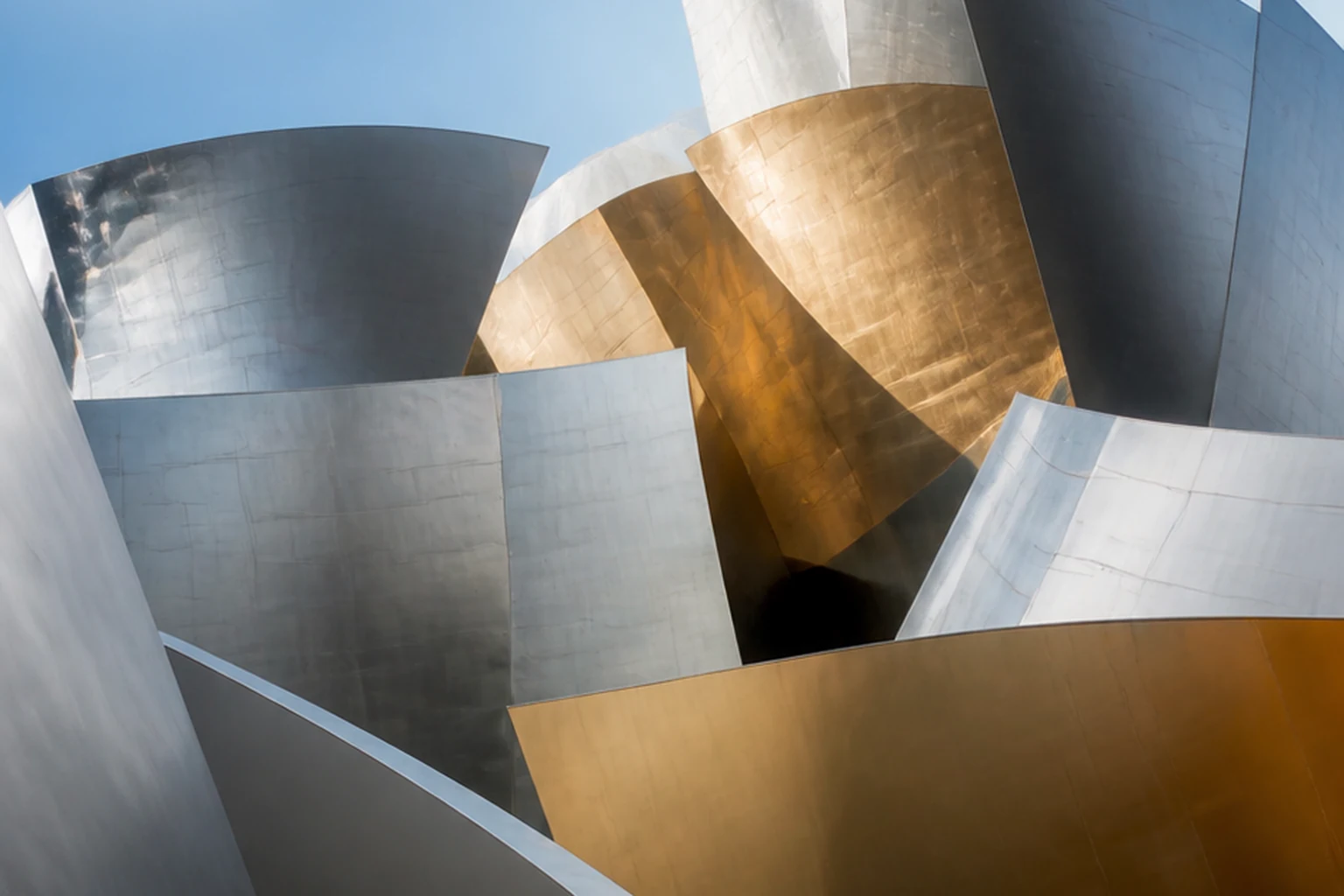
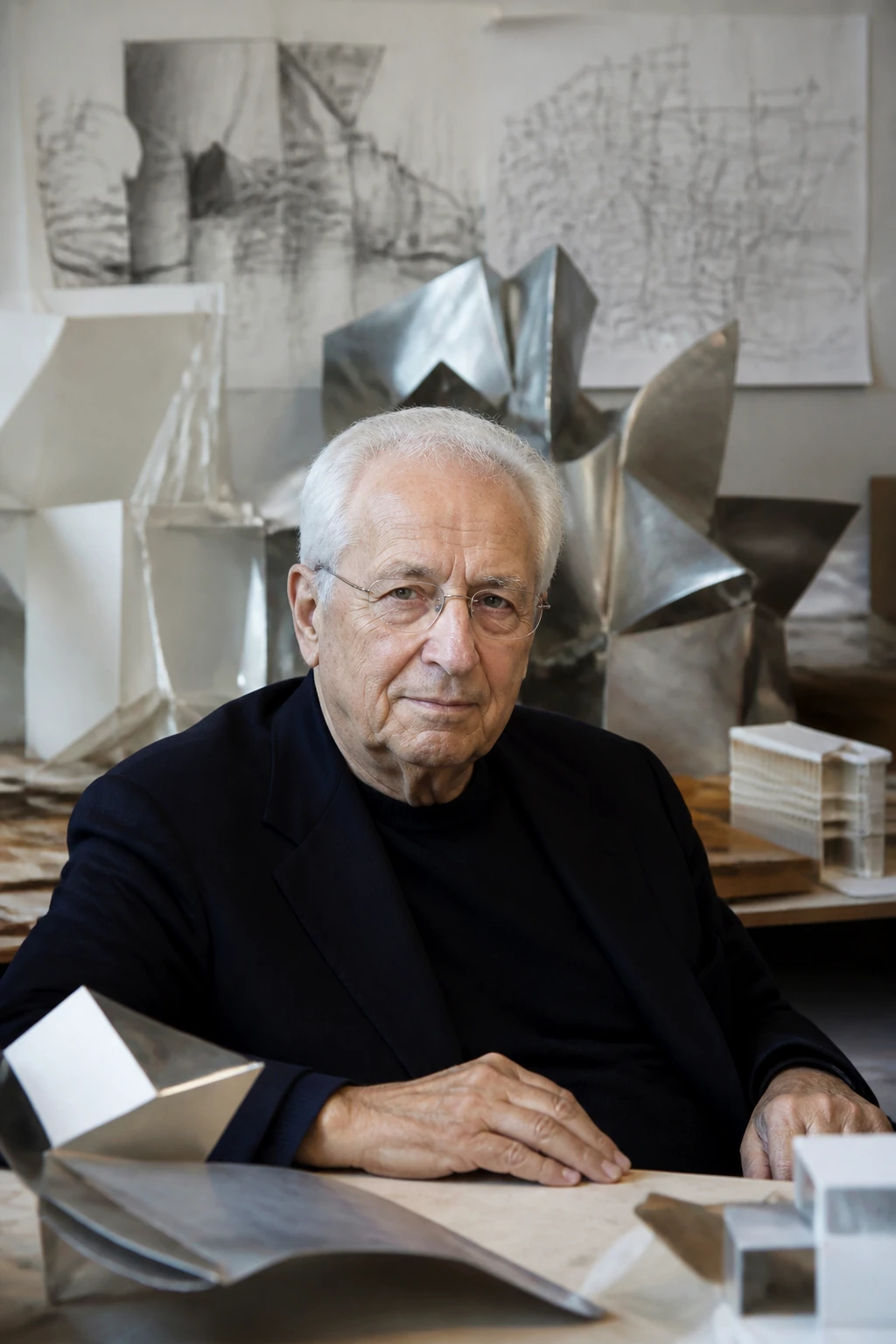
"Gehry transformed architecture not with a single undulating shell. He turned collage, the physical model, the digital model, and industrial production into a unified system capable of translating a free gesture into a built building."
Editorial thesis
Frank Gehry's historical significance is grounded in the integration of artistic collage, everyday materials, sculptural form, complex engineering, and digital fabrication. His projects show how architecture can appear spontaneous while being the result of exceptionally precise coordination of structure, envelope, acoustics, budget, and technology.
Reader question
How did a Canadian-born architect turn plywood, chain-link, metal, and a paper model into a global language of museums, concert halls, and urban landmarks?
To present Gehry as architect, furniture designer, studio leader, and author of a digital production method. The text separates formal effect from the engineering system and examines both cultural achievements and the limitations of iconic architecture.
Primary subject: Frank Owen Gehry, his professional biography and key projects from 1929 onward.
Projects are examined as the result of work by Gehry Partners, engineers, consultants, clients, and contractors.
The term 'deconstructivism' is used cautiously and does not substitute for the author's own development.
Digital technology is analyzed as a means of coordination and production, not as a source of form in itself.
Current projects and statuses require verification immediately before web publication.
Archival photographs, plans, and models require a separate rights review.
Short answer
Frank Gehry was born on February 28, 1929, in Toronto as Frank Owen Goldberg. After the family relocated to Los Angeles, he studied architecture at the University of Southern California and city planning at the Harvard Graduate School of Design, though he did not complete the program. In 1962, he founded his own practice. The renovation of his Santa Monica house in 1978 made visible the materials and processes usually hidden by finish: chain-link, plywood, corrugated metal, and unfinished joints.
In 1989, Gehry received the Pritzker Prize. The Guggenheim Museum Bilbao, opened in 1997, transformed his digitally coordinated titanium shells into a global symbol of a new museum architecture. Walt Disney Concert Hall, Fondation Louis Vuitton, Louis Vuitton Maison Seoul, and other projects developed the method in which a hand-made model is translated into a complex three-dimensional model and then into precise fabrication. Gehry's influence is vast, but the idea of the 'Bilbao effect' often overestimates the capacity of a single building to transform a city automatically.
1. Toronto, family, and the move to Los Angeles
Frank Owen Goldberg was born on February 28, 1929, in Toronto to a family of Jewish immigrants. As a child, he built imaginary cities from scraps of materials in his grandfather's hardware store.
In 1947, the family moved to Los Angeles. Later, he changed his surname to Gehry, which was connected to a desire to lessen the pressure of anti-Semitism on the family and his career.
The experience of moving between Canada and California produced a distance toward any single national school and an interest in the heterogeneous city.
2. USC, Victor Gruen, and the early years of practice
Gehry studied architecture at the University of Southern California and graduated in 1954. He then worked at Victor Gruen Associates.
He enrolled at the Harvard Graduate School of Design for city planning but did not complete his studies. Returning to Los Angeles strengthened his connection to practice and the construction industry.
In 1962, he founded his own office. Early projects included residential, commercial, and exhibition spaces.
3. Easy Edges and cardboard furniture
In the late 1960s to early 1970s, Gehry developed the Easy Edges furniture from laminated corrugated cardboard.
A material associated with packaging proved strong after layers were glued together, allowing sculptural curves.
The project revealed an early interest in revaluing cheap materials and in form arising from production technology.
4. The Gehry House in Santa Monica
In 1978, Gehry renovated an existing house for his family in Santa Monica. The old building was partially surrounded by a new envelope of chain-link, plywood, glass, and corrugated metal.
The house did not hide the conflict between old and new. Unfinished joints and cut volumes turned the process of renovation into the primary image.
The project became an early manifesto: architecture can preserve a previous structure while simultaneously displaying the intervention.
5. Collage, incompleteness, and everyday materials
Gehry developed a method of collage influenced by the contemporary art of Los Angeles. Heterogeneous fragments need not merge into a single calm object.
Chain-link, plywood, stucco, and metal were used not for an effect of poverty but to break the conventional hierarchy of materials.
Over time, the domestic roughness of early projects gave way to high-tech envelopes, but the logic of colliding fragments endured.
6. The fish as form and constructive model
The fish motif regularly appears in Gehry's drawings, sculptures, and architecture. He linked it to childhood memory and simultaneously used it as an alternative to rectangular geometry.
Fish-like forms allowed him to explore curvature, scale-like surfaces, sheen, and surface movement. The Barcelona Fish of 1992 became an important example of a digitally coordinated large-scale structure.
The motif should not be understood as a literal style. It was a laboratory for free curvature and the envelope.
7. Vitra Design Museum
The Vitra Design Museum in Weil am Rhein was completed in 1989 and became Gehry's first major European building.
White volumes, staircases, and curved elements form a sculptural composition, but the museum remains comparatively compact and built by conventional means.
The project marked the transition from early collage to a more unified plasticity.
8. Weisman Art Museum
The Weisman Art Museum in Minneapolis opened in 1993. The stainless-steel facade reflects sky and river, forming a collection of tilted and curved volumes.
The interior galleries are organized more calmly than the exterior shell. This distinction would become characteristic of many subsequent museums.
The project showed that a metal surface can simultaneously be an urban figure and a changing light screen.
9. Guggenheim Bilbao
The Guggenheim Museum Bilbao was opened in 1997 on a former industrial site beside the Nervión River. Titanium panels, limestone, and glass form a complex composition around a central atrium.
The building became a symbol of the cultural regeneration of Bilbao and brought international fame to both the architect and the city.
Its success cannot be attributed solely to form: it depended on the transport, cultural, and economic strategy of the region, the Guggenheim institution, and public investment.
10. Digital design and CATIA
To coordinate complex surfaces, the studio adapted CATIA — a software system originally developed for the aerospace industry.
Physical models were scanned and translated into digital geometry suitable for calculation and fabrication. The digital model linked the architect, engineer, fabricator, and contractor.
The technology did not generate architecture automatically. It made it possible to build forms found through the physical model and artistic decision.
11. Walt Disney Concert Hall
Walt Disney Concert Hall in Los Angeles opened in 2003 after a long history of design and financing.
Stainless-steel surfaces form the external composition, while the interior is organized around a vineyard-type concert hall.
The project became a civic institution and simultaneously demonstrated the complexity of realizing architecture that depends on politics, budget, acoustics, and long-term coordination.
12. Acoustics, interior, and envelope
A concert hall cannot be judged by its exterior image alone. Acoustics, sightlines, distance to the stage, and audience distribution define the primary experience.
Gehry collaborated with acoustician Yasuhisa Toyota. The wooden surfaces and the geometry of the hall form a warm inner world sharply distinct from the metallic envelope.
This contrast shows that the sculptural facade and the functional core can have different material languages.
13. MIT Stata Center
The Ray and Maria Stata Center at MIT opened in 2004. The complex brings together research spaces, auditoriums, and social zones.
Tilted volumes and diverse materials were meant to support informal meetings and intellectual exchange.
Later, the project became the subject of litigation over leaks and construction defects; the dispute was settled. This case underscores the responsibility for the technical reliability of complex form.
14. Fondation Louis Vuitton
Fondation Louis Vuitton in Paris opened in 2014. Glass sails surround white inner volumes that Gehry called icebergs.
The building is situated in the Bois de Boulogne and functions as a museum, exhibition venue, and symbol of the institutional strategy of LVMH.
The project connects cultural program, corporate patronage, and iconic architecture, which demands simultaneous aesthetic and economic analysis.
15. Architecture for fashion and luxury institutions
Gehry has collaborated with fashion and luxury companies in architecture, windows, objects, and exhibition projects.
Louis Vuitton Maison Seoul reinterprets the glass-sail motif at a more compact urban scale.
Such projects show the convergence of architectural authorship, art, branding, and commercial space.
16. Gehry Technologies and the production method
In 2002, Gehry Technologies was founded, developing digital tools and consulting for the architecture and construction industry.
The Digital Project platform adapted parametric coordination for complex buildings and helped reduce the gap between design and fabrication.
The company was later acquired by Trimble. Gehry's method contribution consists not only in form but also in the transformation of the workflow.
17. Studio, collective authorship, and models
Gehry Partners operates through large teams of architects, designers, model specialists, and digital coordinators.
The physical model remains the central instrument: it is cut apart, rebuilt, photographed, and translated into a digital model.
The strong public image of the author must not obscure collective production.
18. The Pritzker Prize and international recognition
Gehry received the Pritzker Prize in 1989. The jury noted his openness to experiment and his ability to connect the art of architecture with everyday culture.
The award was conferred before Guggenheim Bilbao, when his international reputation rested on more intimate and experimental projects.
This is important: the recognition extends not only to the later metal and glass icons.
19. The Bilbao effect: influence and myth
The term 'Bilbao effect' describes the idea that a landmark cultural building can attract tourists and transform a city's economy.
Bilbao's experience was indeed influential, but it cannot be mechanically repeated. It was part of a broader regional transformation.
Attempts to replace an urban strategy with a single expensive object often lead to weak results.
20. Critique, cost, and urban responsibility
Gehry's architecture is criticized for high cost, maintenance complexity, and the transformation of the building into a brand object.
Some projects create a strong urban image, but the complex envelope can dominate the everyday context and program.
A fair assessment must consider not only visual novelty but also durability, accessibility, operation, and public value.
21. Conclusion: the free gesture turned into a system
Frank Gehry made the architectural gesture measurable and producible. His buildings look spontaneous but are built through a long system of models, digital coordination, and engineering.
The early interest in cheap materials and collage did not disappear in the later museums; it was transformed into the collision of volumes, surfaces, and routes.
Gehry's principal legacy is not the undulating metal, but the capacity to connect artistic indeterminacy with technical precision.