architect profile
Frei Otto
Lightweight structures, natural processes, and the architecture of minimal material
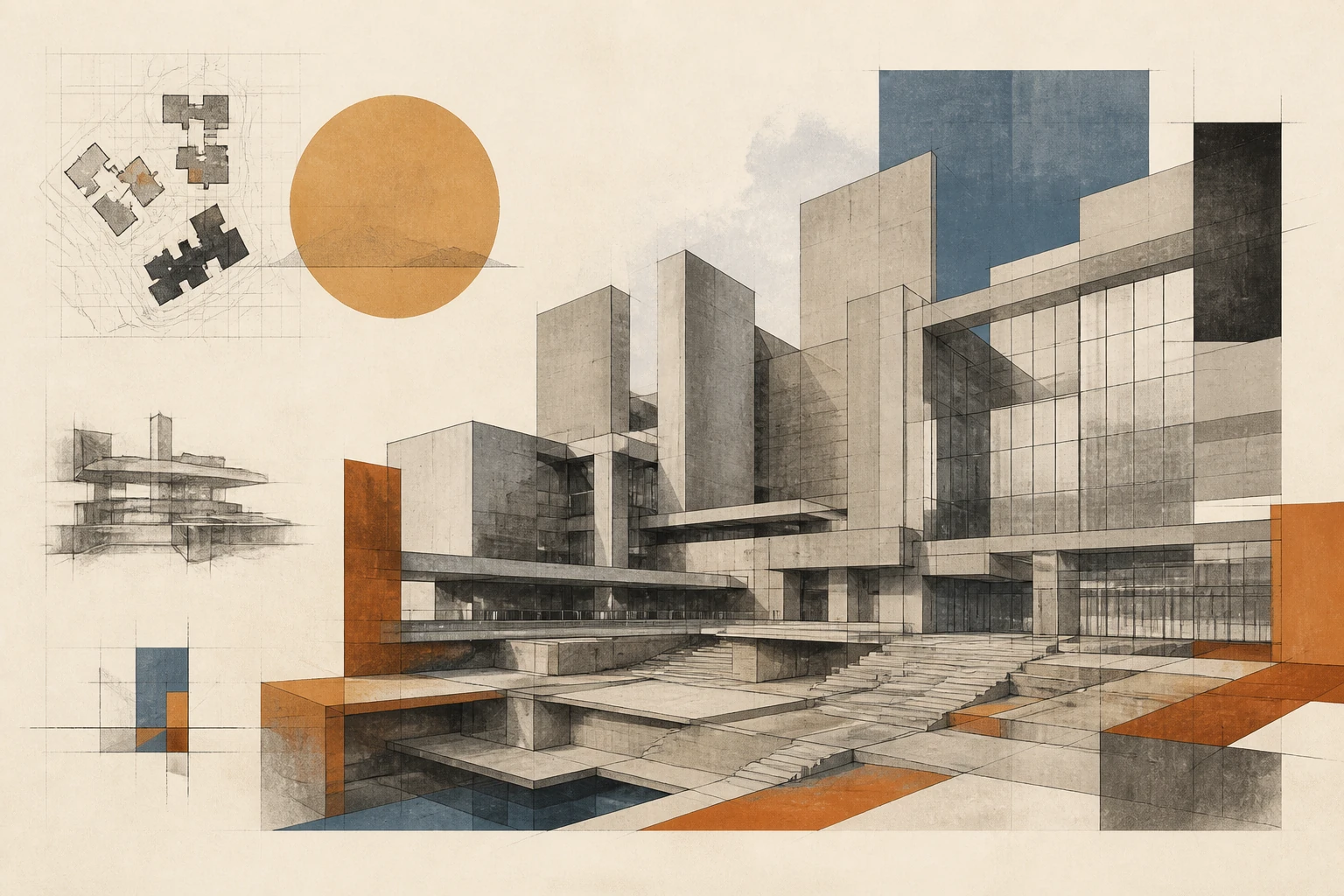
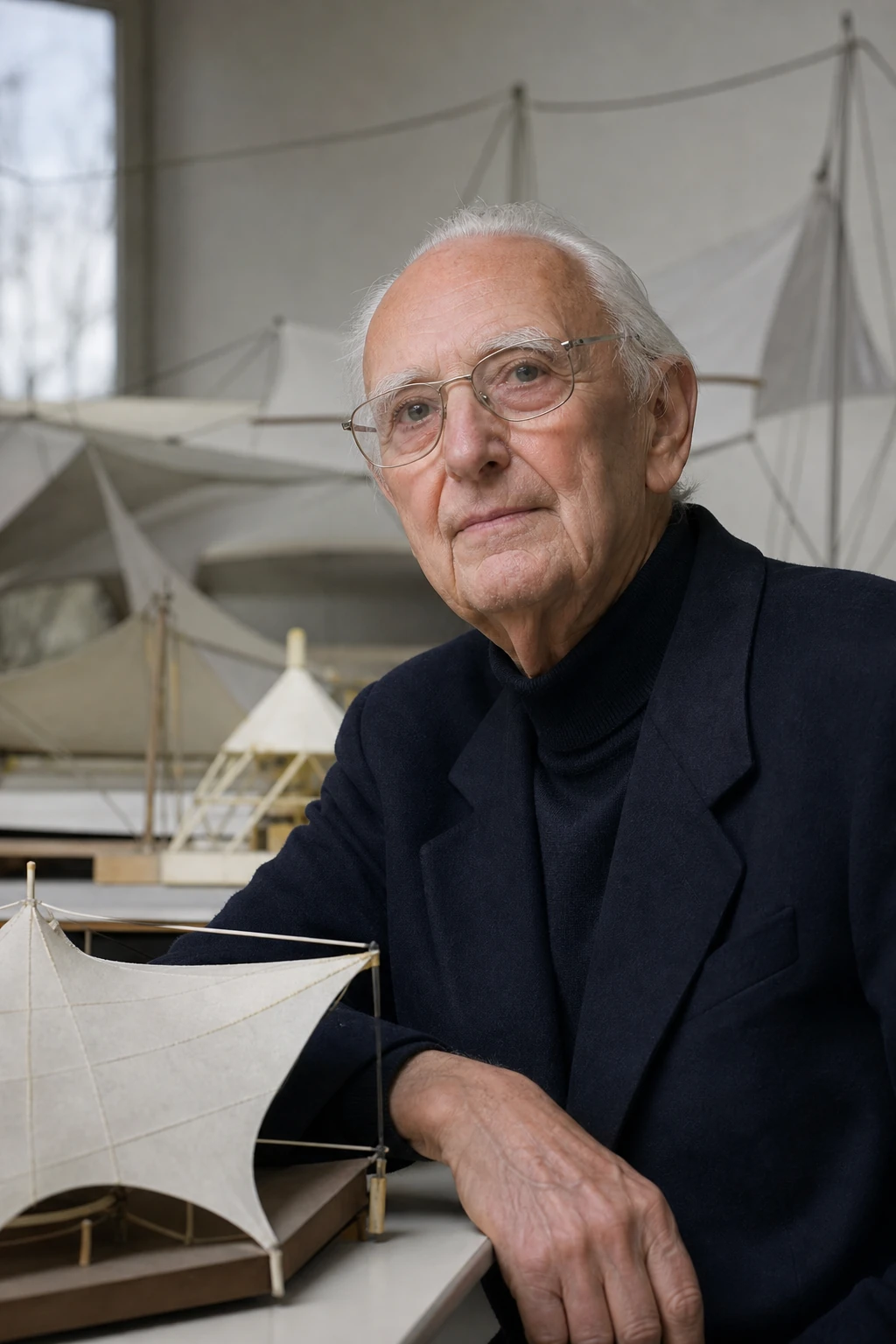
"Frei Otto sought not spectacular form but a state of equilibrium in which the structure does more with less material. His architecture grew out of experiments with fabric, soap films, nets, and natural systems."
Editorial thesis
Frei Otto's significance rests on a research-based approach to lightweight structures. He connected architecture, engineering, biology, physical modeling, and collective design, creating systems in which form arises from forces, material, and process.
Reader question
How did an architect turn the observation of nature and physical experiment into a new constructive culture capable of spanning vast spaces with a minimum of material?
Primary subject: Frei Otto, his research institutes, projects, and collective methods.
Lightness is not automatically equated with sustainability.
The Munich Olympic Park is examined as the result of collaboration with Behnisch & Partner and engineering teams.
Form-finding is analyzed as a physical and computational process, not as decorative biomorphism.
The architect died in 2015; current information pertains to legacy and project conservation.
Archival models, photographs, and drawings require a separate rights review.
Short answer
Frei Otto was born in 1925 in Siegmar, Germany. After military service and captivity, he studied architecture at the Technical University of Berlin, researched tent and membrane systems, and in 1964 founded the Institute for Lightweight Structures in Stuttgart.
The German Pavilion at Expo 67, the Munich Olympic structures, the Multihalle Mannheim, and the IL research series cemented his influence. In 2015, Otto was awarded the Pritzker Prize.
1. Germany, war, and education
Frei Otto was born in 1925 in Siegmar, later incorporated into Chemnitz. His family was connected to craft and sculpture.
During World War II, he served as a pilot, became a POW, and participated in building temporary camp structures.
The experience of material scarcity and the need to span spaces quickly shaped his interest in lightweight construction.
2. First tent structures
After the war, Otto studied architecture at the Technical University of Berlin.
He researched tents, suspended systems, and temporary shells as a full-fledged domain of architecture.
Early works showed that fabric and cable could create large spaces without massive walls and beams.
3. Minimal surface
Otto was interested in forms that arise under uniform stress distribution.
The minimal surface is not arbitrarily chosen: it is defined by boundaries, tension, and physical equilibrium.
Thus form becomes the result of a process, not a pre-drawn silhouette.
4. Soap films and physical models
A soap film automatically seeks the surface of minimum area between given boundaries.
Otto used such models to find the geometry of membranes and nets.
The physical experiment made it possible to see the behavior of a system before complex computation became widely available.
5. Expo 67 German Pavilion
The Pavilion of the Federal Republic of Germany at Expo 67 in Montreal was created jointly with Rolf Gutbrod and engineering teams.
A spatial cable net, supported by masts, carried a light membrane envelope.
The project presented to an international audience a new image of an open, technological, and democratic Germany.
6. Institute for Lightweight Structures
In 1964, Otto founded the Institute for Lightweight Structures at the University of Stuttgart.
The institute brought together architects, engineers, mathematicians, biologists, and manufacturers.
Research was published in the IL series and formed a collective scientific culture that extended beyond the traditional office.
7. Munich Olympic Park
The Munich Olympic structures were built for the 1972 Games to a design by Behnisch & Partner, with key participation by Otto and engineering teams.
A large transparent roof unites the stadium, sports halls, and public routes.
The undulating net sought to create an antithesis to the monumental architecture of the 1936 Olympics.
8. Net, mast, and transparent landscape
The Munich roof consists of a prestressed cable net resting on masts and anchors.
Transparent panels create visual continuity between the sports facilities and the rolling landscape.
The light image conceals a complex system of calculation, erection, and precise stress control.
9. Multihalle Mannheim
The Multihalle Mannheim was built for the 1975 Bundesgartenschau together with architects Carlfried Mutschler and Joachim Langner.
A large timber gridshell was assembled flat, then lifted and given double curvature.
The building became one of the largest and most influential experiments with timber gridshells.
10. Timber gridshell
Thin timber laths work together, distributing load across the curved surface.
The geometry was found through hanging models and measurement, then translated into a construction system.
The structure shows how a weak individual element becomes strong through networked interaction.
11. Mannheim and experimental risk
Experimental buildings often face problems of aging, moisture, joints, and maintenance.
The Multihalle required a lengthy struggle for preservation and technical renewal.
Its history shows that innovation must include a repair plan, documentation, and institutional responsibility.
12. Proximity to nature
Otto studied spider webs, bones, branching, shells, and the organization of living systems.
His interest was not in copying nature's outward appearance but in understanding principles of efficiency and adaptation.
Such an approach would later be linked to biomimicry and morphogenesis.
13. Biology and Bionics
In Stuttgart, Otto participated in interdisciplinary research on biological structures.
He compared architectural networks to natural structures in which material is distributed according to forces.
At the same time, the biological analogy remained a research tool, not proof of automatic sustainability.
14. Pneumatic and cable systems
In addition to membranes, Otto investigated pneumatic shells, suspension bridges, net domes, and transformable structures.
Each system demanded an understanding of pressure, tension, bending, and stability.
The overarching principle was working with forces rather than fighting them through excessive mass.
15. Form-finding
Form-finding means searching for form that corresponds to internal forces and boundary conditions.
The architect sets the supports, material, and load, and the geometry emerges through the modeling process.
This method differs from checking an already chosen form for strength.
16. Analog and digital modeling
Otto worked with chains, fabrics, sand, needles, soap films, and photography.
Later, these principles were translated into digital methods of calculation and parametric modeling.
Contemporary computational architecture owes much to his experimental culture.
17. Collective authorship
Otto's projects cannot be correctly described as the individual works of a single author.
They were created jointly with architects, engineers, researchers, manufacturers, and builders.
Otto himself emphasized the open exchange of knowledge and the collective character of the search.
18. Ecology and material economy
Minimizing mass reduces material consumption and can lower the impact of construction.
However, membranes, plastics, steel, anchors, and complex maintenance carry their own ecological footprint.
Assessment must consider service life, repair, reuse, and real-world operation.
19. The Pritzker Prize
In 2015, Frei Otto was selected as the laureate of the Pritzker Architecture Prize.
He died shortly before the official announcement; the decision was communicated to him during his lifetime.
The jury noted his research influence, humanism, and contribution to the development of lightweight structures.
20. Critique and limitations
Lightweight shells are sensitive to joints, damage, and snow and wind loads.
Their visual transparency can conceal the complexity of maintenance and the cost of specialized production.
Natural analogies also risk becoming rhetoric if not backed by lifecycle measurement.
21. Conclusion
Frei Otto changed the very understanding of how architecture can find form.
He turned physical experiment, interdisciplinary work, and material economy into a unified design culture.
Otto's principal legacy is architecture as the investigation of equilibrium among forces, resources, and the human need for space.