architect profile
Kisho Kurokawa
Metabolism, the capsule and the architecture of symbiosis
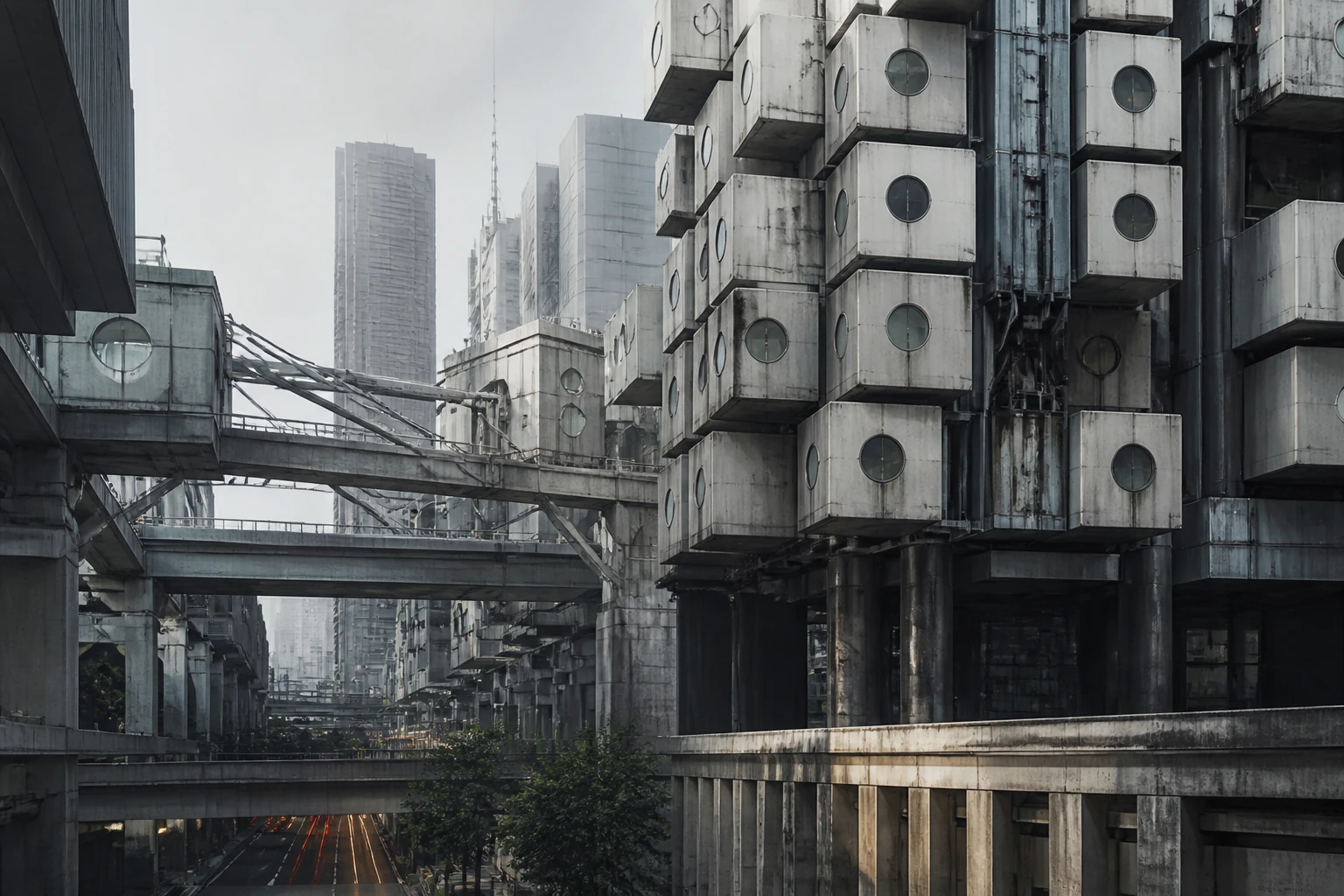
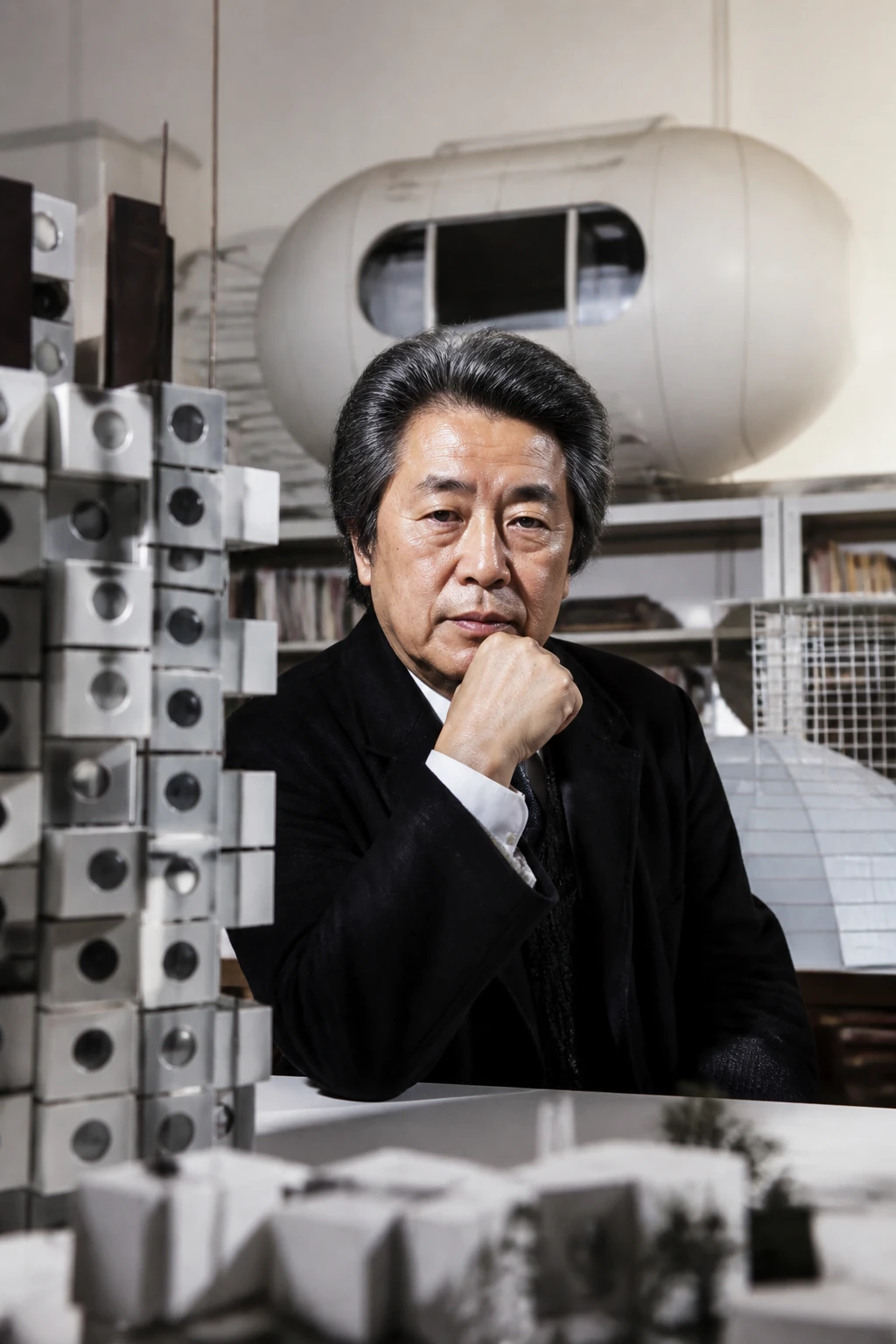
Kurokawa treated the city as a living organism in which a permanent frame and replaceable elements must coexist. His architecture joins technological optimism, the Japanese philosophy of the interval and the idea of the symbiosis of cultures.
Editorial thesis
Kisho Kurokawa's significance rests on an attempt to create an architecture able to change over time. The capsule, the megastructure, the intermediate space and symbiosis become for him instruments of a critique of static modernism.
Reader question
How did one of the founders of Japanese Metabolism turn replaceability, technology and cultural dialogue into an architectural method — and why did his chief icon prove difficult for real renewal?
The core subject is Kisho Kurokawa: his architecture, theory and participation in the Metabolism movement.
The Nakagin Capsule Tower is treated at once as an icon and as an operational experiment.
The unrealised megastructures are distinguished from the built buildings.
The notion of symbiosis is analysed as a philosophical and design concept.
The author died in 2007; current information concerns the preservation and study of his legacy.
Archival photographs, drawings and images of dismantled objects require a rights review.
Short answer
Kisho Kurokawa was born in Nagoya in 1934. He studied at Kyoto University and the University of Tokyo, where he worked in the laboratory of Kenzo Tange. In 1960 he became one of the founders of the Metabolism movement.
The Nakagin Capsule Tower, the Expo 70 Takara Beautilion, the Sony Tower, the Hiroshima City Museum of Contemporary Art, the Kuala Lumpur International Airport and the National Art Center Tokyo show the development of his method. The theory of symbiosis became a key part of the architect's late legacy.
1. Nagoya, Kyoto and the University of Tokyo
Kisho Kurokawa was born in Nagoya in 1934. He studied architecture at Kyoto University, then continued his studies at the University of Tokyo.
In Tokyo he found himself in the laboratory of Kenzo Tange, where the postwar reconstruction, infrastructure and the growth of the metropolis were discussed.
This environment formed his interest in architecture as a changeable system rather than a finished object.
2. Kenzo Tange and the birth of Metabolism
In the late 1950s young Japanese architects sought a language for a rapidly changing country.
Kurokawa, together with Kiyonori Kikutake, Fumihiko Maki and others, took part in forming the Metabolism movement.
The group transferred the biological metaphors of growth, exchange and renewal into architecture and the city.
3. The manifesto of 1960
The Metabolism 1960 manifesto was published for the World Design Conference in Tokyo.
The authors proposed large infrastructural frames and replaceable elements able to respond to population growth and technological change.
The document became one of the most important architectural manifestos of postwar Japan.
4. Capsule Declaration
Kurokawa developed the idea of the capsule as a minimal autonomous unit of life.
The capsule was to be produced industrially, connected to a permanent core and replaced when it became obsolete.
This model joined mass production, mobility and individual autonomy.
5. Nakagin Capsule Tower
The Nakagin Capsule Tower was completed in Tokyo in 1972.
Two concrete core towers carried 140 factory-made capsules attached with bolts.
Each capsule had a round window and a compact interior designed for the urban user.
6. The frame and the replaceable cell
The tower's principal principle lay in the separation of the durable frame and the short-lived capsule.
In theory an individual cell could be removed and replaced without destroying the whole system.
The project became the clearest built expression of the Metabolist idea of renewable architecture.
7. Why the capsules were not replaced
In practice the capsules did not undergo the planned cycle of regular replacement.
The reasons were the complexity of the communications, cost, property rights, asbestos, corrosion and the absence of a production system for new modules.
The history of the building showed that technical replaceability is impossible without an economic, legal and managerial infrastructure.
8. Expo 70 Takara Beautilion
The Takara Beautilion pavilion for Expo 70 in Osaka was assembled from a steel space frame and attachable capsules.
It demonstrated architecture as a temporary, reconfigurable system.
The pavilion strengthened the international fame of Metabolism and its technological image.
9. Sony Tower
The Sony Tower in Osaka was completed in the 1970s.
A vertical volume combined a commercial programme, a media image and engineering expressiveness.
The project reflected the connection of Kurokawa's architecture with corporate culture and Japanese economic growth.
10. The National Museum of Ethnology
The National Museum of Ethnology in Osaka opened in 1977.
The complex is organised as a system of massive volumes, inner streets and courtyards.
The museum shows a transition from the literal capsule to a larger architecture based on connections and intermediate spaces.
11. Hiroshima City Museum of Contemporary Art
The Hiroshima City Museum of Contemporary Art opened in 1989.
The architecture joins geometric forms, stone, metal and a symbolic route.
The project works with the memory of the city, but avoids directly repeating the language of the Peace Memorial Park.
12. Kuala Lumpur International Airport
The Kuala Lumpur International Airport opened in 1998.
A large transport system is organised around repeating modules, natural light and the image of the 'airport in the forest'.
The project shows how the ideas of growth and connection were carried from the utopian megastructure into real infrastructure.
13. National Art Center Tokyo
The National Art Center Tokyo opened in 2007.
A wave-like glass facade forms a deep public foyer and a soft boundary between the building and the city.
The museum has no permanent collection and works as a flexible infrastructure for temporary exhibitions.
14. The architecture of symbiosis
In Kurokawa's late theory the notion of Metabolism gradually yielded to symbiosis.
Symbiosis means the coexistence of differences: the old and the new, nature and technology, the local and the global.
Architecture should not eliminate contradictions but create an intermediate space for their interaction.
15. Ma and the intermediate space
Kurokawa connected symbiosis with the Japanese notion of ma — the interval and the pause.
A passage, gallery, courtyard and an ambiguous boundary allow different systems to coexist.
The in-between becomes not a remainder but the principal spatial resource.
16. East and West
Kurokawa criticised the universalism of modernism, but worked actively in the international architectural environment.
He sought to join Western technological rationality with the Japanese idea of mutability and ambiguity.
Such a cultural synthesis widened the architectural discourse, but sometimes turned into too broad a philosophical formula.
17. International practice
Kurokawa designed museums, airports, offices, master plans and cultural centres in different countries.
His practice became part of the global spread of Japanese architecture after the 1970s.
The international scale strengthened the influence, but required adapting the ideas to different norms, climates and clients.
18. Theory and public activity
Kurokawa wrote books, gave lectures and actively took part in public life.
He developed the notions of symbiosis, the intermediate space and cultural plurality.
His theoretical activity made it possible to present architecture as a philosophical and political position.
19. Collective authorship
Kurokawa's large projects were created by architects, engineers, manufacturers and state institutions.
Nakagin depended especially on industrial production, the assembly system and later management.
The history of the building confirms that an architectural concept exists only together with collective operation.
20. The conservation and dismantling of Nakagin
By the beginning of the twenty-first century the Nakagin Capsule Tower was in a poor technical state.
After long discussions about conservation the building was dismantled in 2022.
Individual capsules were preserved and given to museums, institutions and private owners, turning a coherent object into a distributed archive.
21. Criticism and limitations
Metabolist replaceability proved more difficult than the architectural scheme presupposed.
The high-tech image depended on materials and systems that rapidly became obsolete.
The philosophy of symbiosis could be a productive frame, but sometimes remained too abstract for assessing real social conflicts.
22. Conclusion
Kisho Kurokawa made change and temporality central themes of contemporary architecture.
His legacy matters especially where the utopian scheme collided with real operation and property rights.
Kurokawa's chief lesson is that changeable architecture requires not only replaceable parts but also durable social institutions.