architect profile
Rem Koolhaas
Architecture as the investigation of the city, programme, scale and contemporary power
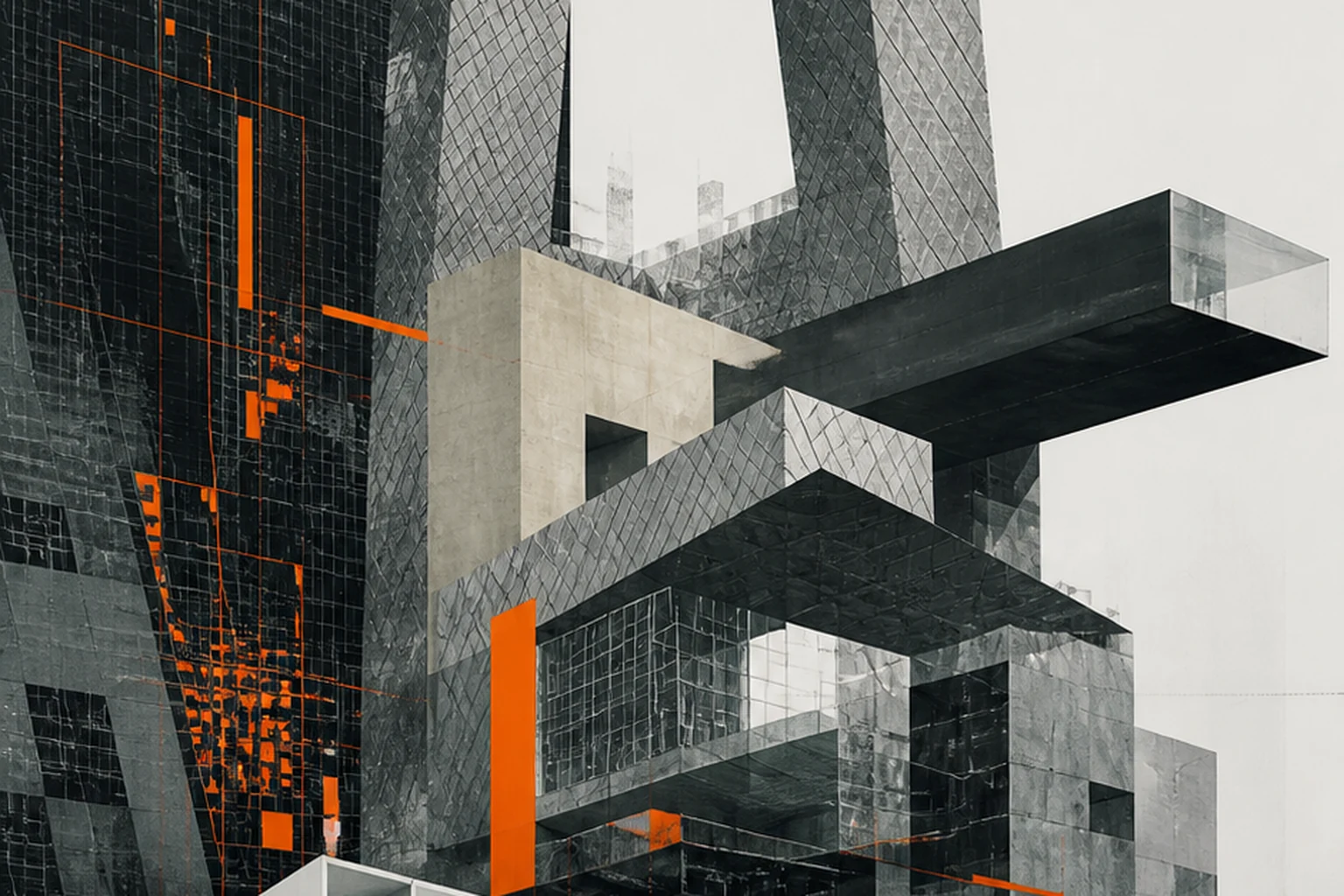
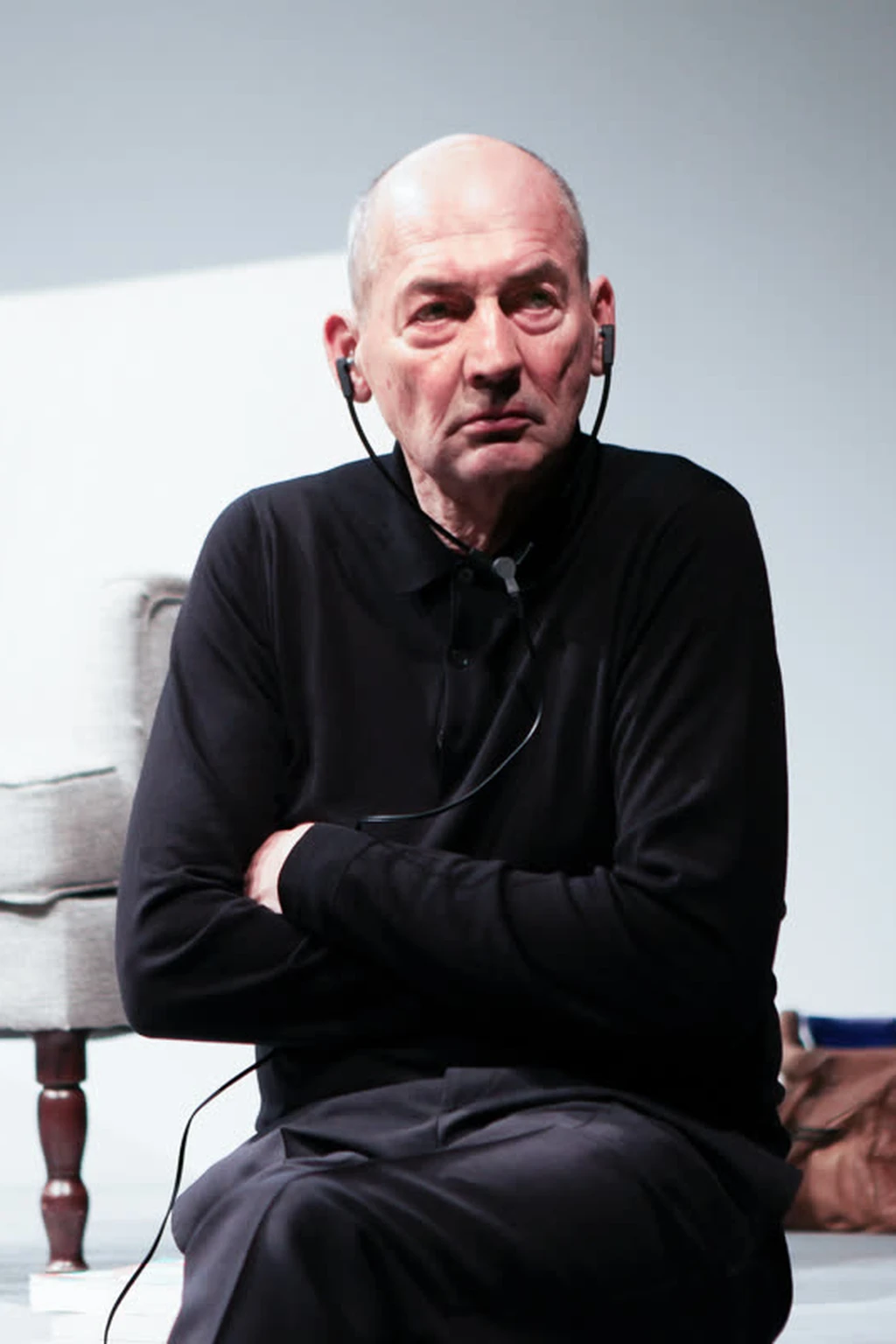
Koolhaas changed architecture not with a single formal style but with a way of asking questions. For him the city, commerce, media, infrastructure, politics and the rural territory are not the background of a building but the material of design.
Editorial thesis
Rem Koolhaas's significance rests on joining design practice, writing, research and institutional critique. He treats architecture not as the production of recognisable objects but as an analysis of the forces that shape the contemporary environment: density, programme, capital, technology, media, politics and logistics.
Reader question
How did a former journalist and scriptwriter turn architectural theory into an international practice, and why did OMA become not a style but a system for investigating contemporaneity?
To present Koolhaas as writer, architect, urbanist, teacher and co-founder of a collective practice. The material distinguishes personal authorship, the work of OMA, the research platform AMO and the contribution of the partners who led individual projects.
The core subject is Rem Koolhaas: his texts, projects and research practice from 1944 to 2026.
OMA is treated as a collective office founded by Koolhaas, Elia and Zoe Zenghelis and Madelon Vriesendorp.
Projects are not credited to a single person when official documentation names other partners and teams.
AMO is distinguished from OMA as a research and design platform operating beyond traditional architecture.
The notions of Bigness, the Generic City and Junkspace are analysed as critical concepts, not as neutral recommendations.
The current list of partners and projects under construction has a cutoff date and requires updating before publication.
Short answer
Rem Koolhaas was born on 17 November 1944 in Rotterdam. Before architecture he worked as a journalist and wrote film scripts. He graduated from the Architectural Association in London, and in 1975, together with Elia and Zoe Zenghelis and Madelon Vriesendorp, founded the Office for Metropolitan Architecture. The book Delirious New York of 1978 brought him international recognition even before a large body of buildings existed.
OMA developed architecture through the conflict of programmes, routes, large scales and the analysis of contemporary culture. Kunsthal Rotterdam, Maison à Bordeaux, Seattle Central Library, Casa da Música, CCTV Headquarters, Fondazione Prada and the Taipei Performing Arts Center show that the office does not follow a single form. In 2000 Koolhaas received the Pritzker Prize. He continues to direct the work of OMA and AMO and remains a professor at the Harvard Graduate School of Design.
1. Rotterdam, Indonesia and journalism
Rem Koolhaas was born in Rotterdam in 1944. He spent part of his childhood in Indonesia, where his father worked in the cultural field.
Before entering architecture school Koolhaas was a journalist for the Haagse Post and took part in creating scripts. This experience formed his interest in montage, interviews, conflicting facts and cultural diagnosis.
In architecture he kept the journalistic method: a project begins not with form but with the observation of the system, the programme and the contradictions of the place.
2. The Architectural Association and Exodus
Koolhaas studied at the Architectural Association in London and graduated in 1972. The school in that period was a centre of experimental architecture and radical graphics.
The degree project Exodus, or the Voluntary Prisoners of Architecture, created with Madelon Vriesendorp, Elia and Zoe Zenghelis, presented London crossed by an architectural strip of voluntary confinement.
The project joined collage, script, political allegory and urban theory. It showed that an architectural image can work as a critical text.
3. Founding OMA
In 1975 Koolhaas, Elia Zenghelis, Zoe Zenghelis and Madelon Vriesendorp founded the Office for Metropolitan Architecture.
The name stressed the scale of the interests: the office sought to work not only with an individual building but with the metropolis, infrastructure and mass culture.
From the very start OMA was a collective system in which architecture, texts, graphics, competitions and research developed in parallel.
4. Delirious New York
In 1978 Koolhaas published Delirious New York: A Retroactive Manifesto for Manhattan. The book analysed Manhattan as a product of density, the grid, the lift, speculation and programmatic incompatibility.
Instead of condemning the commercial city the author treated it as a laboratory. A skyscraper could contain independent worlds on each floor, and the outer shell was not obliged to express the inner life.
The book became an important alternative both to orthodox modernism and to the historicism of postmodernism.
5. The architecture of the programme
For Koolhaas the programme is not a neutral list of rooms. It produces conflicts, crossings of flows and unexpected forms of use.
OMA often organises a project through routes, diagrams, platforms, loops and vertical connections. Space arises from the relations between activities.
Such an approach allows a single building to join a library, theatre, market, infrastructure and public space without trying to reduce them to a single typology.
6. Parc de la Villette and the strategy of strips
The competition project for the Parc de la Villette of 1982 was not realised, but became one of OMA's most influential projects.
Instead of a finished composition the park was proposed as a system of parallel strips of programmes, infrastructural points and changeable events.
The project treated the landscape as the organisation of possibilities, not as a static picture.
7. Kunsthal Rotterdam
The Kunsthal Rotterdam opened in 1992. The building joins the exhibition spaces, auditorium, restaurant and urban routes.
Sloping surfaces, ramps and intersecting trajectories create a continuous movement through a site divided by a road.
The materials are deliberately heterogeneous: expensive and everyday surfaces exist side by side, stressing the programmatic rather than the decorative logic.
8. Maison à Bordeaux
The Maison à Bordeaux was completed in 1998 for a family one of whose members used a wheelchair.
The central element was a lifting cabin-platform moving between the levels of the house. It works at once as a lift, a room and part of a changeable layout.
The project is often interpreted as a technological gesture, but its principal theme is the possibility of organising a house around a specific way of life, without reducing accessibility to a secondary adaptation.
9. S,M,L,XL and Bigness
The book S,M,L,XL, created by OMA, Koolhaas and the designer Bruce Mau and published in 1995, unites the projects, diaries, essays and visual material.
The essay Bigness treated the large scale as a state in which a building ceases to be fully controlled by a single architectural idea. The lifts, engineering and complex programmes create their own autonomy.
Koolhaas did not simply celebrate large buildings. He described the political and cultural consequences of a scale that exceeds the traditional categories of composition.
10. Generic City and Junkspace
Generic City describes the contemporary city that loses a stable identity and is built around airports, motorways, hotels and commercial infrastructure.
Junkspace analyses the endless interiors of consumption, air conditioning and circulation — shopping centres, terminals, atria and connective spaces.
Both texts are deliberately ambiguous. They at once record the reality, criticise it and refuse a simple moral position.
11. OMA and collective authorship
OMA grew into an international practice with several offices and partners. Many buildings were designed under the leadership of different partners and large teams.
The cult of Koolhaas's name can hide the contribution of Elia Zenghelis, Madelon Vriesendorp, Reinier de Graaf, Ellen van Loon, Shohei Shigematsu, David Gianotten and many others.
An accurate history of OMA must distinguish the intellectual influence of the founder from the specific authorship of a project.
12. AMO: architectural thinking beyond the building
AMO arose as a research and design platform applying architectural thinking to media, politics, brands, exhibitions, energy and cultural strategy.
It worked with the European Union, Prada, museums and research institutions. The result could be not buildings but diagrams, scenarios, publications and exhibitions.
AMO widened the architect's profession from the design of form to the analysis of systems and communication.
13. Prada and luxury as a research laboratory
The collaboration of OMA and AMO with Prada began in the late 1990s and included stores, technologies, shows, exhibitions and the Fondazione Prada.
Luxury was treated not only as a commercial sector but as a space of experiment with the identity of a brand, publicness and new ways of using the store.
This work also raises a critical question: can architectural research preserve its independence when it serves the global capital?
14. Seattle Central Library
The Seattle Central Library opened in 2004. The project is organised as a set of functional platforms enclosed in a glass and steel shell.
The Books Spiral allows a significant part of the documentary collection to be placed in a continuous sequence of classification, without a break between the floors.
The building became an example of the library as a public infrastructure in the digital age, not as a neutral repository of books.
15. Casa da Música
The Casa da Música in Porto was completed in 2005. Its polygonal volume arose from reworking a private house project and was adapted to the concert programme.
The main hall has glass end walls that connect the concert with the city. The inner routes pass through different materials, scales and acoustic environments.
The project demonstrates OMA's ability to turn a found constraint into a new typology.
16. CCTV Headquarters
The CCTV Headquarters in Beijing was completed in 2012. Two vertical towers are connected by horizontal and diagonal sections, forming a continuous loop.
The structure makes visible the interdependence of production, management and broadcasting. The building rejects the image of an autonomous skyscraper and turns the high-rise typology into a connected system.
The project is at once an engineering achievement and an object of criticism because of the collaboration with the Chinese state media apparatus.
17. Fondazione Prada
The Fondazione Prada in Milan opened in 2015, and the complex was completed with the opening of the Torre in 2018.
OMA preserved part of the former industrial development and added new volumes, including the gilded Haunted House, the Podium and the white tower.
The complex avoids a single aesthetic. The old and the new, the neutral and the demonstrative coexist as a curated system of differences.
18. The 2014 Venice Biennale
Koolhaas was director of the 14th Venice Architecture Biennale of 2014 under the general theme Fundamentals.
Instead of an exhibition of individual stars the project focused on the elements of architecture — the floor, wall, ceiling, door, window, facade and other basic components.
The national pavilions explored how modernisation had changed the architecture of different countries over a century.
19. Countryside, The Future
The exhibition Countryside, The Future ran at the Guggenheim Museum in New York in 2020-2021 and was prepared by Koolhaas, Samir Bantal, AMO and research partners.
The project contested the idea that the future belongs only to the cities. It explored automation, agriculture, migration, climate, nature conservation and digital infrastructure beyond the metropolises.
The exhibition widened Koolhaas's long-standing interest in territories that architectural culture often considers peripheral.
20. The Pritzker Prize and teaching
In 2000 Rem Koolhaas received the Pritzker Architecture Prize. By this time his influence rested both on the buildings and on the theoretical texts.
Koolhaas has been connected for many years with the Harvard Graduate School of Design, where he is Professor in Practice of Architecture and Urban Design.
The teaching and the research made it possible to join the studio work, global field research and publications.
21. Criticism and contradictions
Koolhaas is criticised for an analytical distance: the description of capitalism and authoritarian systems sometimes looks like an aesthetic acceptance of their logic.
OMA works with states, corporations and luxury institutions, which creates a conflict between criticising the system and taking part in it.
Another contradiction is a collective practice presented through the name of a single intellectual leader. The analysis of the legacy must account both for the force of the method and for the inequality of visibility within the office.
22. Conclusion: architecture as a way of reading contemporaneity
Rem Koolhaas did not create a single formal language. He created a set of instruments for reading the world: the programme, the diagram, montage, research, scale and cultural provocation.
His buildings differ because they arise from different conflicts. What remains common is the striving not to purify reality but to work with its heterogeneity.
Koolhaas's chief legacy is an idea of the architect as an author of spaces and at the same time a researcher of political, economic and media systems.