architect profile
Zaha Hadid
The architecture of movement, tension and liberated geometry
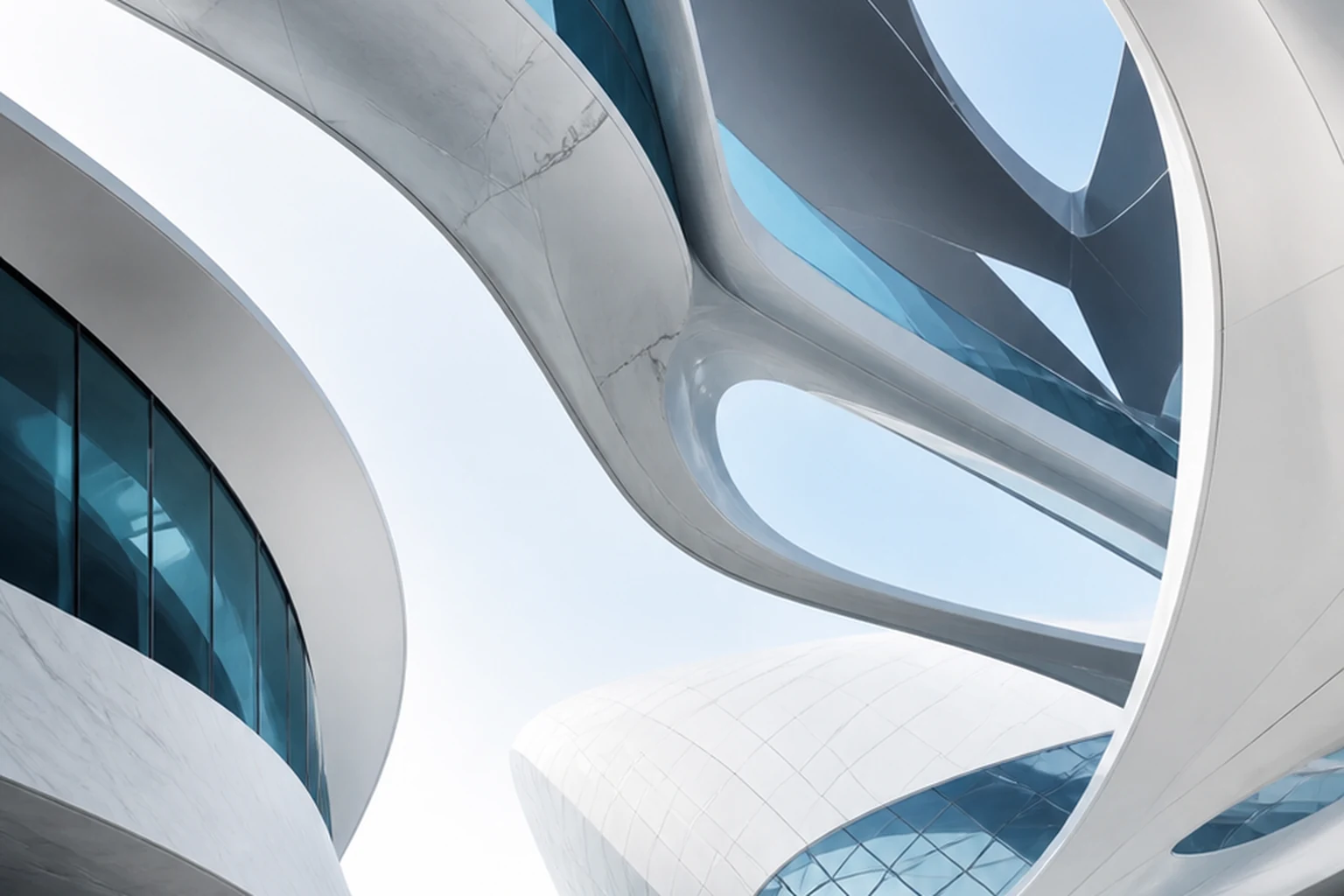
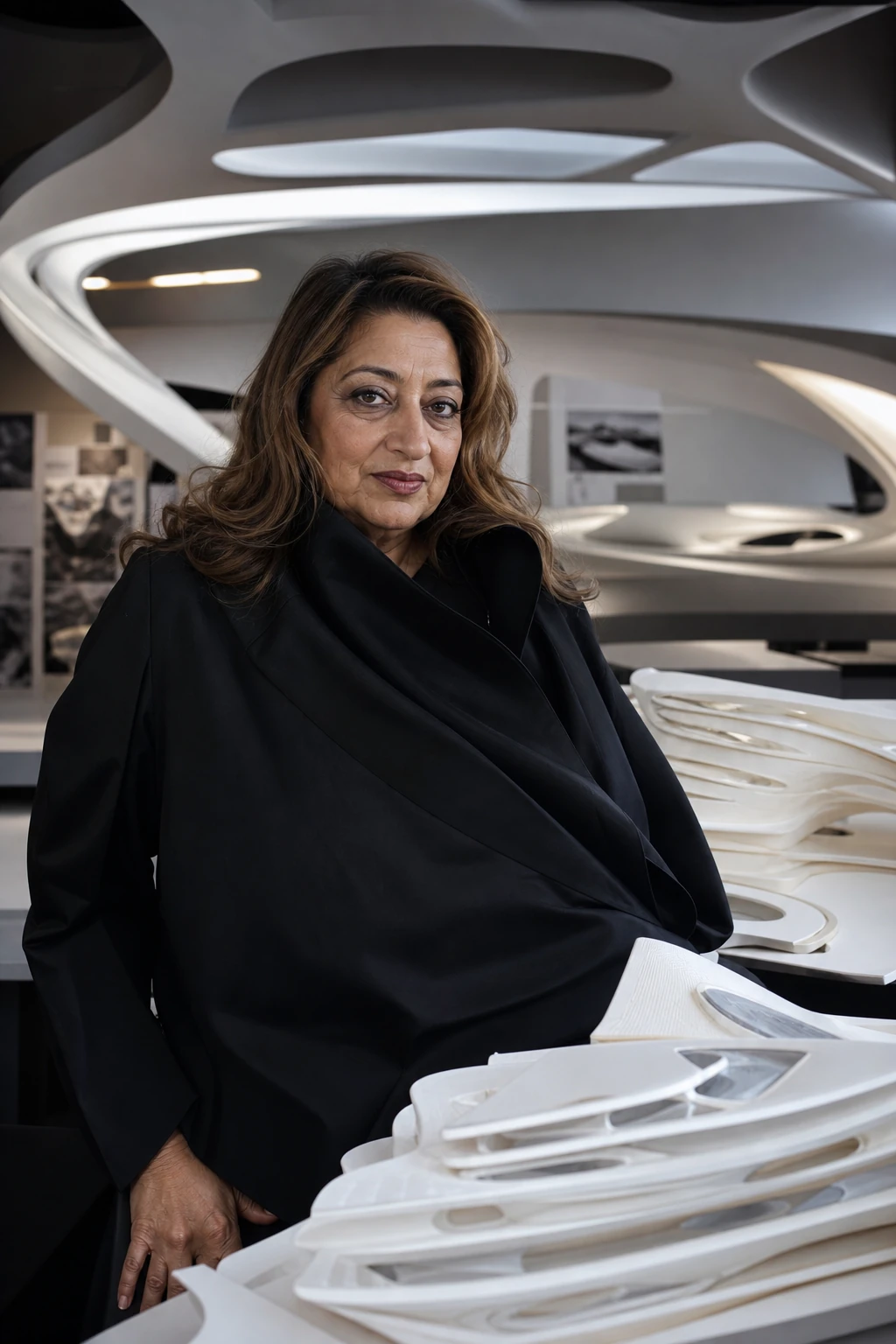
Hadid changed architecture not only through the form of buildings. She changed the very way of representing space: drawing, diagram, digital model and construction became stages of one continuous system of movement.
Editorial thesis
Zaha Hadid's influence rests on turning the avant-garde drawing into a built spatial system. She developed the ideas of Russian Suprematism, deconstructivism, landscape and digital modelling, creating buildings as fields of forces, trajectories and continuous surfaces. Her practice also shows how the authorial brand, engineering and the global institution come together in contemporary architecture.
Reader question
How did an architect whose early projects were considered unbuildable become the first woman to be the sole laureate of the Pritzker Prize and create one of the most recognisable architectural languages of the twenty-first century?
To present Hadid as architect, artist, teacher and head of an international studio. The material separates the early graphic projects, the built architecture, the role of Patrik Schumacher, the engineering infrastructure and the history of the office after the founder's death.
The core subject is Zaha Mohammad Hadid: her biography, method and projects from 1950 to 2016.
Zaha Hadid Architects after 2016 is treated only as a continuation of the institution and requires a separate article.
The term 'parametricism' is connected above all with the theory of Patrik Schumacher and is not used as a universal description of Hadid's whole practice.
Complex geometry is analysed together with construction, programme, movement and urban context.
Criticism of budgets, working conditions and the authorial brand is included as part of the institutional analysis.
Archival images, drawings and photographs require a separate rights review.
Short answer
Zaha Hadid was born on 31 October 1950 in Baghdad. After studying mathematics at the American University of Beirut she entered the Architectural Association in London, where she studied with Rem Koolhaas and Elia Zenghelis. In 1979 Hadid founded her own practice. Her competition projects The Peak and the Cardiff Bay Opera House brought international fame, although they were not realised.
The first key built project was the Vitra Fire Station of 1993. It was followed by the Rosenthal Center for Contemporary Art, the Phaeno Science Center, MAXXI, the Guangzhou Opera House, the London Aquatics Centre and the Heydar Aliyev Center. In 2004 Hadid became the first woman to receive the Pritzker Prize alone. She died on 31 March 2016 in Miami. Her legacy continues in architecture, digital design, education and the activity of Zaha Hadid Architects.
1. Baghdad, the family and early education
Zaha Mohammad Hadid was born on 31 October 1950 in Baghdad into an educated family connected with the public and cultural life of Iraq.
Postwar Baghdad was undergoing modernisation, and Hadid grew up in an environment where new buildings and international ideas coexisted with the historic city.
She later recalled early trips to the Sumerian cities and the marshes of southern Iraq as an important experience of horizontal landscape and water.
2. Mathematics and Beirut
Before architecture Hadid studied mathematics at the American University of Beirut.
The mathematical education does not directly explain her forms, but helped her work with abstraction, systems and spatial relations.
In 1972 she moved to London and entered the Architectural Association.
3. The Architectural Association
At the AA Hadid studied with Rem Koolhaas, Elia Zenghelis and other participants in the radical architectural culture of the 1970s.
The school encouraged speculative projects, drawing and theoretical freedom. Her graduation work Malevich's Tektonik turned to the Russian avant-garde.
For her Suprematism was not a set of quotations but a way of freeing architecture from the stable vertical and the traditional composition.
4. OMA and the founding of her own studio
After graduating from the AA Hadid worked briefly with the Office for Metropolitan Architecture and taught.
In 1979 she founded Zaha Hadid Architects in London. In the early years the studio existed mainly through competitions, exhibitions and research.
The absence of buildings did not mean an absence of practice: the drawings and models formed a new architectural language and a professional network.
5. Drawing as a design instrument
Hadid's early paintings broke the ordinary perspective. A building was depicted as a field of fragments, trajectories and forces.
These works were at once research and persuasion of the client: they showed how space can be perceived in movement.
Later the digital models replaced part of the hand graphics, but the principle of continuous transformation remained.
6. The Peak and architecture without a building
The 1982-1983 competition for The Peak Leisure Club in Hong Kong made Hadid internationally known. The project presented the building as an artificial geological object above the city.
It won the competition but was not built. Such cases created the reputation of a 'paper architect'.
Yet the unbuilt projects had a real influence: they widened the permissible range of architectural imagination.
7. Vitra Fire Station
The Vitra Fire Station in Weil am Rhein was completed in 1993 and became Hadid's first major realised project.
Sloping concrete planes, sharp lines and an elongated route create a feeling of stopped movement.
After the fire station function changed the building became an exhibition space, but kept the status of a key proof that her ideas could be built.
8. Deconstructivism and the limit of the label
Hadid took part in the Deconstructivist Architecture exhibition at MoMA in 1988. This placed her beside Peter Eisenman, Frank Gehry, Rem Koolhaas and others.
The label is useful for describing the break with orthogonal stability, but too narrow for the whole career.
Hadid's late architecture often sought not fragmentation but continuity, fluidity and the integration of systems.
9. Rosenthal Center and the American breakthrough
The Rosenthal Center for Contemporary Art in Cincinnati opened in 2003. It was the first American museum designed by a woman.
The urban carpet — a surface that enters from the street and rises through the building — connects the visitor's movement with the vertical structure of the galleries.
The project confirmed Hadid's transition from an experimental figure to the architect of major cultural institutions.
10. Phaeno Science Center
The Phaeno Science Center in Wolfsburg opened in 2005. A large concrete volume is raised on conical supports.
Beneath the building a public space arises, and inside, routes and platforms form a continuous landscape.
The project shows how a complex form can organise flows, not only create an expressive silhouette.
11. MAXXI and the museum as a field of movement
MAXXI in Rome opened in 2010. Intertwining galleries, stairways and black guide lines create a system of parallel and crossing routes.
The museum has no single main direction. The visitor chooses a trajectory and constantly senses the other spaces.
In 2010 the project received the Stirling Prize; in 2011 the studio won it again for Evelyn Grace Academy.
12. Guangzhou Opera House
The Guangzhou Opera House opened in 2010. The two volumes were described as stones shaped by the erosion of a river landscape.
The complex shell required close integration of architecture, engineering and digital modelling.
The project demonstrated the scale at which Hadid's language could work as an urban symbol.
13. London Aquatics Centre
The London Aquatics Centre was created for the 2012 Olympic Games. A wave-like roof unites the main pools and organises the interior space.
The temporary stands were dismantled after the Games, and the building passed to public operation.
The project shows the difference between an event envelope and long-term infrastructure.
14. Heydar Aliyev Center
The Heydar Aliyev Center in Baku opened in 2012. A continuous white surface connects the square, the walls and the roof.
The building became one of the studio's most recognisable projects and an example of the transition from the object to the topographic shell.
Its analysis must take account of the political context of the client and the use of architecture as an instrument of national image.
15. Parametric design and the digital environment
As the studio grew, digital tools made it possible to coordinate complex surfaces, structure, facades and production.
A parametric model links elements through rules: a change in one parameter affects other parts of the system.
But technology does not create architecture automatically. Decisions about programme, scale, material and the human experience remain design and political decisions.
16. Patrik Schumacher and the collective practice
Patrik Schumacher joined the studio in 1988 and became a key partner in its theoretical and organisational development.
He formulated the theory of parametricism, but it cannot be fully identified with Hadid's personal practice.
Zaha Hadid Architects was a large collective institution in which projects were created by architects, engineers, modellers and consultants.
17. Interiors, furniture and fashion collaborations
Hadid designed furniture, exhibitions, shoes, jewellery objects and temporary pavilions.
The small scale allowed a faster exploration of continuous surfaces, new materials and production.
The collaborations with fashion brands widened the cultural influence, but also strengthened the transformation of the architect's name into a global luxury code.
18. The Pritzker Prize and the institutional breakthrough
In 2004 Zaha Hadid became the first woman to be awarded the Pritzker Architecture Prize alone.
The award recognised not only the built objects but decades of radical design research.
Her success had a symbolic significance for women in the profession, although it did not remove the structural inequality in architecture.
19. Criticism, cost and labour
The studio's projects were criticised for high cost, technical complexity and dependence on large institutional clients.
Working conditions in the global construction industry were also discussed, especially on projects in the Gulf countries.
The architect does not control the whole construction chain, but authorial and corporate responsibility requires transparency and an assessment of social conditions.
20. Death and the legacy of the studio
Zaha Hadid died on 31 March 2016 in Miami of a heart attack after bronchitis.
After her death Zaha Hadid Architects continued to work under the leadership of Patrik Schumacher and the partners.
The continuation of the studio shows the difference between personal authorship and an institution able to develop methods after the founder.
21. Myths and contested formulations
Hadid is often called an architect who 'could not build'. This is false for the mature career and ignores the dozens of realised projects.
Another myth reduces her architecture to free form. Realisation depended on a rigorous geometric, engineering and production discipline.
Finally, the status of the first woman Pritzker laureate must not turn her into a symbol free from professional criticism.
22. Conclusion: space as an active field
Zaha Hadid changed the way architecture is designed and perceived. She showed that a building can be not a static object but an active field of movement.
Her drawings, models and buildings form a single line of development: from fragmentation to continuity, and from hand abstraction to digital coordination.
Hadid's chief legacy is not a recognisable curve but the ability to turn an abstract spatial idea into a real collective project.