artist profile
Andy Warhol
Art, commerce and the manufacture of celebrity
“Warhol turned the mass image into artistic material, and the artist himself into a media system. In his hands the painting, the film, the magazine, the studio, the party, the photograph and the public image all operate as parts of a single production machine.”
Editorial thesis
Andy Warhol’s significance rests on more than moving advertising and consumer goods into the museum. He changed the very model of artistic production, bringing together seriality, mechanical reproduction, collective labour, celebrity, media and business.
Reader question
How did an artist from a working-class Pittsburgh family turn the surface of mass culture into one of the most influential visual languages of the twentieth century — and what price did authorship, intimacy and the people around the Factory pay for it?
The core subject is Andy Warhol: his painting, graphic work, film, photography, publishing and television projects.
The Factory is treated as a collective production environment, not merely as a mythical party.
Work with other people’s images is analysed through authorship, rights, repetition and commercial culture.
The assistants, performers, models and Superstars are not dissolved into the artist’s single authorship.
The trauma of the 1968 shooting is treated without sensationalism.
Museum images and reproductions of the works require a separate rights review.
Short answer
Andy Warhol was born Andrew Warhola in Pittsburgh on 6 August 1928. In 1949 he graduated from the Carnegie Institute of Technology in pictorial design and moved to New York, where he became a successful commercial illustrator.
In the early 1960s Warhol entered the history of Pop art with the Campbell’s Soup Cans, Marilyn, Elvis, Coca-Cola and Death and Disaster series. He then expanded his practice into film, music, publishing, television, photography and the management of his own celebrity. He died in New York on 22 February 1987.
1. Pittsburgh, the family and early visual culture
Andrew Warhola was born in a working-class district of Pittsburgh to Carpatho-Rusyn immigrant parents, Andrej and Julia Warhola. The family preserved the Byzantine Catholic religious tradition.
As a child, illness kept him at home for long stretches. Film magazines, photographs of stars and drawing became an important part of his visual world.
The combination of the religious icon, the Hollywood portrait and mass print later surfaced in his serial images of celebrities.
2. Carnegie Tech and commercial illustration
Between 1945 and 1949 Warhol studied at the Carnegie Institute of Technology, now Carnegie Mellon University, earning a degree in pictorial design.
The course of study joined drawing, design, print graphics and professional communication.
After graduating he moved to New York, where he quickly entered the world of magazines, fashion, window displays and advertising.
3. New York in the 1950s
In the 1950s Warhol worked for magazines, department stores and brands, including fashion and jewellery companies.
His recognisable blotted-line technique produced a drawing that was at once hand-made and reproducible.
Commercial success gave him an understanding of the commission, the print run, packaging and visual positioning — skills that later became part of his artistic strategy.
4. The shift from advertising to Pop art
By the early 1960s Warhol began to use images from newspapers, comics, products and celebrities.
He abandoned the idea of the unique gesture as the sole proof of artistic authenticity.
The mass image became not the theme of the painting but a ready-made module that could be enlarged, repeated and produced in series.
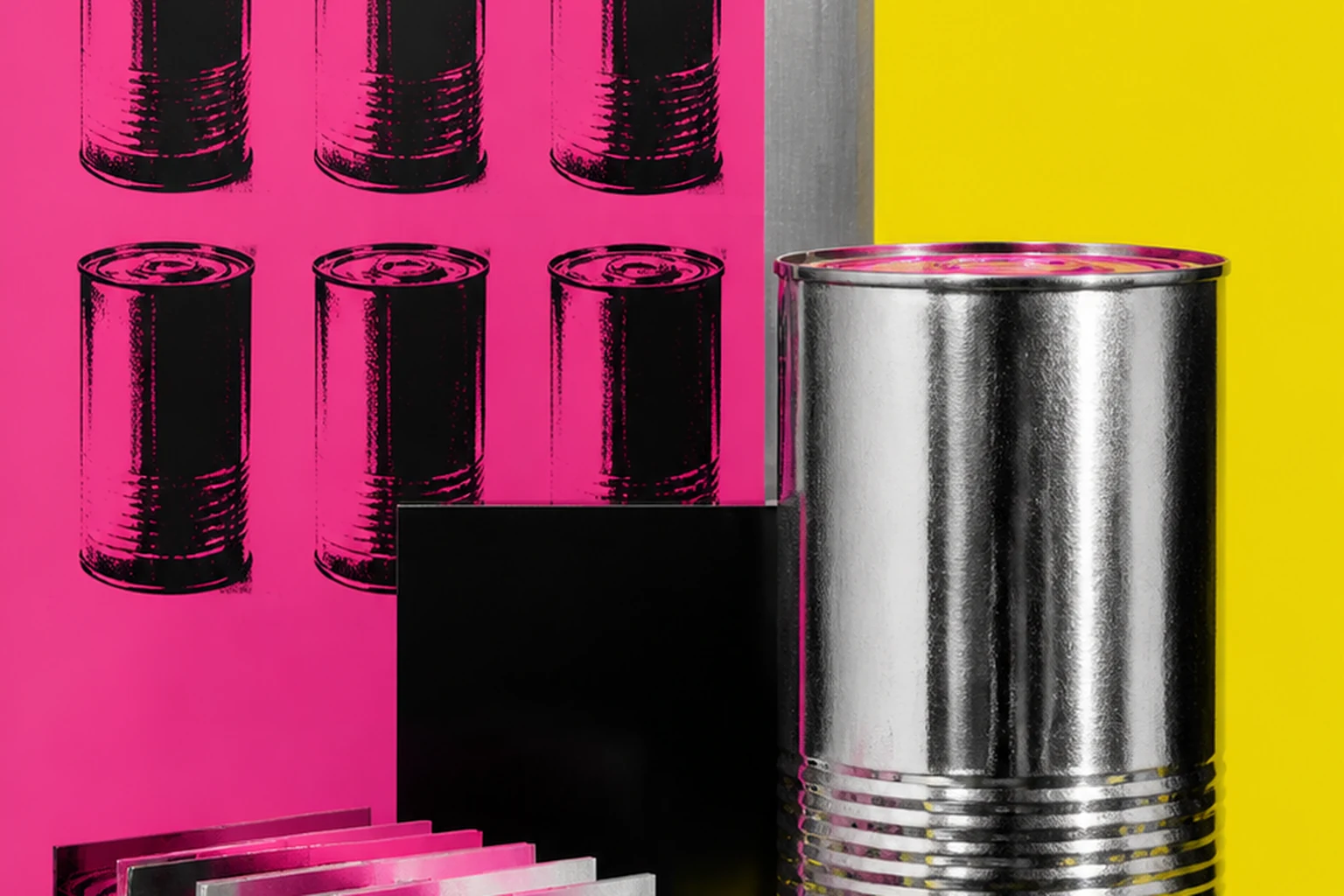
5. Campbell’s Soup Cans
In 1962 Warhol showed at the Ferus Gallery in Los Angeles a series of thirty-two images of Campbell’s Soup cans — one for each variety of the soup then on the market.
An ordinary product was presented as a row of nearly identical images, recalling at once a shop shelf and a museum series.
The work changed attitudes to advertising, packaging and repetition, making everyday consumption an object of artistic analysis.
6. The Marilyn Diptych and the manufacture of an icon
After Marilyn Monroe’s death in 1962 Warhol began to use her promotional photographic portrait as the basis for his silkscreens.
The Marilyn Diptych joins bright coloured repeats with black-and-white prints that gradually fade away.
The celebrity becomes at once a commodity, a religious icon, a media ghost and an image of death.
7. Death and Disaster
In the Death and Disaster series Warhol turned to newspaper images of accidents, suicides, the electric chair and racial conflict.
Repetition dulls the shock, yet at the same time shows how mass print turns trauma into a consumable picture.
The series dismantles the idea of Pop art as exclusively bright and carefree.
8. Silkscreen, repetition and error
Photographic silkscreen made it possible to transfer a found image onto canvas many times.
Misregistrations, gaps in the paint and uneven printing were not always corrected: they became part of the work.
The process combined mechanical reproduction with physical chance, making each repeat similar but not identical.
9. Brillo Boxes and the boundary of art
In 1964 Warhol exhibited wooden boxes that reproduced the packaging of Brillo and other consumer products.
The objects looked almost like warehouse containers, although they had been produced for the gallery.
The work raised the question of what separates an artistic object from industrial packaging: material, context, authorship or an institutional decision.
10. The Factory as a production system
The Factory was at once a studio, a film set, an office, a social scene and a place where images were produced.
Here paintings, films, photographs, music, publications and events were made with the participation of assistants, visitors and performers.
The name stressed the industrial model of art, but the real work depended on a complex network of people who were often insufficiently credited in traditional attribution.
11. Superstars, labour and vulnerability
The Factory created its own system of celebrities — the Superstars — whose appearance and behaviour became the content of the films and of the public myth.
Edie Sedgwick, Candy Darling, Jackie Curtis, Holly Woodlawn, Viva and many others gained a visibility rarely available outside that milieu.
At the same time the boundaries between participation, exploitation, friendship and labour remained unclear, and the consequences for individuals could be severe.
12. Screen Tests
Between 1964 and 1966 Warhol shot roughly five hundred short screen portraits.
The sitter was asked to remain almost motionless before a fixed 16-millimetre camera; when screened, the film was slowed down.
The standardised procedure turned minimal gestures, blinking and facial tension into dramatic events.
13. Sleep, Empire and duration
The early films Sleep and Empire radically stretch screen time while reducing the number of events.
The camera records a sleeping man or a motionless skyscraper, forcing the viewer to become aware of his or her own attention.
Duration becomes not a technical parameter but the film’s principal material.
14. Chelsea Girls and the expanded cinematic image
The Chelsea Girls of 1966 consists of separate long episodes shown in pairs on two screens.
Scenes with the Factory participants form not a linear plot but a variable system of juxtapositions, sound and chance.
The film combined experimental cinema, portraiture, performance and the documentation of an urban subculture.
15. The Velvet Underground and the Exploding Plastic Inevitable
In the mid-1960s Warhol became manager and producer of The Velvet Underground, linking the band to the multimedia performances of the Exploding Plastic Inevitable.
Film projections, strobe light, dance and loud music created an environment in which art could not be divided into separate disciplines.
For the debut album The Velvet Underground & Nico Warhol designed the famous banana cover and supported the band’s creative autonomy.
16. Most Wanted Men and censorship
For the New York State Pavilion at the 1964 World’s Fair Warhol created the facade work Thirteen Most Wanted Men.
The portraits of wanted men were judged too contentious for the fair’s optimistic image and were soon painted over.
The project revealed the limits of permissible imagery when mass visual culture meets official state representation.
17. The 1968 shooting
On 3 June 1968 Valerie Solanas shot Warhol in his studio on Union Square. He underwent a long operation and an extended recovery.
After the shooting his body, his working routine and his attitude to an open studio environment all changed.
The trauma intensified the themes already present in his art: the body’s surface, vulnerability, medical technology and death.
18. Interview Magazine
In 1969 Warhol launched Interview as a monthly film magazine.
Over time the publication became a chronicle of art, fashion, music, society, celebrity and night life.
A recorded conversation between two celebrities turned the interview into part of a network of mutual promotion and media production.
19. Commissioned portraiture and Business Art
In the 1970s and 1980s Warhol developed a lucrative system of commissioned portraits of politicians, collectors, actors and business figures.
A Polaroid snapshot became the source material for a silkscreen, and an individual likeness was fed into a standardised production scheme.
The notion of Business Art describes not art retreating into commerce but the business operation itself being turned into an artistic medium.
20. Polaroid, photography and television
Warhol constantly photographed people, parties, trips and his own daily life on Polaroids and compact cameras.
In his later period he produced television programmes including Fashion, Andy Warhol’s T.V. and Andy Warhol’s Fifteen Minutes.
Television continued his interest in conversation, celebrity, fashion and the repeatable public persona.
21. Time Capsules
From 1974 Warhol began packing correspondence, photographs, newspapers, invitations, bills and random objects into boxes that were then sent into storage.
The museum’s archive holds 569 standard Time Capsules boxes, along with additional containers.
A domestic way of clearing the desk became his largest serial work and a material archive of a cultural network.
22. Basquiat, Haring and the late collaborations
In the 1980s Warhol worked with younger artists, including Jean-Michel Basquiat and Keith Haring.
The collaborative paintings of Warhol and Basquiat joined logos, silkscreen signs, drawing and painterly gesture.
The collaborations provoked arguments about power, the market and mutual influence, but they also dismantled the myth of the late Warhol as a wholly isolated brand.
23. Religion and The Last Supper
Warhol’s religious life long remained less visible than his public persona of a secular observer.
In his late works he repeatedly turned to the cross, the Last Supper and images of Catholic culture.
The Last Supper series, shown in Milan in early 1987, joins Leonardo, advertising, repetition and personal religious memory.
24. Authorship, assistants and production
Warhol deliberately blurred the boundary between individual authorship and collective production.
Gerard Malanga, Billy Name, Brigid Berlin, Paul Morrissey, Vincent Fremont, Ronnie Cutrone and many others took part in producing images, films, events and the business infrastructure.
The history of the Factory demands precise attribution of roles rather than the automatic assignment of all the work to the central celebrity.
25. Critique: surface, consumption and ethics
Warhol was criticised for superficiality, cynicism, market-mindedness and for turning people into material for his own brand.
On the other hand, it was precisely the refusal of explanatory depth that allowed him to reveal the power of packaging, media and the repeatable image.
Any ethical assessment must weigh not only formal innovation but also the relations of labour, consent, vulnerability and commercial gain.
26. The Foundation, the museum and the posthumous legacy
After Warhol’s death in 1987, The Andy Warhol Foundation for the Visual Arts was established in accordance with his will to support the visual arts.
The Andy Warhol Museum opened in Pittsburgh in 1994 and holds the largest collection of the artist’s works and archival materials.
The Foundation continues its grant-making, licensing and support of the scholarly catalogue raisonné, turning the posthumous brand into a resource for new artists.
27. Conclusion
Andy Warhol changed not only the range of permissible artistic images but the very organisation of artistic labour.
He showed that the commodity, the portrait, the magazine, the film, the studio and the business could function as interconnected media.
Warhol’s chief legacy is an understanding of culture as a factory of images in which the viewer is at once consumer, participant and product.