artist profile
Keith Haring
The line, public space and the art of social accessibility
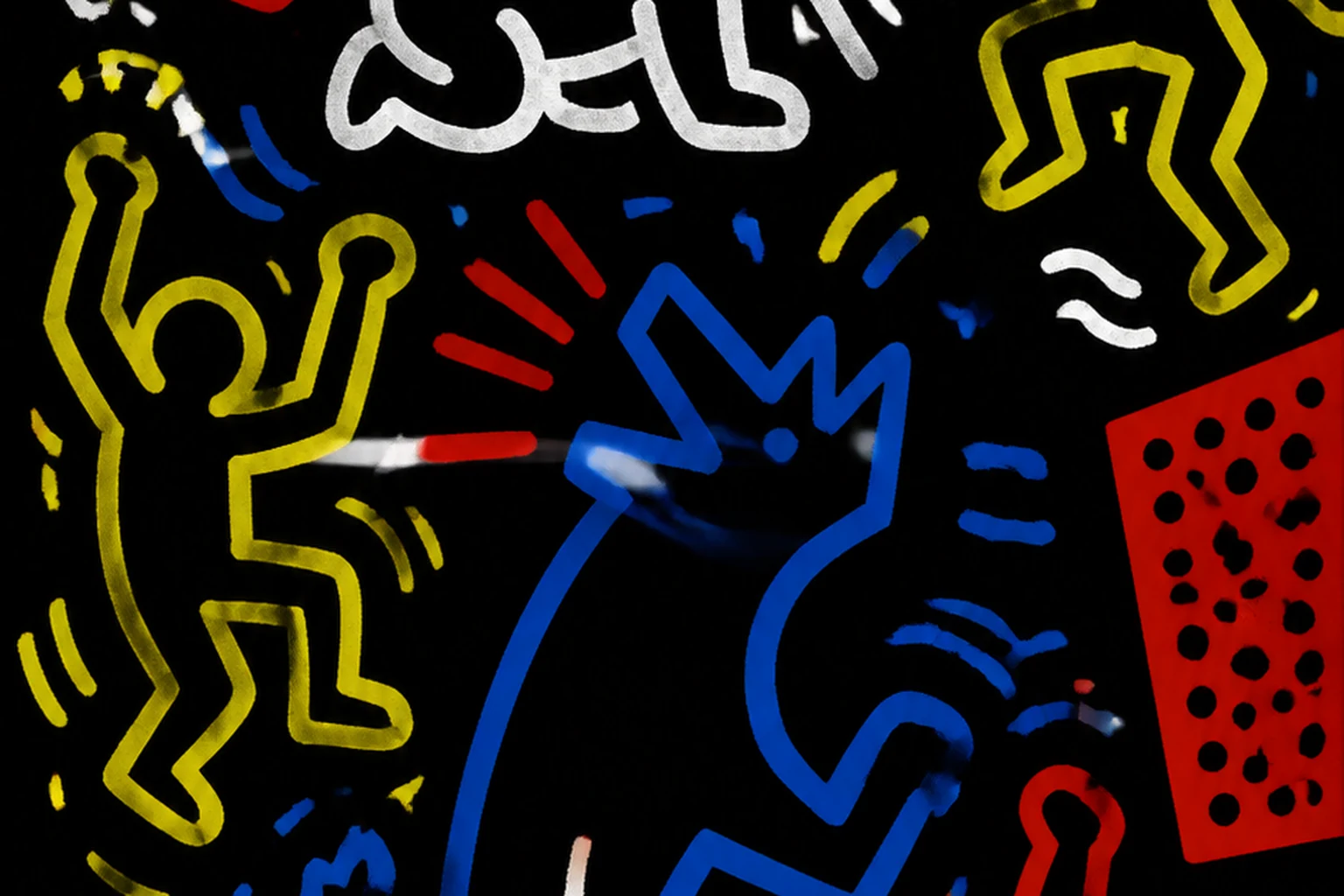
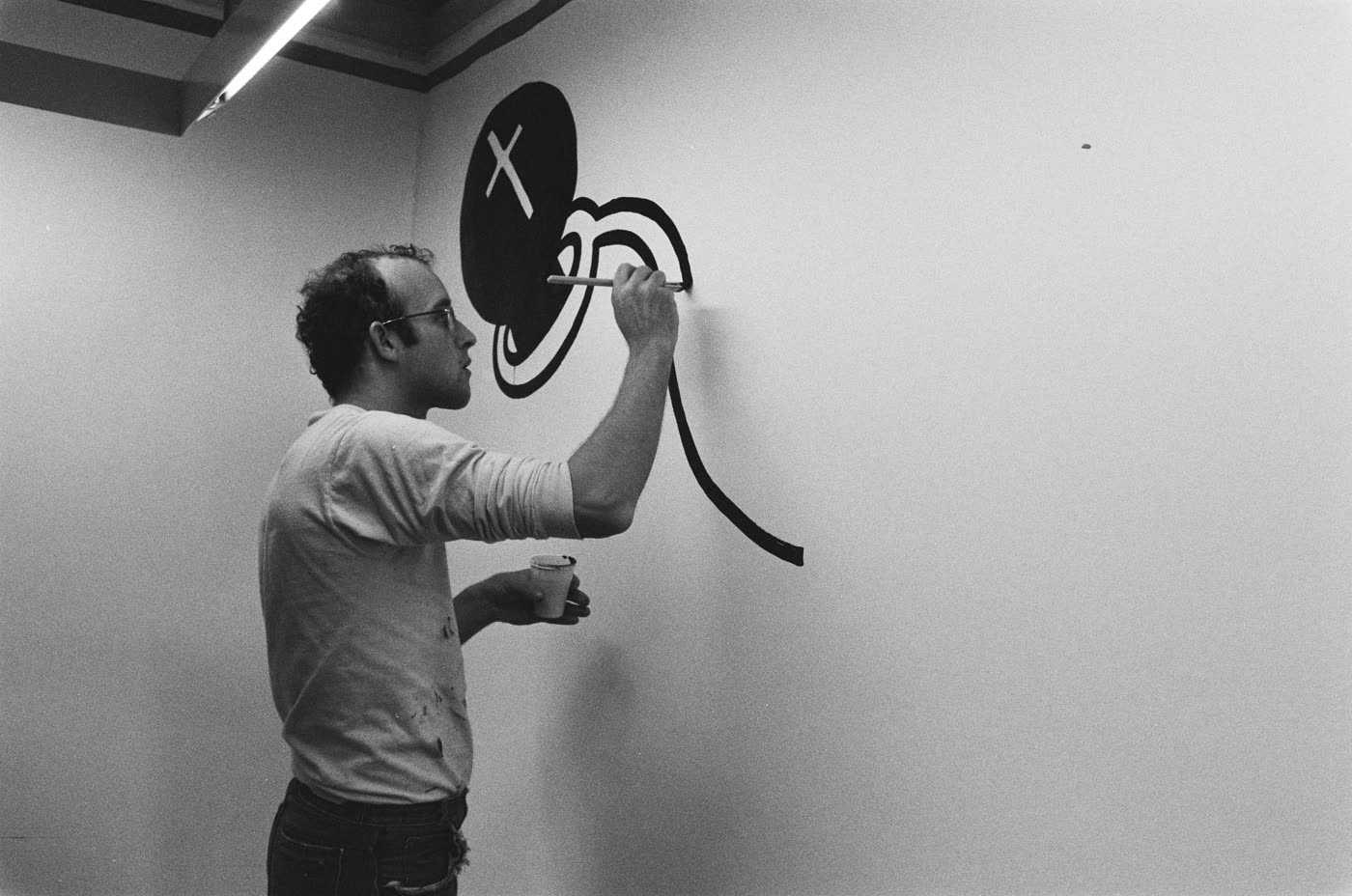
Haring created a visual language that existed with equal confidence in a subway car, a museum, a nightclub, a hospital, a schoolyard and on a T-shirt. His simple line was not a rejection of complexity but a way of making complex themes publicly visible.
Editorial thesis
Keith Haring's significance rests on joining drawing, public space, mass reproduction, queer culture and political action. His language was extremely accessible, yet it addressed power, violence, racism, the nuclear threat, apartheid, drug addiction and the HIV/AIDS epidemic.
Reader question
How could a few repeating figures — the radiant baby, the barking dog, dancing bodies and the black line — become at once a public instrument, an international brand and one of the most recognisable languages of twentieth-century art?
The core subject is Keith Haring: his drawings, painting, print graphics, murals, design, activism and public strategy.
The subway is treated as an illegal and conflicted urban platform, not as a neutral gallery.
Haring is separated from the simplified category of graffiti: his practice intersected with the writers, but had a different system of signs and an institutional trajectory.
Queer identity and HIV/AIDS are examined in political and historical context, without romanticising the illness.
The Pop Shop is analysed as a project of accessibility and as a commercial system.
The collaborative projects require naming the photographers, musicians, dancers, printers, children and community organisations.
The works and images are protected by the rights of the Keith Haring Foundation; museum photography may have separate rights.
Short answer
Keith Haring was born on 4 May 1958 in Reading, Pennsylvania, and grew up in Kutztown. He studied commercial art in Pittsburgh, then moved to New York and entered the School of Visual Arts.
Between 1980 and 1985 Haring created hundreds of drawings in white chalk on the black advertising panels of the subway. He took part in Club 57, exhibited with Tony Shafrazi, carried out international public projects and in 1986 opened the Pop Shop. After an AIDS diagnosis in 1988 the artist intensified his activist work and in 1989 established the Keith Haring Foundation.
1. Pennsylvania, the cartoonist father and early drawing
Keith Haring was born on 4 May 1958 in Reading, Pennsylvania, and grew up in Kutztown. He was the eldest of four children.
His father Allen Haring drew cartoons and, together with his son, invented characters and stories.
Comics, animation, Dr. Seuss and mass graphics formed Haring's respect for the clear line and direct communication.
2. Ivy School and the rejection of a commercial career
After school Haring entered the Ivy School of Professional Art in Pittsburgh, oriented towards advertising graphics.
After two semesters he left his studies, understanding that he did not want to limit his work to commercial illustration.
The rejection of one professional system did not mean a rejection of mass culture: he later deliberately used its methods and channels.
3. Pittsburgh and self-directed education
In Pittsburgh Haring continued to draw, studied contemporary art and visited museums.
Especially important were Pierre Alechinsky, Jean Dubuffet, William Burroughs, Brion Gysin, Christo and Andy Warhol.
In 1978 his early solo exhibition took place at the Pittsburgh Arts and Crafts Center.
4. The School of Visual Arts and the move to New York
In 1978 Haring moved to New York and entered the School of Visual Arts.
He experimented with video, performance, installation, collage and large-scale drawing.
The city gave him an environment in which artistic practice could develop outside the museum — in the club, on the street, in the subway and in temporary exhibition spaces.
5. Club 57 and the alternative infrastructure
Club 57, in the basement of a Polish church on St. Mark's Place, was a venue for exhibitions, music, film, performance and themed parties.
Haring organised events and worked alongside Kenny Scharf, Ann Magnuson, John Sex and other members of the East Village.
The club operated not as an adjunct to the gallery but as an independent system for producing culture and audience.
6. Friendship, competition and the downtown scene
Haring associated with Jean-Michel Basquiat, Kenny Scharf, Futura 2000, Fab 5 Freddy and other authors.
Their practices intersected but were not the same: the writers worked with the name, letter style and territory, whereas Haring built a repeatable system of figures.
The history of the scene must preserve the differences between the artists and not turn them into a single decorative image of the 1980s.
7. Subway drawings
In 1980 Haring noticed that unused advertising panels in the subway were covered with matte black paper.
He began drawing on them in white chalk, using rapidly repeatable figures and clear outlines.
Until 1985 the artist created hundreds of such works, sometimes making dozens of drawings in a single day.
8. The black panel, white chalk and speed
The matte paper and school chalk created high contrast and allowed work without preparation.
The drawing had to be finished before the police, the subway workers or the next train appeared.
Speed became not an aesthetic of chance but a discipline in which the figure was built in a continuous line without a preliminary sketch.
9. Arrests, the right to the city and the audience
The drawings were illegal, and Haring was repeatedly detained for damaging or using advertising property.
The artist understood the subway as a laboratory and a direct link with the people who could observe the process.
Yet the publicity of the work did not cancel the conflict: the urban surface belonged to the transport system and the advertising market, and the artist's access was secured by breaking those rules.
10. The radiant baby
A crawling baby surrounded by rays became one of Haring's principal motifs.
The figure joins birth, energy, innocence, the future and an almost religious sign of light.
Its force is connected with the absence of an individual face: the image is easily recognised, but remains open to different contexts.
11. The barking dog and the system of pictograms
A barking or dancing dog can denote strength, authority, warning, aggression or play.
Ray lines, crosses, screens, pyramids, snakes and human figures create a mobile vocabulary.
This is not a strict alphabet with a single decoding but a system of signs whose meaning changes through adjacency and action.
12. Body, movement and repetition
Haring's figures almost always act: they dance, fall, carry, join, are born or are subjected to pressure.
The lines of movement turn a flat silhouette into a rhythmic event.
Repetition makes the image collective and impersonal, but also allows the depiction of a crowd, contagion, power and mechanical submission.
13. The exhibition with Tony Shafrazi
In 1982 Haring held a notable solo exhibition at the Tony Shafrazi Gallery in SoHo.
The gallery confirmed the transition from temporary and street works to large canvases, vinyl, objects and the collecting market.
Institutional success widened the artist's resources, but created a contradiction between the free public drawing and the expensive unique work.
14. Documenta, the Whitney Biennial and international recognition
In 1982 Haring took part in documenta 7 in Kassel, and then in the São Paulo Biennial and the Whitney Biennial.
In a few years his language became recognisable far beyond New York.
The international projects included museum exhibitions, public murals, posters, scenography and commercial commissions.
15. Times Square, animation and the screen
Haring created animated images for the public Spectacolor screen on Times Square.
Simple figures transferred well into a sequence of frames and a large urban scale.
The screen extended the idea of the subway: art competed with advertising, using its very speed and visibility.
16. Untitled 1982 and the scale of the public line
The large work Untitled 1982 from the MoMA collection is more than seventeen metres long.
The black line forms a continuous scene of bodies, animals, screens and signs.
The scale recalls a temporary mural and shows that the subway language could work as a museum panorama without losing its rhythm.
17. Grace Jones and the body as a moving image
Haring painted the body of Grace Jones for performances and shoots, including projects connected with Robert Mapplethorpe and Jean-Paul Goude.
The drawing changed along with movement, light, costume and the camera.
Such projects require a complex attribution: the artist, the performer, the photographer, the art director and the stage team create a single image.
18. Madonna, clubs and musical culture
Haring collaborated with musicians and took part in club culture, where music, dance, fashion and image were inseparable.
He created sets, invitations, clothing and images for events connected with Madonna, Bill T. Jones and other performers.
The club space allowed the work to exist as a social environment, not only as an object.
19. Tseng Kwong Chi and photographic co-authorship
The photographer Tseng Kwong Chi documented Haring in the subway, the studio, public projects and travels.
His images formed a significant part of the visual memory of the artist.
Photography is not neutral evidence: the composition, moment, edition and rights belong to the photographer and his archive.
20. Anti-Nuclear and End Apartheid
Haring created posters and buttons for the anti-nuclear movement and the fight against apartheid.
Reproduction allowed the image to be spread at demonstrations and outside artistic institutions.
For him a political poster does not illustrate a complex programme but creates an instant sign of a collective position.
21. Crack is Wack
The mural Crack is Wack appeared in 1986 on the wall of a handball court by the Harlem River Drive.
It was a reaction to the destructive spread of crack and to the personal experience of a close person's addiction.
A work initially created without permission became an urban landmark; its history includes punishment, official recognition and restorations.
22. Michael Stewart and police violence
In 1983 Michael Stewart died after being detained by the New York Transit Police.
Haring took part in the protests and created images connected with his death and systemic violence.
This context shows that the subway was not only a place of public art but a space of control, racial profiling and risk.
23. Children's workshops and collective murals
Haring held workshops with children in schools and museums and created joint public works.
In 1986 a project for the centenary of the Statue of Liberty involved the participation of about nine hundred children.
Collectivity was not a decorative addition: teaching and a child's right to leave a public trace were part of the artist's social programme.
24. The Berlin Wall and the political border
In 1986 Haring created a long mural on the western side of the Berlin Wall.
Joined yellow figures on a red-and-black ground offered an image of human continuity across a political division.
The mural existed within the complex situation of the Cold War and could not cancel the material violence of the border itself.
25. Pop Shop
In April 1986 Haring opened the Pop Shop in SoHo, where inexpensive T-shirts, posters, badges, toys and other objects were sold.
The shop's interior was covered with black-and-white painting and acted as a coherent artistic environment.
Haring understood the shop as an extension of art and a way of giving the audience access to the images without buying an expensive painting.
26. Accessibility, commodity and the criticism of commerce
The Pop Shop drew criticism as a sign of commercialisation and of blurring the boundary between art and merchandising.
For Haring the mass object was part of a democratic strategy, close to his free drawings and editioned posters.
The contradiction remains productive: a low price widens access, but the commodity system turns the sign into a brand and a source of licensed income.
27. Swatch, Absolut and branded collaborations
Haring created watches for Swatch, images for Absolut and other commercial projects.
His graphic language was compatible with packaging and advertising thanks to a strong outline and instant recognisability.
Critical assessment must distinguish the authorial use of a commercial channel from the later uncontrolled transformation of the art into a decorative logo.
28. HIV/AIDS and the diagnosis
Haring learned of his AIDS diagnosis in 1988, at a time when the epidemic was accompanied by mass death, stigma and political inaction.
He spoke openly about the illness and used his fame for public information and fundraising.
The diagnosis intensified the pace of his work, but must not be used as a single key to every late work.
29. Silence=Death and Ignorance=Fear
Haring created images connected with ACT UP activism and the collective sign Silence=Death.
The 1989 poster Ignorance=Fear, Silence=Death joins figures covering their eyes, ears and mouth with a slogan against silence and ignorance.
The work turns an easily read pictogram into a political demand for information, medical care and public responsibility.
30. The Barcelona AIDS mural
In 1989 Haring created in Barcelona the mural Todos juntos podemos parar el sida.
The composition shows threat, resistance and collective action through a sequence of black figures on a red ground.
The original work was temporary; the city later reproduced it in another place, which requires distinguishing the authorial mural from an official reconstruction.
31. The Life of Christ and late religious imagery
The Life of Christ is a bronze altarpiece triptych, completed shortly before Haring's death.
A dense cluster of figures joins birth, suffering, death, angels and collective salvation.
The work exists in an edition and shows that a religious form could be connected with mourning for those lost to AIDS without recourse to conservative morality.
32. Keith Haring Foundation
In 1989 Haring established the Keith Haring Foundation.
The foundation supports non-profit organisations working with children, and with education, prevention and care in the field of HIV/AIDS.
It preserves the collection and archive, funds exhibitions and research, and manages the protection of the artistic legacy.
33. Rights, licensing and mass reproduction
The wide circulation of Haring's images is part of their historical force and at the same time a source of legal conflicts.
The foundation treats licensing as a way of protecting context and continuing the charitable mission.
For publication one must separately verify the rights to the work, the photograph, the public mural, the branded product and the reconstruction.
34. Authorship, assistants and public labour
The large murals and sculptures required the preparation of surfaces, materials, lifts, security, documentation and later conservation.
The joint projects with children, dancers and musicians have a distributed authorship of execution, even if the visual system belongs to Haring.
The history of a work must show the organisations and people who ensured its creation, access and preservation.
35. Criticism: universal language and cultural difference
Haring sought images comprehensible without special education.
Yet the notion of a universal language can hide differences of experience, the cultural meanings of a gesture and unequal access to public space.
The force of his art grows when simplicity is seen not as an absence of context but as an invitation to a specific public conversation.
36. Death without romanticisation
Keith Haring died on 16 February 1990 in New York of complications related to AIDS. He was thirty-one years old.
The short life and high productivity contributed to the myth of an artist who worked against time.
The epidemic was not a romantic fate but a crisis of health care and political responsibility, affecting queer communities and many other groups.
37. Legacy and contemporary institutional work
The Keith Haring Foundation continues to support organisations in the fields of childhood, education and HIV/AIDS.
The foundation preserves the works and archives, takes part in exhibitions, publications, research and the licensing of images.
Haring's contemporary legacy requires holding together accessibility, activism, queer history and the danger of turning a critical language into a contextless brand.
38. Conclusion
Keith Haring proved that a clear line can work at once as a drawing, a public sign, a political poster and a mass product.
He widened the audience of art without abandoning the themes of violence, sexuality, illness and power.
Haring's chief legacy is not a set of easily copied figures but a model of art that seeks the person where he lives, moves, learns, receives treatment and resists.