artist profile
David Hockney
Vision, colour and the expansion of the picture
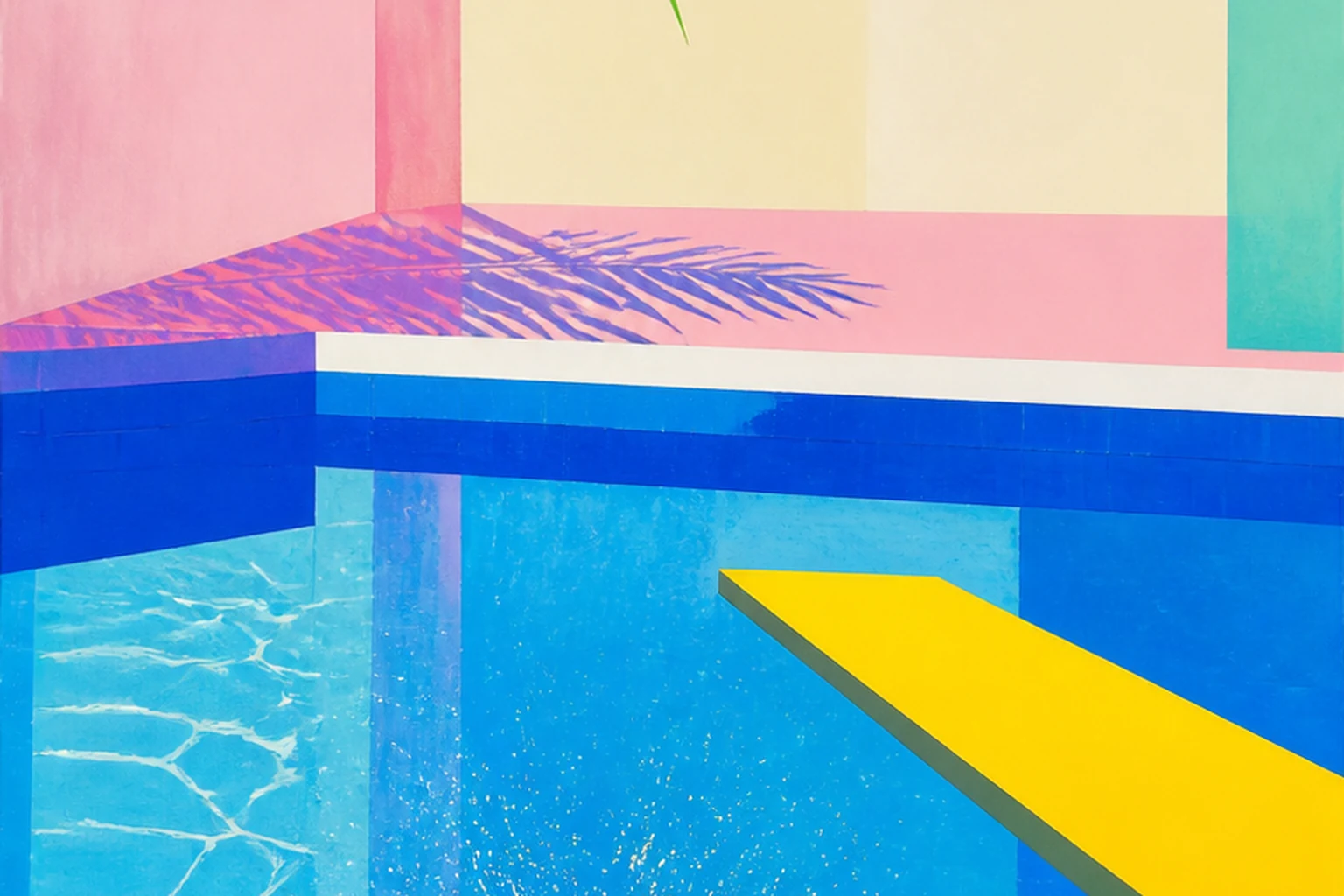
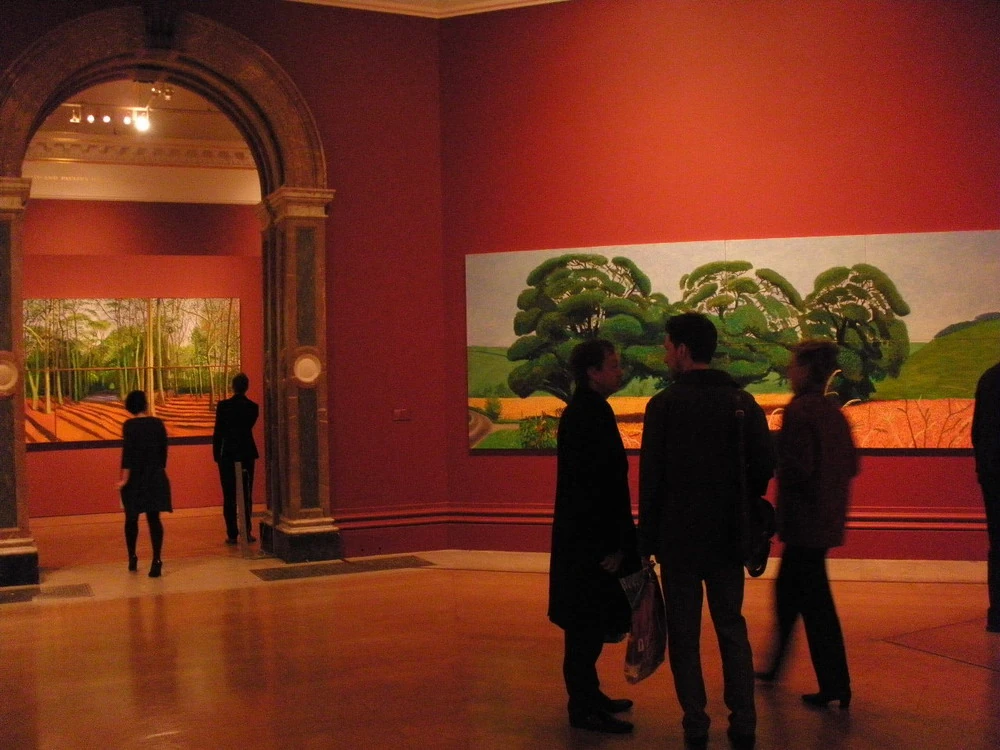
Hockney treated the image not as a fixed window but as a way of gathering time, movement and attention. From the Los Angeles pools to photo-collages, scenography, multi-camera video and drawings on the iPad, he constantly tested how a person actually sees.
Editorial thesis
David Hockney's significance rests on a continuous study of the image. He joined figurative painting, the open representation of queer life, photographic montage, theatrical space, digital drawing and the history of perspective, without setting tradition against technology.
Reader question
How did an artist who became famous for bright pools and portraits turn a seventy-year practice into a sustained study of how vision connects space, time, memory and movement?
The core subject is David Hockney: his painting, drawing, printmaking, photography, scenography, video and digital works.
British Pop art is treated as an early context, not as an exhaustive definition of the whole practice.
Queer subject matter is analysed as an open part of the works and the biography, without reducing the art to the author's identity.
The photo-collages and digital works are examined together with the technical labour of printers, photographers, programmers and the studio team.
The hypothesis that the Old Masters used optical devices is presented as debatable, not as an accepted historical truth.
The artist died on 11 June 2026; the current part concerns the exhibitions, archives and the work of the David Hockney Foundation after his death.
Short answer
David Hockney was born on 9 July 1937 in Bradford. He studied at the Bradford College of Art and the Royal College of Art, became a notable figure of British art in the early 1960s and openly included themes of male desire and queer life in his work.
After moving to Los Angeles Hockney created the pools, interiors and double portraits that became central images of postwar painting. Later he worked with Polaroid, photo-collage, the fax, the photocopier, scenography, video, the iPhone and the iPad. The artist died in London on 11 June 2026 at the age of 88.
1. Bradford and the family environment
David Hockney was born on 9 July 1937 in Bradford, an industrial town in West Yorkshire. He was the fourth of five children.
His father Kenneth Hockney worked as a bookkeeper, drew and held independent pacifist views. His mother Laura raised the children in the Methodist tradition.
The North-English urban landscape, family portraits and the habit of observing everyday life attentively persisted in Hockney's art even after international fame.
2. Bradford College of Art
Between 1953 and 1957 Hockney studied at the Bradford College of Art.
The academic programme demanded constant drawing from life, the study of perspective, composition and the history of art.
This technical foundation allowed him later to change styles freely while keeping drawing as the essential way of thinking.
3. The Royal College of Art and British Pop art
In 1959 Hockney entered the Royal College of Art in London, where he studied alongside R. B. Kitaj, Allen Jones, Derek Boshier and other artists.
His early works joined painting, lettering, newspaper graphics, humour and autobiographical signs.
The 1961 Young Contemporaries exhibition linked him with British Pop art, although he quickly moved beyond that definition.
4. Queer imagery before decriminalisation
In the early 1960s male homosexual relations in England and Wales remained a criminal offence.
Hockney used names, numbers, fragments of Walt Whitman's poems and images of the male body, creating works about same-sex desire.
The openness of these works was an artistic and social gesture, but they also used the coding necessary under legal threat.
5. A Rake's Progress
The etching series A Rake's Progress was created after Hockney's trip to New York and published in 1963.
The title refers to William Hogarth's cycle, but instead of the hero's moral fall the series shows a young British artist's journey through advertising, money, sexuality and American culture.
The printed sequence allowed Hockney to join text, autobiography and visual narrative.
6. The first trips to Los Angeles
In 1964 Hockney first came to Los Angeles for a long stay, a city he had previously imagined through cinema, magazines and photographs.
Sunlight, modernist houses, cars, an open gay culture and the availability of pools differed radically from postwar Britain.
California became for him not just a place but a visual system of clear shadows, flat surfaces and everyday theatricality.
7. The pool as surface and sign
Water presented a complex pictorial problem: it is transparent, reflects light, moves and has no stable form.
Hockney used lines, curls, white strokes and fields of colour, each time inventing a new conventional sign for water.
The pool at once denoted climate, wealth, private architecture, the male body and the distance of the observer.
8. A Bigger Splash
A Bigger Splash was painted in acrylic in 1967, when Hockney was teaching at the University of California, Berkeley.
A geometric house, an empty chair and a diving board are arranged almost motionless, while a white splash records an event that has already ended.
The artist slowly painted an instantaneous movement, showing the difference between the experience of time and its stopped image.
9. The house, architecture and the absent body
The Californian houses in Hockney's work look flat, clear and almost scenographic.
A glass wall promises transparency, but often hides a personal drama or leaves the interior without a person.
Architecture becomes a portrait of a way of life, in which presence can be shown through a trace, a reflection, furniture or a splash of water.
10. Double portraits
From the late 1960s Hockney created large double portraits of friends, collectors and people close to him.
The figures are shown in real interiors, but carefully separated by furniture, windows, plants and lines of perspective.
The relation between the people is expressed not by a gesture of intimacy but by distance, posture, the direction of the gaze and the organisation of the room.
11. Mr and Mrs Clark and Percy
Mr and Mrs Clark and Percy was created in 1970-1971 and depicts the designer Ossie Clark and the textile artist Celia Birtwell.
An open window, a white lily, a cat and separate postures form a tense psychological portrait of the couple.
The title fixes the cat as Percy, although the pet depicted was, according to museum documentation, a different cat of the family; this detail shows the role of the title in creating an enduring story.
12. Portrait of an Artist (Pool with Two Figures)
The 1972 painting joins a swimmer under water and a clothed man standing at the edge of the pool.
The work was created through a complex process of drawings, photographs and re-staging after the destruction of the first version.
In popular interpretation the work is linked to the end of Hockney's relationship with Peter Schlesinger, but the painting cannot be reduced to a single biographical account.
13. Drawing and the portrait of a close circle
Hockney constantly drew friends, relatives, artists, writers and partners.
The line made it possible to record quickly a face, posture and psychological distance without heavy symbolism.
The long series of portraits turn the artist's personal circle into a visual diary of ageing, friendship, desire and loss.
14. C. P. Cavafy and printmaking
In 1966 Hockney made etchings for the poems of Constantine Cavafy, published as a book in 1967.
Contemporary male figures and London interiors translate the poet's historical Alexandria into a living queer experience of the twentieth century.
Print workshops and publishers were important technical collaborators, enabling complex work with line, etching and edition.
15. Paper Pools and the material surface
In the summer of 1978 Hockney worked in Kenneth Tyler's workshop on the Paper Pools series.
Liquid dyed paper pulp was applied into moulds and pressed, so the colour became part of the material rather than a surface layer.
The series returned the pool theme to a new medium and required close interaction with an experienced team of paper production.
16. Photography and the rejection of a single viewpoint
Hockney photographed actively, but criticised the ordinary camera for its attachment to a single point and a single short moment.
He sought to bring the image closer to how a person examines space sequentially, moving attention from detail to detail.
The photographic experiment became a continuation of his interest in Cubism, the Chinese scroll and the movement of the viewer.
17. Composite Polaroids and joiners
From the early 1980s Hockney assembled images from many Polaroids or separate colour photographs.
Small differences in time, scale and camera position create a space that cannot be seen in a single instantaneous glance.
The term joiner became attached to these works, although the method itself includes not only the joining of frames but the montage of duration.
18. Pearblossom Hwy
Pearblossom Hwy., 11-18th April 1986 was created from hundreds of photographs of a road intersection in California.
Road signs, litter, asphalt and the horizon are shown from different distances and angles, so the viewer seems to move inside the image.
The work sets against the camera's mechanical perspective a bodily, accumulative and selective vision.
19. The Chinese scroll and moving vision
Hockney studied Chinese and Japanese scrolls, in which space unfolds gradually as it is unrolled.
The film A Day on the Grand Canal with the Emperor of China, made with Philip Haas, explained his interest in the variable point of view.
For Hockney such a model was not an exotic alternative but proof that perspective has a cultural history and can be organised differently.
20. Scenography and opera
Hockney designed sets and costumes for The Rake's Progress, The Magic Flute, Tristan und Isolde, Turandot and other productions.
Theatre allowed him to work with the image in real space, with scene changes, music, the movement of performers and scale.
Scenography became a laboratory of colour and spatial illusion that influenced the multi-panel paintings and installations.
21. Colour, light and theatrical space
In the theatre Hockney's colour does not imitate natural light but creates an emotional and musical structure.
The perspective distortions work from the viewpoint of the auditorium and change through light and movement.
In this way the painted surface expands into an environment in which the image becomes an event in time.
22. Fax, photocopier and home printing
In the 1980s Hockney used facsimile transmission, office copiers and a colour laser printer.
The Homemade Prints were created by passing a sheet through a copier successively with different colours and fragments.
The artist was interested not in the newness of the equipment itself but in the possibility of drawing, reproducing and transmitting an image immediately.
23. The Grand Canyon and multi-panel painting
In the 1990s Hockney worked with the Grand Canyon, trying to show a space that does not fit into a single photographic frame.
The paintings were assembled from many canvases, allowing the gaze to move between different zones and scales.
The multi-panel structure stresses the physical presence of the painting and refuses the illusion of a single fixed window.
24. Secret Knowledge and the optical hypothesis
In the 2001 book Secret Knowledge Hockney suggested that a number of European artists used mirrors, the camera obscura and other optical devices.
He supported the hypothesis with visual comparisons, his own experiments and observations of changes in portraiture and perspective.
The study provoked an important debate, but many art historians disputed the scale of the conclusions, the dating and the evidentiary strength of the method.
25. Return to Yorkshire
In the 2000s Hockney again focused on the landscape of East Yorkshire.
Roads, woods, hedgerows and seasonal changes were depicted on site and from memory.
The return was not nostalgia for traditional landscape painting: the artist used bright colour, multiple perspective, video and digital tools.
26. Bigger Trees Near Warter
Bigger Trees Near Warter or/ou Peinture sur le motif pour le Nouvel Age Post-Photographique was created in 2007 from fifty canvases.
Digital photography and computer assembly helped control the overall composition while the individual panels were painted on site.
The work joins plein air, the studio system, digital control and a monumental format without turning technology into an independent subject.
27. The Arrival of Spring in Woldgate
In 2011 Hockney drew daily on the iPad the changes of the spring landscape around Woldgate.
The series records not a single ideal moment but the gradual appearance of leaves, colour and light.
The digital file preserves the sequence of gestures and allows the image to be printed at a scale different from the device's screen.
28. Multi-camera video
Hockney created video installations from several synchronous cameras aimed in different directions.
Movement along a road or within a studio turned into a multi-panel image in which time unfolds simultaneously.
The video continues the logic of the joiners: vision need not choose a single central point.
29. iPhone, iPad and digital drawing
Hockney began drawing on the iPhone, then on the iPad, using a digital brush for quick observations, flowers, portraits and landscapes.
He valued the luminous screen, the absence of a need to prepare materials and the possibility of sending an image to friends immediately.
The digital works did not cancel hand drawing; they extended its speed, colour range and ways of publication.
30. 82 Portraits and 1 Still-life
Between 2013 and 2016 Hockney painted a series of portraits of acquaintances, each created over three days.
The sitters occupy the same chair against a neutral background, which stresses the differences of face, clothing, posture and psychological presence.
The empty place of an absent sitter was replaced by a still life, so the series' own system became part of the content.
31. Normandy and A Year in Normandie
In 2019 Hockney settled in Normandy and during the pandemic observed the change of seasons around his home and studio.
A Year in Normandie 2020-2021 is a long digital frieze, inspired by the format of the narrative scroll and by its closeness to the Bayeux Tapestry.
A sequence of trees, rain, flowers and light turns isolation into a long exercise of attention.
32. Late publicity and the exhibitions of 2025-2026
In 2025 the Fondation Louis Vuitton showed the major exhibition David Hockney 25, covering seven decades of work.
In spring and summer 2026 A Year in Normandie was shown at Serpentine North, and other projects took place in Paris, Margate, New York and Portland.
The late popularity joined a museum retrospective, digital immersion, new paintings and the intense commercial reproduction of recognisable images.
33. Death and the transition to legacy
David Hockney died on 11 June 2026 at his home in London, a month before his 89th birthday.
The official statement stressed his seventy-year practice, his study of perspective and his enduring commitment to observing the world.
After his death attention shifts to the preservation of digital files, technical documentation, authorial versions, scenographic materials and a divided international archive.
34. Collective production and the David Hockney Foundation
The scale of Hockney's practice depended on printers, photographers, stage workshops, digital specialists, publishers, assistants and exhibition organisers.
Gemini G.E.L., Tyler Graphics, Petersburg Press and other workshops took part in developing materials and complex editioning processes.
The David Hockney Foundation preserves and supports the study of the legacy; the official resource brings together the works, chronology, bibliography, exhibitions and public collections.
35. Criticism: beauty, market and technological optimism
Hockney often defended beauty, pleasure and the accessibility of art, which attracted a wide audience.
Critics pointed out that bright colour and appealing subjects can soften the social differences of the Californian environment and turn into a luxury brand.
His enthusiasm for technology also requires accounting for the rapid obsolescence of devices, dependence on software and the difficulty of preserving digital works.
36. Conclusion
David Hockney showed that figurative painting can remain experimental after photography, cinema and the digital screen.
He did not choose between old and new technology: drawing, the camera, the printing press, theatre and the tablet became different instruments of a single task.
Hockney's chief legacy is the conviction that vision is active, durational and multiple, and that an image should not copy the world but teach one to notice it.