artist profile
Barbara Kruger
Language, power and the architecture of persuasion
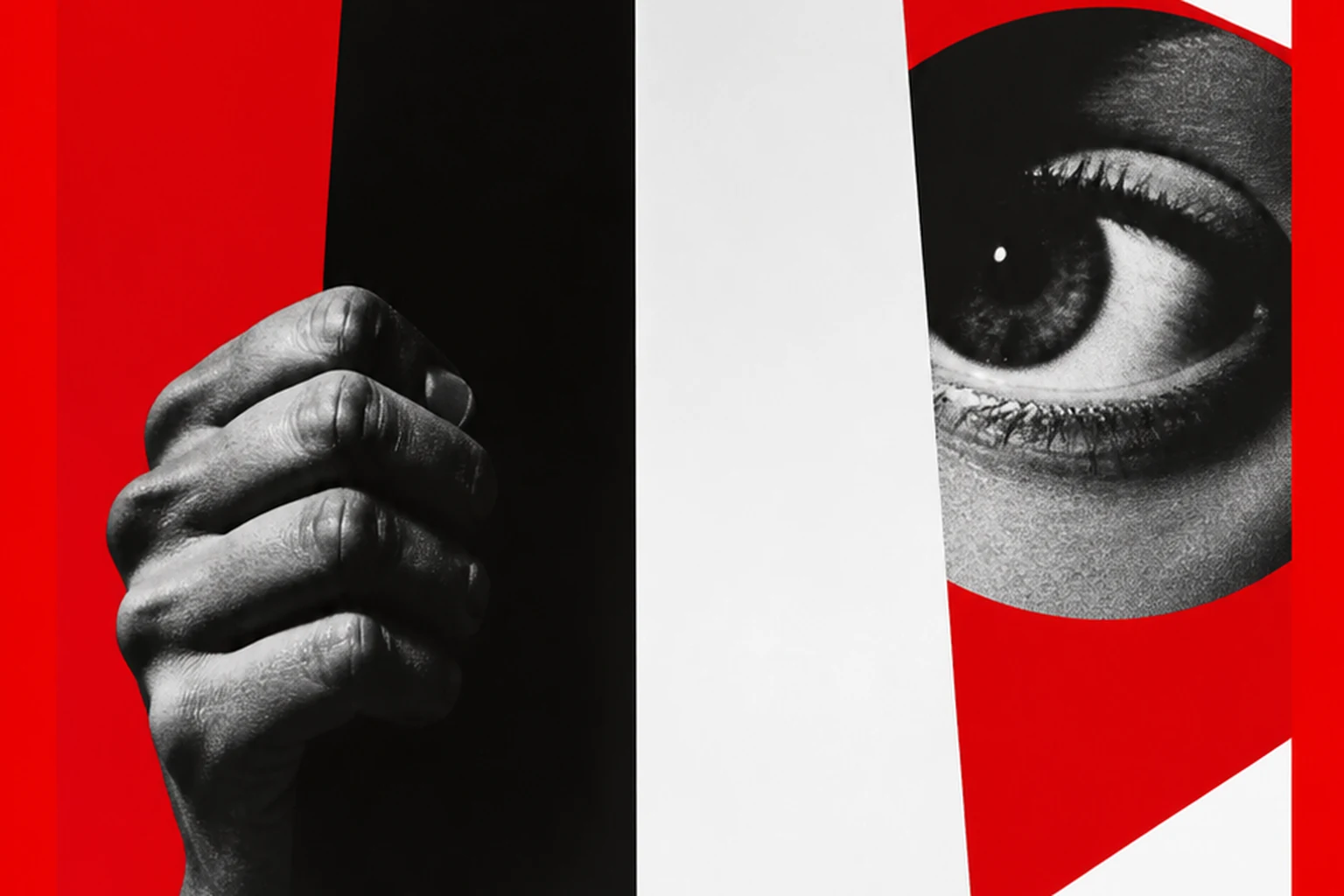
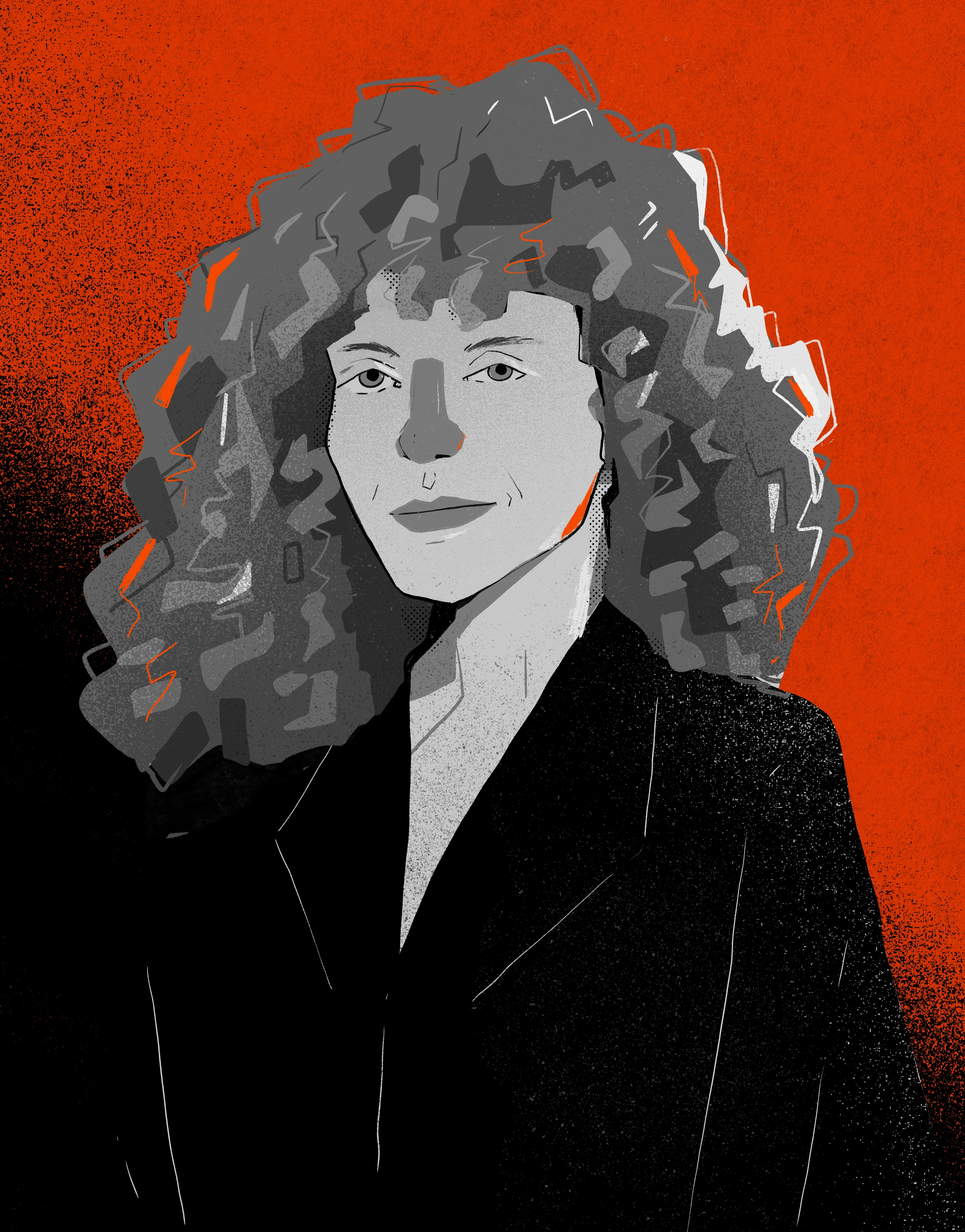
Kruger uses the language of advertising not to sell a product but to expose the mechanism that produces desire, norm and consent. Her pronouns — 'I', 'you', 'we', 'they' — turn the viewer from an observer into a participant in the distribution of power.
Editorial thesis
Barbara Kruger's significance rests on joining graphic design, appropriated photography, critical theory and direct address. Her practice shows that power operates not only through law or violence but through the everyday grammar of advertising, news, religion, art and personal desire.
Reader question
Why can a few words over a black-and-white photograph change the meaning of an image, make the viewer responsible for the reading, and turn a museum, street or screen into a space of political conflict?
The core subject is Barbara Kruger: her paste-ups, print graphics, public projects, architectural installations, video, sound and critical texts.
The experience of magazine design is treated as a professional and intellectual foundation, not as a 'pre-artistic' stage.
The Pictures Generation is used as a historical frame, but not as an exhaustive definition of the practice.
Feminist critique is connected with the body, reproductive rights, labour, consumption and the production of the gaze.
Appropriation is analysed together with copyright, the source of the image and the unequal distribution of visibility.
The resemblance to the Supreme brand is treated as a question of the circulation of visual language, not as a simple dispute about copying a logo.
The current section includes Guggenheim Bilbao 2025, the National Gallery of Art's video acquisition in 2026 and the Athens project of 2026.
Short answer
Barbara Kruger was born on 26 January 1945 in Newark, New Jersey. She studied at Syracuse University and the Parsons School of Design, after which she worked at Condé Nast, including Mademoiselle, as a designer and layout editor.
In the late 1970s Kruger moved to found black-and-white images and short texts of direct address. Works such as Untitled (Your Gaze Hits the Side of My Face), Untitled (We Don't Need Another Hero), Untitled (I Shop Therefore I Am) and Untitled (Your Body Is a Battleground) turned the language of advertising into an instrument for criticising power, consumption and gender. The artist later scaled this method up to architectural envelopes, video, sound and digital screens.
1. Newark and postwar visual culture
Barbara Kruger was born on 26 January 1945 in Newark, New Jersey, into a working-class family. Her childhood coincided with the mass growth of television, advertising and consumer culture in the United States.
The urban environment, magazine covers, shop windows and political slogans shaped an understanding of the image as an instrument of behaviour, not only an aesthetic object.
Kruger would later use a language already familiar to the viewer from advertising in order to break the automatic trust in it.
2. Syracuse and Parsons
After school Kruger entered Syracuse University, but soon left her studies and moved to New York.
In 1965 she began classes at the Parsons School of Design.
The brief formal education mattered not for its length but for the encounter with teachers and the professional visual culture of the city.
3. Diane Arbus, Marvin Israel and the editorial eye
At Parsons Kruger studied with the photographer Diane Arbus and the designer Marvin Israel.
Arbus showed that photography at once fixes a person and produces a social type. Israel worked with magazine composition, sequence and the psychological impact of the page.
These two directions — the critique of the photographic gaze and the management of visual attention — came together in Kruger's mature practice.
4. Condé Nast and magazine design
Kruger worked as a designer and layout editor in the Condé Nast publishing system, including the magazine Mademoiselle, and also collaborated with House and Garden and Aperture.
Her work included selecting images, scaling, cropping, typography and controlling the pace of reading.
Magazine design taught her that meaning is produced not by a single photograph but by the montage of image, text, size and position on the page.
5. Early fabric and wall works
In the early 1970s Kruger created large works from yarn, fabric, sequins and other materials.
These works took part in the discussion of decorative art, craft and the gendered division of artistic techniques.
The artist later distanced herself from this practice, considering it insufficiently precise for the questions of power and representation that interested her.
6. From the material object to picture practice
After a period of doubt Kruger turned to photography, text and publishing montage.
The term picture practice is more precise than 'photomontage': the artist works not only with the image but with the social conditions of its circulation.
The source may be found in a magazine, textbook or archive, but the final work arises through cropping and linguistic intervention.
7. The Pictures Generation and appropriation
Kruger is often associated with the Pictures Generation — a circle of artists who explored mass images, cinema, advertising and authorship.
Appropriation made it possible to show that photographs already carry ideological roles before the artist intervenes.
Yet the found image is not a neutral resource: one must account for the photographer, the original context and the people turned into visual material.
8. The paste-up as laboratory
Kruger created small original paste-ups, joining a photograph and printed text by hand.
The composition could then be enlarged, photographed, and transferred into silkscreen, poster, vinyl or magazine.
The small working original functioned as a precise layout for a potentially enormous public image.
9. Futura, Helvetica and the voice without an author
High-contrast sans-serif typefaces recall advertising, a newspaper headline and a political poster.
The text usually lacks handwritten individuality, so it sounds like an institutional command or a collective voice.
Red, white and black heighten urgency, but Kruger's practice itself is not limited to one typography and one colour code.
10. Pronouns and the distribution of power
The words I, You, We, They are not fixed to stable characters.
The viewer must determine who speaks, who is addressed and whether he is included in the collective 'we'.
In this way grammar becomes a political structure: the pronoun distributes responsibility, belonging and the right to speak.
11. Untitled (Your Gaze Hits the Side of My Face)
The 1981 work joins the profile of a classical female head with a phrase about a gaze that hits the side of the face.
The depicted figure does not meet the viewer's eye, but the text makes the very act of looking visible and aggressive.
The work analyses the objectification of women and shows that the gaze is an action, not neutral perception.
12. Untitled (We Don't Need Another Hero)
In the 1986 work an image of a boy demonstrating strength is accompanied by the phrase We Don't Need Another Hero.
The composition borrows the language of childhood socialisation, advertising and national mythology.
Against heroic individualism Kruger sets the question of who pays for the cult of strength, leadership and male exceptionalism.
13. We Will No Longer Be Seen and Not Heard
The 1985 portfolio distributes the phrase We Will No Longer Be Seen and Not Heard across separate sheets with gestures of the hands.
The title inverts the upbringing formula that asks children and subordinates to be visible but silent.
The work connects the body, language and a collective statement without finally fixing who belongs to the 'we'.
14. Picturing "Greatness" at MoMA
In 1988 Kruger organised at MoMA the exhibition Picturing "Greatness", drawn from museum photographic portraits of famous artists.
The project analysed how the camera, the museum and the caption produce the image of the artistic genius.
The curatorial act became a continuation of her art: instead of creating a new image, she reconfigured the existing archive and the language of authority.
15. Untitled (I Shop Therefore I Am)
The phrase I Shop Therefore I Am appeared in 1987 over an image of a hand holding a rectangular text block.
It parodies the philosophical formula cogito ergo sum, replacing thought with consumption.
The work shows how the market offers a person a ready-made identity through purchase, taste and belonging to a brand.
16. Consumption and the subject of desire
Kruger does not depict the consumer exclusively as a victim of advertising.
Her texts show a person's active participation in the system of desire, comparison and self-assessment.
Purchase promises freedom of choice, but at the same time standardises needs and turns the personality into a measurable profile.
17. Untitled (Your Body Is a Battleground)
Untitled (Your Body Is a Battleground) was created in 1989 in connection with a mass demonstration in Washington for reproductive rights.
A woman's face is divided into positive and negative halves, and the text turns the body into a field of political struggle.
The work does not claim the body is only a victim: the word your simultaneously addresses, mobilises and transfers responsibility to the viewer.
18. Reproductive rights and the protest poster
The composition was distributed as a poster and could exist outside the museum system.
Its force rests on joining the individual face with a collective political situation.
Later digital replays return the work to the context of new restrictions on reproductive rights, changing its medium and temporal structure.
19. Public carriers and everyday objects
Kruger placed texts on billboards, buses, facades, stations, newspaper pages and urban screens.
The public carrier does not simply enlarge the audience: it changes the relations between message, ownership and the urban environment.
The work competes with advertising on its own territory and uses its form to criticise the mechanisms of persuasion.
20. Matchbooks, bags, T-shirts and posters
The artist transferred works onto matchboxes, paper bags, T-shirts, postcards and other mass-produced objects.
Such formats lowered the threshold of access and allowed the image to circulate through everyday use.
At the same time they show how easily a critical slogan becomes a commodity and loses context.
21. Architectural installations
From the 1990s Kruger increasingly covers walls, floors, stairways, facades and passages with text.
The viewer no longer looks at the work from the side: he physically finds himself inside conflicting statements.
Architecture becomes a reading system in which the direction of movement, scale and acoustics determine meaning.
22. Belief+Doubt
Belief+Doubt was created in 2012 for the lower level of the Hirshhorn Museum and continues to be designated by the museum as an ongoing installation.
Text covers the walls, floor, escalators and the space of the bookshop.
Questions about law, freedom, choice, silence and money turn the institutional passage into a hall of contradictory public voices.
23. Floor, walls and the voice of space
When the text is placed on the floor, the visitor steps on the words and becomes part of the composition.
Phrases can simultaneously direct, accuse, seduce and contradict one another.
The spatial work shows that the language of power has no single source: it circulates through the institution, architecture and the viewer's body.
24. Video, sound and Twelve
Kruger extended her practice into video and sound installations, keeping an interest in direct speech and the conflict of roles.
In Twelve characters exchange accusations, confessions and threats, and the viewer finds himself inside an emotional montage.
The moving image allows work with duration, intonation and shifts in the position of the speaker.
25. Replays, 2019-2020
From 2019 Kruger began translating well-known static compositions of the 1980s into short digital videos on LED panels.
Text appears, breaks down, is replaced and accompanied by sound, so the original slogan turns into a dispute with its own cultural legacy.
A replay is not a simple animation of an old work: it explores how meaning changes in an environment of screens, notifications and memes.
26. Untitled (No Comment)
Untitled (No Comment) from 2020 is a multi-channel video installation using texts, internet memes, images and a sound stream.
The work reproduces the overload of the digital environment, where a serious message instantly sits beside entertainment and reaction.
The phrase no comment ceases to mean silence: online, refusing to speak also becomes a public gesture.
27. That's the Way We Do It and digital re-appropriation
In Untitled (That's the Way We Do It) Kruger gathers internet-found imitations of her red-and-white textual language.
She re-appropriates images that have already appropriated her visual method.
The work shifts the question from 'who copied the original' to how a style becomes a shared digital template and loses a stable owner.
28. Supreme and the economy of visual resemblance
The Supreme logo is often compared with Kruger's characteristic visual language.
The artist did not build her practice around prosecuting such borrowings; her works rather explore the very mechanism of copying and branding.
The resemblance reveals a paradox: a critique of consumer culture can become the basis of one of the strongest commercial signs of streetwear.
29. Thinking of You. I Mean Me. I Mean You.
The major exhibition Thinking of You. I Mean Me. I Mean You. was organised by the Art Institute of Chicago, LACMA and MoMA between 2021 and 2023.
The project covered more than four decades and adapted to the architecture of each museum.
The title changes the addressee in the middle of reading and shows that accusing another easily returns to the speaker.
30. Guggenheim Bilbao, 2025
The exhibition Another day. Another night. ran at the Guggenheim Museum Bilbao from 24 June to 9 November 2025 and was the first full retrospective of Kruger in Spain.
Vinyl, sound, video and digital screens turned the museum into a linguistic environment. The work Camino used English, Spanish and Basque to organise movement.
The project stressed that translation changes not only words but the political position of a message in a particular city.
31. Your Body Is a Battleground at the NGA, 2026
In 2026 the National Gallery of Art acquired the video version of Untitled (Your Body Is a Battleground), dated 1989/2019.
The work is a single-screen video on an LED panel with sound and shows how a historic poster moves into the moving image.
The acquisition fixes the replays as independent museum works, not as digital appendages to well-known collages.
32. Untitled (Pride and Contempt), Athens 2026
Untitled (Pride and Contempt) runs at the Stavros Niarchos Foundation Cultural Center in Athens from 28 April to 1 November 2026.
The project includes thirteen new site-specific works, including a monumental painting about ninety metres long on the building of the National Library of Greece.
For the first time the texts are written by Kruger in Greek and consider truth, power, polarisation and individual responsibility in public space.
33. Translation, local language and the public audience
Translating Kruger's work cannot be limited to a literal substitution of words.
Pronouns, imperative forms, cultural quotations and the degree of aggressiveness work differently in each language.
The translator and the local team become intellectual participants in the work, not merely technical executors.
34. Feminism, class and racial visibility
Kruger analyses gendered power, but her practice also addresses class, money, religion, nationalism and institutional hierarchy.
The found images often come from media archives in which white bodies and normative appearance are disproportionately represented.
Critical reading should consider who is visible in the original archive, who is absent, and how the universal 'you' is distributed among different audiences.
35. Authorship, fabrication and installation teams
Large vinyl envelopes, LED screens, sound and public projects require architects, designers, translators, printers, engineers, installers and programmers.
Kruger's authorial system sets the text, the visual structure and the relation with space, but the material realisation is collective.
Correct attribution should include the museum, the galleries, the technical team, the photographer and the translator when their contribution determines the final form.
36. Writing, teaching and critical theory
Kruger wrote texts about television, cinema, architecture, fashion and culture and taught at several universities, including UCLA.
Her practice is connected with feminist theory, semiotics, psychoanalysis and media critique, but avoids turning the work into an illustration of a single school.
The short phrase works because behind it lies a complex understanding of how language creates the subject and public consent.
37. Market, collecting and resistance to the brand
Kruger's works are held in major museum and private collections and are represented by the galleries David Zwirner and Sprüth Magers.
Her visual language is widely commercialised, but the artist constantly returns it to the question of who gains the right to speak and to extract value.
Resistance to the brand does not mean abandoning the market: it appears in creating works that show the viewer the conditions of their own circulation.
38. Conclusion
Barbara Kruger turned graphic design into one of the most influential forms of critical art of the late twentieth and early twenty-first centuries.
Her work acts not because the word explains the photograph but because the text disrupts the habitual regime of trust in the image.
Kruger's chief legacy is an understanding of language as an architecture of power within which the viewer always already takes a position.