artist profile
Anish Kapoor
Void, material and the politics of monumental form
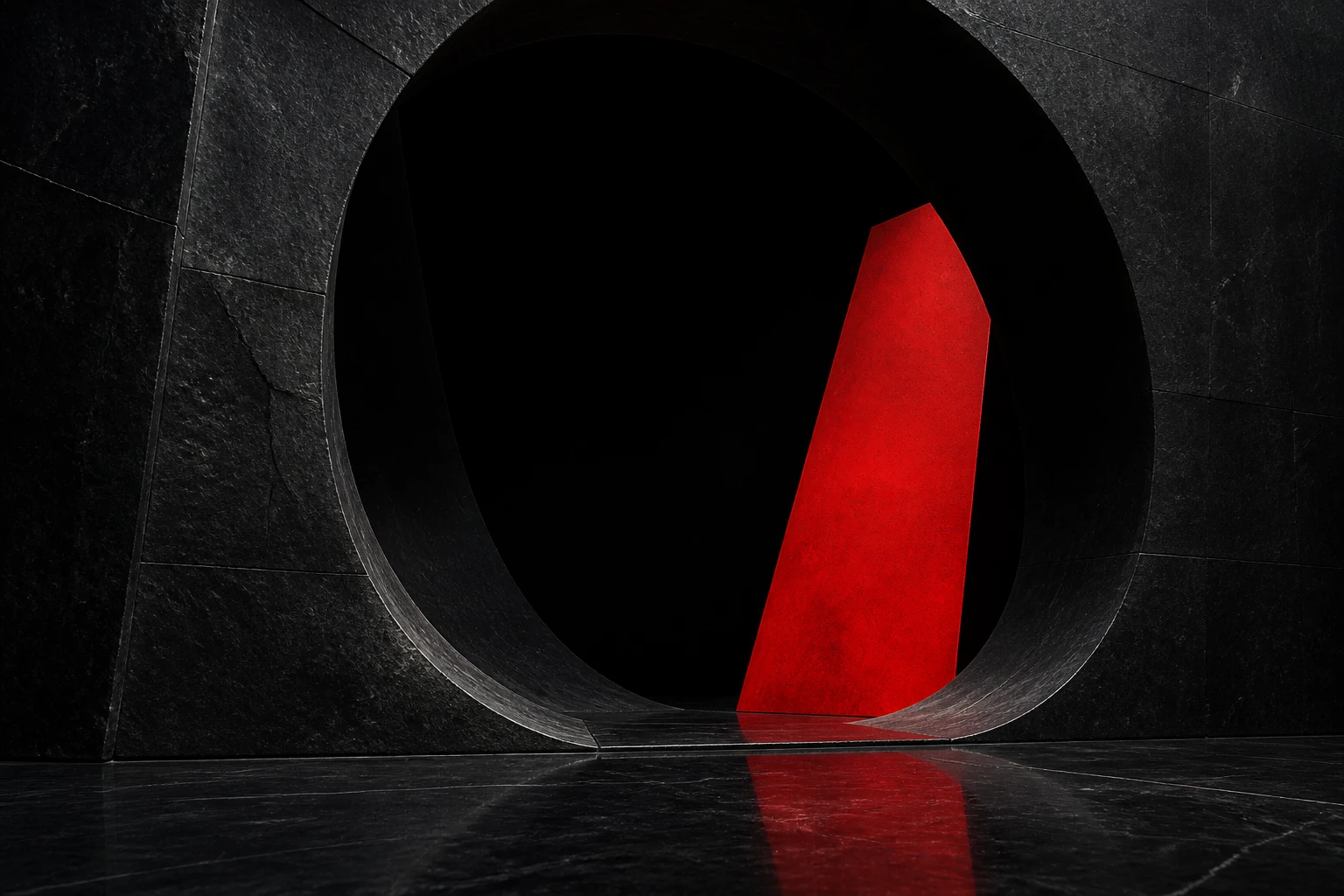
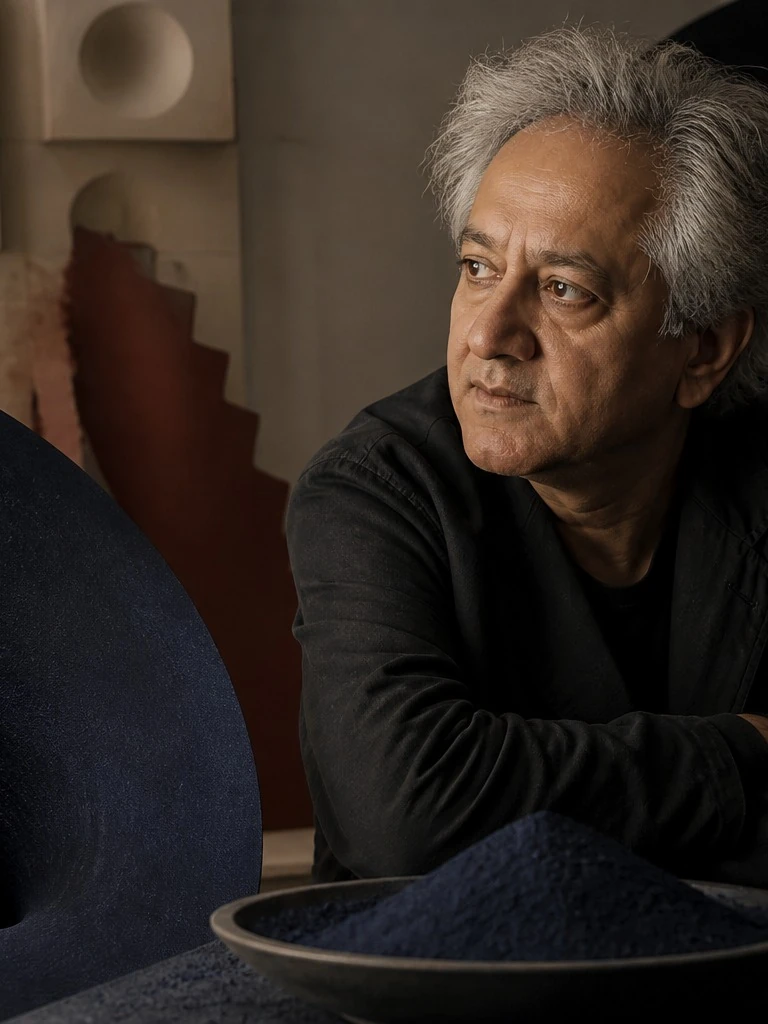
"Kapoor turns sculpture into an event between object and disappearance. Pigment, mirror, wax, stone, water and an almost absolute black do not simply compose a form — they force the viewer to doubt depth, scale, the boundary of the body and the stability of space."
Editorial thesis
Kapoor'"'"'s significance rests on a sustained investigation of negative form, void, reflection and material transformation. His practice connects metaphysics, architecture, engineering and public policy, but it also raises questions about scale, authorial control, patents, labour infrastructure and access to shared space.
Reader question
Why can a sheet of polished steel, a hole in the floor, a red membrane or a rotating vortex be perceived not as things but as passages, threats and unstable states of space itself?
The central subject is Anish Kapoor — his sculpture, installation, painting, architectural and public projects.
Indian origins and a British career are considered without reducing the practice to a single national identity.
Void and spirituality are analysed as artistic categories rather than as confirmation of any particular religious doctrine.
Monumental works are examined together with their engineers, architects, fabricators and commissioners.
Vantablack is discussed alongside the exclusive right of artistic use and the controversy it provoked.
Public projects are assessed by access, safety, financing and impact on the city.
All images and installation views require clearance from the artist, the gallery, the institution and the documentation photographer.
Short answer
Anish Kapoor was born on 12 March 1954 in Bombay. In the early 1970s he moved to Israel, then to the United Kingdom, where he studied at Hornsey College of Art and Chelsea School of Art. International recognition came through pigment sculptures and works exploring negative space.
Kapoor represented Great Britain at the Venice Biennale in 1990 and received the Turner Prize in 1991. Marsyas, Cloud Gate, Leviathan, ArcelorMittal Orbit, Descension and the series of mirrored and black objects extended his practice to the scale of architecture and urban infrastructure.
1. Bombay, family and migration
Kapoor was born in Bombay into a family with Indian and Jewish-Iraqi roots.
The multilingual, religiously heterogeneous environment does not translate directly into the symbolic vocabulary of his art.
Later criticism often tried to explain the work through "the East", although the artist was formed within international modernism.
2. Israel and the move to Britain
In the early 1970s Kapoor lived in Israel and then moved to London.
The experience of migration shaped his position between cultural systems.
He consistently resisted the demand to represent a single national tradition.
3. Hornsey and Chelsea
Kapoor studied at Hornsey College of Art and Chelsea School of Art.
In the British environment of the 1970s he encountered post-minimalism, process art and the new British sculpture.
His interest quickly shifted from the autonomous object to the space around it.
4. 1000 Names
The 1000 Names series of the late 1970s and early 1980s consists of geometric forms coated in bright, dry pigment.
The objects appear to emerge partially from the floor or wall.
The pigment erases the trace of the hand and creates the impression of a form that came into being on its own.
5. Pigment as form and trace
Loose colour binds together the surface, the air and the space around the object.
Pigment is simultaneously material and optically elusive.
Its vulnerability demands special museum conditions and makes conservation part of the work.
6. Void Field
Void Field of 1989 presents a group of stone blocks with dark openings.
The work earned Kapoor the Premio Duemila at the Venice Biennale in 1990.
Each object appears not as a mass but as a shell around an unknown depth.
7. Void and negative form
For Kapoor, void is not the absence of material.
It acts as an active form that draws the gaze in and creates psychological tension.
The viewer cannot reliably determine the depth, scale and boundary of the object.
8. Adam and Descent into Limbo
In Adam and Descent into Limbo the dark surface can read as a hole or as a flat patch.
The work depends on lighting and on a safe distance.
The real risk of falling demonstrates that optical uncertainty has physical consequences.
9. Svayambh
Svayambh uses a mass of red wax that slowly moves through the museum'"'"'s doorways.
The title means "self-born" or "self-manifested".
The architecture shapes the material, and the trace that remains becomes part of the work.
10. Wax, machine and self-producing sculpture
The mechanism replaces the traditional gesture of modelling.
The red mass evokes flesh, blood, an industrial product and a ritual substance.
Authorship resides in the creation of a system, not in the manual handling of every surface.
11. Taratantara
Taratantara of 1999 was made for the Baltic Flour Mills before the building was converted into an arts centre.
A vast red membrane connected opposite sides of the industrial space.
The work made the architecture an interior of the sculpture.
12. Marsyas
Marsyas was installed in the Turbine Hall of Tate Modern in 2002.
Three steel rings were joined by a red PVC membrane running the length of the hall.
The work could not be seen whole from a single point, so its scale was experienced through movement.
13. Membrane, body and architecture
The red envelope recalls skin, an internal organ, a musical instrument and an architectural tunnel.
The title alludes to the myth of Marsyas, who was flayed alive.
Engineering precision and bodily association generate a tension between control and vulnerability.
14. Sky Mirror
Sky Mirror presents a large concave mirrored surface that reflects the sky and the city.
The image inverts and shifts with the weather and the viewer'"'"'s position.
The sculpture turns the surrounding environment into a continuously updated material.
15. Cloud Gate
Cloud Gate was installed in Chicago'"'"'s Millennium Park and opened to the public in 2004, with the final polishing completed later.
The polished steel produces a continuous reflection of the cityscape and its visitors.
The internal arch multiplies bodies and shapes a collective scene of self-observation.
16. Reflection, public and city
The mirrored work appears open to everyone, yet it depends on municipal policy, maintenance and image control.
Cloud Gate became a tourist symbol and a brand for Chicago.
Its public success shows how a work can move from the artistic canon into the everyday visual infrastructure of a city.
17. Leviathan
Leviathan was created for Monumenta 2011 at the Grand Palais.
Visitors entered the interior of a vast red inflatable structure.
The work inverted the relation between sculpture and architecture: the gallery became a shell around yet another interior world.
18. Monumenta and inner volume
The translucent membrane shifted the light and colour of the space.
The collective entry into the interior created a bodily sense of scale.
At the same time, the experience depended entirely on ventilation, pressure, safety and the technical team.
19. ArcelorMittal Orbit
ArcelorMittal Orbit was created by Kapoor and the engineer Cecil Balmond for the London Olympic Park in 2012.
The tower combines sculpture, viewing platform, engineering structure and corporate sponsorship.
A slide by Carsten Höller was later added, changing the way the public used the structure.
20. Art, branding and the Olympics
An Olympic commission turns art into an instrument of urban renewal and national representation.
The title preserves the name of the sponsoring steel corporation.
The project demands analysis not only of form but also of financial, political and development logic.
21. Descension
Descension produces a rotating vortex that descends into a dark centre.
The work reads as a hole in the ground, although it is a controlled hydraulic system.
Sound and movement make the void a physical event.
22. Vortex and real danger
The viewer feels drawn to the centre but must remain behind a safety barrier.
The project shows that "void" can be produced by pumps, reservoirs and engineering calculation.
The aesthetic experience depends on an invisible infrastructure of control.
23. Shooting into the Corner
In this work a pneumatic cannon periodically fires red wax into the corner of the hall.
The material accumulates as a record of repeated impact.
The machine turns violence into the rhythm of exhibition time.
24. Red, violence and ritual
For Kapoor, red is tied to the body, birth, sacrifice, celebration and threat.
The artist refuses any single symbolic reading.
The intensity of the colour unites material revulsion and visual attraction.
25. Vantablack
Kapoor obtained the exclusive right of artistic use of the material Vantablack S-VIS.
The coating absorbs almost all visible light and disrupts the perception of volume.
An object can appear as a cut-out section of space.
26. Material exclusivity and cultural conflict
The exclusivity was criticised as a privatisation of artistic access to a colour.
The controversy with other artists turned a technical material into a cultural symbol of control.
The case shows the links between art, patent, licence and public image.
27. Versailles and Dirty Corner
In 2015 Kapoor'"'"'s exhibition was held in the gardens of Versailles.
Dirty Corner presented a vast metal vortex and was interpreted by the artist through sexual and political metaphor.
The work was vandalised with antisemitic graffiti.
28. Antisemitism, vandalism and the institutional response
The decision to leave the inscriptions temporarily in place as a record of violence triggered a legal and ethical conflict.
The work was later closed and altered in line with court requirements.
The case shows the tension between preserving a testimony, protecting the public and authorial control.
29. Painting and bodily matter
In recent decades Kapoor has developed painterly and relief works using dense red, black and white matter.
The surface resembles a wound, an internal organ, a landscape and a process of decay.
Painting continues the investigation of void through an excess of material.
30. Studio production and engineering
Monumental projects require models, digital calculations, welding, polishing, membranes, hydraulics and building permits.
The studio coordinates a large number of specialists and outside contractors.
Precise attribution must include engineers, architects, fabricators and institutions.
31. Rights, patents and image control
Public works are often photographed as part of the urban environment, yet the rights for commercial use may be restricted.
Materials and technologies can be governed by licences and patents.
Editorial use requires separate clearance of copyright, photographer, object, location and type of use.
32. Public position and political statements
Kapoor has spoken out on migration, human rights, nationalism and political violence.
His public stance has become part of the artist'"'"'s media image.
A political statement should be distinguished from the formal content of a particular work.
33. Hayward Gallery 2026
A major exhibition at the Hayward Gallery runs from 16 June to 18 October 2026.
It brings together mirrored sculptures, Vantablack, voids, paintings and new red installations.
The project marks the artist'"'"'s return to the gallery after almost three decades.
34. Serlachius 2026–2027
The exhibition at Serlachius Manor opened on 27 June 2026 and runs until 4 April 2027.
A new monumental sculpture, Ancestor, has been created for it.
The display connects new works, non-objects and paintings.
35. The critique of monumentality and resources
Scale produces a strong bodily experience, but it requires significant amounts of material, energy and capital.
Monumentality can reinforce the power of the museum and the prestige of corporations.
Ecological and labour assessment must accompany any aesthetic analysis.
36. The museum canon and conservation
Kapoor'"'"'s works require complex care of mirrored steel, pigment, wax, membranes and mechanical systems.
Reinstallation depends on protocols, technical drawings and authorial supervision.
Documentation becomes part of the long-term existence of the work.
37. Conclusion
Anish Kapoor has made void, reflection and material transformation central concerns of contemporary sculpture.
His works force the body to experience space before the mind has time to explain it.
Kapoor'"'"'s principal legacy is the understanding of sculpture as an unstable threshold between object, architecture, danger and disappearance.