artist profile
Olafur Eliasson
Light, perception and the politics of shared space
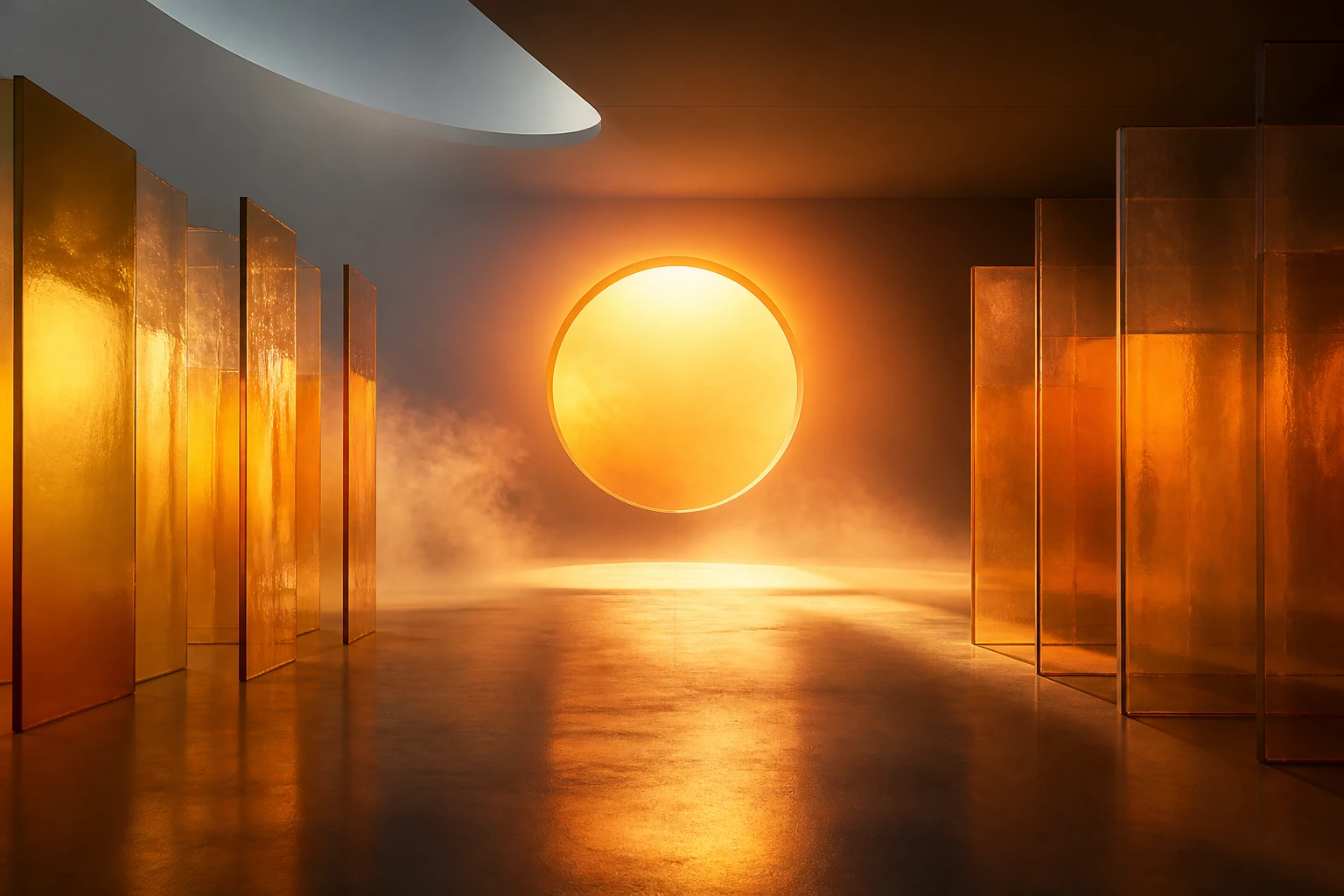
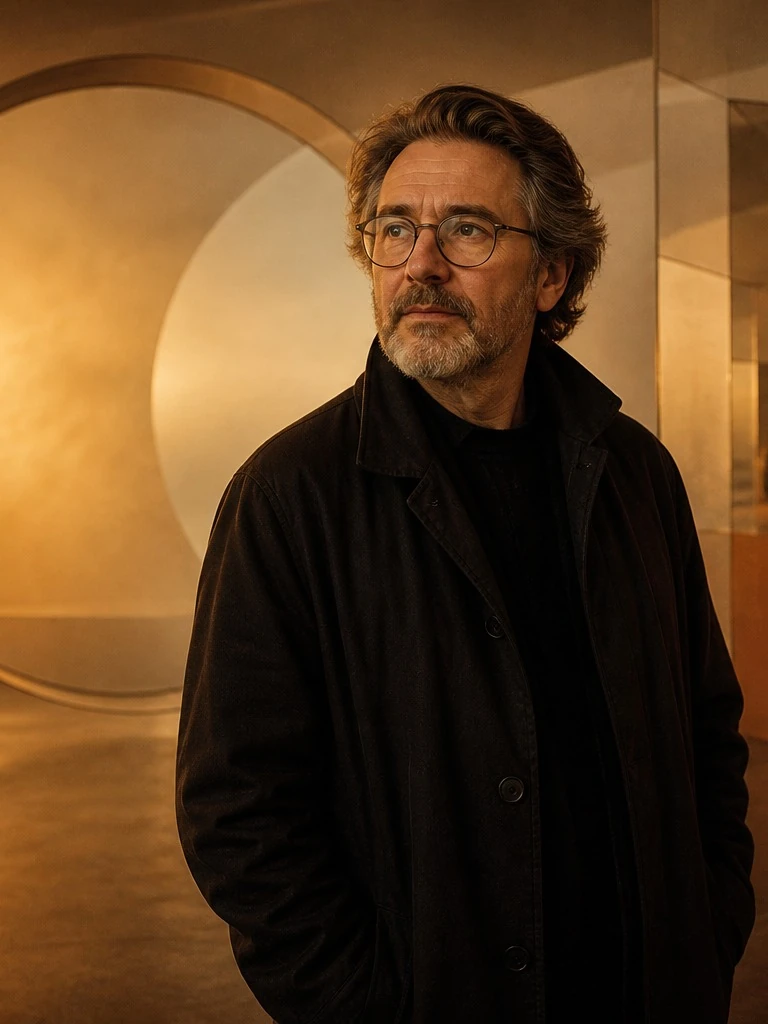
Eliasson does not simply produce striking natural illusions. He shows that perception is always produced by the body, by architecture, by technology, by society and by climate. Light, fog, water, mirror and colour become instruments of collective experience and of a political question: how do we share space and responsibility?
Editorial thesis
Eliasson's significance rests on the convergence of phenomenology, architecture, science, engineering and environmental politics. His works do not depict nature as an external object; they create conditions in which the viewer becomes aware of their own body, of the collective and of the infrastructure of perception.
Reader question
How can artificial fog, a lamp, a mirror, a flow of water or melting ice turn from a visual effect into an investigation of trust, climate, public space and human responsibility?
The core subject is Olafur Eliasson, his installations, architectural projects, public works, photography, design and social initiatives.
Natural processes are examined as technically constructed and institutionally organised conditions.
The viewer is analysed as a participant in the work, but participation is not assumed to be automatically democratic.
Climate subject matter is separated from environmental marketing and assessed together with the material footprint of exhibitions.
Studio Olafur Eliasson is treated as a collective infrastructure of architects, engineers, researchers, craftspeople and administrators.
Little Sun is analysed as a social business, a design project and an educational programme.
All works, architectural projects and photographs require rights checks with the artist, the studio, the institution and the photographer.
Short answer
Olafur Eliasson was born on 5 February 1967 in Copenhagen to a family of Icelandic origin. He studied at the Royal Danish Academy of Fine Arts and founded his studio in Berlin in 1995.
Since the 1990s he has made works with light, water, fog, mirrors, movement and colour. Beauty, The mediated motion, The Weather Project, Your rainbow panorama, the New York City Waterfalls, Ice Watch and Little Sun have made him one of the key figures of environmental art and of the climatic imagination.
1. Copenhagen, Iceland and early biography
Eliasson was born in Copenhagen and spent a significant part of his childhood in Iceland.
Icelandic landscapes, water, volcanic geology, fog and shifting light became an important visual memory.
The artist does not, however, reproduce nature as a romantic image: he examines how landscape is constructed by culture and infrastructure.
2. The Royal Danish Academy and New York
Between 1989 and 1995 Eliasson studied at the Royal Danish Academy of Fine Arts.
In the early 1990s he worked and studied in New York, where he encountered post-minimalism, institutional critique and urban culture.
Early experiments with optics, movement and water already presupposed an active body on the part of the viewer.
3. Founding Studio Olafur Eliasson
In 1995 the artist founded his studio in Berlin.
Over time it became an interdisciplinary structure bringing together artists, architects, engineers, researchers, model-makers and communications specialists.
The studio is not only a production mechanism but a site of research, archive and public education.
4. Beauty
Beauty of 1993 creates a fine curtain of water lit by a spotlight.
A rainbow appears only when the viewer stands in a particular relation to the light and the droplets.
The work shows that a visual event does not exist independently of the observer's body.
5. Fog, light and the materiality of perception
Eliasson uses fog and light not as atmospheric decoration but as physical materials.
Visibility becomes restricted, colour reorients itself and distance is felt by the body.
The illusion is disclosed together with its mechanism, so that wonder and technical knowledge exist at the same time.
6. Moss Wall
Moss Wall of 1994 consists of reindeer lichen fixed to a vertical surface.
The material changes with humidity, smell and time.
The work breaches the boundary between the architectural wall, a living substance and the museum's system of care.
7. Green River
Between 1998 and 2001 Eliasson dyed rivers in several cities a fluorescent green without prior announcement.
The colour temporarily made water visible as an active element of the urban system.
The project produced surprise but also raised questions of consent, safety and an artist's right to intervene in shared space.
8. Colour as an event
Eliasson studies colour through monofrequency light, spectra, prisms, filters and successive contrasts.
Colour does not belong to an object as a permanent property; it arises in the relations between light, eye and environment.
The Colour experiment series joins observation, painting and scientific model.
9. Your strange certainty still kept
In this work stroboscopic light illuminates falling water.
A continuous flow appears as a set of arrested droplets.
The viewer simultaneously knows about the movement and sees stillness, becoming aware of how their own perception is constructed.
10. The mediated motion
The 2001 exhibition at Kunsthaus Bregenz was built as a sequence of spaces containing water, fog, soil, plants and sloping surfaces.
The route demanded physical adaptation and turned the museum into a changeable environment.
The work was made in dialogue with the landscape architect Günther Vogt, which underlines the collective character of the project.
11. The Weather Project
The Weather Project was installed in the Turbine Hall at Tate Modern in 2003.
A semicircle of monofrequency lamps was reflected in a mirrored ceiling and created the image of an enormous sun.
Fog and a restricted spectrum turned the architecture into a shared atmospheric space.
12. An artificial sun and collective behaviour
Visitors lay on the floor, formed shapes and watched their own reflections.
The work became an event of mass participation, but its sociality arose inside a museum infrastructure and a media frenzy.
It shows how a collective forms around a shared spectacle and around the awareness of oneself as an image.
13. The Blind Pavilion
The Blind Pavilion represented Denmark at the 2003 Venice Biennale.
Mirrored, glass and optical structures complicated the distinction between inside and outside.
The title refers not to an absence of sight but to the blind spots of any system of observation.
14. Your rainbow panorama
The circular glass walkway opened on the roof of ARoS Aarhus Art Museum in 2011.
The visitor moves through a sequence of colours and sees the city tinted by filters.
The work joins architecture, the urban prospect and bodily movement into a sustained optical event.
15. Mirror, double and the viewer's movement
Kaleidoscopes, spherical mirrors and polygonal structures produce multiple reflections.
The viewer does not only look at an object but continually meets their own image.
Self-observation turns perception into a social situation, because other bodies are visible alongside.
16. The New York City Waterfalls
In 2008 four artificial waterfalls were installed along the New York waterfront.
The project worked with the scale of the harbour, the movement of water and the view from different districts.
The engineering infrastructure was deliberately visible and underlined the artificiality of the natural event that had been made.
17. Public art and the infrastructure of the city
Large urban projects depend on permits, funding, safety, transport and maintenance.
Being public does not guarantee equal access or public consent.
Critical analysis must take account not only of the impression but of the administrative system that made the work possible.
18. Harpa and the architectural envelope
The façade of the Harpa concert hall in Reykjavík was created by Studio Olafur Eliasson with Henning Larsen Architects.
The modular glass structure is based on quasi-brick geometry and changes with the light.
The building turns urban light and weather into a continuously shifting surface.
19. Studio Other Spaces
In 2014 Eliasson and Sebastian Behmann founded the architectural practice Studio Other Spaces.
Its projects combine architecture, landscape, colour, climate and user participation.
This extension shows that the boundary between artwork, building and public infrastructure remains mobile.
20. Little Sun
Little Sun was founded in 2012 by Eliasson and the engineer Frederik Ottesen.
The solar lamp was designed as an affordable source of light for regions with limited access to electricity.
The project combines design, entrepreneurship, education and climate communication.
21. Design, energy and social business
Little Sun was distributed through both commercial and non-commercial models.
Purchases in wealthier regions helped support programmes in other countries.
A critique of such projects must take account of actual local needs, distribution, the durability of the device and the risk of a symbolic answer to a systemic problem.
22. Ice Watch
Ice Watch was first shown in Copenhagen in 2014, then in Paris and London.
Large blocks of ice brought from Greenland melted in public space.
Visitors could see, touch and hear the material of climate change.
23. Ice, climate and temporality
The work turns abstract statistics into a bodily experience of time and loss.
At the same time, transporting the ice and the scale of production raise the question of the ecological footprint of climate art.
The ethical force of the project depends on transparency about logistics and on its connection to scientific data.
24. The glacier melt series 1999/2019
In 1999 Eliasson photographed Icelandic glaciers, and in 2019 he repeated the survey.
The paired images document a marked reduction in ice mass.
The series joins artistic repetition, testimony and the temporal scale of a climatic process.
25. Riverbed and the artificial landscape
Riverbed of 2014 filled the galleries of the Louisiana Museum with stones and running water.
Visitors moved across the uneven surface, choosing their own path.
The project violated museum cleanliness while remaining a carefully designed and controlled environment.
26. Green Light
Green Light of 2016–2017 took the form of a workshop assembling modular green lamps.
Refugees, migrants, students and visitors took part.
The work sought to combine the production of an object with public discussion.
27. Migration, the workshop and the critique of participation
Green Light was criticised for the risk of turning vulnerable participants into a symbol of a humanitarian theme.
Participation does not automatically remove the inequality between artist, institution and invited group.
Assessing the project requires information about payment, the duration of the relationship and the participants' control over their own image.
28. Life
In the 2021 project Life at the Fondation Beyeler parts of the building's façade were removed and dyed green water flowed inside.
The exhibition remained accessible to people and to other living creatures around the clock.
The work weakened the distinction between museum, garden, body of water and urban ecosystem.
29. Water, architecture and the more-than-human environment
Life invited the visitor to perceive space from more than a human point of view.
Light, plants, insects, water and temperature became participants in a changing system.
Even so, the environment remained the result of complex control, maintenance and institutional decision.
30. The curious desert
The curious desert was presented in Qatar in 2023–2024, both inside a museum and in the desert landscape.
The works used mirrors, shadows, light, geometry and climatic conditions.
The desert appeared not as an empty backdrop but as a culturally and ecologically specific territory.
31. Desert, climate and cultural geography
International art in the Gulf states is bound up with large investment, museum diplomacy and carbon-intensive infrastructure.
The ecological language of the project must therefore be analysed together with its economic and political setting.
Local context should not disappear behind a universal vocabulary of light and nature.
32. Your curious journey
The touring exhibition Your curious journey brings together work from three decades.
It includes works of light, optics, water, photography and space.
The route emphasises that the work is completed through the visitor's active attention.
33. Art as a travelling system
An international tour requires packing, transport, architectural adaptation and the training of local teams.
Each version of the exhibition changes according to the space and the climate.
At the same time the global mobility of the works creates a material and carbon footprint.
34. Projects of 2025–2026
In 2026 Your curious journey is showing at MCAD Manila after stages in Singapore, Taipei, Auckland and Jakarta.
The studio's official resource also records new works, including A symphony of disappearing sounds for the Great Salt Lake and Memory lantern for extinct fireflies.
Current practice retains an interest in light, disappearing ecosystems, sound and collective attention.
35. Collective authorship in the studio
Projects are created by a team of architects, engineers, artists, researchers, managers and external contractors.
Eliasson's authorial concept sets the direction, but material realisation is distributed.
Crediting Studio Olafur Eliasson and its partners is a necessary part of accurate attribution.
36. Ecological footprint and institutional critique
Climate art can raise public attention while depending on air freight, energy and large museums.
Eliasson publicly pursues environmental initiatives, but individual projects require assessment of their specific logistics.
Criticism does not cancel the work; it makes visible the contradiction between message and infrastructure.
37. The museum canon, rights and documentation
Eliasson's works are held in major museum collections and often exist as instructions, equipment, software and documentation.
Reinstallation requires precise adherence to light, materials, space and technical parameters.
A photograph of an installation does not replace the work itself and has its own author and rights.
38. Conclusion
Olafur Eliasson made perception the principal material of art.
His works show that nature, architecture and society do not exist separately but are produced through relations and infrastructure.
His principal legacy is not the striking illusion but the capacity to make the viewer a responsible participant in their own seeing.