artist profile
Cindy Sherman
Mask, image, and the production of identity
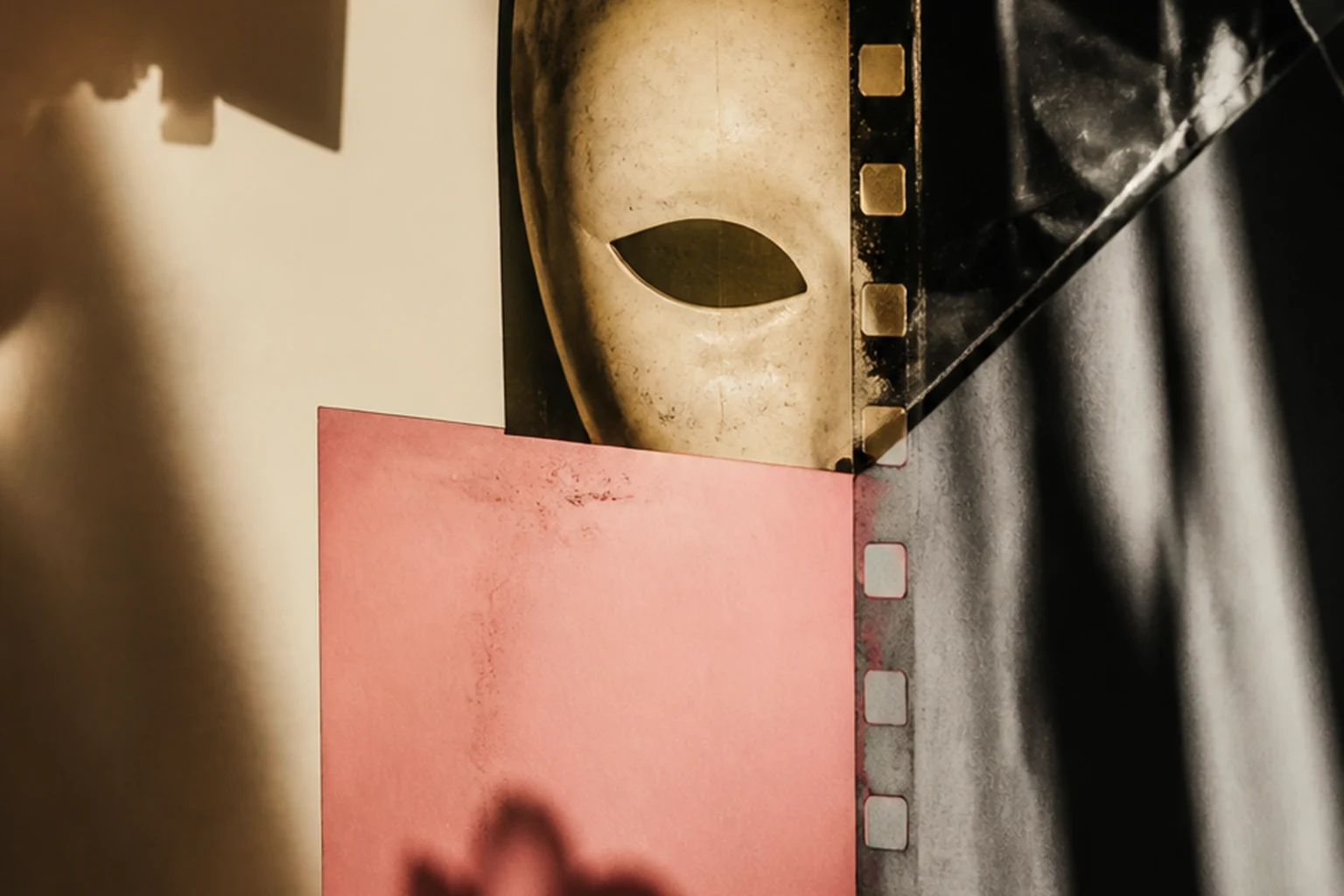
"Sherman uses her own body not as confession, but as a flexible carrier of borrowed images. The camera, makeup, costume, prosthetics, set design, and digital processing turn the self into a stage on which mass culture reveals its own rules."
Editorial thesis
Cindy Sherman's significance rests on her sustained investigation of how images produce gender, age, class, beauty, fear, and social legibility. She nearly always uses her own face and body, yet creates not self-portraits but fictional types shaped by cinema, fashion, advertising, painting, and digital culture.
Reader question
Why can a photograph of the same person read as dozens of different biographies — and what does this mutability tell us not about the artist, but about our habits of identifying woman, status, age, and character through visual codes?
Primary subject: Cindy Sherman, her photography, performative work before the camera, makeup, costume, props, digital processing, and rare film works.
Untitled Film Stills are approached as a series of fictional cinematic types, not as literal frames from existing films.
The term 'self-portrait' is used critically: the artist is physically in the frame, but the characters are not synonymous with her personal identity.
Feminist interpretation is examined as an important history of reception, but not as the artist's sole programmatic intent.
Works involving the grotesque, the sexualized body, and prosthetics require sensitivity review and age advisories upon publication.
Critique of the focus on white Western visual culture and the limits of transformation is incorporated into the analysis.
Current representation and 2026 exhibitions verified via the official Hauser & Wirth resource.
Short answer
Cynthia Morris Sherman was born on January 19, 1954, in Glen Ridge, New Jersey, and grew up on Long Island. At Buffalo State College, she shifted from painting to photography and, together with Robert Longo, Charles Clough, and others, founded the independent space Hallwalls.
After moving to New York, Sherman produced the 69 black-and-white Untitled Film Stills between 1977 and 1980. In subsequent series, she employed color, horizontal format, rear projections, mannequins, prosthetics, theatrical makeup, digital backdrops, and social media. In 2021, Hauser & Wirth announced her global representation; in the autumn of 2026, the gallery scheduled the London premiere of her new series, Fabric Matrons.
1. Glen Ridge, Long Island, and early environment
Cindy Sherman was born on January 19, 1954, in Glen Ridge, New Jersey, and grew up in Huntington on Long Island. She was the youngest of five children.
Postwar American culture surrounded her with television, advertising, family photography, magazines, and cinematic images of femininity.
Later, the artist did not directly illustrate her own childhood, but continually worked with the ready-made types that mass culture offers a person as possible roles.
2. Buffalo State College
In 1972, Sherman enrolled at Buffalo State College. She initially studied painting but gradually focused on photography.
The camera allowed her to combine image, costume, performance, and rapid transformation without the need to commit to a single painterly style.
At college, she met Robert Longo and others who would later be associated with the Pictures Generation.
3. Hallwalls and alternative infrastructure
In 1974, Sherman, Robert Longo, Charles Clough, and Nancy Dwyer co-founded Hallwalls in Buffalo.
The space supported exhibitions, performance, film, video, and discussion outside the traditional museum system.
Hallwalls demonstrates that Sherman's early career was shaped not only by individual studio work but also by collective infrastructure.
4. Untitled A-E and paper transformations
In the 1975 series Untitled A-E, Sherman successively alters her face through makeup, hairstyle, and expression.
The work reveals her interest in transformation even before the celebrated Film Stills.
Early experiments also included cut-paper figures and frame-by-frame metamorphoses in which identity was understood as montage.
5. Move to New York
After finishing college, Sherman moved to New York in 1977.
She found herself among artists who were analyzing photography, television, cinema, advertising, and the appropriation of ready-made images.
This milieu later came to be called the Pictures Generation, although the practices of its members varied considerably.
6. Untitled Film Stills
In 1977, Sherman began Untitled Film Stills — a series of small black-and-white photographs, completed in 1980.
The artist portrayed secretaries, housewives, actresses, students, travelers, and women caught in ambiguous situations.
Costume, wig, pose, and setting conjure a recognizable cinematic role without a name or a resolved narrative.
7. Sixty-nine fictional stills
The complete series consists of 69 photographs. The Museum of Modern Art acquired it in its entirety in 1995 and exhibited the full series in 1997.
The works evoke publicity stills from 1950s-60s films, film noir, B-movies, and European auteur cinema.
No single image reproduces a specific scene: recognition arises from the viewer's cultural memory.
8. Not a self-portrait, but a role
Sherman is physically present in nearly every frame, but Untitled Film Stills should not be understood as a narrative of her personal life.
She uses herself as a readily available model while simultaneously controlling the photograph, image, expression, and framing.
The distinction between the author's body and the character is key: the photograph reveals how easily external signs become a biographical illusion.
9. Cinema without a film
Each Film Still looks like a narrative fragment, yet the viewer receives neither the previous nor the next frame.
The ambiguity compels the audience to supply its own threat, romance, escape, anticipation, or defeat.
In this way, Sherman investigates not a specific film, but the habit of reading woman through ready-made narrative templates.
10. Rear Screen Projections
In 1980, Sherman began using color and rear projection, placing characters before artificial landscapes.
The visible artifice of the background heightens the sense of studio production and psychological isolation.
The series demonstrates that photographic verisimilitude can persist even when the technology of the set is plainly visible.
11. Centerfolds / Horizontals
In 1981, Artforum magazine commissioned Sherman to produce horizontal images designed for the magazine spread.
Large-scale color figures shot from above or at close range appear vulnerable, anxious, or self-absorbed.
The editors declined to publish the series out of concern that the images might be read as scenes of sexual assault.
12. Untitled #96 and the horizontal gaze
Untitled #96 shows a young woman reclining with a torn piece of newspaper classifieds in her hand.
The horizontal format recalls the magazine centerfold, yet the pose offers no assured erotic access.
The work sustains a tension between commercial sexualization, adolescent fantasy, and psychological opacity.
13. Pink Robes
In the 1982 Pink Robes, the character sits in a pink robe and looks directly at the camera.
The soft fabric suggests a backstage moment in an erotic shoot, yet the model's gaze shatters the observer's safe position.
The series shows the subject after or before the production of the desired image, when the role is no longer fully under control.
14. Fashion commissions
Sherman repeatedly received commissions from fashion magazines and designers, including projects for Interview, Vogue, Harper's Bazaar, and Comme des Garçons.
Instead of idealized displays of clothing, she created awkward, aggressive, aging, or theatrically artificial figures.
The fashion commission became a way to expose the production of glamour and the dependence of clothing on pose, face, and social script.
15. Fairy Tales
In the mid-1980s, Sherman turned to fairy tale, horror, and bodily metamorphosis.
Harsh light, artificial body parts, slime, masks, and low camera angles create a space of childhood fear and adult disgust.
For her, the fairy tale does not restore innocence but lays bare violence, punishment, and the body's instability.
16. Disasters and disgust
In the Disasters and Civil War series, the human figure often disappears, giving way to food, earth, bodily fluids, and traces of destruction.
The photograph becomes almost tactile, testing the limits of the viewer's desire to look.
Disgust here is tied to the violation of the boundary between the beautiful image and the materiality of decay.
17. Sex Pictures
In the 1992 Sex Pictures, Sherman used medical mannequins and anatomical prosthetics in place of her own body.
The figures are placed in explicit poses, but the absence of a living face renders sexuality mechanical, unsettling, and depersonalized.
The series emerged in the context of the culture wars, censorship, and political pressure on art dealing with the body and sexuality.
18. Prosthesis, mannequin, and the absent face
Artificial genitalia, plastic skin, and articulated joints openly display the production of the body as object.
The mannequin makes it possible to depict vulnerability and violence without the documentary exploitation of a specific person.
At the same time, the cold artificiality does not eliminate ethical discomfort but shifts it onto the level of the cultural construction of the sexual gaze.
19. History Portraits
In 1989-1990, Sherman created the History Portraits, depicting aristocrats, clergy, milkmaids, and generic characters from old European painting.
She worked from reproductions and cultural memory, without aiming to copy specific paintings exactly.
The large format and ceremonial pose clash with poorly concealed prosthetics, cheap fabrics, and deliberately crude makeup.
20. Old Masters and visible artifice
Untitled #216 mimics the image of the Madonna, yet the prosthetic breast, fabric folds, and set decoration retain a visible falseness.
Sherman does not try to prove that photography equals Old Master painting; she shows that museum authority itself is constructed through costume, pose, and recognizable codes.
The parody is aimed at once at the sacred status of art and at the contemporary desire to believe a persuasive surface.
21. Masks and Horror
Throughout the 1990s and 2000s, the artist continued working with masks, clowns, artificial heads, and horror imagery.
The face becomes a mobile surface on which a smile can appear more threatening than overt aggression.
The mask does not conceal a true identity: with Sherman, beneath it there is often another mask — or emptiness.
22. Film: Office Killer
In 1997, Sherman directed the feature film Office Killer.
A dark comedy and horror film, it tells the story of an unnoticed office worker who turns the workplace into a site of murder and a domestic archive of bodies.
The film extends her themes of female role, corporate invisibility, the grotesque, and the transformation of domestic order into violence.
23. Clowns
In the Clowns series of the early 2000s, Sherman used digital backdrops, vivid color, and elaborate makeup.
The clowns simultaneously offer entertainment, despair, aggression, and the fear of the compulsory smile.
The digital composition amplifies the artifice, turning each character into a poster of their own emotional crisis.
24. Society Portraits
In the 2008 Society Portraits, Sherman portrays affluent women against backdrops of lavish interiors and landscapes.
Clothing, jewelry, makeup, and posture strive to affirm status but cannot entirely conceal age, anxiety, and the effort of self-presentation.
The series analyzes class and aging in a culture where women's social value is tied to youth and the management of appearance.
25. Aging, class, and the digital backdrop
The digital landscape looks plausible from a distance but remains slightly excessive and theatrical.
The characters seem already to belong to their own official portraits, destined for a home, a charity report, or the society pages.
Sherman shows status as daily labor — maintaining one's face, posture, clothing, and the correct surroundings.
26. Murals and the figure at architectural scale
In 2010, Sherman created large-scale black-and-white figures for architectural installations.
Digitally altered characters stretch across the wall, losing the familiar format of the framed photograph.
Scale turns the guise into an environment and forces the viewer to physically relate their own body to the enlarged image.
27. Flappers and retro age
In the 2016 Flappers series, the characters resemble aging actresses of the silent-film era and the 1920s.
The retro costume does not restore youth but underscores the distance between past glamour and the present body.
The series continues the investigation of aging but shifts it into the territory of historical nostalgia and theatrical memory.
28. Instagram and the mobile mask
Sherman used Instagram as a laboratory for the digital face, employing mobile filters, deformations, and collage.
The posts aligned her decades-long method with everyday selfie culture, in which any user can instantly alter their appearance.
The difference lies not in the technology, but in the degree of critical control over how the filter produces a desirable or frightening persona.
29. Digital collage of the 2020s
In works from the early 2020s, Sherman combined fragments of different faces and expressions, creating characters with unstable anatomy.
The digital montage becomes visible, resembling at once a cosmetic filter, a caricature, and a facial-recognition error.
The image investigates the contemporary condition in which the face is continually optimized, archived, and automatically classified.
30. Men and gender as staging
In the Men series, the artist used male costumes, wigs, makeup, and digital tools to create generic male types.
The works do not claim to reveal an inner male essence; they present gender as a set of poses, expressions, and historical signs.
The movement between female and male roles extends her long-standing analysis of visual recognizability without becoming a simple change of clothes.
31. Ominous Landscapes, fashion, and archival dress
In the 2010-2012 Ominous Landscapes, theatrical characters appear in artificial landscapes wearing archival Chanel garments.
The luxurious costume and the ominous backdrop disrupt fashion photography's promise of coherence among face, dress, and world.
This line became an important precursor to her later collaboration with the fashion house's archive.
32. Fabric Matrons 2026
For autumn 2026, Hauser & Wirth London has announced the premiere of the series Fabric Matrons.
The characters are formed through elaborate drapery and elements from Chanel's archives, partially dissolving into the surrounding fabric.
The series continues the themes of aging, visibility, and the pressure on women to sustain a public image across an entire lifetime.
33. Photographer, model, stylist, and makeup artist in one
Sherman has historically combined the roles of photographer, model, director, stylist, makeup artist, and costume designer.
This convergence gives her exceptional control over the construction of the character and the moment when its artificiality is revealed.
Yet the image of the solitary author must not obscure the work of labs, assistants, printers, digital specialists, and exhibition teams.
34. Assistants, labs, and digital production
Large-format color prints require color management, proofing, mounting, framing, transport, and conservation.
Digital series depend on software, file versions, print profiles, and decisions about permissible scale.
The full story of a work must separate authorial staging from technical execution, without devaluing either.
35. Feminist reception
Untitled Film Stills and Centerfolds became central works in feminist critiques of the representation of women.
Scholars analyzed the male gaze, stereotype, identity as performance, and the impossibility of finding a 'real' woman beneath the role.
Sherman herself has repeatedly distanced herself from a single theoretical program, but her authorial position does not cancel the political force of the works.
36. Critique: race, class, and the limits of universality
Most of Sherman's characters derive from white Western culture of cinema, fashion, and art history.
This makes her analysis especially incisive within that visual field but limits any claim to a universal description of female identity.
Contemporary interpretation must recognize that the freedom to try on a role depends on race, class, bodily norms, and the historical power of image-making.
37. Market, edition, and Untitled #96
Sherman's photographs exist in limited editions in which print number, size, print date, and provenance carry legal and market significance.
Untitled #96 became one of the best-known examples of high photographic value on the auction market.
A record price does not explain artistic meaning, but it does affect the series' visibility, museum insurance, publications, and the risk of forged documentation.
38. Metro Pictures and Hauser & Wirth
Metro Pictures represented Sherman for decades and played a significant role in the institutional history of the Pictures Generation.
The gallery closed in 2021; historical museum credits continue to preserve its name.
In March 2021, Hauser & Wirth announced the artist's global representation and continues to organize her exhibitions.
39. Rights, archive, and museum canon
Sherman's works are protected by copyright; separate rights may pertain to museum photography, publication, and exhibition view.
MoMA holds the complete series of Untitled Film Stills and more than one hundred of the artist's works in its online catalog.
Archival work must record title, number, year, technique, edition, size, print date, and exhibition history.
40. Conclusion
Cindy Sherman demonstrated that identity in an image is produced through costume, pose, camera, title, and the viewer's expectation.
Her practice has moved from the small black-and-white frame to digital collage and architectural installation, all the while holding a single question: who exactly appears before us, and why are we so sure we recognize this person.
Sherman's principal legacy is not an endless masquerade, but a critical grammar of the image that enables us to see labor, power, and stereotype within a persuasive face.