artist profile
Francis Bacon
Deformation, chance and the brutality of fact
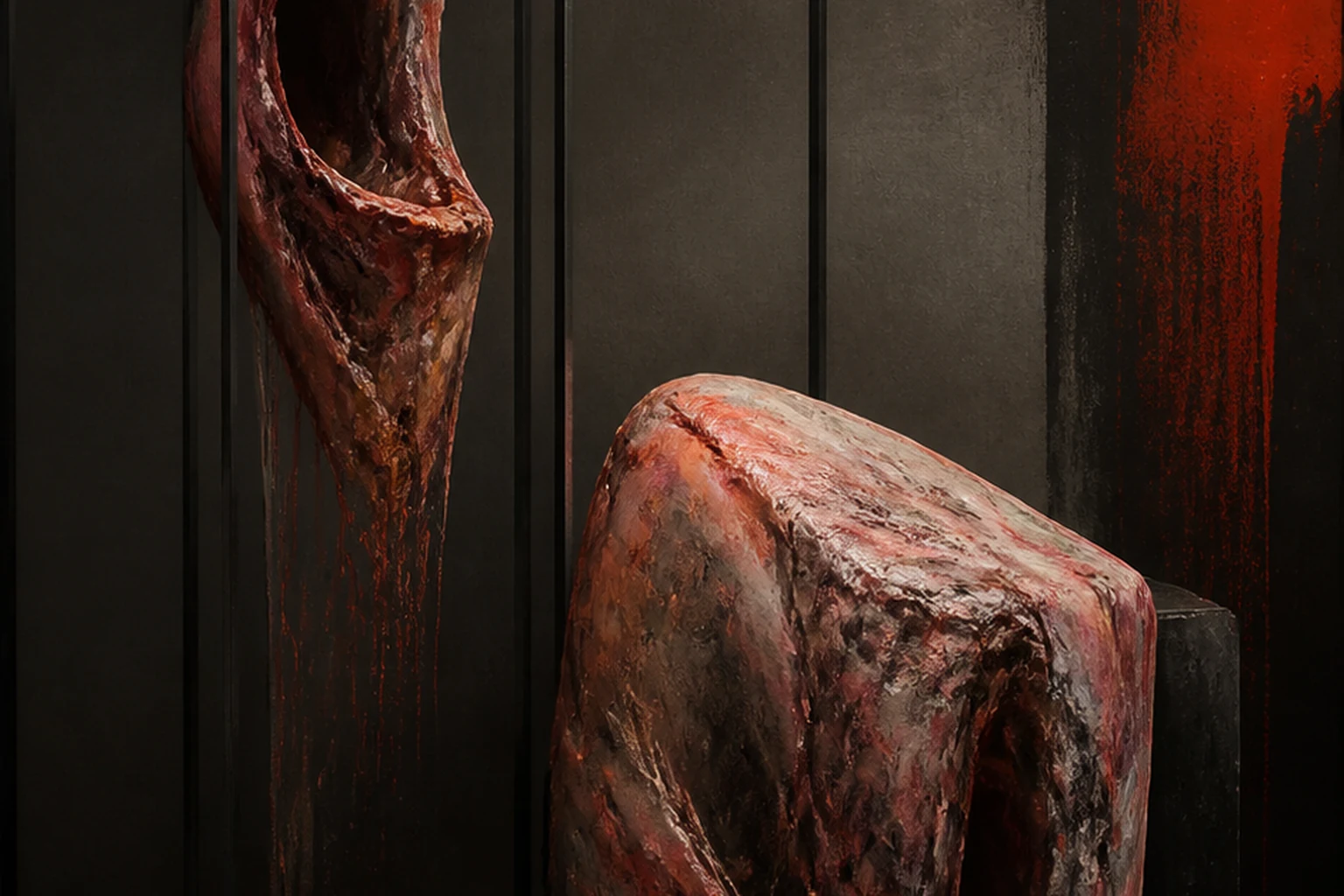
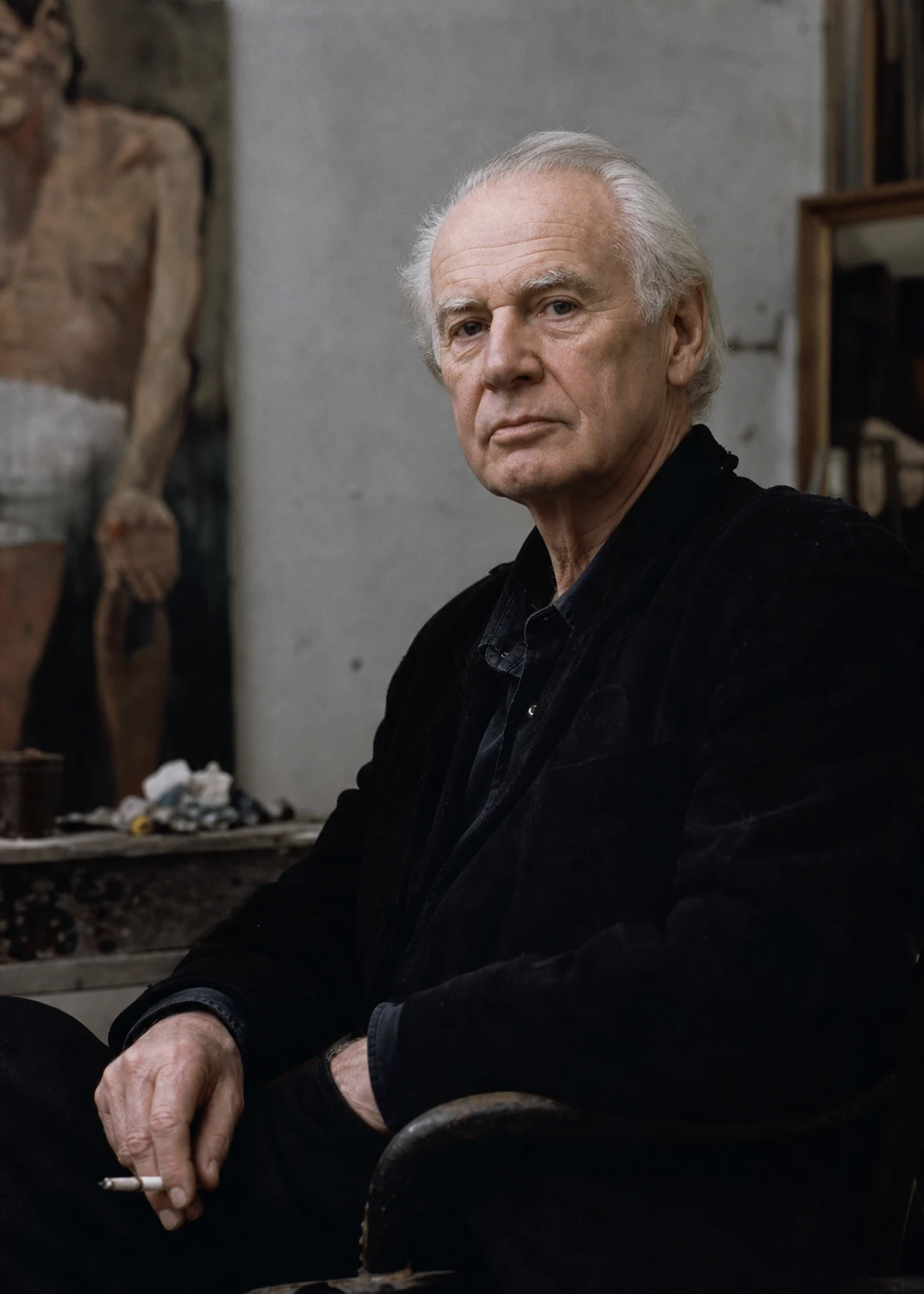
Bacon preserved the recognisability of the human figure but made it endure the pressure of paint, photography, memory and the chance gesture. His painting does not illustrate violence literally: it makes looking itself physically unstable.
Editorial thesis
Francis Bacon's significance rests on turning figurative painting into a field of collision between the body, photography, the historical image, chance and the material gesture. His canon must be examined together with queer history, personal relationships, the market system, self-censorship and the collective labour around the studio.
Reader question
How did an artist with almost no formal artistic education create one of the most recognisable languages of figurative painting in the twentieth century, and why do his images still feel physically unsettling?
The core subject is Francis Bacon, his painting, image sources, studio, interviews and public mythology.
Biographical violence and the artist's relationships are not used as the sole explanation for the deformed figures.
George Dyer, Peter Lacy, John Edwards, Isabel Rawsthorne, Lucian Freud and other models are treated as real people, not merely motifs.
The queer context takes into account the criminal prosecution of male homosexuality in Britain before partial decriminalisation in 1967.
The term 'School of London' is used as a late critical and exhibition frame, not a formal group.
Reproductions of works and archival photographs require a separate rights review.
Short answer
Francis Bacon was born in Dublin on 28 October 1909 to English parents. Owing to asthma, conflict with his father and an unstable family life he left home early, lived in London, Berlin and Paris, worked as an interior and furniture designer and then concentrated on painting.
Three Studies for Figures at the Base of a Crucifixion, Painting 1946, the series after Velázquez, portraits of friends, self-portraits and large triptychs made Bacon a central figure in postwar painting. His studio at 7 Reece Mews was transferred to the Hugh Lane Gallery in Dublin and became a key archive of his method.
1. Dublin, Kildare and an unstable childhood
Francis Bacon was born on 28 October 1909 in Dublin to English parents recently settled in Ireland. The family moved between country houses in Kildare and Laois and periodically lived in England.
His childhood coincided with the First World War, the Irish War of Independence and the Civil War. Political violence should not be turned into a direct formula for his painting, but the experience of an unstable space was part of his early environment.
The only extended period of formal schooling was Dean Close School in Cheltenham, which he attended from 1924 until the spring of 1926.
2. Asthma, his father and an early departure from home
From childhood Bacon suffered from chronic asthma, which made him ill-suited to horses, hunting and the physical pursuits valued by his father.
Family relations were conflictual. Later biographies describe paternal rejection of his son's femininity and sexuality, though isolated dramatic episodes require careful verification of sources.
Around the age of sixteen Bacon left home and began an independent life with no settled education or profession.
3. Berlin, Paris and visual modernity
In the late 1920s Bacon visited Berlin and Paris, where he encountered new architecture, cinema, nightlife, design and avant-garde art.
In Paris an important impression was an exhibition of Picasso, as well as the visual culture of newspapers, medical photography and cinematography.
He did not undergo an academic training in painting and shaped his method through observation, copying, design and experiment.
4. Furniture, interiors and early design
In London Bacon worked as a designer of furniture, carpets and interiors. His studio interiors of the late 1920s and early 1930s were linked to the modernist aesthetic.
The design experience is visible in his later painting: podiums, curved walls, geometric frames, carpet-like planes and artificial light organise space around the figure.
The transition to painting was not an instantaneous break with design; the spatial discipline of the interior remained part of his visual language.
5. The first crucifixions and the destruction of works
In the 1930s Bacon exhibited painting but endured long periods of uncertainty and limited recognition.
The Crucifixion became a structure for him that allowed the joining of the body, sacrifice, meat and the historical tradition, though the artist was a committed atheist.
Bacon regularly destroyed works he considered unsuccessful. The surviving corpus therefore reflects not only production but also a severe authorial selection.
6. Three Studies for Figures at the Base of a Crucifixion
The 1944 triptych Three Studies for Figures at the Base of a Crucifixion became the first work from which Bacon later preferred to begin his own mature history.
Three creatures on an orange ground recall Furies, animals and deformed human bodies. They do not add up to a traditional religious narrative.
The public showing in 1945, just after the war in Europe, linked the painting to the trauma of the era, though its sources and meanings are wider than a direct war allegory.
7. Painting 1946
Painting 1946 unites a figure in a dark suit, an open umbrella, suspended carcasses and a space resembling simultaneously a political tribune and a butcher's shop.
The work came about through the transformation of an initial idea and demonstrates the role of a chance turn in the process.
The painting was acquired by the Museum of Modern Art and played an important part in Bacon's international recognition.
8. Velázquez and the papal portraits
In the 1950s Bacon repeatedly returned to Diego Velázquez's Portrait of Pope Innocent X, working mainly from reproductions.
He turned the motionless ceremonial portrait into a figure trapped in a transparent cage, a darkened space or a stream of vertical brushstrokes.
The series shows how the historical image of power can be dismantled by photography, memory and the painterly gesture.
9. The scream, Battleship Potemkin and the cinematic frame
The open mouth became one of Bacon's best-known motifs. Among its visual sources was the scene of the wounded nurse from Sergei Eisenstein's film Battleship Potemkin.
The cinematic freeze-frame made it possible to detach an expression from a complete narrative and turn it into an autonomous visual impulse.
The scream in Bacon does not necessarily denote a specific character's emotion: it can act as an opening, an animal gesture and a rupture of the face's surface.
10. Photography as working material
Bacon rarely painted models directly from life and preferred to work from photographs, reproductions and damaged printed images.
Photographs in the studio were folded, torn, covered with paint and used repeatedly. Their physical condition became part of the process of transformation.
He joined images of friends with sports shots, medical illustrations, animals and works by old masters.
11. Muybridge, movement and the body
Eadweard Muybridge's sequences of movement photographs were an important source for Bacon's figures.
Sequences of wrestlers, running people and animals offered a way of seeing the body as a set of phases rather than a stable anatomical form.
The painterly deformation often unites several moments of movement in a single body.
12. Chance, the smudge and raw canvas
Bacon valued the chance brushstroke, the thrown paint and the unexpected transformation of the image, but worked within a strict compositional frame.
He often painted on the unprimed reverse of the canvas, where the paint was rapidly absorbed and difficult to correct.
Chance therefore did not mean the absence of control: the artist accepted, amplified or destroyed the result in a process of rigorous selection.
13. The cage, glass and the space of confinement
Many figures are placed in thin geometric frames, circular platforms, rooms or transparent boxes.
These lines simultaneously recall a museum vitrine, a sports ring, a photographic studio and a cage.
The glass of the frame, which Bacon preferred to keep in front of his paintings, adds the viewer's reflection and physically separates the depicted body.
14. The triptych as montage
The triptych allowed Bacon to join three autonomous images without a compulsory sequential story.
The gaps between panels act like montage cuts: forms repeat, change and conflict.
The religious history of the format persists as cultural memory, but the centre no longer guarantees a single object of worship.
15. Portraits of friends and the deformation of likeness
Bacon painted mainly people from his close circle: friends, lovers, artists, critics and bar owners.
Likeness is preserved not through an accurate description of the face but through a recognisable pose, the structure of the head, movement and repeated photographs.
Deformation does not destroy identity; on the contrary, it strives to convey the intensity of presence that the artist considered inaccessible to the neutral portrait.
16. Isabel Rawsthorne, Lucian Freud and Michel Leiris
Isabel Rawsthorne was an artist and a constant participant in the London art scene, not only Bacon's model.
Relations with Lucian Freud included friendship, mutual sitting, professional rivalry and a late estrangement.
The portraits of the writer Michel Leiris arose from an intellectual friendship and an exchange of thoughts on realism, the body and autobiography.
17. George Dyer
George Dyer entered Bacon's life in the 1960s and became one of the most frequently depicted people in his painting.
Popular accounts romanticise their meeting as a burglary of the studio, but versions of the event diverge and should not be presented as established fact.
The relationship combined closeness, dependence, social inequality and destructive conflicts.
18. Triptych, May-June 1973
Dyer died in Paris in October 1971, shortly before the opening of Bacon's retrospective at the Grand Palais.
Triptych, May-June 1973 is linked to his death and shows the figure in a hotel space, at a door and a lavatory.
The work turns personal loss into a sequence of bodily states without offering the viewer a consoling resolution.
19. Self-portrait and the ageing body
After the death of those close to him Bacon increasingly turned to the self-portrait.
Small heads and large triptychs show the face as an unstable mass, changing under the action of time, illness and observation.
The self-portraits are not confessions in a straightforward sense: they continue his general experiment with likeness and deformation.
20. Queer London and the criminal law
Much of Bacon's early and middle life was spent during a period when sexual relations between men were prosecuted under British law.
Bars, private flats, clubs and circles of friends formed an alternative social infrastructure of queer life.
A reading of his bodies, wrestling figures and male closeness must take this historical risk into account without reducing every image to a hidden biographical code.
21. The violence of biography and the limits of explanation
Biographies of Bacon are filled with stories of conflict with his father, sadomasochistic relationships, gambling, alcohol and nightlife.
These facts matter, but a mechanical explanation of the painting through personal trauma turns the work into a symptom and weakens analysis of form, sources and technique.
The editorial task is to distinguish document, testimony, legend and the subsequent commercialisation of the image of the 'accursed artist'.
22. 7 Reece Mews
In 1961 Bacon settled and began working at 7 Reece Mews in South Kensington.
The small studio was filled with paint, books, photographs, cuttings, fabrics and damaged canvases. The outward chaos coexisted with a steady working order.
After the artist's death the studio was documented, dismantled and transported to Dublin City Gallery The Hugh Lane.
23. The destruction of works and authorial editing
Bacon cut up, threw away and asked for the destruction of paintings that did not meet his standard of completion.
Surviving unfinished and damaged canvases reveal stages of work that the artist usually concealed.
The posthumous display of such materials generates productive knowledge but simultaneously raises the question of the boundaries of authorial will.
24. Interviews with David Sylvester
The series of conversations with the critic David Sylvester became one of the most influential sources on Bacon's method.
The artist discussed chance, photography, Velázquez, triptychs, likeness and the aspiration to convey the intensity of fact.
The interviews should be read as a carefully shaped public position, not as neutral access to the author's intention.
25. The School of London
The term School of London links Bacon with Lucian Freud, Frank Auerbach, Leon Kossoff and other figurative painters.
This was not a school with a single manifesto or a shared programme. The label crystallised through criticism, exhibitions and museum narratives.
The frame helps to speak about the continuation of figurative painting but can obscure differences of biography, method and cultural stance.
26. Galleries, the market and the museum canon
Collaboration with the Hanover Gallery and later with Marlborough Fine Art ensured exhibitions, sales and the international circulation of works.
High market value later reinforced the myth of the exceptional genius and made questions of provenance and authentication especially sensitive.
The museum canon was shaped through retrospectives, publications, collections and control of access to images.
27. An ethical reading of the body and suffering
Bacon's painting often shows a vulnerable, open or deformed body but offers no straightforward account of who suffers and why.
Such refusal of explanation can resist illustrativeness, yet the viewer and the museum bear responsibility for the context of display.
It is especially important not to turn queer life, addiction, the death of models and real traumas into decorative 'shock' marketing.
28. The Estate, catalogue raisonné and the Hugh Lane
After Bacon's death his sole heir was John Edwards. Edwards donated the Reece Mews studio to the Hugh Lane Gallery in 1998.
The five-volume catalogue raisonné of the paintings was published by the Estate of Francis Bacon in 2016; the official digital resource includes information on 584 numbered works.
The Hugh Lane Gallery closed for a major refurbishment in September 2025 for at least three years; Bacon's studio remains on site and is protected during the works.
29. Conclusion
Francis Bacon created a language in which the human figure is simultaneously recognisable and perpetually under threat of disintegration.
His painting joins old masters, cinema, medical photography, the chance gesture, personal presence and rigorous composition.
Bacon's critical legacy demands that we see not only the effect of deformation but also the system of images, relationships, law, the market and archival labour that made that effect possible.