artist profile
Damien Hirst
Death, system and the economy of the artistic spectacle
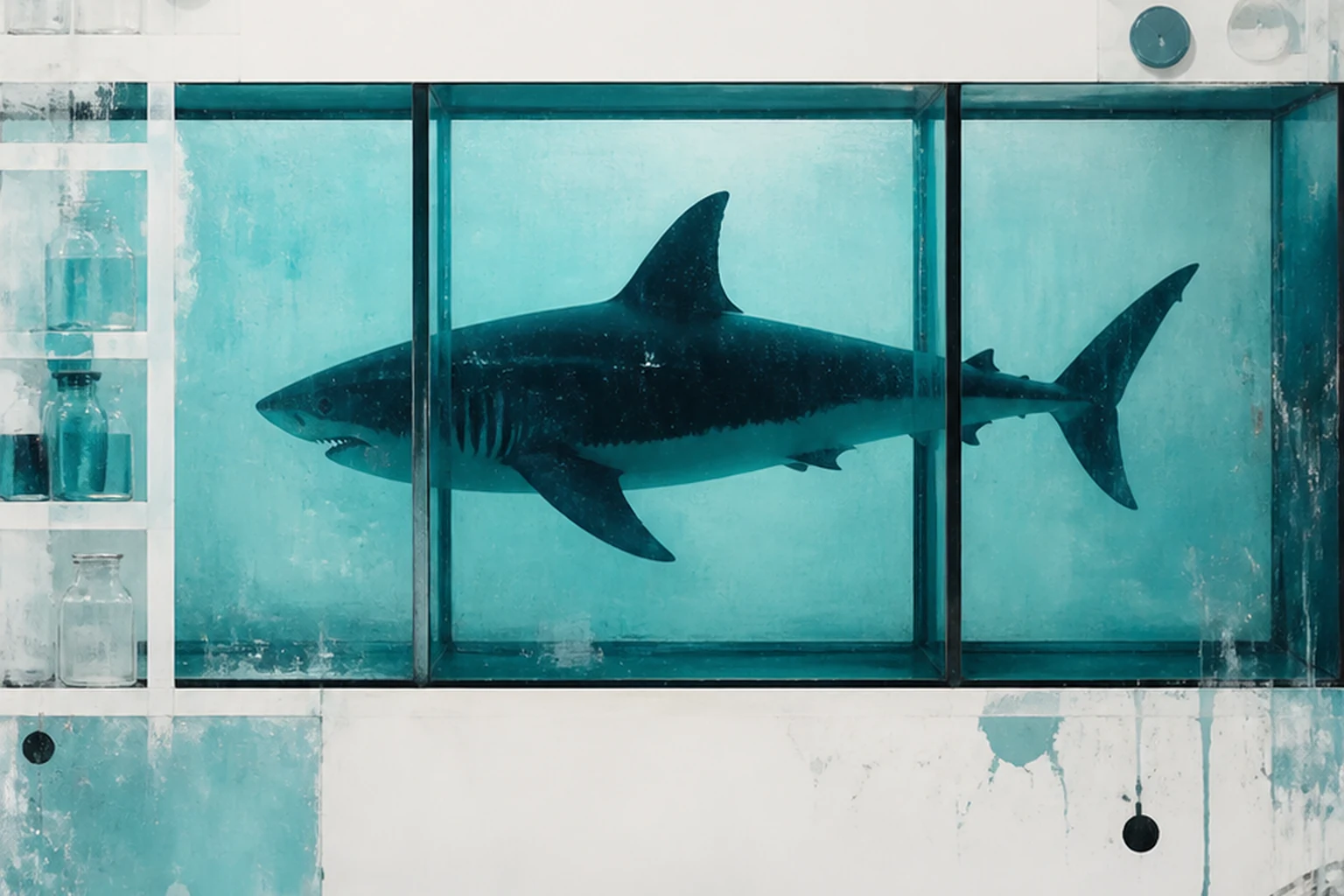
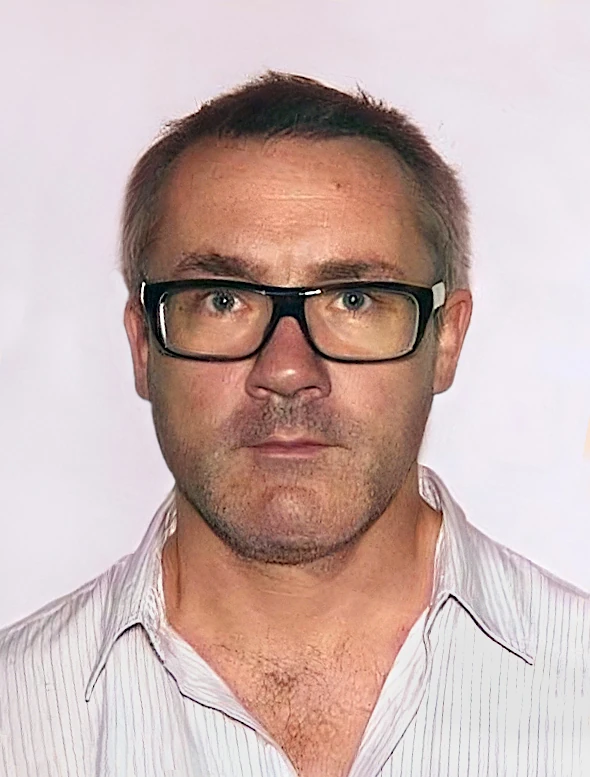
Hirst turned death, medicine, the showcase, seriality and price into a single production system. His work exists not only as an object but as a laboratory, a brand, a legal construction, a museum event and a dispute about where art ends and the management of attention begins.
Editorial thesis
Damien Hirst's significance rests on joining existential themes with the mechanisms of exhibition and market. He uses biological material, medical aesthetics, serial rules, assistants, advertising and price as parts of the work. Critical analysis must take account of the artistic concept, the real animal bodies, the studio labour, conservation, capital and institutional power.
Reader question
How did an artist turn a shark in a tank, a pharmacy cabinet, a row of coloured dots and a diamond skull into global images of death — and why can their meaning not be separated from money, production technique and media spectacle?
The core subject is Damien Hirst: his installations, painting, sculpture, printmaking, curatorial projects, publishing and collecting activity.
Animals and organic materials are examined together with ethics, provenance, conservation and the requirements of display.
The Young British Artists are described as a group shaped institutionally and by the media, not as a single artistic movement.
Studio production is analysed as collective labour under the management of an authorial system.
Market records and auction strategies are separated from artistic assessment, but are not excluded from the history of the work.
NFTs, The Currency and the destruction of physical works are treated as an economic and legal experiment, not only as a technological novelty.
Images of the works are protected by Damien Hirst and Science Ltd / DACS; museum photography may have separate rights.
Short answer
Damien Hirst was born on 7 June 1965 in Bristol and grew up in Leeds. He studied at Goldsmiths College in London, where in 1988 he organised the exhibition Freeze with the participation of students and graduates. The project became an important point in the formation of the generation later called the Young British Artists.
A Thousand Years, The Physical Impossibility of Death in the Mind of Someone Living, In and Out of Love, Pharmacy, Mother and Child, Divided, the Spot Paintings, the Spin Paintings and For the Love of God created a system of images between laboratory, religion and commodity. Hirst received the Turner Prize in 1995, opened the Newport Street Gallery in 2015 and continues to work as artist, publisher, collector and manager of a large studio infrastructure.
1. Bristol, Leeds and an early interest in death
Damien Hirst was born on 7 June 1965 in Bristol and grew up in Leeds. He was raised by his mother, who worked in counselling and community care.
In his youth Hirst visited anatomical museums and drew in a morgue, treating the dead body as a limit of visual knowledge.
The later biography often turns these episodes into a prediction of the future career, yet what matters more is how he connected bodily material with the institutional showcase.
2. Goldsmiths and Michael Craig-Martin
After an unsuccessful first application Hirst studied at Goldsmiths College from 1986 to 1989.
The programme encouraged conceptual thinking and did not tie a student to a single technique. Michael Craig-Martin was an important teacher and intellectual reference.
Hirst used the college not only as a place of study but as a network of future artists, curators and organisers.
3. Freeze as an exhibition and an infrastructural gesture
In 1988 Hirst organised Freeze in a vacant London Port Authority building in Docklands.
Students and graduates of Goldsmiths took part in the exhibition, and the design, catalogue, invitations and work with visitors created a professional image outside the traditional gallery.
Freeze became significant not because it instantly formed a single style but because it showed the ability of young artists to produce an institution themselves.
4. The Young British Artists and the media production of a generation
The term Young British Artists became fixed in the 1990s around a group of authors connected with independent exhibitions, the collection of Charles Saatchi and the new British press.
The artists worked in different languages, but they were united by scale, direct impact, the use of found objects and a readiness to work with the media.
The image of the generation was the result not only of the works but of galleries, collectors, magazines, television and national cultural policy.
5. Medicine Cabinets
Hirst began creating medicine cabinets in the late 1980s, arranging packets of medicine according to formal and colour rules.
The cabinet recalls a modernist grid, a shop display and a medical altar. The titles often refer to songs, religion and human relations.
The packaging promises control over the body, but at the same time recalls illness, dependence on the healthcare system and trust in the brand.
6. A Thousand Years
A Thousand Years of 1990 presents a glass showcase in which maggots turn into flies, feed on a severed cow's head and die in an electric insect killer.
The life cycle takes place in real time and makes death not an image but a process within the exhibition space.
The work joins a laboratory, a theatre of cruelty and an autonomous biological system observed by the viewer.
7. Formaldehyde and Natural History
The Natural History series uses animals placed in glass tanks with a preserving solution.
Formaldehyde preserves a recognisable form, but does not stop chemical change forever. The object requires environmental control, sealing and specialised maintenance.
The tank acts as a sculptural frame, a laboratory chamber and a museum showcase, turning the body into a presence that is at once close and inaccessible.
8. The Physical Impossibility of Death in the Mind of Someone Living
The 1991 work presents a tiger shark in a large tank and was created with the support of the collector Charles Saatchi.
The title describes the impossibility for a living consciousness of imagining its own absence. The shark looks ready to move but is forever stopped.
The work became one of the principal symbols of 1990s art, in which the physical simplicity of the object joins a large-scale philosophical and market narrative.
9. The animal body, replacement and conservation
The original shark changed noticeably over time, and it was later replaced by another specimen as part of a restoration decision.
The replacement raises the question of whether the identity of the work lies in a specific body, the construction of the tank, the authorial instruction or the continuity of the title.
The ethics of the work include the provenance of the animal, the conditions of obtaining the body, toxic substances, staff safety and the consequences of long-term storage.
10. In and Out of Love
The 1991 exhibition In and Out of Love included a space with live butterflies and a room with monochrome canvases bearing the bodies of butterflies.
The viewer entered an environment of birth, flight, feeding and death, in which the exhibition period coincided with the short life cycle of the insects.
The project created a strong image of transformation, but at the same time raised questions about the permissibility of using living creatures as expendable material.
11. Butterflies, life and exhibition mortality
For Hirst the butterfly denotes the soul, beauty, religious resurrection and the fragility of the material body.
In the mosaics and paintings the wings turn into an ornament recalling stained glass, although the beauty rests on the remains of a living organism.
Critical analysis must distinguish the symbolic theme of death from the actual destruction or use of animals in the production of the work.
12. Pharmacy
The installation Pharmacy was first shown in the early 1990s and reproduces the space of a pharmacy with shelves of medicine, a table and laboratory equipment.
The organisation of the drugs by colour and type turns medicine into a total system of classification.
The pharmacy promises healing, but Hirst sets pharmaceutical faith beside a religious altar and a commercial display.
13. Medicine, faith and consumer packaging
Drug names, logos and standardised boxes create a language of scientific confidence.
The patient usually does not understand the molecular mechanism of a drug and trusts the institution, the packaging and the specialist.
Hirst uses this dependence as a model of faith, in which modern medicine is not rejected but shown as a cultural system of authority.
14. Mother and Child, Divided
Mother and Child, Divided of 1993 consists of longitudinally sectioned bodies of a cow and a calf in separate tanks.
The viewer can walk between the halves of the bodies and see the inner anatomy with unusual closeness.
The title joins laboratory division with family loss, turning a scientific demonstration into an emotional structure.
15. The Turner Prize of 1995
In 1995 Hirst received the Turner Prize.
The prize confirmed his status as a central figure of British art and intensified the public dispute about animals, conceptual authorship and the role of scandal.
The award was not the beginning of the career but an institutional recognition of an already formed system of works, collectors and media attention.
16. Spot Paintings
In the Spot Paintings coloured circles are arranged in a regular grid on a white background, usually without repeating a single shade within a painting.
The titles of many works come from chemical compounds and pharmaceutical substances.
The series joins modernist abstraction, laboratory classification, decorative appeal and potentially endless production.
17. The serial rule and the labour of assistants
Most of the Spot Paintings were executed by assistants according to the rules and control of the studio.
Authorship moves from the manual trace to the design of the system, the choice of colours, scale, title and quality of execution.
At the same time the history must keep visible the real labour, since the image of impersonal precision is supported by many skilled executors.
18. Spin Paintings
The Spin Paintings are created by applying paint to a rotating surface.
Centrifugal force distributes the colour, combining a set procedure with an unpredictable result.
Bright spectacle allowed the method to be used in public events, children's workshops and commercial collaborations.
19. Chance, spectacle and mass participation
In the Spin Paintings the viewer easily understands the mechanism by which the image appears, making the process part of entertainment.
Chance does not cancel authorial control: the artist defines the device, the palette, the moment of application and the criterion of completion.
Mass participation widens access, but also turns the method into a recognisable attraction and a licensing format.
20. Black butterflies and religious stained glass
In the Butterfly Paintings and kaleidoscopic series the wings are arranged into symmetrical circles and arches.
The compositions recall the windows of a Gothic cathedral, joining religious beauty with the bodily material of death.
The ornament hides the individuality of each organism and turns a multitude of bodies into a perfect surface.
21. For the Love of God
For the Love of God of 2007 presents a platinum cast of a human skull covered with thousands of diamonds, with the human teeth preserved.
The work joins a memento mori, jewellery luxury, a reliquary and a financial asset.
The title, the brilliance and the real human element create a conflict between the inevitability of death and the attempt to defeat it through material value.
22. Diamonds, death and price
The price of the work was part of its public image from the moment of presentation.
A diamond promises durability and purity, but its value depends on extraction, certification, the market and institutional trust.
The skull shows that luxury does not remove death but makes it an expensive, portable commodity.
23. Beautiful Inside My Head Forever
In September 2008 Sotheby's held a two-day auction of new works by Hirst under the title Beautiful Inside My Head Forever.
The artist and his company bypassed the usual primary-market model, selling the works directly through the auction house.
The event turned the release of a new series into a global financial spectacle and tested the boundaries between the studio, the gallery and the secondary market.
24. The direct auction and the financial event of 2008
The auction coincided with the start of the global financial crisis, which strengthened its symbolic significance.
The success of the sales showed the strength of the brand and the marketing infrastructure, but the later movement of prices was uneven.
Market history does not prove artistic value, yet it is part of the concept when a work is deliberately built around price and trust.
25. Tate Modern, 2012
In 2012 Tate Modern held the first major British retrospective of Hirst.
The exhibition brought together key series from the early installations to the formaldehyde works, butterflies, dots and the diamond skull.
The retrospective confirmed the museum canonisation of the artist and made it possible to see repetition, scale and the system of production as a single project.
26. Newport Street Gallery and the Murderme collection
Newport Street Gallery opened in Vauxhall in 2015 to show works from Hirst's Murderme collection.
The gallery occupies converted theatre workshops and new blocks designed by Caruso St John, and offers free entry.
By 2026 the institution continues its exhibition programme: six galleries and the infrastructure of the gallery turn private collecting into a public cultural resource.
27. Treasures from the Wreck of the Unbelievable
In 2017 Palazzo Grassi and Punta della Dogana showed the large project Treasures from the Wreck of the Unbelievable.
The exhibition told a fictional story of an ancient shipwreck and presented sculptures as archaeological finds, including versions with sea encrustations and museum-cleaned specimens.
The project mixed classicism, mass culture, authorial mystification, a documentary film and expensive production.
28. Fictional archaeology and the authority of the museum
The visitor was invited at once to believe the legend and to notice the obvious anachronisms.
Museum light, the label, the photograph of underwater discovery and the language of restoration created an authority that supported a knowingly fictional story.
Criticism of the project concerned not only kitsch but the colonial history of archaeology, the appropriation of cultural forms and the financial scale of the spectacle.
29. Cherry Blossoms and the return to painting
In the Cherry Blossoms series Hirst worked with thick paint, branches and masses of flowering dots.
The paintings return the dot motif to the image of nature and to the bodily surface of painting.
At the same time the gestural visibility does not remove the studio system and the brand: the series continues to exist within a large production and exhibition apparatus.
30. The Currency
The Currency was launched as a series of ten thousand unique works on paper, each linked to a digital token.
The owner was invited to choose the physical work or the NFT; the unaccepted version was destroyed or ceased to exist in the declared format.
The project explored money, trust, rarity, exchange and the question of where the work lies — in the paper, the online record, the certificate or the owner's choice.
31. NFT, the owner's choice and the burning of the physical object
The physical works corresponding to the chosen digital versions were publicly burned at Newport Street Gallery.
The destruction was not an accidental loss but a pre-announced rule and a spectacular part of the project's economic system.
Criticism concerned the environmental footprint of the blockchain, the theatricalisation of scarcity and the dependence of meaning on the speculative market.
32. Drawing as a conceptual laboratory
Hirst's drawings can precede a major work, record the device of a showcase or return to an idea after realisation.
The exhibition Drawings at the Albertina Modern in 2025 became the first museum survey of his works on paper.
The material shows that an effective final construction often begins with a short scheme, a list, a diagram or a verbal formula.
33. Studio, factory and collective production
Hirst's projects require assistant artists, chemists, engineers, animal-material specialists, founders, jewellers, restorers, digital developers and lawyers.
Science Ltd organises production, rights, the archive and the commercial infrastructure.
The model is close to architectural or cinematic production: a single public authorship manages a multitude of specialised operations.
34. Criticism: animals, labour, ecology and financial power
The use of animals raises questions about the necessity of death for an artistic statement and about responsibility towards living organisms.
Toxic fluids, large volumes of materials, international transport and digital technologies create an environmental cost rarely visible in a clean showcase.
Financial power makes it possible to produce works of museum scale and at the same time reinforces inequality of access to institutions and the market.
35. Rights, fakes, editions and provenance
The practice includes unique works, studio series, print editions, Other Criteria products, NFTs and licensed goods.
For correct attribution one must distinguish the original work, an authorised edition, a derived product and the unauthorised use of an image.
Publication requires verification of Science Ltd, DACS, the photographic credit, the museum licence and the exact state of the work.
36. Current legacy and institutional activity
In 2025 the Albertina Modern showed a museum survey of Hirst's drawings, stressing the importance of preparatory and retrospective graphics.
In 2026 Newport Street Gallery continues its free programme of exhibitions from the artist's collection and of invited projects.
Hirst remains at once an artist, owner of a collection, manager of an exhibition venue and participant in the market, which makes the institutional role part of his work.
37. Conclusion
Damien Hirst made death visible through a perfectly controlled surface, a showcase and a system of repetition.
His art cannot be assessed only as provocation or only as philosophy: it constantly joins the material body, production labour, the institution, price and the media.
Hirst's chief legacy is an understanding of the artistic object as a managed ecosystem in which the idea, matter, market and public dispute are produced at the same time.