artist profile
Jean-Michel Basquiat
Language, race and the production of artistic value
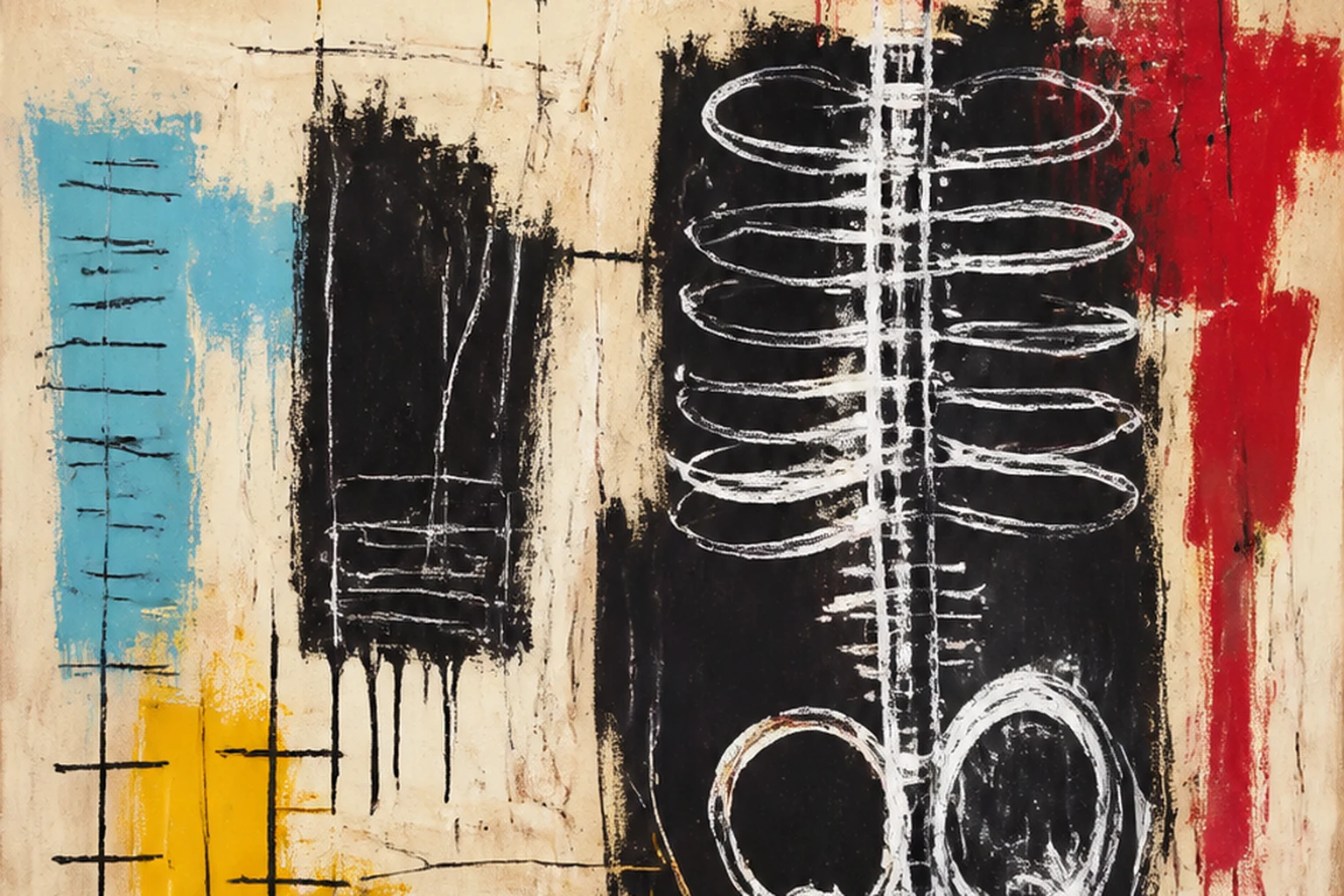
Basquiat turned the canvas into a field of conflicting voices: anatomy, jazz, boxing, colonial history, racist caricature, the trademark and the personal signature existed at once. His work was not spontaneous chaos but a fast and disciplined montage of cultural memory.
Editorial thesis
Basquiat's significance rests on joining text, drawing, Afro-Atlantic history, mass culture and personal mythology. His works expose the ways in which power distributes visibility, knowledge and price, but the artist's own career was also shaped by racism, the speculative market and the production of the image of the young genius.
Reader question
How did a young artist from Brooklyn create in a few years one of the most recognisable languages of the late twentieth century — and why did the label 'graffiti artist' at once make him famous and limit the understanding of his intellectual practice?
The core subject is Jean-Michel Basquiat: his painting, drawing, text, music, print graphics and public image.
SAMO is treated as a joint textual project of Basquiat and Al Diaz, not as an individual signature of a single author.
The term 'graffiti artist' is used critically and does not replace the analysis of studio painting.
The Haitian and Puerto Rican background is examined without turning the biography into a fixed ethnic formula.
The relationship with Andy Warhol is analysed as a friendship, collaboration, exchange of resources and an unequal institutional position.
Drug dependence and death are not used as a romantic explanation of the creativity.
Market records are separated from artistic assessment, provenance and questions of authentication.
Short answer
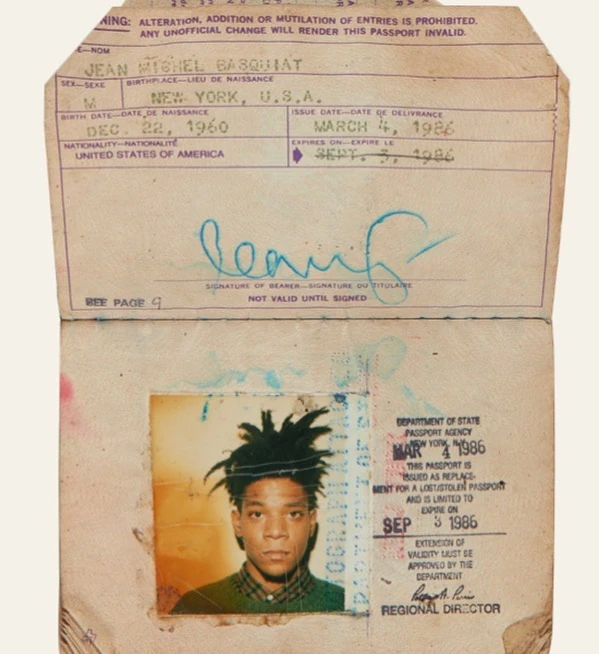
Jean-Michel Basquiat was born on 22 December 1960 in Brooklyn. His father Gérard Basquiat was of Haitian origin, and his mother Matilda Andrades was born in Brooklyn to a Puerto Rican family. From an early age he visited museums, drew and spoke English, Spanish and French.
In the late 1970s Basquiat, together with Al Diaz, created the SAMO texts in Lower Manhattan, played in the band Gray and took part in the downtown scene. After the Times Square Show and New York/New Wave he quickly entered the gallery system. The key works of 1981-1988 join anatomy, jazz, the history of slavery, colonialism, police violence, sport, celebrity and the economy of the art market.
1. Brooklyn, family and the linguistic environment
Jean-Michel Basquiat was born on 22 December 1960 in Brooklyn and grew up in a family of Haitian and Puerto Rican roots.
His mother Matilda Andrades took her son to New York museums and supported his interest in drawing. His father Gérard worked as an accountant.
The multilingual environment — English, Spanish and French — later appeared in the paintings as a free mixing of words, historical names and phonetic fragments.
2. The accident, Gray's Anatomy and the map of the body
As a child Basquiat was hit by a car and underwent surgery. During his recovery his mother gave him the medical atlas Gray's Anatomy.
Bones, teeth, organs, incisions and captions of the body became enduring elements of his artistic language.
For Basquiat anatomy works not as a scientific illustration but as a way of showing the body as at once living, vulnerable, historically classified and economically valued.
3. City-As-School and alternative education
As a teenager Basquiat studied at City-As-School, an alternative Manhattan school that joined learning with urban practice.
There he met Al Diaz, the future co-author of SAMO.
The absence of an academic art diploma did not mean an absence of education: Basquiat read intensively, listened to music, visited museums and gathered visual information.
4. SAMO with Al Diaz
SAMO arose as a joint project of Jean-Michel Basquiat and Al Diaz in the late 1970s.
Short texts were applied to the walls of Lower Manhattan and mocked commerce, religion, artistic clichés and the language of urban advertising.
The reading of the name as 'same old shit' stressed the ironic character of the project, but its force lay in an aphoristic ambiguity.
5. Text on the street as critical aphorism
SAMO differed from the territorial tag: at its centre was a phrase, not only the author's name.
White chalk or spray turned the urban facade into a rapidly circulating page.
The art market later often used SAMO as a romantic story of a 'street discovery', diminishing the role of Al Diaz and the intellectual complexity of the texts.
6. Gray and downtown music
Basquiat played clarinet and synthesiser in the experimental band Gray.
The band performed at the Mudd Club, CBGB and other spaces of the New York downtown scene.
Noise, improvisation, fragmentation and the layering of sounds have direct parallels with the rhythm of his painting.
7. Canal Zone, Fashion Moda and the Times Square Show
Before stable gallery recognition Basquiat sold postcards and painted objects, and took part in group exhibitions and self-organised projects.
Fashion Moda in the South Bronx and the Times Square Show of 1980 joined artists from different districts, music, graffiti, punk and an experimental exhibition culture.
These spaces were not a preparatory step towards the 'real' gallery but independent infrastructures of art.
8. New York/New Wave
The exhibition New York/New Wave, organised by Diego Cortez at P.S.1 in 1981, became an important moment of public recognition for Basquiat.
His works were shown alongside photography, music, graffiti and the art of the downtown scene.
The exhibition helped move his practice from urban subculture into international artistic circulation.
9. Modena and Annina Nosei
Basquiat's first solo gallery exhibition took place in 1981 in Modena at Emilio Mazzoli's.
In 1982 his first solo exhibition in New York took place at Annina Nosei's gallery.
Nosei provided a basement studio space, yet the later history often described this period through the contested image of a dealer producing an artist for the market.
10. Studio, speed and discipline
Basquiat worked fast, but speed did not mean chance. He kept books, television, music, reproductions and materials in view at the same time.
The paintings were built in layers: drawing, word, overpainting, repetition, quotation and erasure.
The unfinished surface and visible corrections are not an absence of technique but a way of showing the process of thought.
11. Untitled (Skull) and the anatomical portrait
Untitled of 1981, often informally called Skull, joins a head, skull, mask and X-ray image.
The face is at once open and closed: the viewer sees teeth, seams, layers of colour and an intense gaze.
The work resists the racist tradition of turning the black face into a type or caricature, offering an image of a complex inner structure.
12. The crown, halo and the sign of power
The three-pointed crown became one of Basquiat's most recognisable signs.
It can denote power, sanctity, victory, self-proclamation, a brand or the return of dignity to a historically excluded figure.
The crown was later commercialised so widely that it often separates from the specific heroes and the political function within the painting.
13. Word, crossing-out and repetition
Basquiat wrote names, prices, scientific terms, lists, phrases and single letters.
A crossed-out word does not disappear: it becomes more visible, since the viewer tries to recover the forbidden or hidden reading.
Repetition turns the text at once into sound, visual rhythm, evidence and an obsessive thought.
14. Photocopy, collage and reproducible memory
The artist often made photocopies of his own drawings and included them in the paintings.
A single image could be repeated, enlarged, cropped and move between works.
The photocopy allowed the building of a personal archive of symbols and at the same time imitated the mass circulation of a document, advertisement or police bulletin.
15. Irony of Negro Policeman
Irony of Negro Policeman of 1981 shows a black figure turned by form and inscriptions into a rigid mechanism of power.
The title points to the contradiction between a person's racial identity and an institution that historically controlled the black population.
The painting does not accuse an individual person by a simple scheme but explores the internal operation of a power structure.
16. Charles the First and the black hero
Charles the First of 1982 is connected with the jazz saxophonist Charlie Parker, nicknamed Bird.
The painting joins the crown, musical and historical fragments, turning the jazz musician into an intellectual monarch.
The warning MOST YOUNG KINGS GET THEIR HEADS CUT OFF connects fame with violence, early death and the exploitation of talent.
17. Jazz, bebop and Horn Players
Basquiat constantly listened to jazz and dedicated works to Charlie Parker, Dizzy Gillespie, Max Roach and other musicians.
Horn Players of 1983 is built as a visual improvisation of names, sound repetitions, faces and anatomical signs.
The composition does not illustrate the music but acts like bebop: it speeds up, breaks apart and reassembles the theme.
18. Boxing, Joe Louis and sporting iconography
In the paintings appear Joe Louis, Jack Johnson, Sugar Ray Robinson and other black athletes.
Boxing offers the image of physical victory, but at the same time recalls an industry that earns from the damage done to the black body.
The crown and the list of victories return to the hero a status that mass culture often limited to spectacle.
19. Slavery, colonialism and the commodity language
Basquiat included the names of raw materials, ships, trade routes, currencies, brands and historical figures.
Sugar, cotton, tobacco and the human body turn out to be parts of a single economic history.
In his painting the trademark can be at once evidence of global circulation and a mark of violent appropriation.
20. Hollywood Africans
Hollywood Africans was painted in 1983 during Basquiat's stay in Los Angeles.
At the centre are depicted Basquiat, Toxic and Rammellzee, surrounded by words about Hollywood, caricature and the limited roles for black people.
The painting analyses an industry that produces visibility but reduces a complex personality to a racial cliché.
21. Defacement and the death of Michael Stewart
In September 1983 the young black artist Michael Stewart died after being detained by the New York Transit Police.
Basquiat created Defacement (The Death of Michael Stewart) on the wall of Keith Haring's studio.
The work became an immediate response to police violence and testimony of the artist's own fear of racial profiling.
22. Beat Bop, Rammellzee and K-Rob
In 1983 Basquiat financed and produced the recording Beat Bop with Rammellzee and K-Rob and created the record's artwork.
The track joins early hip-hop, experimental sound and downtown culture.
The authorship of the project must account for the performers, production, recording, independent distribution and visual design.
23. Documenta and the Whitney Biennial
In 1982 Basquiat took part in documenta 7 in Kassel.
In 1983 his works were included in the Whitney Biennial.
Institutional recognition came extremely quickly and fixed a contradictory position: the artist became a symbol of new American painting while remaining an object of racist exoticisation.
24. Los Angeles and Larry Gagosian
Basquiat worked in Los Angeles and exhibited with Larry Gagosian in the early 1980s.
The Californian period gave him large working spaces, new collectors and connections with the music scene.
At the same time the growing international gallery network intensified the pressure of productivity and turned the young artist into a scarce market resource.
25. Andy Warhol: acquaintance and mutual exchange
Basquiat had long been interested in Warhol and in 1979 sold him a postcard. A closer acquaintance came in 1982 through Bruno Bischofberger.
Warhol provided access to institutions, collectors and the model of artistic celebrity; Basquiat returned to him the energy of hand painting and contact with a new generation.
The relationship was friendly and productive, but existed within an unequal distribution of age, capital and cultural power.
26. The joint paintings of Basquiat and Warhol
Between 1983 and 1985 the artists created joint works, sometimes together with Francesco Clemente.
Warhol applied logos, newspaper fragments and large signs, over which Basquiat drew, wrote and partly destroyed the image.
The works should be perceived not as a young artist added to a ready background but as a visual collision of equal authorial systems.
27. Critical reaction and institutional asymmetry
The 1985 joint exhibition of Basquiat and Warhol received harsh reviews, often presenting Basquiat as dependent on the older artist.
Such criticism reinforced the already existing racist narrative of the young 'wild talent' needing a white intermediary.
Contemporary analysis must assess the paintings themselves and at the same time study the language through which criticism distributed authority.
28. Friends, partners and the autonomy of their practices
Connected with Basquiat were Suzanne Mallouk, Madonna, Paige Powell, Jennifer Goode, Keith Haring, Fab 5 Freddy, Toxic, Rammellzee and many members of the downtown scene.
The popular biography often turns the women into romantic appendages and the friends into the background of the story of the genius.
An accurate editorial treatment must preserve their independent biographies, professions and authorship.
29. Market, the tokenisation of the person and the racist gaze
Basquiat's career developed during the rapid growth of the market for contemporary painting in the early 1980s.
Critics and collectors often described him through primitivising words: instinctive, wild, untrained.
These formulas at once raised the exotic market appeal and denied the reading, the historical knowledge and the complexity of the compositional method.
30. The late works and Riding with Death
In the late paintings the space often becomes more sparse and the figures more isolated.
Riding with Death of 1988 shows a schematic rider on a skeletal creature and is often perceived as a dark final image.
Yet reading the late work exclusively as a prediction of death simplifies its formal connections with Leonardo, anatomical drawing and the theme of control of the body.
31. Death without romanticisation
Jean-Michel Basquiat died on 12 August 1988 in New York of acute mixed drug intoxication.
He was twenty-seven years old.
Drug dependence, isolation and the pressure of the market are an important context, but not an explanation of the artistic force and not a basis for turning the death into a romantic brand.
32. Archive, Estate and rights
The Estate of Jean-Michel Basquiat manages the legacy and maintains an official resource with a chronology, collections and materials about the artist.
Images of the works are licensed through the authorised structure Artestar, as reflected in the museum credits.
Publication requires verifying the rights to the work, the museum photograph, the portrait of the artist and the archival document as separate objects.
33. Authentication, fakes and the end of the authentication committee
The high value of Basquiat's works made provenance and technical examination especially important.
The Estate's authentication committee ceased work in 2012 and no longer issues opinions.
Recent cases of fakes showed that a museum exhibition or a convincing owner's story does not replace documented provenance and independent examination.
34. The museum canon and new interpretations
Basquiat's works are held at the Whitney Museum, the Brooklyn Museum, MoMA, The Broad, the Menil Collection and other international collections.
Contemporary exhibitions increasingly examine his notebooks, music, political themes, collaborations and the role of the family.
This extends the canon beyond the image of the young graffiti genius and returns to the artist the status of reader, historian and editor of cultural signs.
35. Conclusion
Jean-Michel Basquiat created a visual language in which the personal signature, encyclopaedic knowledge and the history of racial violence act at once.
His paintings show how a name becomes a brand, the body a field of power, and the hero an object of glorification and exploitation.
Basquiat's chief legacy is not the crown as a logo but the ability to turn the conflicting languages of culture into a critical structure of the image.