artist profile
Jeff Koons
Desire, production and the economy of the perfect surface
Koons turns a cheap toy, a household appliance, an advertising image and a child's party into an object of flawless technical precision. Behind the festive surface of his art lie questions of desire, class taste, authorial labour, copying and the power of the market.
Editorial thesis
Jeff Koons's significance rests on a radical joining of the readymade, the mass image, industrial precision and the art market. His works at once offer pleasure without shame and demonstrate how carefully contemporary culture produces desire, value and a flawless surface.
Reader question
Why do objects resembling a vacuum cleaner, an inflatable rabbit, a porcelain figurine or a balloon require the most complex engineering, an enormous budget and decades of production — and how does this labour-intensity change the meaning of the mass image?
The core subject is Jeff Koons: his sculpture, painting, photography, editioned objects, public projects and authorial rhetoric.
The readymade is examined together with the legacy of Marcel Duchamp, Pop art and commodity culture.
Production is analysed as the collective labour of the studio, engineers, founders, polishers, printers and specialised factories.
Made in Heaven is examined in the context of sexual representation, consent, publicity and family biography without reproducing explicit images.
The appropriation lawsuits are presented as different legal decisions, not as a single assessment of the whole practice.
Auction records are separated from artistic significance and institutional influence.
Current activity and Moon Phases are verified against the artist's official resource as of the preparation date.
Short answer
Jeff Koons was born on 21 January 1955 in York, Pennsylvania. He studied at the Maryland Institute College of Art and the School of the Art Institute of Chicago, received a BFA in 1976 and moved to New York in 1977.
Starting with Inflatables, Pre-New and The New, Koons explored desire through new goods and reflective surfaces. Equilibrium, Luxury and Degradation, Statuary, Banality, Made in Heaven and Celebration established him as a central and contested figure of 1980s-1990s art. The later series broadened the method through digital design, the Old Masters, antiquity and space infrastructure.
1. York, the family trade and an early interest in art
Jeff Koons was born on 21 January 1955 in York, Pennsylvania. His father Henry Koons ran an interiors business, and his mother Gloria worked as a seamstress and seller.
In the family shop the young Koons observed how an object, the window display, the lighting and the way of presentation create the desire to buy.
He drew early and sold his own works through his father's shop, so for him the artistic object existed from the start alongside trade and public display.
2. Baltimore, Chicago and Ed Paschke
Koons studied at the Maryland Institute College of Art, then spent a period at the School of the Art Institute of Chicago.
In Chicago he worked near Ed Paschke, whose painting joined mass culture, bright colour and a psychologically charged image.
In 1976 Koons received a BFA from the Maryland Institute College of Art and continued to shape a practice between painting, the object and commodity presentation.
3. New York, MoMA and the financial sector
In 1977 Koons moved to New York and worked in the membership department of the Museum of Modern Art, attracting visitors through a theatrical manner of speech and appearance.
He later worked in the financial sector and used the income to produce artistic projects.
This experience joined the museum, sales, persuasion and capital — themes that became the structure of his later career.
4. Inflatables
In the Inflatables series of the late 1970s cheap vinyl flowers and rabbits were placed before mirrors.
An inflatable object looks alive, but depends on air, is easily damaged and gradually loses its shape.
The mirror includes the viewer and the room, turning a simple toy into a system of desire, narcissism and instability.
5. Pre-New and household appliances
In Pre-New Koons showed toasters, kettles and other appliances as images or objects detached from use.
New goods promise an improved life even before the buyer begins to use them.
The artist is interested not in the household function but in the psychological energy of the promise contained in design and advertising.
6. The New
In the series The New new vacuum cleaners were displayed in transparent cases with fluorescent light.
The appliances remained unused and kept a state of shop cleanliness.
The case at once recalls a shop, a museum display, an aquarium and a religious reliquary.
7. Newness, cleanliness and the case
For Koons the word new denotes not only the age of the goods but a moral fantasy of stainlessness.
The use of an object inevitably leads to dust, wear and the loss of a flawless state.
The case therefore protects the object and at the same time strips it of practical life.
8. Equilibrium
The solo exhibition Equilibrium took place in 1985 and joined basketballs in tanks, bronze life-saving devices, advertising images and sporting symbolism.
Keeping the ball centred in the liquid required a precise mixture of distilled water and reagents, developed in consultation with the physicist Richard Feynman.
The series joins sporting success, social mobility and a state of equilibrium that cannot be maintained permanently.
9. The basketball, the liquid and the unattainable balance
A ball suspended in a tank looks free of gravity, yet its position slowly changes and requires technical maintenance.
The sporting object is connected with the dream of escaping economic and racial inequality through exceptional talent.
The perfect equilibrium turns into an image of unattainable salvation supported by a complex system.
10. Luxury and Degradation
In 1986 the series Luxury and Degradation joined advertising images of alcohol with bar-culture objects cast in stainless steel.
Koons set side by side advertising aimed at different social groups, showing how one product changes its language of promise according to the audience.
The title connects luxury with degradation and points to the double role of consumption.
11. Alcohol advertising, class and desire
Advertising posters do not simply show a drink: they offer status, sexuality, belonging and a model of behaviour.
Polished steel makes a cheap or functional object precious and at the same time cold.
The viewer sees himself in the surface of the object and becomes part of the advertising mechanism.
12. Statuary
The 1986 Statuary series transferred into stainless steel objects ranging from mass souvenirs to a historical portrait bust.
The same material equated Louis XIV, Bob Hope, an Italian woman and an inflatable rabbit.
The hierarchy of high and low taste was replaced by a shared system of reflection and commodity appeal.
13. Rabbit
Rabbit of 1986 is made of mirror-polished stainless steel after the model of a cheap inflatable toy.
Hard metal precisely imitates the soft shell, the folds and the sealed emptiness of the original object.
The absence of a face makes the figure at once attractive, sexualised, combative and emotionally impenetrable.
14. Reflection, emptiness and the viewer
The surface of Rabbit does not reveal the interior of the sculpture but reflects everything around it.
The viewer sees his own distorted body and the museum environment, so the object cannot be perceived as an autonomous form.
The emptiness inside becomes not a flaw but the condition of an ideal outer shell.
15. Banality
The 1988 Banality series used porcelain, polychrome wood and professional craft workshops to create complex figures.
The sources were souvenirs, popular characters, religious images and commercial illustration.
Koons deliberately abandoned the distance of good taste and invited the viewer to accept his own pleasure in the sentimental and the decorative.
16. Michael Jackson and Bubbles
Michael Jackson and Bubbles of 1988 is made of porcelain and covered with gilded decorative elements.
The pop star and the chimpanzee are presented as an almost religious or courtly group, at once intimate and artificially flawless.
The work joins celebrity, innocence, luxury, racial representation and the production of the public persona.
17. Kitsch, porcelain and 'bad taste'
Porcelain is historically connected with expensive decorative objects, collecting and the bourgeois interior.
Koons uses technical perfection to deprive the viewer of the comfortable position of ironic superiority over kitsch.
Yet the rejection of critical distance also allows the work to exist as an extremely expensive luxury object.
18. Made in Heaven
Made in Heaven developed from the late 1980s and included photographs, painting, glass and sculpture featuring Koons and Ilona Staller, known as Cicciolina.
The works demonstratively joined pornographic visuality, a romantic union, religious composition and artistic celebrity.
The series tested the boundaries between a private act, a consensual performance, commercial eroticism and the museum image.
19. Sexual publicity and family biography
Koons and Staller married, and their public images became part of the works and a media project.
The later conflict over custody of their son Ludwig greatly affected the artist's personal life and the interpretation of the Celebration series.
Editorial work must distinguish artistic publicity, the family's legal history and the child's right to privacy.
20. Puppy
Puppy was created in 1992 as an enormous sculpture in the shape of a dog, covered with living flowers.
The permanent version stands in front of the Guggenheim Museum Bilbao and became one of the museum's most recognisable public images.
The sculpture joins a sentimental motif, the Baroque garden, an engineering frame and a continuous cycle of plant care.
21. Living sculpture and maintenance
Puppy cannot exist without a system of soil, watering, plant replacement, gardeners and technical monitoring.
The outer form remains recognisable, but the colour, density and state of the surface constantly change.
The work shows that monumental public sculpture can be not an eternal material but a maintained living organism.
22. Celebration
The Celebration series was conceived in 1994 around holidays and life-cycle events: a birthday, love, a gift and children's play.
It includes large paintings and sculptures in mirror-polished steel with a transparent coloured coating.
The simple motifs become archetypal, but require extraordinarily long development and production.
23. Balloon Dog, Tulips, Hanging Heart and Play-Doh
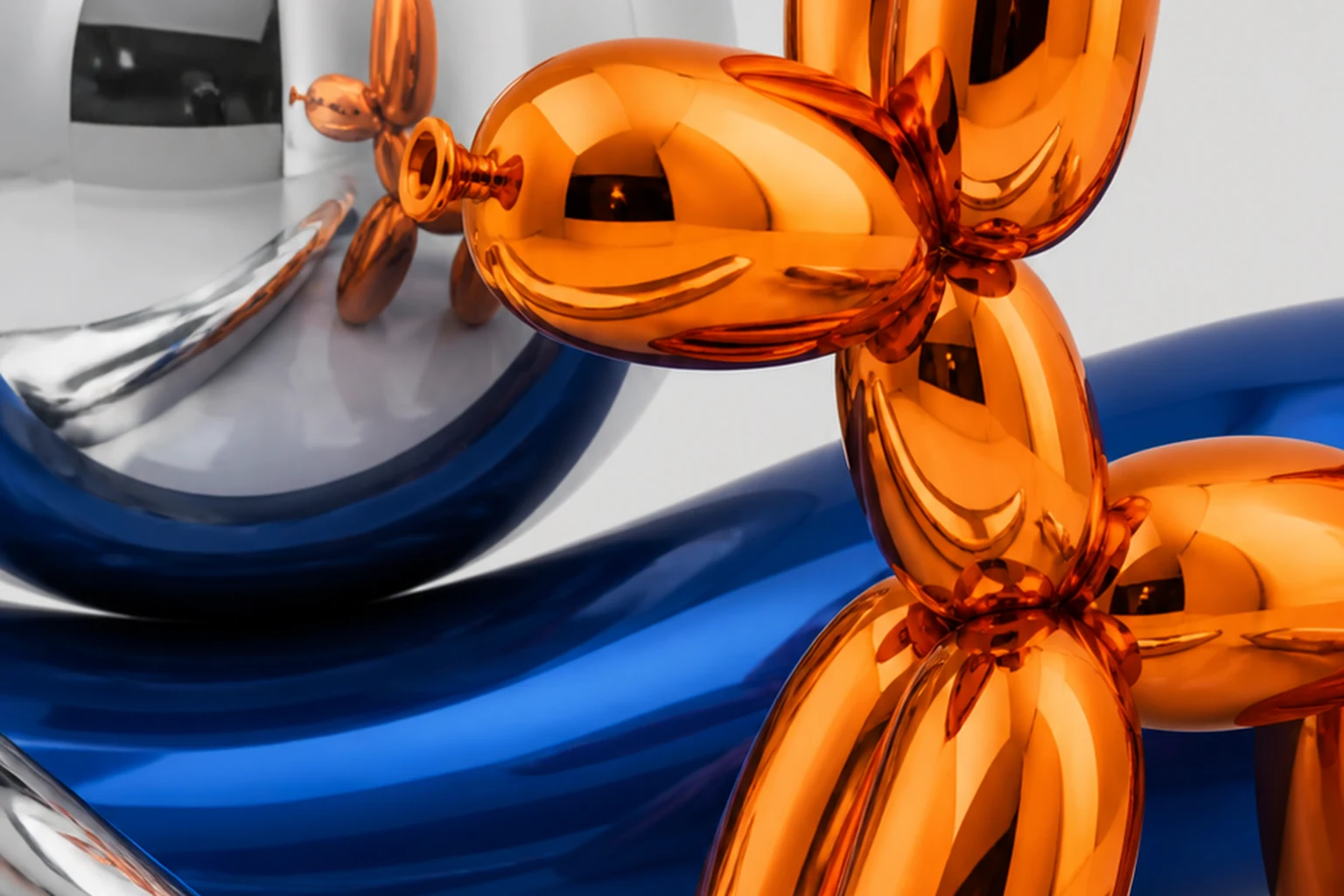
Balloon Dog reproduces a twisted balloon toy at a scale of over three metres and exists in five colour versions.
Tulips and Hanging Heart translate a flower and a gift into complex reflective volumes in which the perfect surface hides the weight and the engineering structure.
Play-Doh took about two decades to create, in order to reproduce precisely a random child's mound of plasticine in polychrome aluminium.
24. The perfect surface and industrial production
Mirror steel requires precise welding, repeated grinding, polishing and control of the coating.
Digital scanning, modelling, prototypes and specialised factories make it possible to reproduce softness, transparency and chance in a heavy material.
The invisibility of the seams and handwork is the result of an enormous amount of collective labour.
25. Easyfun and Easyfun-Ethereal
Easyfun used mirrored silhouettes of animals and objects, while Easyfun-Ethereal developed the digital collage in large oil painting.
Advertising fragments of food, hair, body, water and landscape joined into images without a single natural perspective.
The paintings were painted by hand after carefully prepared digital schemes, joining computer montage with traditional technique.
26. Popeye and the return of the inflatable object
The Popeye series returns to inflatable toys and everyday objects, but transfers them into polychrome aluminium and complex assemblies.
The soft object becomes permanent, while a rope, bucket or waste bin takes part in the visual equilibrium.
The Popeye character symbolises physical reinforcement through consumption and connects children's culture with an adult fantasy of strength.
27. Hulk Elvis and high-precision fabrication
Hulk Elvis joins the figure of the Hulk, the image of Elvis, military power, Asian visual culture and abstract painted layers.
The sculptures are created using complex form capture and production methods close to advanced engineering.
The more precisely the material double looks like a cheap inflatable toy, the stronger the contradiction between the image and the real cost.
28. Antiquity and dialogue with the canon
In Antiquity Koons joins reproductions of ancient sculpture, bodily silhouettes, children's drawings and elements of mass culture.
The history of art becomes not a sequential line but a surface of simultaneous access and digital montage.
Such a method broadens the dialogue with the canon, but also raises the question of context, rights and turning another's image into material.
29. Gazing Ball
The Gazing Ball series began in 2013 with white plaster sculptures and blue reflective spheres, then included versions of famous paintings.
The sphere reflects the viewer and the space over the reproduction of an Old Master work.
The history of art turns into a present-time situation in which the museum canon and the person present occupy a single visual plane.
30. Versailles and the institutional conflict of tastes
The 2008 exhibition Jeff Koons Versailles placed contemporary works in the ceremonial spaces of the palace.
The juxtaposition of mirror steel, porcelain and historical decoration underlined the closeness of Koons's art to court luxury and spectacle.
The project drew public protests and showed that the dispute over taste is connected not only with form but with national memory, institutional power and the tourist economy.
31. The authorial studio and collective labour
Koons's studio operates as a large production system with artists, digital specialists, engineers, managers and external contractors.
The author defines the concept, sources, composition, material and surface standards, while realisation is distributed among many specialists.
Critical analysis must name the collective labour, reducing the studio neither to an impersonal factory nor to the myth of an individual hand.
32. Appropriation and Rogers v. Koons
String of Puppies from the Banality series was created on the basis of Art Rogers's photograph Puppies.
In 1992 the Second Circuit Court of Appeals upheld copyright infringement and rejected the fair use argument in the specific circumstances of the case.
The decision showed that a reference to a general satire of consumer society does not automatically justify the exact copying of a protected composition.
33. Blanch v. Koons and fair use
In Niagara from the Easyfun-Ethereal series Koons used a fragment of Andrea Blanch's fashion photograph.
In 2006 the Second Circuit Court of Appeals found the use a transformative fair use, considering the new purpose, scale and context of the collage.
Comparing the two cases shows that appropriation is assessed by the specific manner of use, not by the artist's status or the genre of the work.
34. The market and the Rabbit record
In May 2019 one version of Rabbit was sold at Christie's for 91,075,000 dollars including the buyer's premium.
At the time of sale the result became a world auction record for the work of a living artist.
The record strengthened the symbolic link between Rabbit and financial value, but is not in itself proof of artistic quality.
35. Moon Phases
Moon Phases of 2023 consists of 125 unique sets, each linking a miniature lunar sculpture, an Earth sculpture and an NFT.
The miniature objects are dedicated to people who influenced human history and join a portrait of memory with the phases of the Moon.
The project carries Koons's familiar strategy — reflection, edition, precious material and celebrity — into the infrastructure of a space mission.
36. NFT, space and an authorised object on the Moon
On 22 February 2024 the Odysseus lander of Intuitive Machines delivered the set of Moon Phases miniatures to the lunar surface.
The artist's official resource describes the project as the first authorised work of art placed on the Moon.
The status of the object raises questions of preservation without access, private space infrastructure, digital ownership and cultural claims beyond the Earth.
37. Editions, licensing and commercial products
Koons issues porcelain and print editions and collaborates with fashion, design and technology brands.
In 2026 the official store presents new editioned products, including Balloon Dog lamps and wooden versions of Split-Rocker.
The edition broadens the audience but creates a complex ladder of prices — from the museum monument to the licensed domestic object.
38. Criticism: acceptance or corporate serenity
Koons consistently speaks of self-acceptance, pleasure and freedom from shame before one's own taste.
Critics see in this position a rejection of conflict that turns commodity culture and wealth into an unconditionally positive surface.
The force of the works lies precisely in the impossibility of finally deciding whether they expose desire or serve it as efficiently as possible.
39. Legacy and current practice
Koons lives and works in New York and continues his international exhibition, publishing and public activity.
The official resource records active talks and awards of 2026, and his works are held in the largest museum collections.
The current practice extends the boundaries between the unique object, the technological project, the licensed product and global cultural diplomacy.
40. Conclusion
Jeff Koons made the production of desire visible through objects that look instantaneous but require extraordinarily long development.
His art joins the readymade, kitsch, engineering, the authorial studio, celebrity, law and the market into a single system.