artist profile
Joseph Beuys
Social sculpture, myth and the politics of artistic action
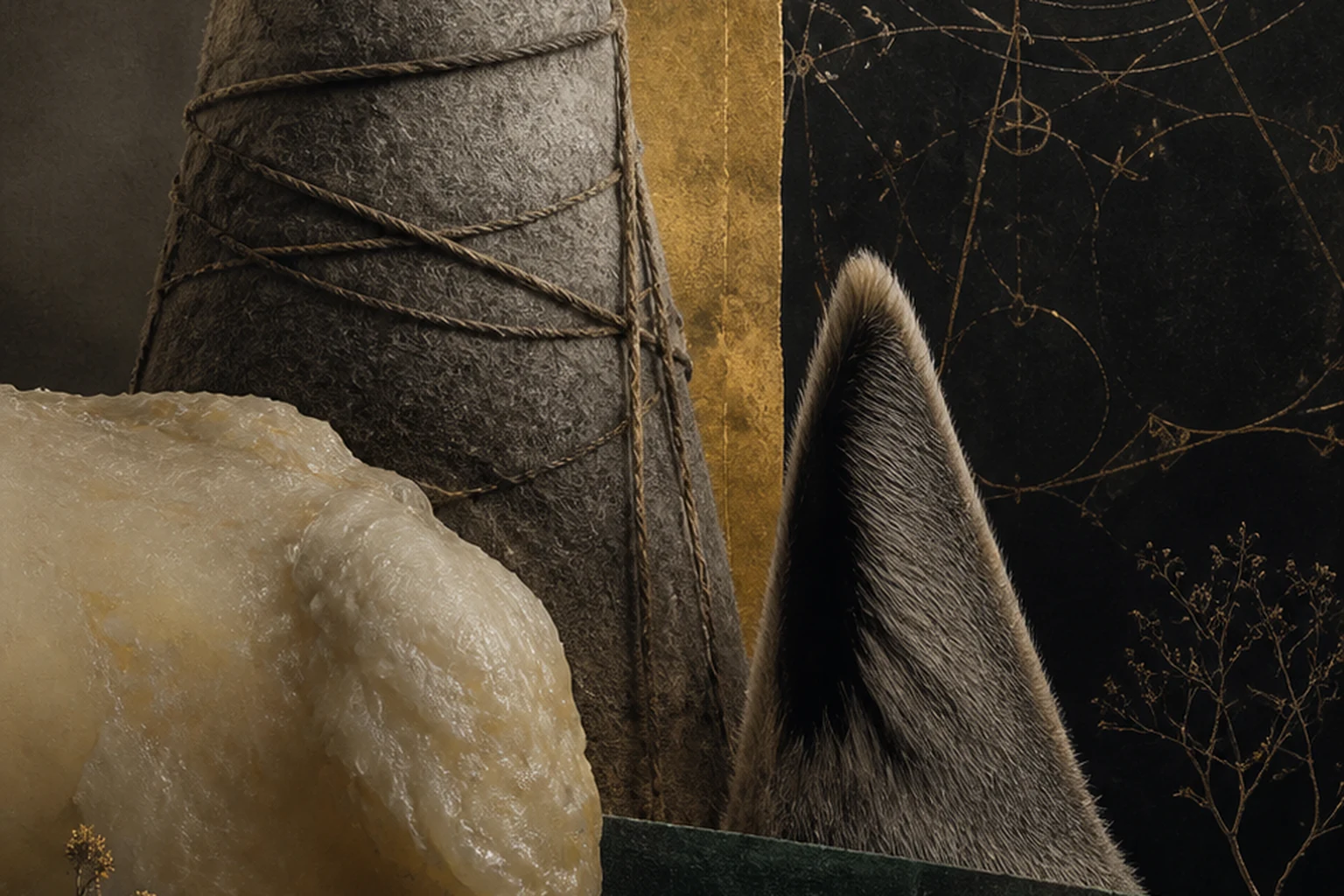
Beuys extended the notion of sculpture to speech, education, political organisation and the urban forest. But his project cannot be understood without a critique of the military legend he created, the charismatic role of the artist and postwar Germany's complex relation to responsibility and healing.
Editorial thesis
Joseph Beuys's significance rests on turning artistic practice into a system of actions, lectures, materials, political initiatives and collective participation. His legacy keeps its radical force only if one simultaneously considers the artist's mythology, the real biography, institutional power, the labour of collaborators and the limits of his universalist claims.
Reader question
How could an artist call society a sculpture, a lecture a work, the planting of trees a long urban action and his own biography material of art — and where does the boundary lie between a transformative idea and the cult of the author?
The core subject is Joseph Beuys: his drawing, sculpture, actions, teaching, political initiatives, multiples and public image.
The story of the plane crash and the rescue by the Crimean Tatars is treated as an authorial legend that diverges from documentary research.
Participation in the Nazi youth structures and service in the Luftwaffe are not neutralised by the language of healing.
The phrase 'every man is an artist' is explained as a thesis about creative capacity, not as a denial of professional knowledge.
The actions are analysed together with the photographers, musicians, organisers, viewers and the later museum transformation of the remains into objects.
The works and archival photographs are protected by the rights of VG Bild-Kunst / ARS and require a separate rights review.
Short answer
Joseph Beuys was born on 12 May 1921 in Krefeld and grew up in Kleve. During the Second World War he served in the Luftwaffe; after the war he studied at the Düsseldorf Art Academy under Ewald Mataré and from 1961 taught monumental sculpture there.
The actions How to Explain Pictures to a Dead Hare, Eurasienstab and I Like America and America Likes Me, the objects The Pack and Felt Suit, Honey Pump at the Workplace, the public lectures and 7000 Oaks formed an expanded notion of art. Beuys died on 23 January 1986; the 7000 Oaks project was completed in Kassel in 1987.
1. Krefeld, Kleve and an early interest in nature
Joseph Beuys was born on 12 May 1921 in Krefeld and grew up in Kleve, near the Dutch border. The family belonged to a middle-class Catholic milieu.
In his youth he was interested in animals, botany, medicine, music and North European mythology.
Nature later became not a landscape theme but a model of the circulation of energy, growth, damage and recovery.
2. The Hitler Youth, war and the Luftwaffe
Like many German teenagers of his generation, Beuys was drawn into the structures of the National Socialist youth organisation.
In 1941 he volunteered for military service and was trained as a radio operator and air gunner in the Luftwaffe.
The military biography is an essential part of his history and must not dissolve into the later reputation of a humanist artist.
3. The plane crash in Crimea and the created legend
In March 1944 Beuys's plane crashed in Crimea. The pilot died, and Beuys was wounded and evacuated by the German military.
The artist later told that nomadic Tatars found him, covered him with fat and wrapped him in felt, saving him from the cold.
Documentary research does not confirm this version. The legend became an authorial explanation of key materials and an example of how Beuys turned biography into artistic myth.
4. Return, crisis and postwar Germany
After the war Beuys returned to the destroyed Germany and gave up his original intention to study medicine.
In the 1950s he suffered a severe psychological and physical crisis, working and recovering for a time within the van der Grinten family environment.
Themes of wounding, warmth and healing arose in a country that at once needed reconstruction and avoided a full conversation about its own responsibility.
5. The Düsseldorf Academy and Ewald Mataré
In 1947 Beuys entered the Kunstakademie Düsseldorf and studied with the sculptor Ewald Mataré.
Mataré worked with animal forms, wood, bronze and church commissions, combining modernism with craft discipline.
In 1951 Beuys completed his studies in Mataré's workshop and began to form an independent practice.
6. Drawing as an energy map
Drawing remained the basis of Beuys's practice from the early images of animals to the schemes of social theory.
He used pencil, watercolour, oil, blood, wax, fat, chocolate and ordinary paper.
For him drawing was not a preparatory stage but a means of thought, in which biology, myth, politics and the movement of energy could join before an object appeared.
7. Felt, fat, honey, copper and the changing material
Felt insulates and preserves heat, fat softens and hardens, honey is connected with the collective labour of bees, and copper conducts energy.
Beuys used the physical properties of the materials as part of the meaning, not as a purely symbolic signature.
Organic substances age, smell and change, creating a constant conflict between the process of the work and museum conservation.
8. Fluxus and the expansion of the action
In the early 1960s Beuys took part in Fluxus events in Düsseldorf and other European cities.
Fluxus joined music, everyday action, instruction, chance and anti-commercial provocation.
Beuys shared the wish to destroy the autonomy of the artistic object, but developed a more symbolic and charismatic language than many members of the movement.
9. Siberian Symphony First Movement
Siberian Symphony First Movement was presented in 1963 at the Fluxus festival in Düsseldorf.
Beuys worked with a piano, clay forms, wires and a dead hare, joining music, the animal body and an improvised ritual.
The action marked a transition from sculpture as a stable object to an event in which sound, time, gesture and remains have equal status.
10. How to Explain Pictures to a Dead Hare
The action took place in November 1965 at the Galerie Schmela in Düsseldorf. The viewers first observed through the window of a closed space.
Beuys covered his head with honey and gold leaf, held a dead hare and moved with it before the works, as if explaining the pictures.
The work set bodily, intuitive knowledge against the standard museum explanation, while strengthening the image of the artist as an intermediary between worlds.
11. The shamanic figure and the problem of cultural appropriation
Critics often described Beuys as a modern shaman, and the artist himself supported this role through costume, ritual and stories of healing.
Such a model made it possible to present art as a transformative spiritual practice.
Yet the universal image of the 'shaman' can appropriate and mix specific traditions, turning culturally distinct knowledge into a resource of the European author.
12. Eurasienstab and the collaboration with Henning Christiansen
Eurasienstab was performed in 1967 and 1968 by Beuys together with the Danish composer Henning Christiansen.
A copper staff, felt corners, the movement of the body and organ music organised the space as an energy system.
Correct attribution must keep visible Christiansen's musical authorship, not reduce the action to a solo icon of Beuys.
13. The Academy, open admission and conflict with the institution
In 1961 Beuys became professor of monumental sculpture at the Düsseldorf Academy.
He argued that art education should not depend on a limited competitive selection, and admitted to his class students who had been officially refused.
The open admission was a political gesture against institutional selection, but the class also depended on the professor's personal authority.
14. The dismissal of 1972 and the dispute over pedagogical power
In 1972, after a conflict over the admission of students, the education minister of North Rhine-Westphalia dismissed Beuys from the academy.
The courts later found the dismissal unlawful, yet he did not return to regular teaching in its previous form.
The event strengthened the image of Beuys as a defender of free education, but at the same time showed the tension between the democratic principle and personal charisma.
15. Multiples as transport of ideas
From the 1960s Beuys created hundreds of multiples: editioned objects, postcards, posters, packages, records, boxes and political printed matter.
He called them means or transport devices that spread ideas beyond the unique museum object.
Editioning democratised access, but the market gradually turned many inexpensive issues into collectable and investment objects.
16. The Pack, Sled and Felt Suit
The Pack of 1969 includes a Volkswagen vehicle and a group of sledges, each carrying felt, fat and a torch as a conditional emergency kit.
Sled and Felt Suit translate warmth and protection into a serial object that recalls at once rescue equipment and a human shell.
The objects demonstrate Beuys's method: an everyday thing becomes a carrier of a biographical legend, a social metaphor and a material process.
17. I Like America and America Likes Me
In May 1974 Beuys spent several days with a live coyote in the René Block Gallery in New York.
According to the authorial scenario he arrived from the airport wrapped in felt, without touching American ground, and after the action was taken away the same way.
Inside the gallery were used felt, a staff, straw, Wall Street Journal newspapers, sounds and the repeated interactions of the animal with the man.
18. The coyote, America and the critique of symbolic substitution
Beuys linked the coyote with Indigenous cultures, colonial violence and the possibility of healing American society.
The action criticised capitalism and historical displacement, but spoke of Indigenous peoples without their direct participation.
The work therefore at once keeps the power of the encounter with the animal and demonstrates the limits of symbolic representation by a European artist.
19. Social sculpture
Beuys's expanded notion of art led to the idea of social sculpture: social relations can be formable material.
Speech, education, economics, legislation and collective decision become fields of creative intervention.
The strength of the concept is the recognition of political form; its risk is turning any activity into art without a clear criterion of responsibility and result.
20. 'Every man is an artist'
The phrase does not mean that any product is automatically a professional work of art.
Beuys claimed that every person has the capacity to create forms of social life, labour and thought.
The thesis widens the democratic understanding of creativity, but is often used apart from its demands for education, self-organisation and social responsibility.
21. Political organisations and direct democracy
Beuys took part in creating the German Student Party, the Organization for Direct Democracy through Referendum and other initiatives.
He argued for plebiscitary mechanisms, educational reform, ecological policy and alternative economic models.
He later took part in the early history of the German Greens and was a candidate in the European Parliament elections, without turning into a professional party politician.
22. Free International University
In 1973 Beuys and Heinrich Böll published the manifesto of the Free International University for Creativity and Interdisciplinary Research.
The initiative was meant to create an open educational environment outside the traditional disciplinary and examination system.
The FIU existed as a network of discussions, working groups, public events and local branches, but remained closely tied to Beuys's name.
23. Honey Pump at the Workplace
Honey Pump at the Workplace was created for documenta 6 in Kassel in 1977.
A mechanical system pumped honey through pipes across the museum space, while the FIU held a hundred days of discussions about labour, democracy and society.
The honey and the machine formed a metaphor of the social organism, but the meaning of the work arose not only from the installation but from the long labour of the discussion participants.
24. 7000 Oaks
The project 7000 Eichen — Stadtverwaldung statt Stadtverwaltung began at documenta 7 in 1982.
In Kassel seven thousand trees were to be planted, each beside a vertical basalt stele. The pile of stones before the Fridericianum shrank as the planting progressed.
After Beuys's death the last tree-stone pair was set in 1987; the project became a permanent part of the urban fabric.
25. Ecology, city and duration
7000 Oaks joins ecological action, sculptural form, civic organisation, funding and years of maintenance.
The trees grow, become ill, are replaced and come into conflict with transport, street repairs and private property.
The work shows that ecological art does not end with a symbolic planting: it requires institutions, care and negotiation over time.
26. Blackboard drawings and the lecture as a work
During his lectures Beuys drew schemes in chalk on boards, connecting freedom, equality, fraternity, economics, culture and natural processes.
The board arose as a temporary instrument of explanation, but after the event could be preserved and sold as an artistic object.
This transition raises the question: where does the work lie — in the conversation, in collective thinking, in the chalk trace or in museum ownership.
27. Cases, relics and museum conservation
Beuys often placed the remains of actions, organic substances, tools and small objects in museum cases.
The case at once protects the material and turns a living event into a historical relic.
Conservators must decide whether to preserve the change, smell and decay or to stabilise the object against the author's processual logic.
28. Myth, charisma and the production of the authorial image
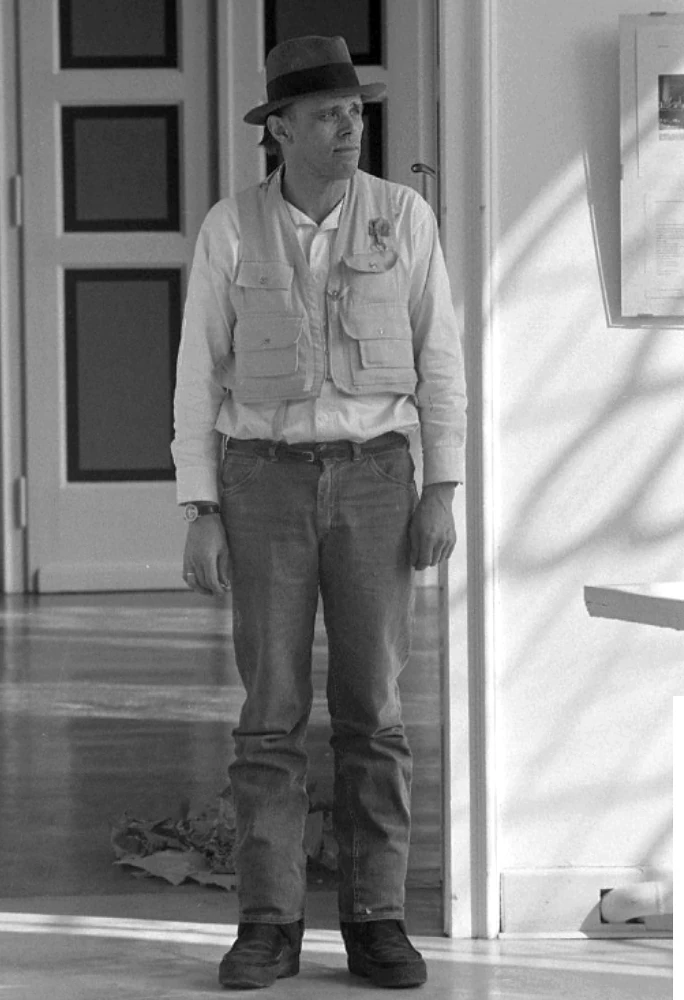
The felt hat, the waistcoat, the fishing jacket and the repeated profile became a recognisable visual system of Beuys.
Interviews, photographs, lectures and the legend of the rescue created the image of the wounded teacher and healer.
This strategy strengthened the spread of the ideas, but could replace collective politics with faith in the exceptional figure of the artist.
29. Nazism, memory and the rhetoric of healing
Beuys's practice is often interpreted as an attempt to work with the trauma of the destroyed Europe and postwar Germany.
Brown crosses, felt, fat, wounds and recovery can be connected with historical memory, but the author rarely gave a direct analysis of his own participation in the war.
The language of healing becomes ethically convincing only while preserving the difference between the suffering of the German soldier, the responsibility of the regime and the victims of Nazi violence.
30. Gender, universalism and the figure of the male shaman
The universal 'man' in Beuys's speech was often represented by the male figure of the teacher, lecturer and political leader.
Women took part in the organisation, documentation and development of the environment, but the cult of the author made their labour less visible.
Feminist criticism shows that the democratisation of creativity requires an analysis of who speaks on behalf of all and who performs the supporting work.
31. Collective production and the rights of co-authors
Beuys's actions depended on musicians, photographers, camera operators, gallerists, translators, students, animals, city services and discussion participants.
Henning Christiansen, Caroline Tisdall, René Block, the FIU and numerous local teams influenced the form and preservation of the projects.
The history of a work must distinguish the authorial concept, the execution, the documentation, the institutional support and the later market for the image.
32. Archive, museum and the contemporary legacy
The Joseph Beuys Archive at Museum Schloss Moyland is a major international research centre, also connected with the Kunstakademie Düsseldorf.
The archive holds more than two hundred thousand constantly growing items, including documents, correspondence, photographs and working materials.
7000 Oaks remains a living urban work in Kassel, and the Dia Art Foundation's extension of the project is preserved on West 22nd Street in New York.
33. Conclusion
Joseph Beuys changed the idea of what can be a sculpture, including in it education, speech, ecology and political organisation.
His art requires not a choice between worship and exposure but the simultaneous analysis of form, myth, responsibility and collective labour.
Beuys's chief legacy is the question of how creativity can change society without replacing democracy with the charisma of the artist.