artist profile
Louise Bourgeois
Memory, the body and the architecture of psychological space
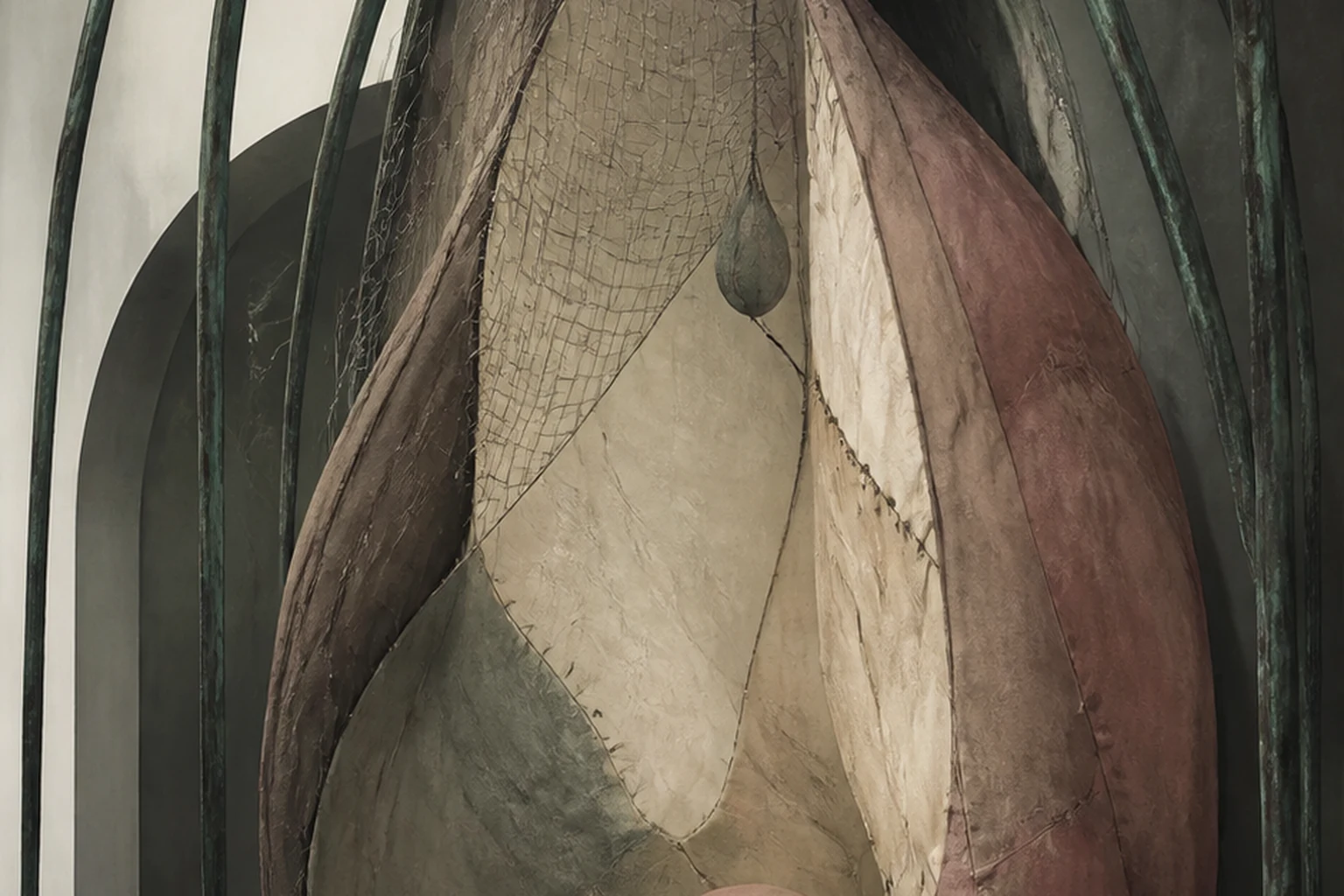
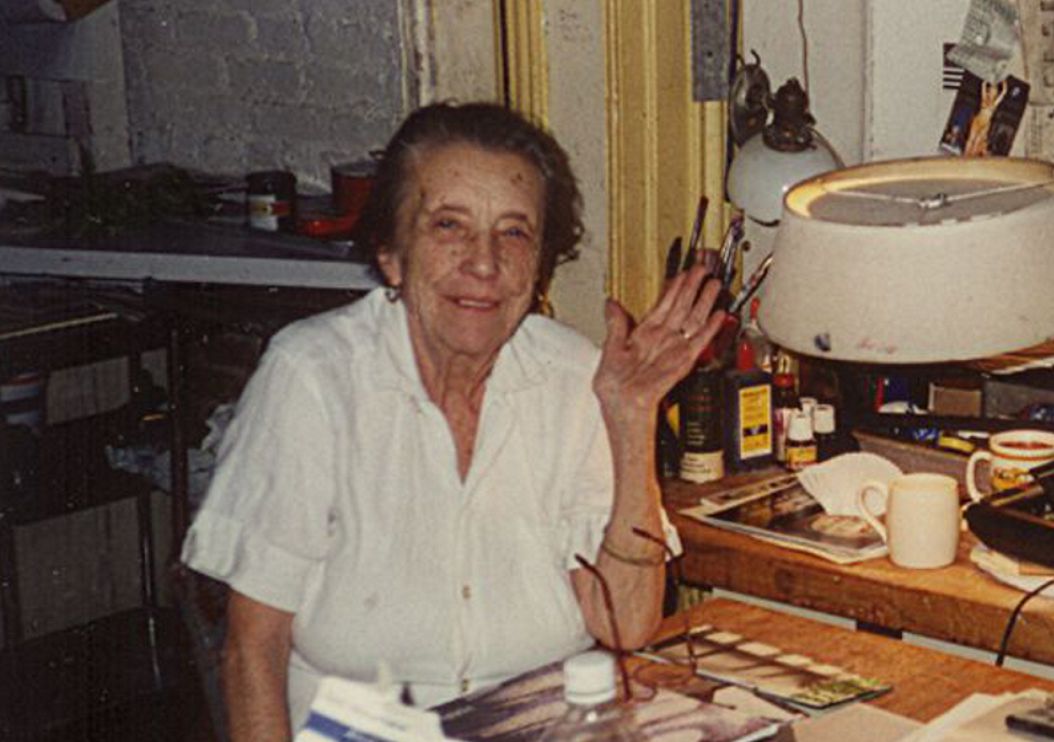
Bourgeois turned memory not into autobiographical illustration but into material: wood became solitude, fabric the body and repair, the cell a space of fear, and the spider an image of maternal protection, labour and ambiguous power.
Editorial thesis
Louise Bourgeois's significance rests on turning personal memory, bodily vulnerability, family power and anxiety into a complex sculptural language. Her practice intersects with Surrealism, Abstract Expressionism, feminism and installation, but cannot be reduced to any single movement.
Reader question
How could an artist turn domestic fabric, an architectural fragment, a cell, a spiral and a spider into universal forms of fear, care, sexuality, memory and repair?
The core subject is Louise Bourgeois: her painting, sculpture, installation, printmaking, fabric, texts and performative practices.
The biography is used as a documented context, but the works are not reduced to direct symbolic decodings of childhood.
Psychoanalysis is treated as a long intellectual and therapeutic process, not as a universal key to the whole oeuvre.
The feminist reception is separated from the attempt retroactively to assign the artist a single political identity.
The monumental works are analysed together with the labour of the assistants, foundries, printers and installation teams.
The photographs, texts, works and archival materials are protected by the rights of The Easton Foundation and require a rights review.
Short answer
Louise Bourgeois was born on 25 December 1911 in Paris into a family of dealers and restorers of antique tapestries. She studied mathematics and art, in 1938 married the American art historian Robert Goldwater and moved to New York.
The early Femme Maison and Personages, the installation Destruction of the Father, the Cells series, the suspended bodies, the fabric sculptures and the monumental spiders show how Bourgeois joined intimate memory with spatial experience. The MoMA retrospective of 1982 became a decisive moment of her international recognition.
1. Paris, tapestries and the family craft
Louise Bourgeois was born on 25 December 1911 in Paris. Her parents, Louis Bourgeois and Joséphine Fauriaux, dealt in antique tapestries and restored them.
The family workshop in Antony required the precise restoration of lost fragments. The young Louise helped draw the missing parts of the compositions.
The experience of repairing fabric, repeating the ornament and restoring a damaged image later became an important basis of her artistic language.
2. Mother, father and the story of a double betrayal
The artist's mother was ill for a long time after the Spanish flu, and Louise took part in caring for her.
For many years her father maintained a relationship with the English governess Sadie Gordon Richmond, who lived in the family home.
Bourgeois later described this situation as a double betrayal and used it in her texts and works, yet the art should not be reduced to a single family story.
3. Mathematics and the turn to art
After her mother's death in 1932 Bourgeois withdrew from her university studies in mathematics and turned to art.
Mathematics attracted her with the promise of stable rules and provable order.
In art she found a space in which contradiction, anxiety and instability could be not eliminated but given form.
4. The Parisian schools and Fernand Léger
Bourgeois studied at several Parisian schools and studios, including the École du Louvre, the Académie de la Grande Chaumière and the Académie Ranson.
According to her recollections, Fernand Léger drew attention to the artist's spatial thinking and suggested that sculpture was closer to her.
This was not an instantaneous transition: painting, drawing and printmaking continued to remain part of the practice throughout her life.
5. Robert Goldwater and the move to New York
In 1938 Bourgeois met the American art historian Robert Goldwater, married him and moved to New York.
Goldwater studied modernism and so-called primitive art, taking part in the American museum and academic environment.
The move gave Bourgeois access to the New York avant-garde, but at the same time placed her in the position of a migrant, a mother and an artist without a stable professional status.
6. Painting and Femme Maison
In 1945 Bourgeois's first solo painting exhibition took place at the Bertha Schaefer Gallery.
The Femme Maison series joins the female body with the architecture of the house: in place of the head or the upper part of the figure appears a facade or an enclosed volume.
The image at once speaks of protection, belonging, domestic labour and the disappearance of the person within a role.
7. House, body and double invisibility
In Femme Maison the house does not simply surround the woman but literally becomes part of her body.
An architectural volume can protect from the external gaze and at the same time deprive the figure of a face, voice and social visibility.
The work therefore has no single feminist decoding: it holds at once shelter, enclosure, shame, identity and the desire to be seen.
8. Atelier 17 and He Disappeared into Complete Silence
In the 1940s Bourgeois worked in the New York print workshop Atelier 17, founded by Stanley William Hayter.
In 1947 she published He Disappeared into Complete Silence — a series of prints with short parables.
Architectural towers, isolated structures and a dry text create an early model of her theme: solitude turns into a spatial construction.
9. Personages
In the late 1940s Bourgeois began creating vertical wooden figures, which received the name Personages.
They recall totems, human silhouettes, tools or architectural posts and are installed as a group.
The first solo sculpture exhibition took place at the Peridot Gallery in 1949.
10. Solitude, migration and the sculptural group
Bourgeois connected the Personages with the people left in France and with the experience of emigration.
Each figure is autonomous, but its meaning is strengthened through the distance and the relations with the other objects.
In this way the sculptural group becomes a model of community in which closeness does not cancel isolation.
11. Psychoanalysis and the archive of writing
After her father's death in 1951 Bourgeois began psychoanalysis with Dr. Henry Lowenfeld.
The intensive work continued from 1952 to 1966, and then episodically until the mid-1980s.
More than a thousand psychoanalytic records, diaries and audio recordings show that writing was an independent instrument for exploring memory and the artistic process.
12. The organic forms of the 1960s
In 1964, after a long break, Bourgeois showed organic plaster sculptures at the Stable Gallery.
Soft bulges, cavities, clusters and fluid forms differed sharply from the vertical wooden Personages.
The transition between geometry and the organic became a constant principle of her practice, not a linear change of styles.
13. Fillette and the ambivalent body
Fillette of 1968 presents a suspended form recalling an enlarged phallus, a torso, a limb or a helpless creature.
The title means 'little girl', which destroys confidence in the gendered classification of the object.
Bourgeois uses the bodily form not as an anatomical illustration but as a space of power, vulnerability, humour and anxiety.
14. Destruction of the Father
Destruction of the Father was created in 1974 as a dark spatial installation with soft forms, plaster, latex, wood and red light.
The work recalls at once a table, a cave, an internal organ and the scene of a ritual act.
Bourgeois connected it with the fantasy of a family that rises against a dominant father and destroys his symbolic power.
15. The family table, aggression and the theatre of memory
In the installation the viewer does not observe the event from a safe distance but enters its emotional atmosphere.
The materials look bodily, but do not form an unambiguous figure; the story exists as a tension of the space.
The personal story turns into a theatrical structure of power in which love, dependence, revenge and guilt are inseparable.
16. The feminist environment and A Banquet/A Fashion Show of Body Parts
In the 1970s Bourgeois took part in exhibitions and discussions connected with the women's movement in art.
In the performative event A Banquet/A Fashion Show of Body Parts of 1978 the participants wore latex forms that turned parts of the body into a costume and a public action.
The artist supported young women and feminist initiatives, but kept a distance from a single programmatic identity.
17. The MoMA retrospective of 1982
The Louise Bourgeois retrospective opened at the Museum of Modern Art in November 1982 and was organised by Deborah Wye.
The exhibition and its accompanying monograph presented for the first time Bourgeois's long practice as a coherent story to an international audience.
Recognition came late, but it allowed the artist to expand the scale, materials and institutional possibilities.
18. Articulated Lair and the origin of the Cells
Articulated Lair of 1986 is considered one of the direct predecessors of the Cells series.
Movable metal panels create an enclosure that at once reveals and hides the interior space.
From this moment architecture ceases to be only the image of a house and becomes a physical structure regulating the viewer's movement.
19. Cells: the architecture of fear and memory
The Cells series developed in the 1990s and 2000s as a group of rooms, cages, cabinets and enclosed environments.
Inside are beds, doors, mirrors, clothing, glass, sculptural bodies and personal objects.
Cell means at once a monastic cell, a prison cell, a biological cell and a minimal unit of memory.
20. The early spiders and Ode à Ma Mère
The spider motif appeared in Bourgeois's drawings and prints long before the monumental sculptures.
In the portfolio Ode à Ma Mère of 1995 the spider is connected with the mother as a patient, intelligent and useful restorer of fabric.
The web becomes an image of repair, dependence and a complex network of relations, but not an exclusively positive symbol.
21. Maman
Maman was conceived in the late 1990s and received a monumental form in bronze, stainless steel and marble.
Beneath the body of the giant spider is a sac of marble eggs, joining threat with the maternal function.
The scale forces the viewer to physically experience at once the protection beneath the sculpture and the vulnerability before a creature surpassing the human.
22. The mother as protection and threat
For Bourgeois the image of the mother is not an idealised symbol of unconditional safety.
It includes care, illness, dependence, patience, control and the need to defend oneself.
The power of the spider arises precisely from ambiguity: it mends the fabric of the world and at the same time builds a trap.
23. Arch of Hysteria and the suspended body
Arch of Hysteria shows a headless body arched like a bow and suspended in the air.
The pose refers to historical images of hysteria, but a male anatomy breaks the medical tradition that linked the diagnosis mainly with women.
Suspension deprives the body of support and turns it at once into an object of pleasure, pain, display and instability.
24. Fabric, clothing and repair
In the late decades Bourgeois actively used her own clothing, bed linen, embroidery and patchwork constructions.
The cutting and sewing of fabric repeat the experience of the family workshop, but now the repair does not return the original state but creates a new body.
Textiles connect skin, memory, domestic labour, ageing and the possibility of assembling a whole from damaged parts.
25. The late printmaking and collaboration with printers
From the late 1980s Bourgeois again worked intensively with etching, drypoint, lithography and the artist's book.
Long relations with Harlan & Weaver, Judith Solodkin, Peter Blum Edition, Osiris and other workshops allowed her constantly to change the states of the print.
Hand additions, re-etching and variation turned an edition not into a mechanical copy but into a sequence of decisions.
26. Sunday Salons
In her home on West 20th Street Bourgeois held Sunday salons, where artists, writers and curators showed works for discussion.
The meetings could be supportive, harsh and unpredictable; the hostess's authority joined mentorship with a test.
The foundation's archive contains hundreds of hours of video recordings of the salons of 1999-2007, allowing them to be studied as a social and pedagogical practice.
27. Assistants, foundries and collective production
The monumental bronzes, steel cells, marble details, print editions and exhibition installations required a large number of specialists.
Jerry Gorovoy was a long-time assistant and close participant in the late studio practice, while the foundries and print workshops translated the ideas into material objects.
Bourgeois's public authorship must be supplemented by the visibility of the technical, organisational and archival labour.
28. Feminism, canon and late recognition
Femme Maison, the bodily fragments, domestic labour and motherhood made Bourgeois an important figure of feminist art.
Yet her practice formed before the institutional feminist movement and constantly went beyond a single political category.
The late recognition shows how the museum canon long excluded older women artists, and then could rapidly turn them into symbols of a corrected history.
29. The critique of biographism and psychoanalytic reduction
Bourgeois herself actively spoke about family, fear, jealousy and betrayal, directing the interpretation of her works.
This makes the biography an important source, but creates the risk of reading every object as an encoded episode of childhood.
Form, material, scale, exhibition history, gender politics and the labour of production must be analysed on a par with the authorial account.
30. The Easton Foundation, the house, studio and archive
The Easton Foundation preserves the house, studio, sculpture garden, library and archive of Louise Bourgeois in New York.
The archive includes diaries, psychoanalytic records, photographs, audio material and more than six hundred hours of video recordings of the Sunday salons.
Researcher access and group tours are organised by appointment; the rights to the works and archival materials are managed by the foundation through VAGA/ARS.
31. Conclusion
Louise Bourgeois turned memory into a spatial and material process not limited by the genre of autobiography.
Her sculptures join the body, the house, fabric, architecture, desire and fear in forms that cannot be reduced to a single symbol.
Bourgeois's chief legacy is an understanding of art as a repeated work with damage: not the erasure of the past but its transformation into a new structure.